Perseus Slays Medusa: The Mirror, the Sickle, and the Severed Head
c. 800-700 BCE (mythic time) · Seriphos, the western edge of the world, the cave of the Gorgons
Contents
A king sends a boy on an errand designed to kill him: bring back the head of a monster whose face turns men to stone. The gods give him gifts. The boy uses a polished shield as a mirror, looks at the reflection, and swings the sickle.
- When
- c. 800-700 BCE (mythic time)
- Where
- Seriphos, the western edge of the world, the cave of the Gorgons
There is a chest on the sea.
Inside the chest is a young woman and her infant son. The woman’s name is Danaë. Her father, Acrisius of Argos, was told by an oracle that his daughter’s son would kill him, so he locked her in a bronze tower without doors. Zeus came to her as a shower of gold through the roof. The boy was born anyway. Acrisius nailed mother and child into a chest and pushed it into the sea.
The chest washes ashore on the island of Seriphos. A fisherman named Dictys finds it, opens it, and takes the woman and her boy in. The boy is Perseus.
He grows up on the island. He grows tall. He grows beautiful in the unsettling way of half-divine children, and the king of Seriphos — Polydectes, the fisherman’s brother — wants Danaë for himself. Danaë refuses. Perseus, grown now, stands between his mother and the king with the obvious patience of a son who is not going anywhere.
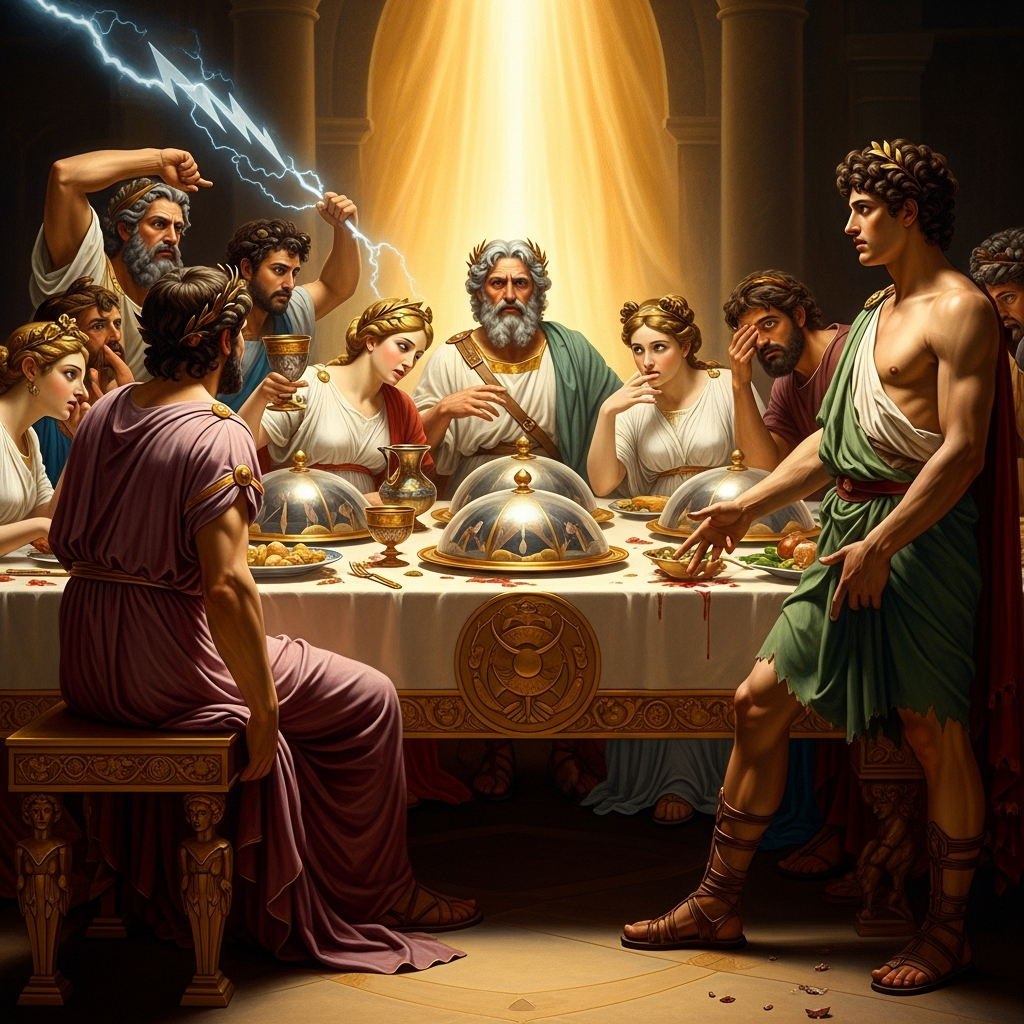
So Polydectes throws a banquet. Each guest, by custom, must bring a gift — a horse, by tradition. Perseus has no horses. The king, smiling, asks what the boy will bring. Perseus, baited and proud, says he will bring whatever the king names — even, if the king wishes, the head of Medusa.
The king names it.
Medusa is one of three Gorgons who live at the western edge of the world. Her sisters are immortal. She alone is mortal, and her face turns men to stone. Around her cave stand the petrified bodies of every previous hero — frozen in mid-step, in mid-shout, in mid-glance.
Perseus has nothing. He has no ship, no weapon, no map. He sits on the beach and weeps, and Athena and Hermes come to him.
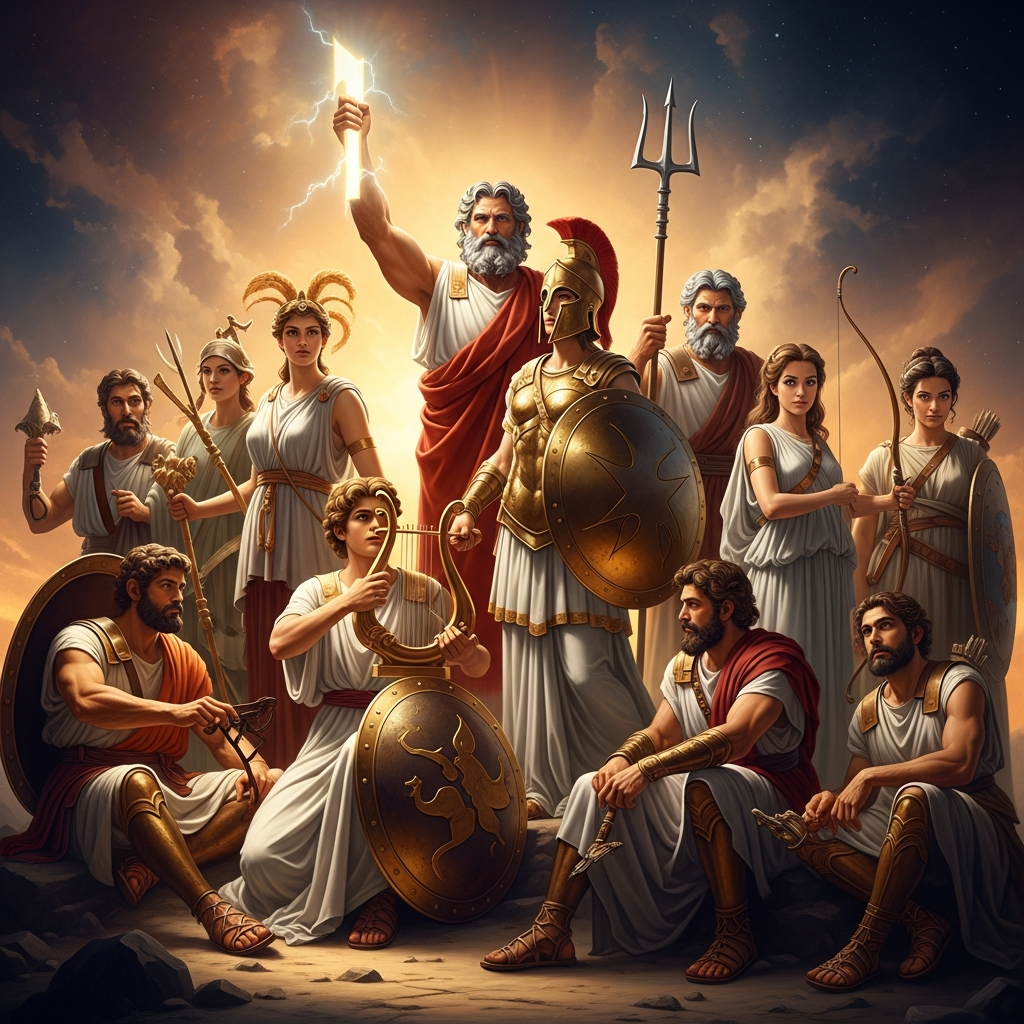
The gods give him gifts. Hermes gives him a sickle of adamant — the curved blade of the harvest, not the straight blade of war. Athena gives him a shield polished to the brightness of a mirror. From the nymphs of the north he must obtain three more things: winged sandals, a leather bag (the kibisis) wide enough to hold the head, and the cap of Hades, which makes the wearer invisible. To find the nymphs, Perseus must first find the Graeae — three grey witches who share one eye and one tooth between them. He waits until they are passing the eye from hand to hand. He snatches it from the air. He tells them they will not have it back until they tell him the way.
They tell him.
He flies west on the borrowed sandals. He arrives at the cave at the edge of the world. He turns his back on it.
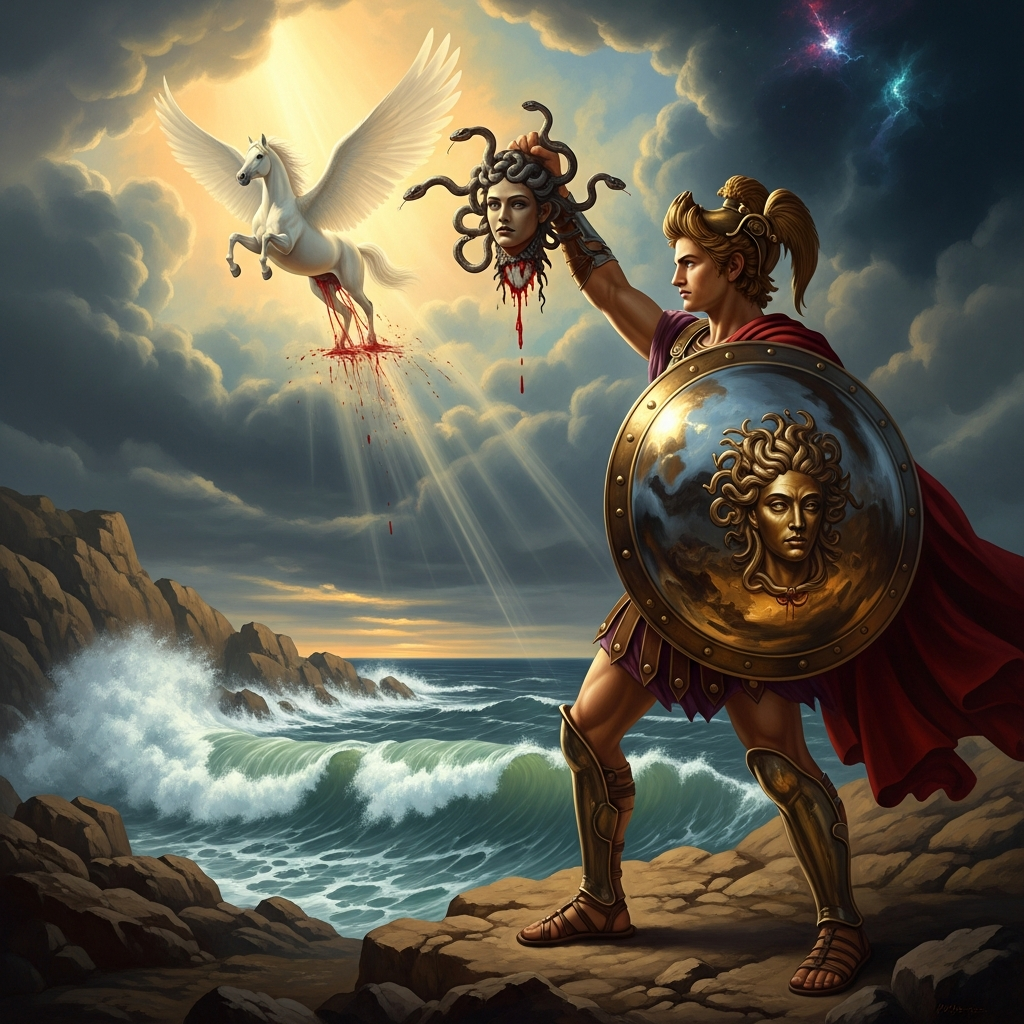
Walking backward, watching only the reflection in Athena’s polished shield, he enters the cave of the sleeping Gorgons. Their snakes rustle. Stheno, Euryale — the immortal sisters — do not stir. Medusa lies between them. In the mirror she is terrible and quiet. Perseus raises the sickle, watching the reflection, and brings it down.
The blood is enormous.
From the severed neck — from this single mortal Gorgon at the moment of her death — leap two beings she has been carrying: Pegasus, the white winged horse, and Chrysaor, the warrior with the golden sword. They spring fully formed from her wound and gallop out into the world. Perseus does not see them. He is fumbling for the bag, eyes closed, hand by feel, sliding the head into the kibisis and pulling the drawstring tight. Stheno and Euryale wake. They scream. Perseus, invisible under the cap of Hades, flies.
He carries the head west. He uses it to turn Atlas into a mountain. He uses it to save Andromeda from the sea-monster, holding it up like a lantern of horror. He brings it home to Seriphos. He walks into the throne room of Polydectes, where his mother is being pressed once more, and he says: I have brought the gift you asked for. The king laughs. Perseus pulls the head from the bag.
Polydectes and his court become statues in mid-laugh.
Perseus gives the sandals back to Hermes. He gives the cap back to Hades. He gives the head to Athena, who fixes it to the front of her shield, where it remains forever — the face that froze gorgons turned outward at the world, the icon of the goddess of strategic war.
The boy with no father, sent by a king who wanted him dead, has used borrowed tools and a mirror to defeat what could not be looked at directly. This is the lesson the myth keeps teaching: against certain horrors, you must not face them — you must reflect them. The hero is not the strongest. The hero is the one who knows how to look without looking.
Scenes
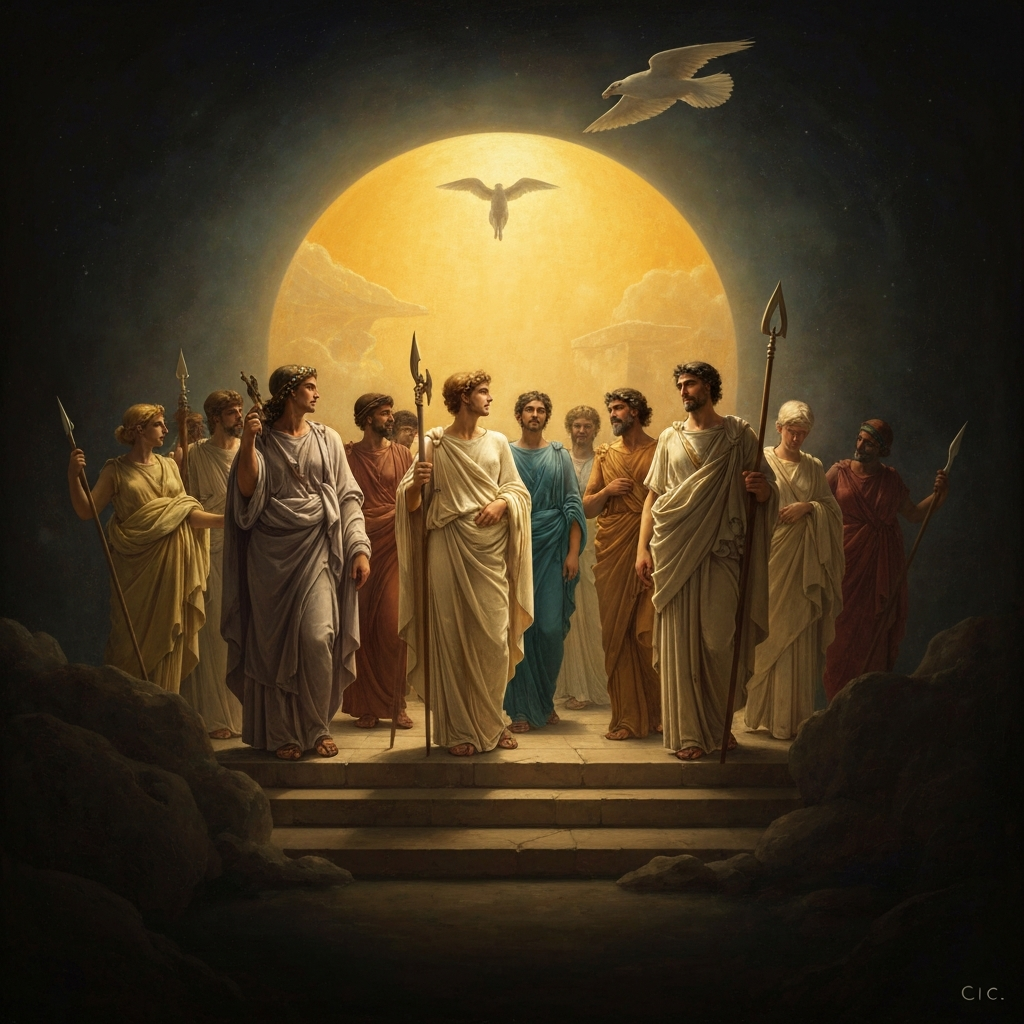
Polydectes presides over a sham banquet on Seriphos, demanding wedding gifts
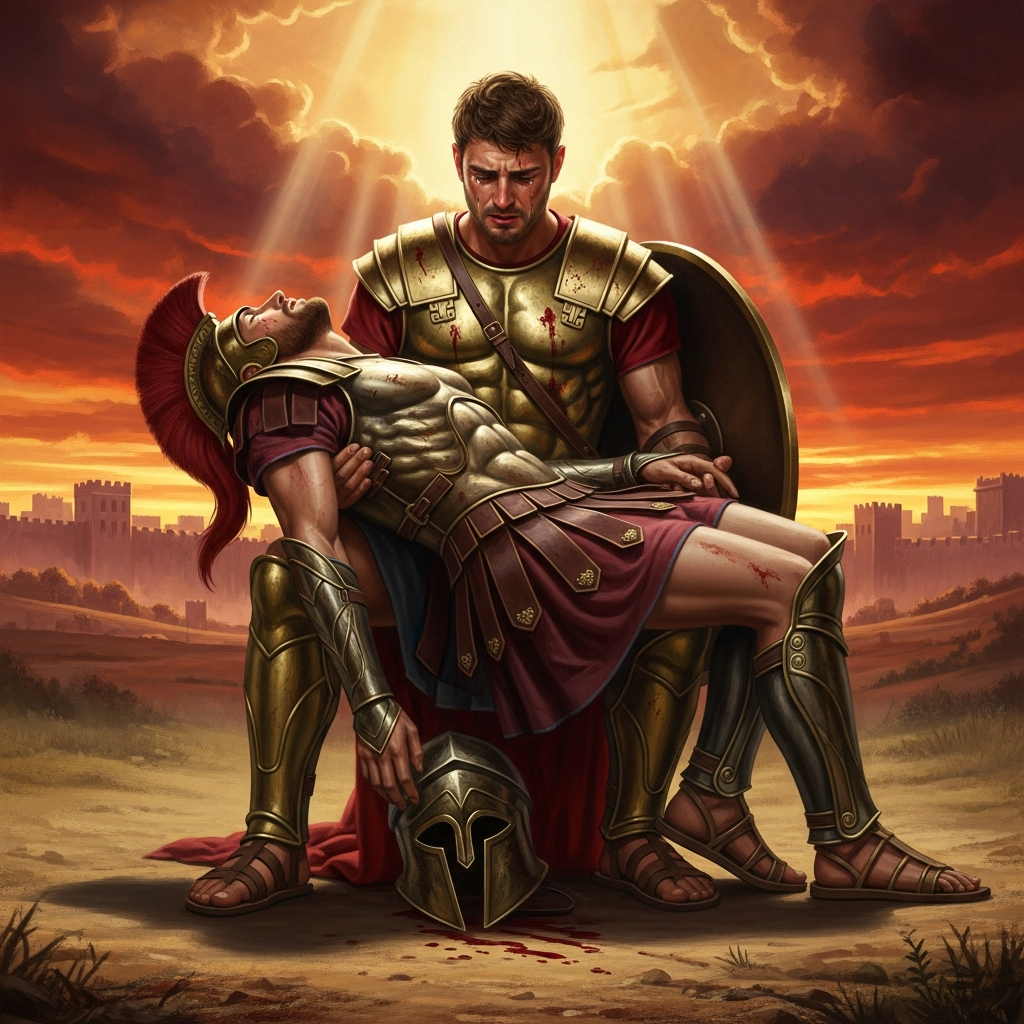
At the cave's edge, Perseus walks backward toward the sleeping Gorgons, watching their reflection in Athena's mirror-bright shield
The sickle falls
Echoes Across Traditions
Entities
- Perseus
- Medusa
- Danaë
- Polydectes
- Athena
- Hermes
- The Graeae
Sources
- Hesiod, Theogony 270-283
- Apollodorus, Library 2.4.1-3
- Ovid, Metamorphoses IV.604-803
- Pindar, Pythian 12