Tantalus and the Divine Banquet
Mythic age — three generations before the Trojan War, the founding of the line that produces Atreus, Agamemnon, and Orestes · Mount Olympus (the banquet); Mount Sipylus in Lydia (Tantalus's mortal kingdom); Tartarus (his eternal punishment)
Contents
Tantalus was invited to dine at the table of the gods on Olympus — an honor unprecedented for a mortal. To test whether they were really omniscient, he killed his own son Pelops, cooked him into a stew, and served him to the gods. Every god recognized the meat and drew back. Only Demeter, blind with grief over Persephone, took a bite of the shoulder. The gods restored Pelops with an ivory shoulder; Tantalus they buried in Tartarus, eternally hungry, eternally thirsty, with fruit just out of reach above his head and water that recedes whenever he bends to drink.
- When
- Mythic age — three generations before the Trojan War, the founding of the line that produces Atreus, Agamemnon, and Orestes
- Where
- Mount Olympus (the banquet); Mount Sipylus in Lydia (Tantalus's mortal kingdom); Tartarus (his eternal punishment)
Tantalus is invited to Olympus.
This is unheard of. Mortals are not invited to the table of the gods. Heroes have, occasionally, been brought up — Heracles after his apotheosis, Ganymede as cup-bearer — but those are special cases, exceptions, ascensions. Tantalus is a king. He is the king of Sipylus in Lydia. He is the son of Zeus by an Oceanid (this is one version; in others Tmolus or Tantalus the elder). He is famously rich; his name means bearer, perhaps from talanton, a balance, the heavy mass he is associated with. The gods love him, and they bring him up.
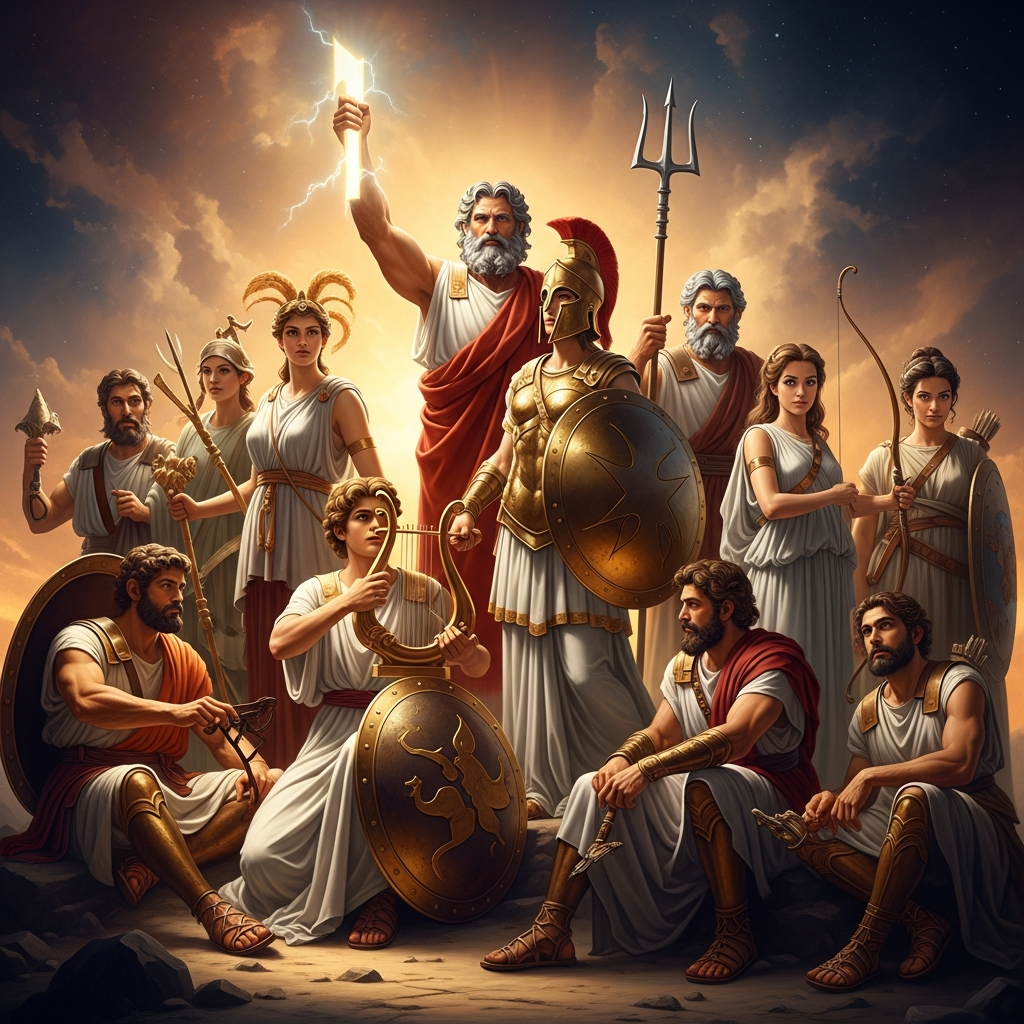
He sits at their table. He drinks ambrosia. He eats nectar. He is the only mortal in the room.
This is, on its face, the highest honor the gods have ever conferred on a man.
He responds to the honor by deciding to test them.
The test he devises is grotesque from any angle, but Greek myth preserves it because the Greek tradition was interested in the question Tantalus is asking — do the gods really know everything? are they really omniscient? what would happen if I gave them something monstrous and disguised it well? — and the answer matters.
He goes back to Sipylus. He returns the visit. He invites the gods to dine at his table.
Then he kills his son.
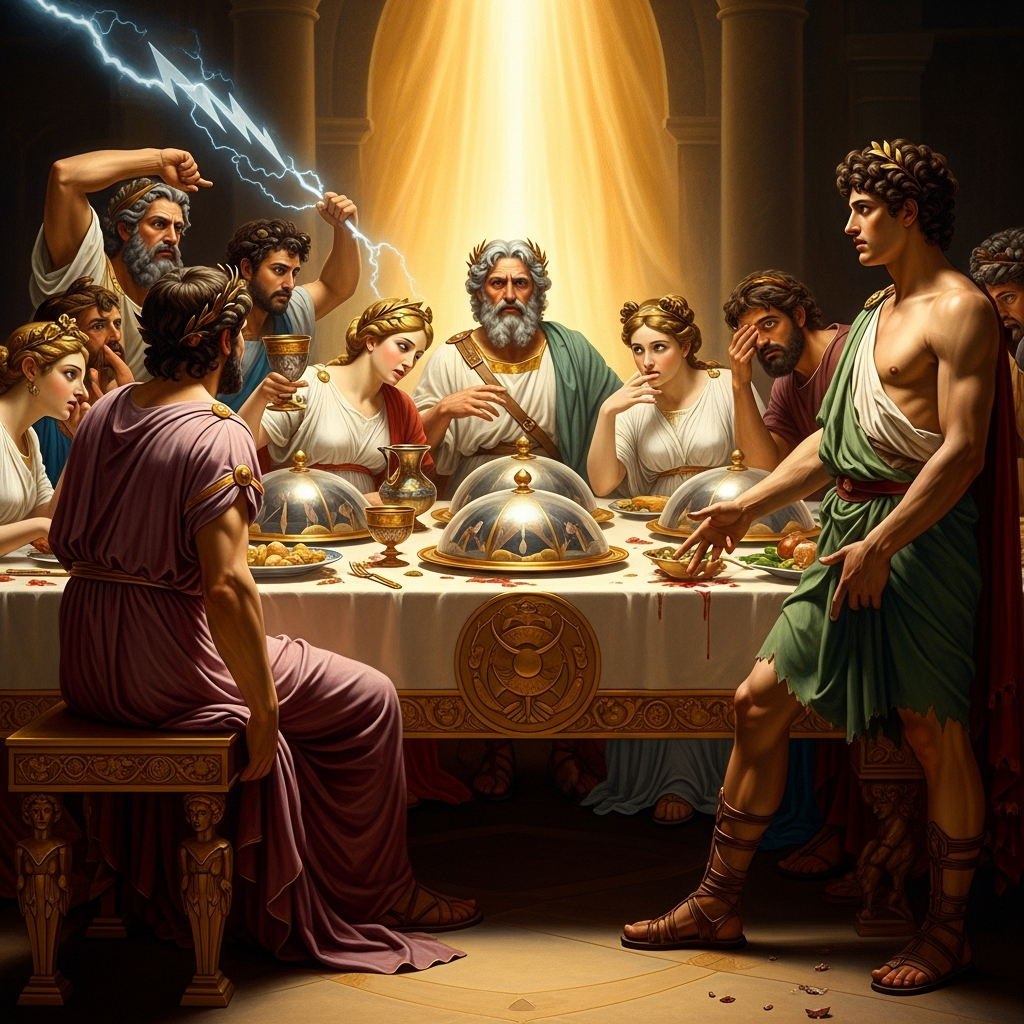
His son is Pelops — a young man, beloved, the heir of Sipylus. Tantalus kills him, butchers him, cooks his body into a stew, and arranges it on platters. The shoulder is in one place, the thighs in another, the back, the arms. He sits the gods down at the table. He serves them.
The gods know.
They know immediately. Apollo lifts the cover off the platter and recognizes the shape of a young man’s leg under the sauce. Hermes pulls back. Zeus puts down his cup. Around the table, every god draws back from the food, recognizes what has been done, and looks at Tantalus, and the room goes very cold.
But one of the gods does not pull back.
Demeter is grieving.
Persephone has been taken to the underworld — this is the timing, in Pindar’s version — and Demeter has been wandering the world looking for her, eating only what is set in front of her, hardly noticing what it is. She is the goddess of the harvest sitting at a feast in mourning for her own daughter. She lifts a piece of meat from the platter — the shoulder — and she eats it.
She chews. She swallows.
She realises what she has eaten.
The horror that goes around the table at this moment is older than the gods themselves. Demeter, the great mother, the giver of grain, has eaten a child — a particular child, in front of the child’s father, who put him in the pot for exactly this reason. The Olympian feast has become the original cannibalism.
Zeus stands up.
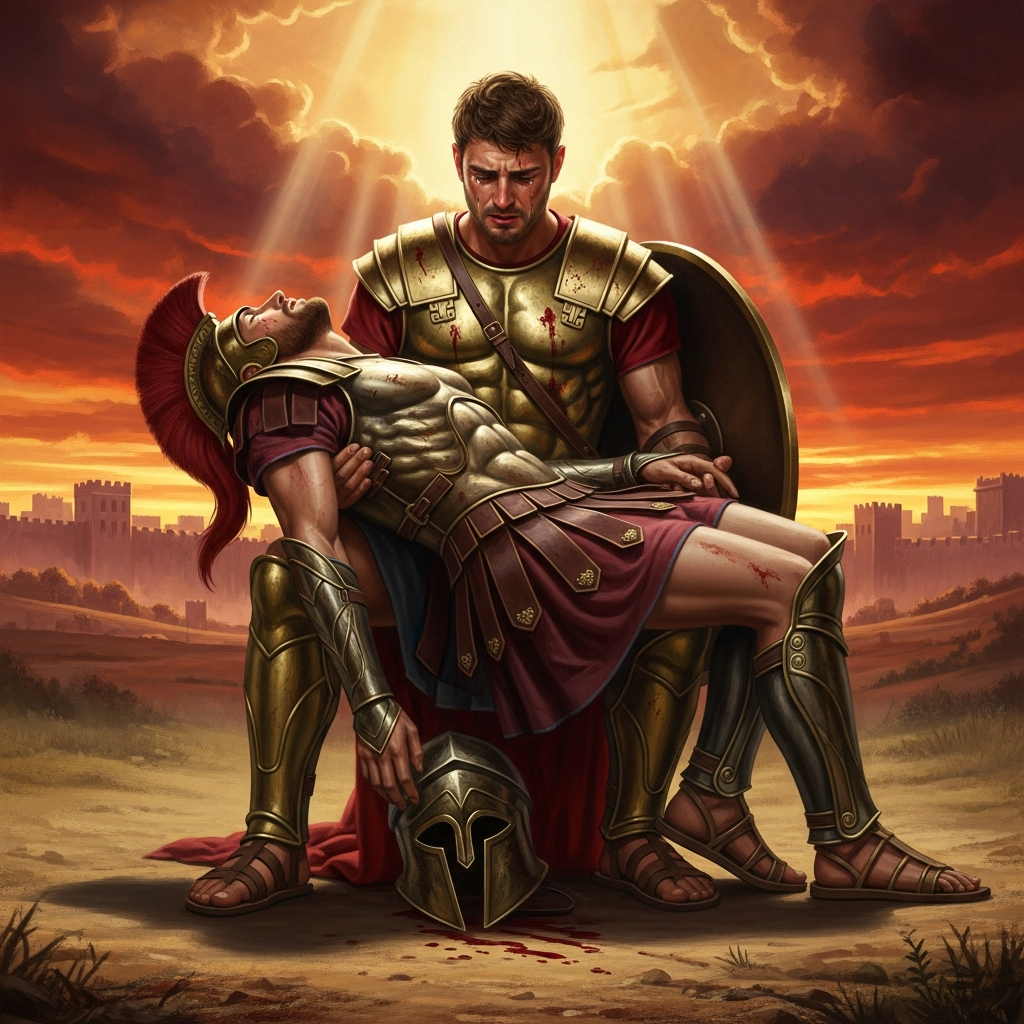
He does what gods do in this position. He acts. He calls for the bones of Pelops to be gathered and put back into the cauldron. The gods perform a kind of resurrection on the spot — the meat that has been served reassembles itself, the boy is reconstituted on the table, the cooking is undone. The cauldron becomes a womb. Pelops climbs out of it whole, alive, breathing.
But not entirely whole.
The shoulder Demeter ate is gone. Demeter ate it; Demeter cannot un-eat it, even in this miracle. The boy is missing a shoulder. So the gods make him one — out of ivory, white and seamless, fitted into the joint and welded to him by divine craft. Pelops will go through the rest of his life with one ivory shoulder that gleams differently from the rest of his body. His descendants — for generations afterward — will be born with a white birthmark on the same shoulder, the mark of the curse.
He is alive. He is restored. He grows up to be one of the great heroes of Greek myth — the man Poseidon falls in love with, the man whose chariot race wins him Hippodameia, the man for whom the entire Peloponnese, Pelops’s island, is named. But he carries the ivory shoulder for the rest of his life, and the curse runs in his blood, and his sons will repeat the table-crime against each other.
That is the future. That is later.
In the present, Zeus turns to Tantalus.
The punishment is not destruction.
Zeus does not strike Tantalus dead — that would be too clean, and Tantalus’s crime is not the kind of crime you wash off with a thunderbolt. Zeus sentences him to Tartarus, the lowest pit of the underworld, the place reserved for crimes against the divine order itself.
Tartarus is below Hades. It is below the meadow of asphodel where ordinary souls drift; it is below the courts where Minos and Rhadamanthus judge the dead. Tartarus is the iron-floored pit where the worst offenders are kept under torture forever. The Titans are there. The Hundred-Handed are stationed at the gate. Sisyphus rolls his stone there. Ixion turns on his wheel there.
Tantalus is taken there.
The sentence is specific. He is placed in a pool of fresh water that comes up to his chin. Above his head, hanging just above his face, are the branches of a fruit tree heavy with figs, pears, pomegranates, apples, and ripe olives.
He is hungry. He is thirsty.
He bends his head to drink. The water recedes, sinks into the ground, leaves him standing in dry mud. He waits. The water returns. He bends again. It recedes again.
He reaches up to take a fig. The branch lifts itself just out of his reach. He stretches; it lifts higher. He waits; the fruit comes back down to a finger’s width above his fingertips. He grabs; the wind takes it.
This goes on forever.
Homer puts him in Book 11 of the Odyssey.
Odysseus, in the underworld, sees Tantalus standing in the lake. He watches him reach for the water and the fruit. He watches him fail. The image — the old man up to his chin in water, the fruit a hand’s breadth above his face, both forever just out of reach — becomes one of the most copied images in the Western tradition. The English verb tantalize is his name. Every painting of him repeats the geometry: the figure straining upward, the figure bending downward, the food and the water permanently a fraction of an inch wrong.
Pindar, two centuries before Homer, gives a different punishment: a stone is suspended over Tantalus’s head, always about to fall, never falling. The terror of imminent destruction with no release.
Some versions combine them. He is hungry; he is thirsty; he is also waiting for the rock.
The point is the same.
The crime was an appetite that consumed others — that turned a son into a meal to satisfy a question Tantalus could have left alone. The punishment is appetite suspended forever above its own object. Tantalus cannot reach the water. He cannot reach the fruit. He has, after all this, exactly what he had at the table on Olympus: a feast he cannot eat without destroying it.
The line he started runs through Greek tragedy.
Pelops grows up. Pelops, with his ivory shoulder, wins Hippodameia by cheating at a chariot race — bribing his father-in-law’s charioteer to sabotage the wheel — and the charioteer, dying, lays a curse on Pelops’s whole house. The curse settles on Pelops’s sons.
His sons are Atreus and Thyestes. Atreus, in revenge for his brother’s affair with his wife, invites Thyestes to a feast and serves him the cooked flesh of his own children. The Tantalus crime happens again, one generation later, with Atreus in Tantalus’s role and Thyestes in the role of the unwitting Demeter.
Atreus’s son is Agamemnon, who sacrifices his own daughter Iphigenia at Aulis to get the wind to Troy. Agamemnon’s wife Clytemnestra, in revenge, kills Agamemnon at the bath when he comes home. Their son Orestes kills Clytemnestra to avenge his father, and is hunted by the Furies for it until Athena finally — in Aeschylus’s Oresteia — convenes a court at Athens to end the cycle by trial instead of vengeance.
The whole arc of the most famous tragic cycle in Greek literature is the working out of Tantalus’s table-crime through five generations.
It ends only when Athena, at the end of the Eumenides, tells the Furies that the blood-feud is over and instates the law-court instead. The crime that started on Olympus is finally undone in an Athenian courtroom four hundred years and five murders later.
Tantalus is still in the lake. Tantalus is still reaching for the fruit. Nothing in his Tartarus has changed. The line he founded has been judged and released; he himself remains.
Pindar refuses to tell the cannibalism story straight in his first Olympian Ode. He says the version that has Demeter eating Pelops’s shoulder is unspeakable — abominable, not the kind of thing one says about the gods — and he tries to substitute a softer version in which Pelops was simply taken up to Olympus by Poseidon, who fell in love with him. Pindar is doing what later religious traditions also do: cleaning up the embarrassing parts of the inherited myths to make the gods more dignified. But he reports the cannibalism even while disclaiming it. He cannot quite let it go. The story was older than his discomfort with it.
The reason it survives in Greek thought is that it captures something the Greek mind kept returning to: the question of what happens when xenia — the sacred bond of host and guest — is violated. Xenia is the foundational ethical relationship in Greek culture, more central than even kinship. To be a host who serves his son to his guests, or a guest who eats his host’s son, is to commit the worst possible crime. Tantalus does both at once: he is the host serving the obscene meal and the guest who has just been at the gods’ own table. Every Greek hearer would have felt the doubled violation.
Tartalus’s punishment is also a parable about a particular kind of greed — the greed that wants to know everything, to test everything, to put even the gods on trial. The crime was not hunger; the crime was the test. Tantalus had been given the rarest possible gift — the table of the gods — and he used it to set up an experiment. The Greek tradition is unforgiving about this. The punishment is the appetite without satisfaction, perpetually. Whatever he was hungry for at the gods’ table, he will be hungry for forever and never have.
The smallest detail in the story is the largest. Demeter ate the shoulder. The goddess of grain, the great mother, ate a child — accidentally, in grief, but she ate him. The gods are not exempt. Even the divine, when struck by their own loss, can be brought to do the unspeakable. The shoulder is replaced with ivory; the wound persists. Pelops’s descendants are born for generations with a white mark where the ivory was, the visible memory of what the goddess swallowed and could not give back.
Echoes Across Traditions
Entities
- Tantalus
- Pelops
- Demeter
- Zeus
- Hermes
Sources
- Pindar, *Olympian Ode* 1 (476 BCE)
- Homer, *Odyssey* 11.582-592
- Ovid, *Metamorphoses* 6.401-411
- Apollodorus, *Bibliotheca* Epitome 2.1-3
- Hyginus, *Fabulae* 82-83