Contents
The greatest warrior of the age has withdrawn from the war over an insult. The Greeks are losing. His dearest friend, Patroclus, borrows his armor to rally the line — and is killed by Hector. Grief returns the warrior to the field, but the man who comes back is no longer the man who left.
- When
- c. 1200 BCE (mythic time)
- Where
- The plain of Troy, the Greek camp, the river Scamander, the walls of Ilion
The poem begins with a quarrel.
Agamemnon, commander-in-chief of the Greek expedition against Troy, has been forced to give back a captive woman — Chryseis, daughter of a priest of Apollo — because Apollo has loosed plague on the Greek camp until she is returned. Furious, Agamemnon takes Briseis, the captive woman assigned to Achilles, instead. The reasoning is political: he is the king, he cannot lose face, someone must give up a woman, it will not be him.
For Achilles this is not about the woman. It is about time, the Greek word for honor — the visible portion, the prize one has earned. To take Briseis is to declare publicly that Achilles’s portion is less than the king’s. Achilles does what nothing else in the war has made him do. He withdraws. He goes to his tent, sits down, takes up the lyre, and begins to play.
For nine more years the war has dragged on without him. (The Iliad covers about fifty days of it.) The Greeks are dying. Hector — Troy’s eldest prince, its best fighter, husband of Andromache, father of the infant Astyanax — is driving them back to their ships. Without Achilles the Greek line cannot hold.
Embassies come. Odysseus, Phoenix, and Ajax come to the tent at night, bringing offers — gold, tripods, captive women, the hand of one of Agamemnon’s daughters in marriage. Achilles refuses. He has discovered, in his isolation, a thought no Homeric hero has spoken before: Why am I here? My mother told me, he says, that I had two fates. To fight at Troy and die young and famous, or to go home and live long and be forgotten. I came for the glory. I am beginning to think the glory does not exist.
He stays in his tent. The fighting goes badly. The Trojans reach the ships and begin to burn them.
Patroclus comes.
Patroclus is older than Achilles. He came to Phthia as an exiled boy and was placed in the household of Achilles’s father; the two grew up together, Patroclus the gentler one, the one who knew how to speak to people, the one Achilles had always trusted with everything. He has been with Achilles in the tent through the long withdrawal. Now, watching the ships burn, he weeps.
He kneels at Achilles’s feet. Lend me your armor, he says. The Trojans think you are dead. If they see your armor on the field they will break. Even if you will not fight, let me fight. Let the men think you have come back.
Achilles agrees, on conditions: drive them back from the ships, but no further. Do not pursue them to the walls of Troy. Do not seek single combat with Hector. Come back when the line is restored.
Patroclus straps on the armor of Achilles. The Myrmidons follow him. The Trojans see the famous shield, the famous helmet, and they break. The line is restored at the ships. Patroclus presses on. He has the bloodlust now — he is in the great man’s armor and his own ordinary body cannot hold the role — and he chases the Trojans across the plain. He kills Sarpedon, son of Zeus. He approaches the walls of Troy.
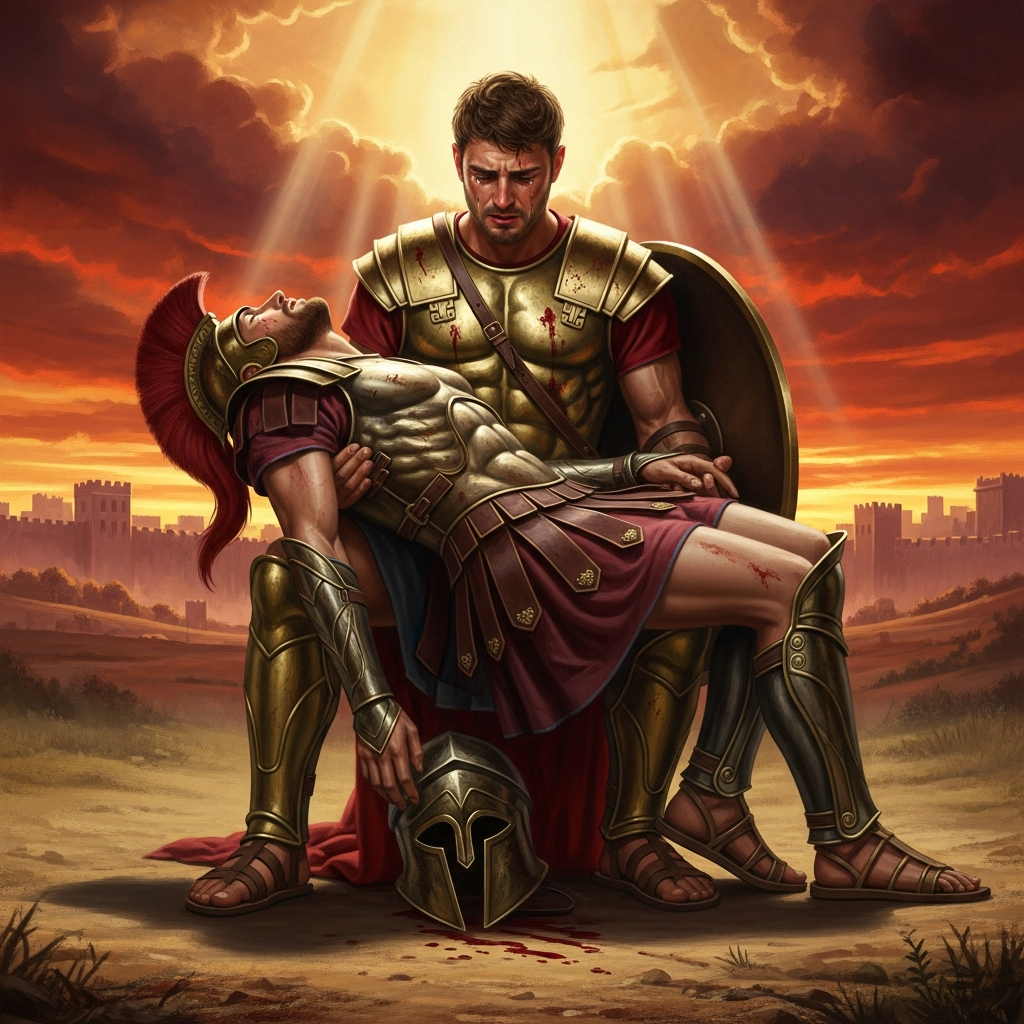
Apollo strikes him from behind. The blow is enough to stun him — to knock his helmet off, to loosen his shield, to leave him momentarily exposed in the open field. A young Trojan, Euphorbus, drives a spear into his back. Patroclus staggers. Hector arrives and finishes the kill with a thrust to the belly.
Hector strips the armor — Achilles’s armor — from the dying man. Patroclus, with his last breath, says: You are next, Hector. The man whose armor you are stripping will come for you, and you will die at his hands.
He dies.
Word reaches Achilles in the camp. The messenger is afraid to speak. When Achilles understands, he falls to the ground. He pours dust over his head. He claws at his own face. He cries out in a voice his mother hears beneath the sea, and Thetis comes up to him through the salt water and asks what is wrong.
He says: Patroclus is dead and I let him die. I sat in this tent over a quarrel about a woman while the man I loved most went out in my armor and was killed. There is nothing left for me but to kill Hector — and I know that to kill Hector is to die myself. So be it.
Thetis weeps. She tells him: yes — your fate is bound to Hector’s; if he dies, you die soon after. He says he knows. He has chosen.
His armor has been taken; she will go to Hephaestus and have new armor made overnight. The shield Hephaestus forges is described in the longest piece of ekphrasis in ancient literature — a shield with the whole world on it: weddings, harvests, lawsuits, dancing, the cosmos, the ocean stream around its rim. Achilles will carry the world on his arm into the killing.
He returns to the field at dawn.
He kills everyone. He kills until the river Scamander rises in protest against the bodies clogging it and pursues him along the bank. He kills until the Trojan army flees inside the walls. Hector alone remains outside.
Hector waits. His parents on the wall beg him to come inside. He cannot. He has stayed too long, urging the army on; if he flees now, his shame will be greater than his death. Achilles approaches. At the last moment Hector breaks and runs. They circle the walls of Troy three times — Hector running, Achilles after him — until at last Athena, in disguise, tricks Hector into stopping and turning.
They fight. Achilles kills him. Then he ties Hector’s body to the back of his chariot and drags it around the walls of Troy and back to the Greek camp. He drags it again every morning, around the burial mound of Patroclus.
For days he refuses to release the body. The gods themselves grow uneasy. Zeus sends Thetis to her son: enough.
That night, an old man enters the camp.
He has come on a wagon, alone, by ways that should not have been open. The gods have brought him through. He is Priam, king of Troy, father of Hector. He has come for his son’s body.
He kneels at Achilles’s feet. He kisses the hands that have killed his son. He says: Think of your own father. He is far away. He waits for you, as I waited for Hector. I have endured what no man has endured — I have kissed the hands of the man who murdered my child.
Achilles takes him by the wrist and gently sets him aside. He weeps for his father. He weeps for Patroclus. The old man weeps for Hector. They sit together in the lamplight and weep, the killer and the father of the killed, and somewhere in that long weeping Achilles becomes a different man.
He gives Priam the body. He arranges twelve days of truce so the funeral games can be held. The poem ends with Hector’s funeral, with Andromache’s lament, with the women keening, with the burial of the body. There is no victory in it. There is only the recognition, dawning across the whole final book, that the wrath of Achilles has cost more than even the gods accounted for.
The Greeks have not yet won the war. Achilles will be dead within weeks — felled by Paris’s arrow, guided by Apollo, into the one vulnerable heel his mother failed to dip in the Styx. He knows this. The poem knows this.
What it gives the audience, instead of a triumph, is the moment two enemies sit in lamplight and recognize each other as men.
Scenes
In the Greek camp, Achilles sits before his tent with the lyre, singing of the famous deeds of men, while the sea breaks behind him and the war rages without him
Patroclus in Achilles's borrowed armor leads the Myrmidons against the Trojans
By firelight, Priam kneels and kisses the hands of the man who killed his son
Echoes Across Traditions
Entities
- Achilles
- Patroclus
- Hector
- Agamemnon
- Briseis
- Thetis
- Priam
Sources
- Homer, Iliad I, IX, XVI, XVIII, XXII, XXIV
- Aeschylus, Myrmidons (fragments)
- Plato, Symposium 179e-180a