Contents
A comprehensive guide to Greek mythology — the twelve Olympians, the Titans, Prometheus, the hero tradition, the Greek underworld, the Oracle at Delphi, and the mythology's living influence.
- When
- Mycenaean origins c. 1600 BCE · classical codification 8th–5th century BCE
- Where
- The Greek world — Olympus, the Aegean basin, Troy, the underworld beneath Tartarus
At the center of everything is a mountain no one can climb.
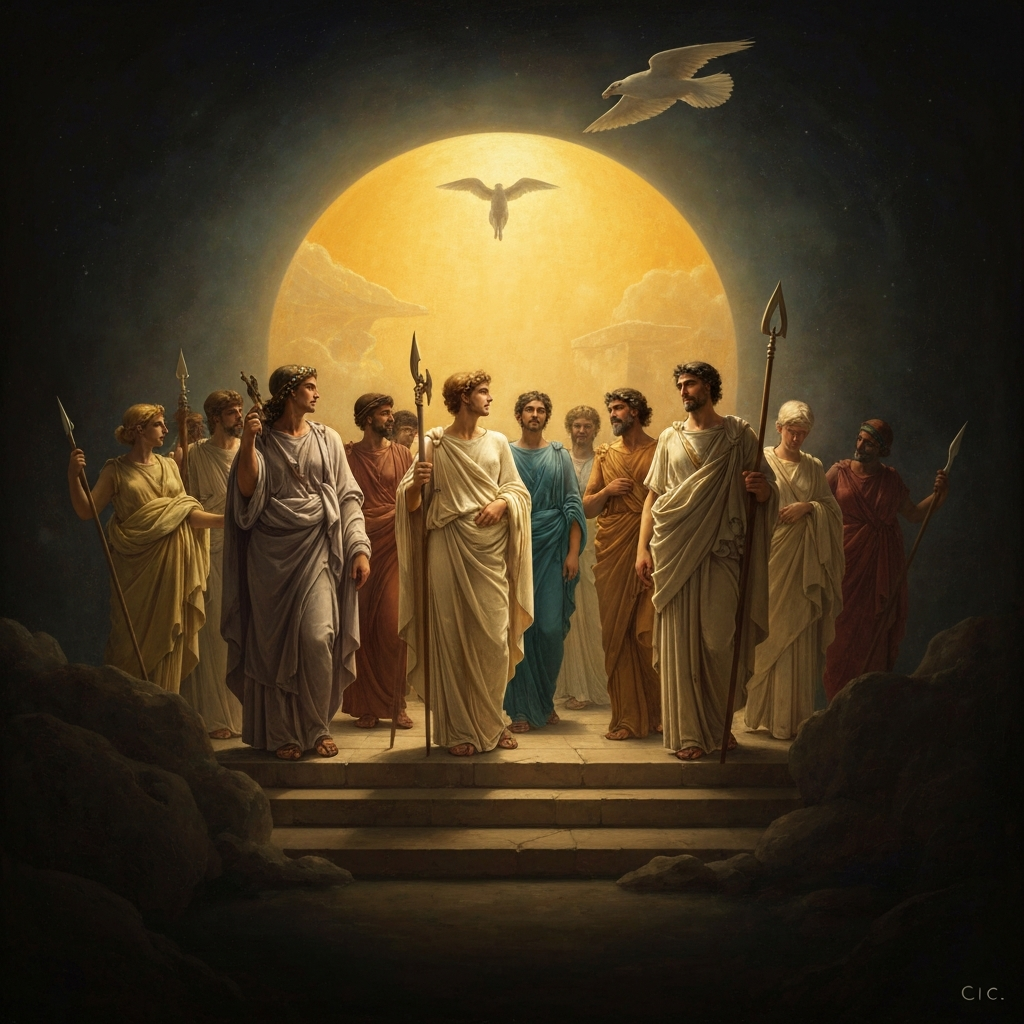
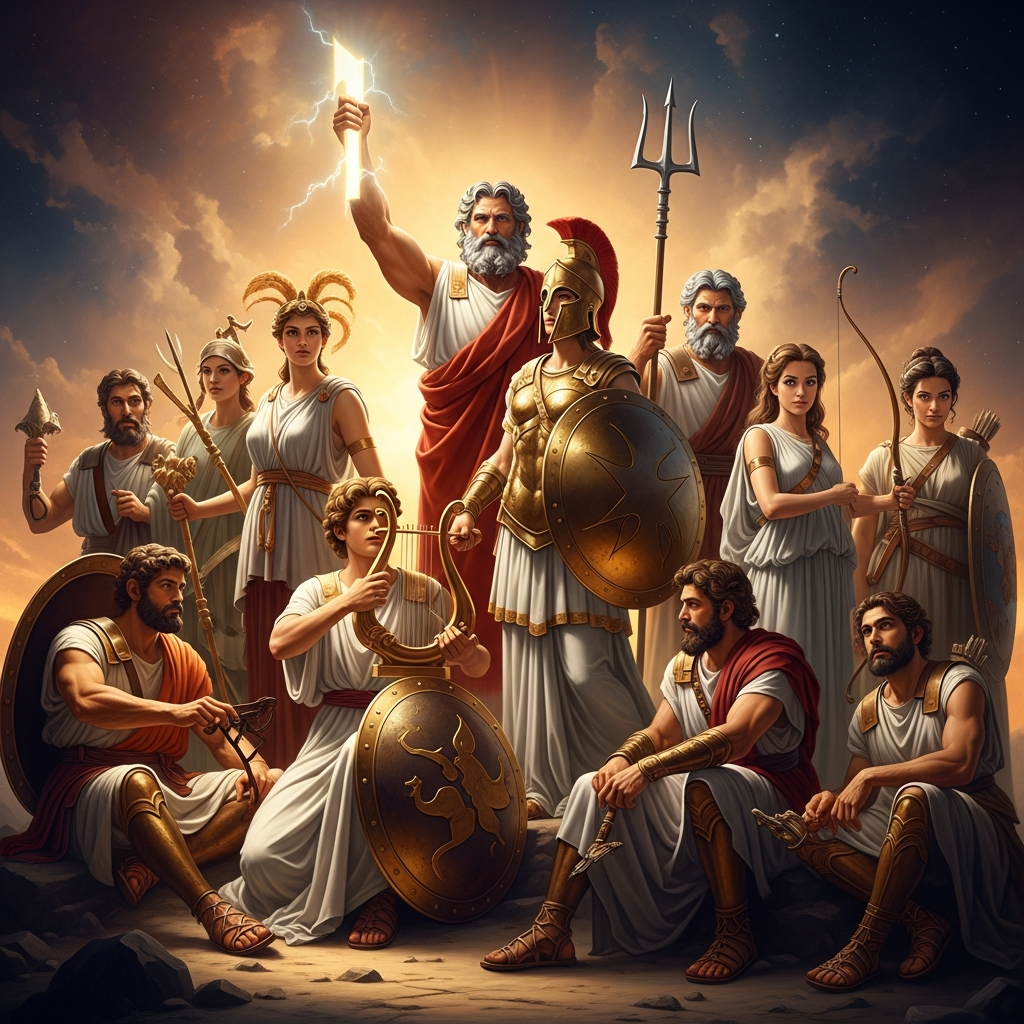
Olympus — not the actual mountain in Thessaly, though the Greeks used it as a placeholder for the divine — is the axis of the Greek cosmos. Twelve gods live there in palaces of bronze and gold, attended by the Muses, nourished on ambrosia and nectar, watching the humans below the way a bored court watches entertainment it can intervene in whenever it likes. The gods are not omnibenevolent. They are not even consistently good. Zeus commits adultery with a frequency that reads as compulsive. Hera retaliates against Zeus’s lovers and children with a vindictiveness that is perfectly understandable and entirely disproportionate. Apollo can cure plague or send it, in either case because someone either honored or offended him. The Greeks did not build their theology on divine virtue. They built it on divine power — and then asked what human life looks like underneath that power, which turns out to be a surprisingly good question.
The Twelve Olympians and Their Domains
The canonical twelve vary slightly by source, but the core is fixed: Zeus (king, sky, thunder, justice in the most coercive sense), Hera (marriage, sovereignty, often deployed as an obstacle), Poseidon (sea, earthquakes, horses), Demeter (grain, the agricultural cycle, the reason winter exists), Athena (wisdom, warfare’s strategic dimension, crafts, the city of Athens specifically), Apollo (the sun in some accounts, prophecy, music, healing, plague), Artemis (the hunt, wild places, the moon, childbirth’s patron despite her virginity), Ares (war’s brute violence — notably unpopular among the Greeks), Aphrodite (erotic love, beauty, the anarchic force that makes people act against their own interests), Hephaestus (fire, the forge, divine craftsmanship, and the humiliation of being the ugly god married to the beautiful goddess), Hermes (boundaries, travel, commerce, thieves, and the souls of the dead whom he escorts), and either Dionysus (wine, ecstasy, the dissolution of identity) or Hestia (the hearth, domestic order, the goddess who never appears because she is always already present).
Each domain is not just a portfolio. It is a principle of how the world works. Demeter’s grief over Persephone is not just a mother’s sadness — it is the explanation for why crops fail every year, why winter exists, why fecundity is contingent and temporary. Aphrodite’s power is not just desire — it is the force that overrides rational calculation in everyone from Helen to Achilles to the gods themselves. The Greek pantheon is a taxonomy of the ways the world works on human beings against their will.
The Titans: Before the Olympians
Before the twelve, there were twelve Titans — the elder gods, children of Ouranos (Sky) and Gaia (Earth). Their king was Cronos, who castrated his own father and swallowed his children to prevent the prophecy that said one of them would overthrow him. His wife Rhea substituted a stone for the infant Zeus. Zeus grew up hidden in Crete, returned, fed Cronos an emetic that brought up his swallowed siblings (Hestia, Demeter, Hera, Hades, Poseidon — born twice, each of them), and led the Olympians against the Titans in the Titanomachy, a ten-year war that ended with the Titans imprisoned in Tartarus, in the pit beneath Hades, chained there by the hundred-handed Hecatoncheires as guards.
The Titanomachy matters for the same reason all divine succession myths matter: it establishes that the current cosmic order was won, not given. Zeus rules because he fought for it, not because it was always so. This introduces a theological instability — if Zeus won by overthrowing the previous king, what prevents a further overthrow? The Greeks never entirely resolve this anxiety. Zeus knows from Themis that any son born to the sea-nymph Thetis will surpass his father, which is why Zeus arranges Thetis’s marriage to the mortal Peleus, producing Achilles instead of a god-killer. The whole Trojan War begins, on one level, from Zeus’s fear of his own prophecy.
Prometheus: The Pivot
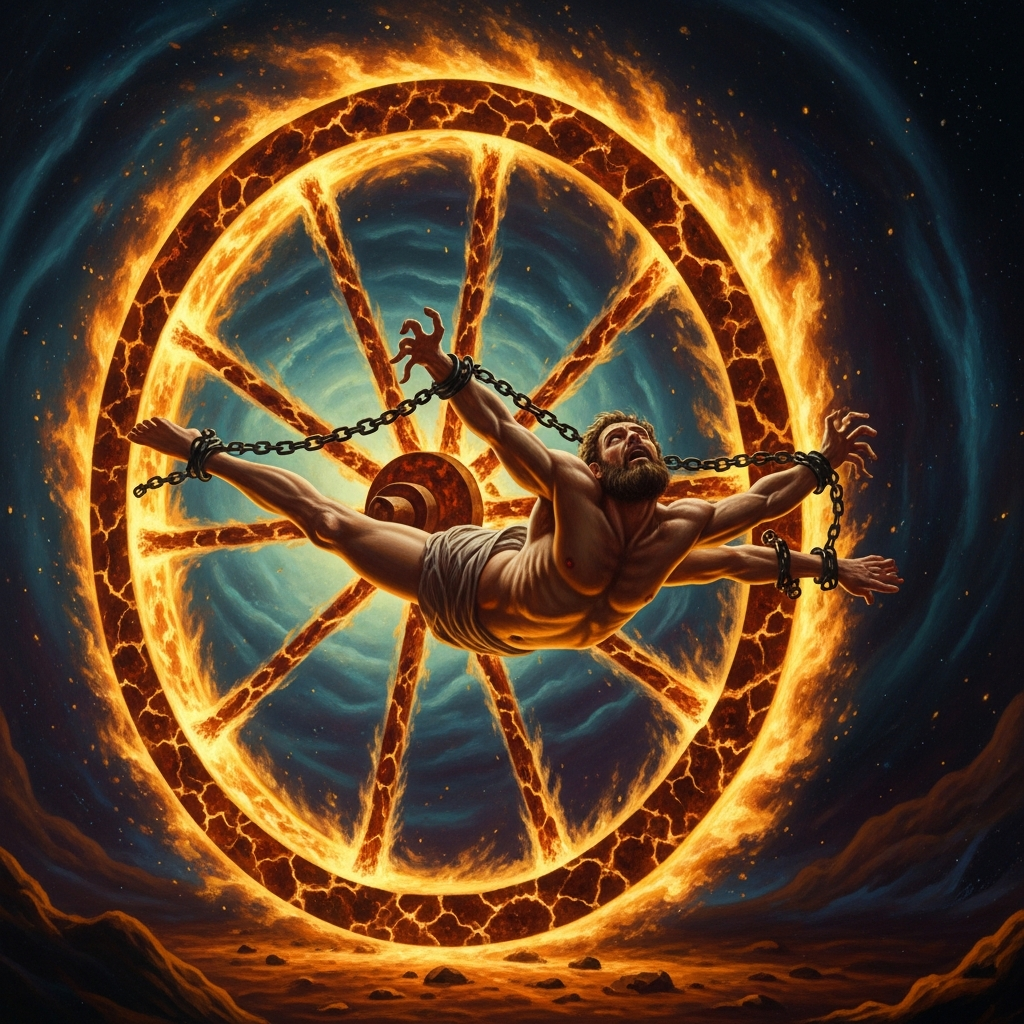
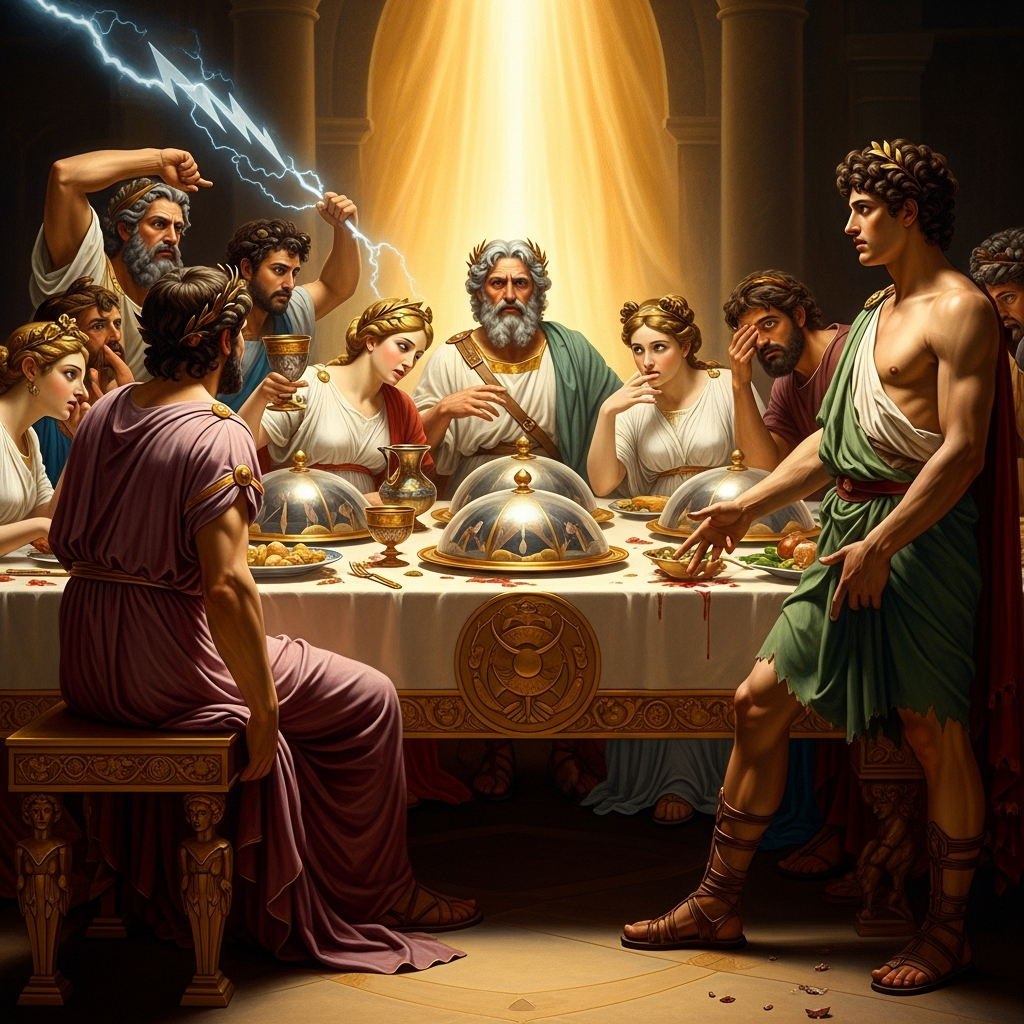
Prometheus — the Titan who sided with Zeus in the Titanomachy and was therefore not imprisoned — is the figure who stands between the divine and human worlds and creates the problem of both. He stole fire from the gods and gave it to humanity, not as a gift exactly but as a correction: Zeus had cheated humans at a sacrifice, taking the good meat for the gods and leaving humans the bones and fat. Prometheus redressed the balance. Zeus punished him by chaining him to a mountain in the Caucasus where an eagle ate his liver each day, which regrew each night, for thirty years (or eternity in some versions) until Heracles freed him.
The cost to humanity was Pandora — the first woman, shaped by Hephaestus, given gifts by each god, and sent to Prometheus’s brother Epimetheus with a jar that contained every evil and illness, plus Hope at the bottom. Hesiod’s version is cruelly ambivalent: Hope remains in the jar (consolation preserved), but everything else escaped (misery loosed on the world). Prometheus paid for his gift with his liver. Humanity received fire, lost paradise, and got Hope as compensation — which is either generous or insulting depending on how you read it.
The Hero Tradition: Greatness and Its Costs
Greek heroes are not simply strong people who do impressive things. They are half-divine hybrids (almost always the son of a god and a mortal woman) defined as much by their fatal flaws as by their feats. The tradition insists that the qualities that make them extraordinary are the same qualities that destroy them.
Heracles — the most famous — possesses strength no mortal or god can match, and a rage he cannot control. In a fit of madness sent by Hera, he kills his own wife and children, which is why he must perform the Twelve Labors: not to become great, but to atone. The Labors are punishment. His apotheosis at the end (burned alive on a pyre, ascending to Olympus) is the only escape from a life structured around a crime he did not choose to commit.
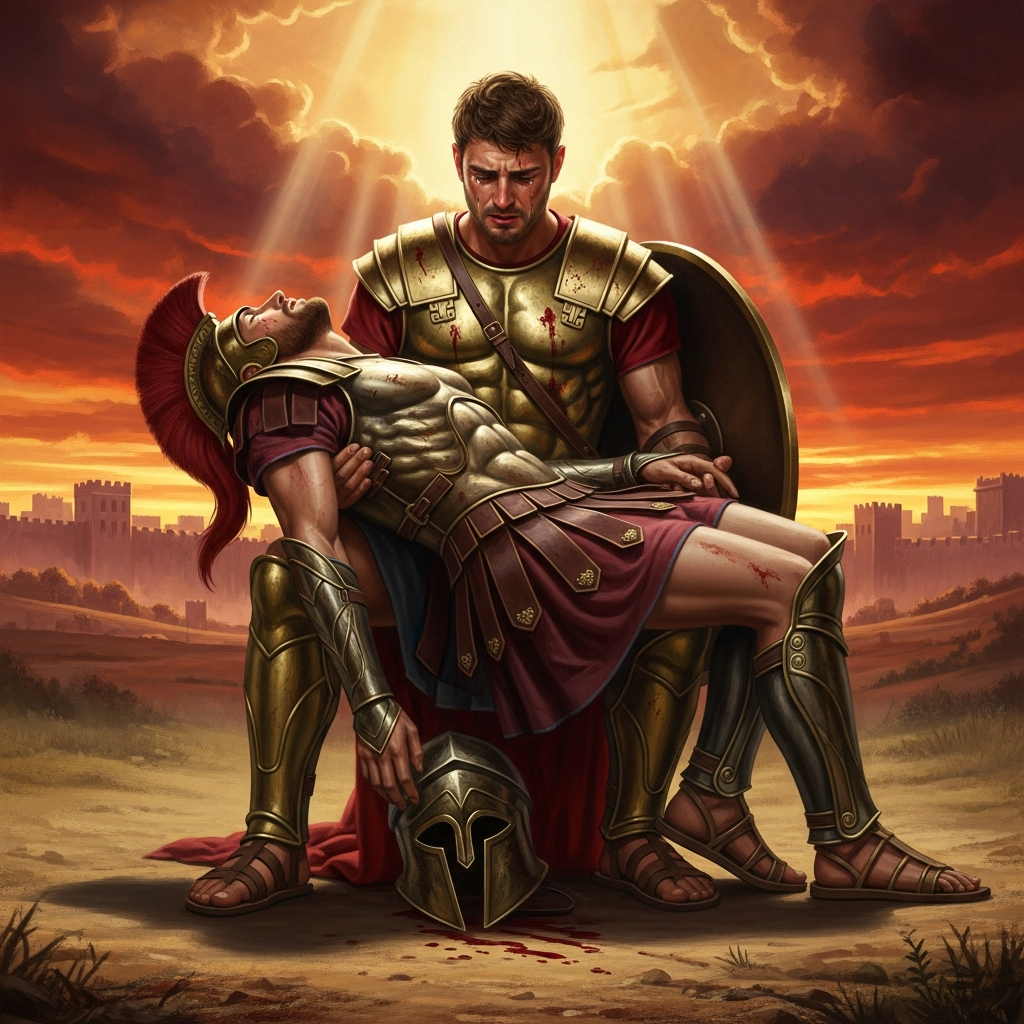
Achilles is the greatest warrior who ever lived, and he knows it. His mother Thetis gave him the choice: long, undistinguished life, or short, glorious life with eternal fame. He chose glory. The Iliad begins not with his heroism but with his rage — withdrawn from battle over a quarrel about a prize-slave, refusing to fight while his companions die, finally returning not from duty but from grief over Patroclus’s death and a desire for revenge. Achilles is the purest expression of the Homeric heroic code and simultaneously its most damning critique: a man whose gift for war is his whole identity, who cannot navigate a world that requires anything other than the ability to kill.
Odysseus survives the Trojan War because he is not primarily a warrior. He is the man with the most flexible definition of virtue — cunning rather than strong, patient rather than brave. The Odyssey is ten years of problem-solving on the way home, and the problems are all versions of the same one: how do you remain yourself when every external support — ship, crew, home, wife, identity — is stripped away? He loses everything and his return is the answer. He arrives disguised as a beggar, proves who he is with his bow, kills the suitors, and reclaims what was his. It is the most optimistic resolution in Homer, and even it ends with a curse from Poseidon that will one day require Odysseus to travel inland until no one recognizes an oar.
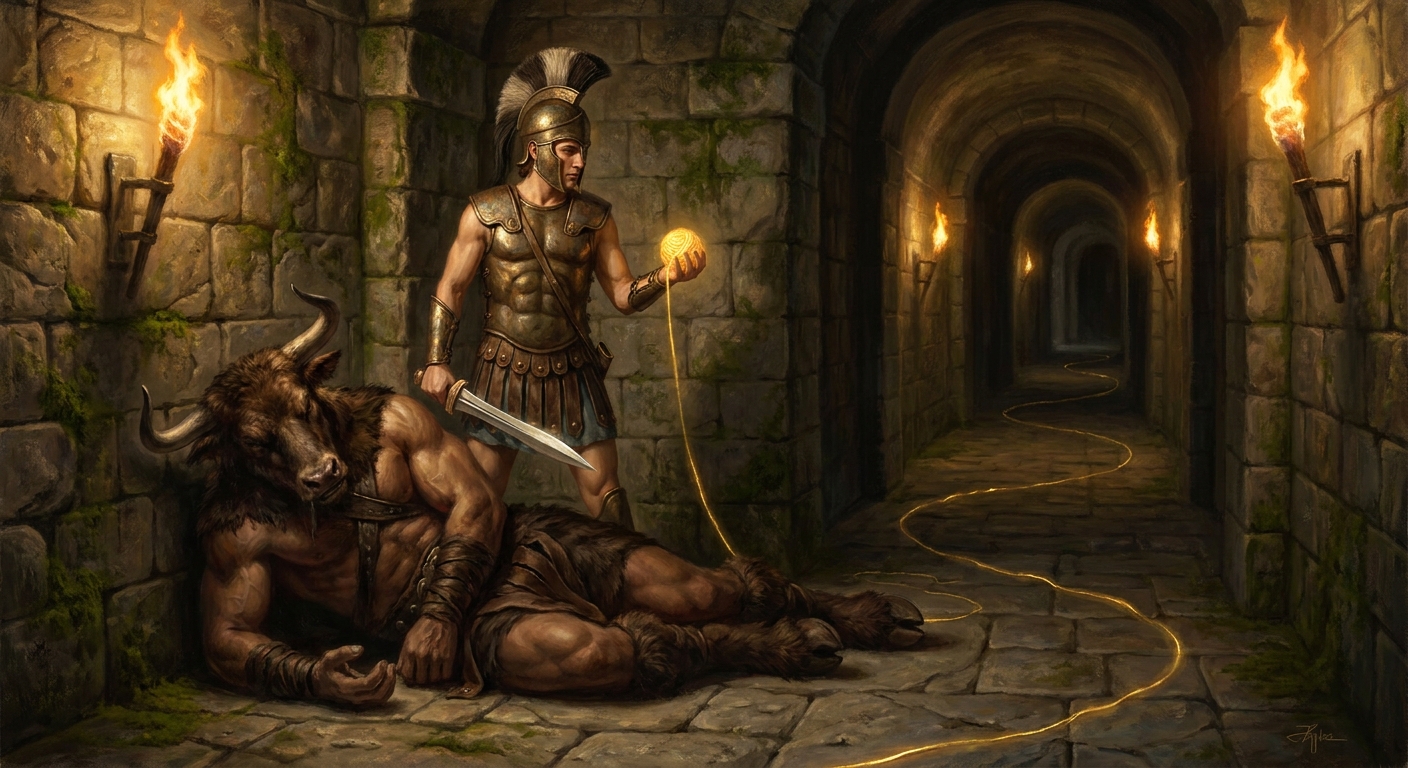
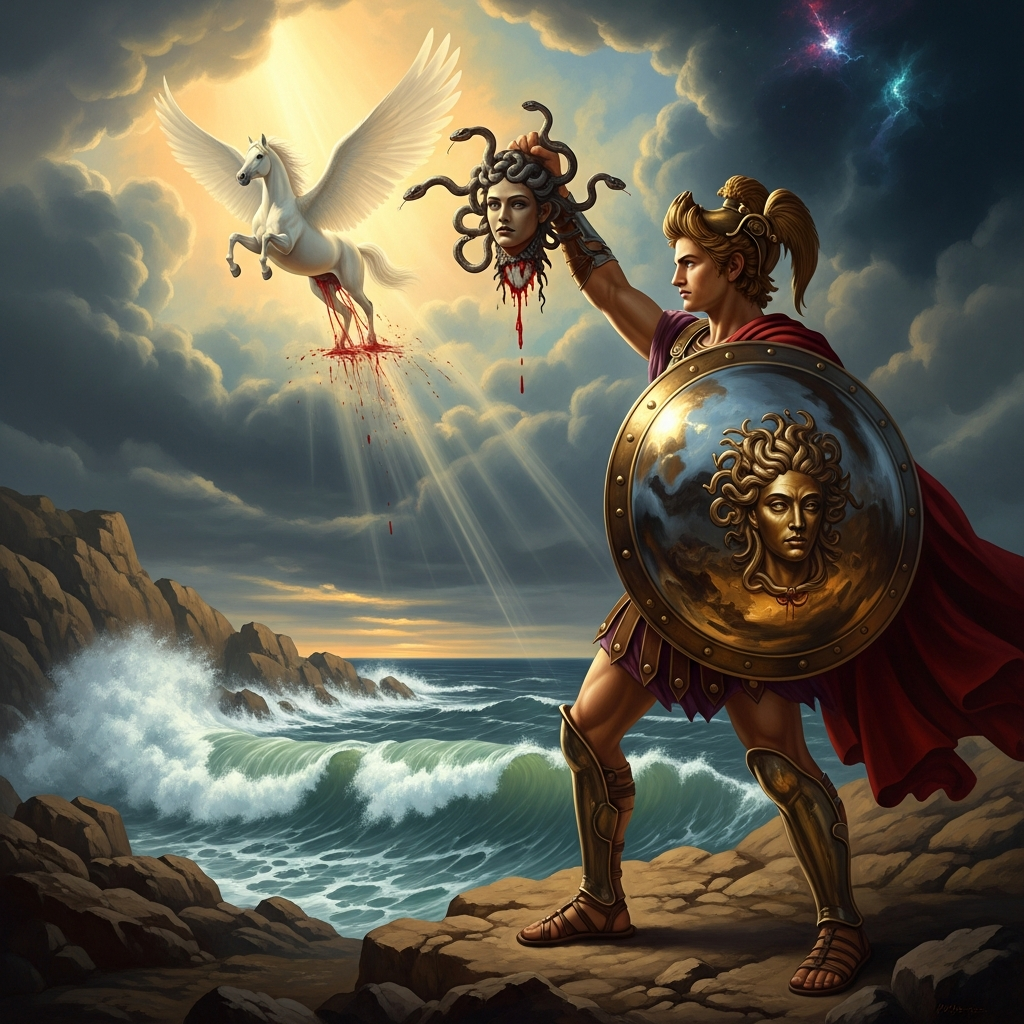
Perseus and Theseus follow the structure of the monster-slaying quest. What gives them permanence is not the monsters they kill (Medusa, the Minotaur) but the institutional founding they represent. Perseus’s gift is the head that keeps killing. Theseus’s gift is Athens itself — the city that replaces the labyrinth’s tribute. Greek heroes always civilize something in the killing.
The Underworld: A Bureaucracy of Death
The Greek underworld is not hell. It does not punish the wicked in proportion to their sins by default. It is a vast gray plain where most of the dead wander in dim awareness, drinking from Lethe (the river of forgetfulness) and becoming less themselves over time. Hades — the third great brother, who received the underworld when the brothers divided the cosmos by lot after the Titanomachy — rules it with Persephone as queen. He is not malevolent. He is thorough. He does not like visitors.
The rivers matter: Styx, by which even the gods swear unbreakable oaths; Lethe, which strips memory; Mnemosyne, which preserves it for those initiated in mystery cults who knew to drink from the right spring. The three judges — Minos, Rhadamanthus, Aeacus — adjudicate where the dead go: the Fields of Elysium for the virtuous and heroic, the Fields of Asphodel for the ordinary majority, Tartarus for those who offended the gods specifically. The moral accounting is real but secondary to the bureaucratic fact: everyone dies, everyone arrives, everyone is processed.
The Oracle at Delphi and the Role of Fate
The Oracle at Delphi — Apollo’s priestess, the Pythia, inhaling volcanic gases from a fissure under the temple and speaking in riddles that priests transcribed and interpreted — was not a theatrical prop. For roughly a thousand years (c. 800–400 BCE, with continued influence thereafter), Delphi was consulted before wars, colonizations, lawmaking, and major political decisions by virtually every Greek city-state and many foreign powers. The Oracle’s authority depended on a theological claim: that Apollo, as god of prophecy, had access to Zeus’s knowledge of fate, and that fate was real, fixed, and knowable in principle even if not always in time.
The Greek concept of fate (Moira) is not determinism in the modern sense. It does not eliminate choice. It establishes outcomes that choices lead to. Oedipus chooses everything he does — he flees Corinth to avoid the prophecy, he kills the stranger at the crossroads, he investigates the plague — and every choice brings him closer to the truth he is trying to escape. The Oracle never lies. The problem is always the listener’s interpretation, or the listener’s belief that cleverness can outmaneuver what the Fates have already written.
This is one of the most intellectually serious things Greek mythology does: it takes the problem of free will and necessity seriously, builds its greatest tragedies around it, and refuses to resolve the tension. The plays of Sophocles are still being performed because the tension has not been resolved.
The Western Inheritance
The influence of Greek mythology on Western civilization is so pervasive it is difficult to see as influence — it has become the background. Western literature’s central vocabulary of narrative (tragedy, comedy, the hero’s journey, the Muse, the fatal flaw) derives from Greek originals. Western philosophy grew in explicit dialogue with the mythological tradition — Plato’s Republic bans Homer because Homer’s gods are too human, which is a philosophical diagnosis, not just a censorship. Western art from the Renaissance forward has used Greek mythological subjects as its default painterly language. The names of the planets, many constellations, the days of the week (in their Romance-language forms), the names of psychiatric disorders and behavioral patterns (narcissism, Oedipus complex) — Greek mythology’s fingerprints are on the entire Western organizational structure of knowledge.
This is not because the Greeks were the only sophisticated mythological tradition. It is because Alexander’s conquests and Rome’s administrative apparatus carried Greek mythology into every corner of Europe and the Mediterranean, where it fused with local traditions and became the water those cultures thought in. You cannot understand Dante, Shakespeare, Milton, Keats, or Freud without Greek mythology. You can barely understand English without it. The myths themselves are worth knowing; their presence in the foundations of everything else makes knowing them essential.
Greek mythology’s lasting power is not in the spectacle — the monsters, the transformations, the divine politics. It is in the insistence that humans are worth the story. The gods have power. The humans have character. And character, in the Greek account, is what gets you through the labyrinth, across the wine-dark sea, and — sometimes — home.
Echoes Across Traditions
Entities
- Zeus
- Hera
- Athena
- Apollo
- Prometheus
- Heracles
- Odysseus
- Achilles
- Hades
Sources
- Hesiod, *Theogony* and *Works and Days* — c. 700 BCE (West trans., Oxford, 1988)
- Homer, *Iliad* and *Odyssey* — c. 750–650 BCE (Lattimore trans.; Fagles trans.)
- Aeschylus, *Oresteia*; Sophocles, *Oedipus Rex*, *Antigone*; Euripides, *Medea* — 5th c. BCE
- Walter Burkert, *Greek Religion* (Harvard, 1985)
- M.L. West, *The East Face of Helicon: West Asiatic Elements in Greek Poetry and Myth* (Oxford, 1997)
- Robert Graves, *The Greek Myths* (Penguin, 1955 / 1960) — useful, but treat interpretations cautiously
- Timothy Gantz, *Early Greek Myth: A Guide to Literary and Artistic Sources* (Johns Hopkins, 1993)