Ilmarinen Forges the Sampo
Mythic time, the world-age before the Sampo's loss · Pohjola in the far north, the smithy with the four winds working its bellows
Contents
The eternal smith Ilmarinen — who once hammered the dome of the sky out of nothing — is sent to the dark farm of Pohjola to forge the Sampo, a magical mill that grinds out flour, salt, and gold without stopping. His first four attempts produce a crossbow, a boat, a heifer, and a plough that all want to do harm; only on the fifth attempt does he produce the Sampo, the cosmic object no one in the runos can fully describe.
- When
- Mythic time, the world-age before the Sampo's loss
- Where
- Pohjola in the far north, the smithy with the four winds working its bellows
Ilmarinen does not want to go.
He is in his smithy when Väinämöinen finds him. The forge is going. The four winds — north, south, east, west — are working the bellows for him, the way they always do; Ilmarinen is the smith for whom the elements themselves are tools. He is hammering a piece of iron flat. He looks up when the door opens.
Väinämöinen is at the door. Väinämöinen is muddy. Väinämöinen has been on the road for a long time, and he has come straight from the smithy of Pohjola — though he was not a guest there; he was a captive, and he has talked his way out, and the price of his release was the promise that Ilmarinen will be sent to forge the Sampo.
He explains.
He explains that Louhi, the witch-mother of the north, will give the hand of her daughter — the famous Maid of Pohjola, the most beautiful woman in the runos — to whichever hero can forge the Sampo. He explains that the Sampo is a mill of abundance: salt on one side, flour on the second side, gold on the third. He explains that the Maid of Pohjola is a prize Ilmarinen has wanted since the day he heard of her.
He does not explain that he, Väinämöinen, has already proposed to her and been rejected. He leaves that out.
Ilmarinen says no.
He says it without putting the hammer down. I am not going north. The north is dark. I have heard about the smithy at Pohjola. The bellows do not have winds in them. I will not work in a smithy without winds.
Väinämöinen sings him into the air.
This is the part the runo is precise about.
Väinämöinen, who is older than Ilmarinen, who is the singer of the original songs, does not argue. He sings a small whirlwind. The whirlwind comes through the door of the smithy, lifts Ilmarinen off his feet — gently, almost politely — carries him out the door and up into the sky and northward over the lakes and the forests and the bear-country, and deposits him on the path leading down to Pohjola’s gate.
Ilmarinen lands on his feet. He is still holding the hammer.
He does not turn back. The whirlwind is gone; the door of his smithy is far away; and standing in front of him is the gap-toothed Louhi, the witch-mother of the north, who has come to the gate to meet him because she has been expecting him.
She smiles.
You are the smith, she says. I know your work. Come into the house. Eat. Forge me the Sampo.
The smithy at Pohjola is bad.
Ilmarinen sees it the next morning. It is small. The walls are damp. The bellows are dry leather — no winds in them, just two slave-boys who pump the handles in shifts and tire after an hour. The anvil is rusted at the edges. The fire is sluggish. There is no proper chimney; the smoke leaks out through gaps in the roof. The forge is the worst smithy Ilmarinen has ever seen.
He stands looking at it.
He sets down his hammer. He rolls up his sleeves. He says to the slave-boys, Pump.
He starts the fire.
The first attempt produces a crossbow.
The metal will not behave at first. It refuses the shape Ilmarinen is asking for. He works it for a day, two days, three days, and what he draws out of the fire on the third day is a magnificent crossbow — beautifully made, perfectly balanced, the bow-arm shining, the string already strung — but the moment Ilmarinen looks at it he sees that the crossbow has the wrong eyes.
It looks at him. The crossbow has eyes — fine, narrow, predatory eyes worked into the wood of its stock — and the eyes are hungry. Give me a head every day, the crossbow says, in the silent voice that magic objects speak in. Give me a head every day and I will be your weapon.
Ilmarinen breaks it across his knee and throws the pieces back into the fire.
The second attempt produces a boat.
This time the metal cooperates better. Out of the fire on the third day comes a beautiful red boat, carvel-built, with iron ribs, with a sail of cloth-of-gold. Ilmarinen lifts it down from the anvil. He sets it on the floor. The boat looks at him. The boat says, Take me to war. I want to fight every other boat. I want every other boat at the bottom of the sea.
Ilmarinen breaks it apart and throws it into the fire.
The third attempt produces a heifer.
A red-and-white heifer with golden horns, made of iron, but breathing. She walks off the anvil. She lows. The two slave-boys gasp; they have not seen a smith make a living animal before. Ilmarinen walks around her. He looks at her face.
She is wicked.
She is wicked in the way only a perfectly-made livestock animal can be wicked — she will trample her own calves, she will gore her milkmaid, she will lead the herd off a cliff. Ilmarinen sees it in the set of her ears.
He breaks her up and throws her into the fire.
The fourth attempt produces a plough.
A plough of bright copper. The handles of birchwood. The blade so sharp it whistles in the air. Ilmarinen sets it on the ground. The plough looks at him. The plough says, Plough up the cornfields. Plough up the meadow. Plough up the fields of other men.
He breaks it apart and throws it into the fire.
He stands in front of the forge.
He has been at this for many days. The slave-boys are exhausted. The leather bellows are starting to crack. The fire is low. He has destroyed four objects, each of them more beautiful than the next, each of them ruined by some small wickedness of intention that had crept into the metal during the working.
He understands, finally, what the problem is.
The forge has no winds.
The bellows are too small. The fire is too cold. He has been working the metal at the wrong heat — hot enough to make the shape, not hot enough to burn the malice out of it. The objects he has been making are coming out half-formed because the smithy itself is half-formed.
He calls the four winds.
This is the part the runo lingers on.
He calls the south wind — Etelä — by its old name, and the south wind comes through a crack in the wall and lies down beside the bellows and waits. He calls the north wind — Pohjoinen — and it comes too, the cold one, the white one, and it stands beside the south wind and bows its head.
He calls the east wind. He calls the west wind.
The four winds are in the smithy.
He takes the leather of the bellows and he opens them, and he tells the four winds get inside, and the four winds — who do not normally fit inside a leather bag — make themselves small, and they go inside, and the bellows now have winds in them the way Ilmarinen’s own bellows back home have always had winds in them.
He pumps.
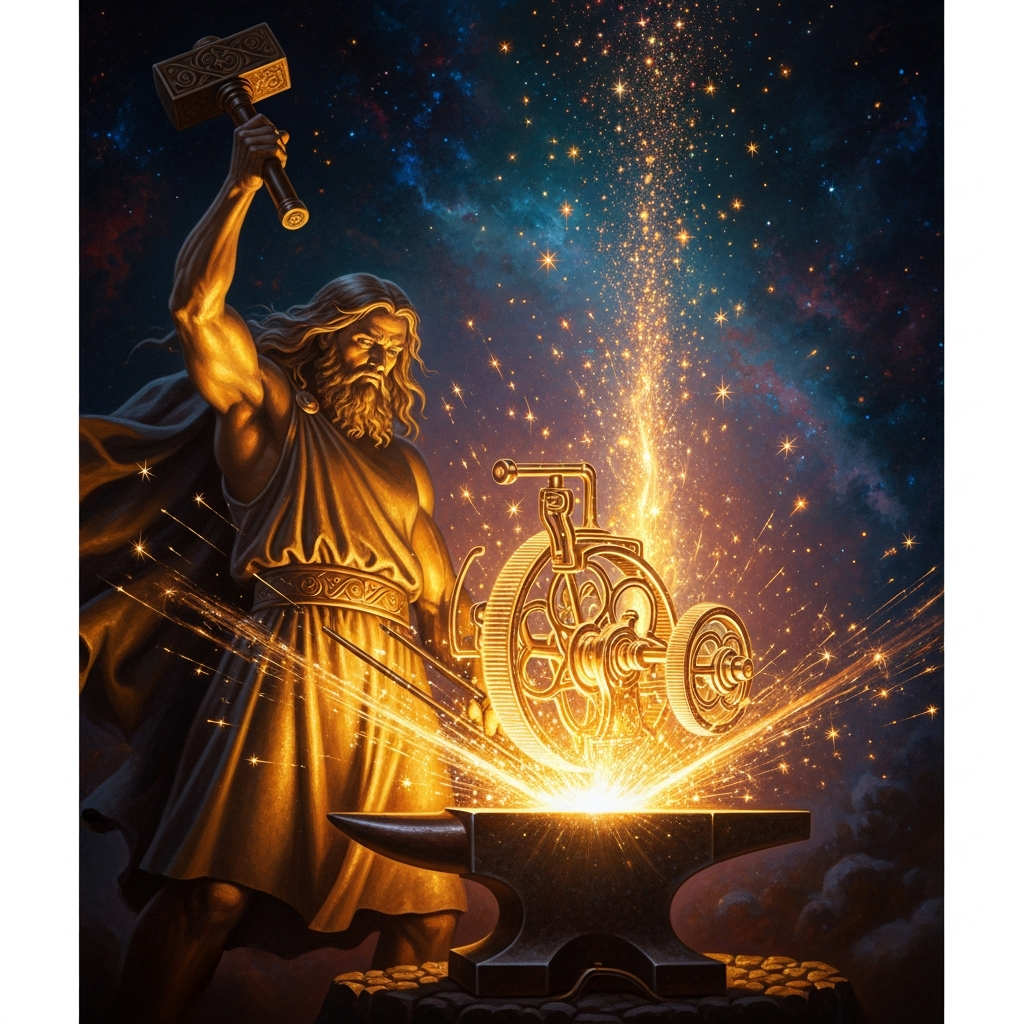
The fire roars up to twice its previous height. The roar is not the sound of fire; it is the sound of the four winds working in unison, and the heat is enormous — the slave-boys back away to the wall, the iron of the anvil glows, the air in the smithy shimmers — and Ilmarinen takes a fresh ingot of iron, and a piece of copper, and a piece of silver, and a piece of gold, and milk from a barren heifer, and a single grain of barley, and the wool of a summer ewe — the runo lists every ingredient, the runo is a recipe — and he throws them all into the fire together, and he begins to hammer.
What comes out of the fire on the fifth attempt is the Sampo.
The runos cannot describe it.
This is the famous problem with the Sampo. Lönnrot, who compiled the Kalevala, was working from dozens of singers across Karelia, and every singer described the Sampo differently. It is a mill. It is a pillar. It is a tree with golden roots. It has a kirjokansi — a many-colored lid — and the lid is the sky-dome itself; it has three sides — flour, salt, gold — and a fourth side that the singers will not name; it has roots that go nine fathoms into the ground, into Pohjola itself, which is why it cannot be moved easily; it has a top that touches heaven.
Ilmarinen lifts it down from the anvil. It takes him and the two slave-boys to lift it. It is heavier than four of him. It hums in his hands — a low hum, the hum of a thing already at work — and on the floor of the smithy, where its base touches, a small drift of fine white flour begins to accumulate, and a small drift of salt, and a small bright glitter of gold-dust.
It is working already. He has not even installed it yet.
He carries it out into the yard.
Louhi is there. She has been waiting for many days. She has not gone back into the house even once. When she sees the Sampo she makes a small sound that is not quite a laugh and not quite a sob — the sound a person makes when an old prayer is finally answered — and she walks up to it and lays both her hands on its many-colored lid.
The Sampo grinds.
Even faster, with her hands on it, the flour comes out, and the salt, and the gold. The pile on the ground grows. In ten minutes there is enough flour to feed Pohjola for a week. In an hour there is enough gold to make every woman in the household rich. In a day the storehouses of Pohjola are full and Louhi is ordering them emptied to make room for more.
She has the Sampo.
She does not give Ilmarinen the daughter.
This is the joke the runo tells, very quietly. Ilmarinen has fulfilled the bargain. The Sampo is forged. The Maid of Pohjola is supposed to be his. But Louhi turns to him in the yard, beside the grinding mill, with her hands full of new gold, and she says — calmly, almost kindly — My daughter has not yet decided. Come back another year.
Ilmarinen stares at her. He has been worked. He sees it now. He has been worked the way a piece of iron is worked — heated and hammered and shaped to the purpose of someone smarter than him — and the Sampo, which he made, is not his. It is hers. It will stay in Pohjola, in the iron-bound vault deep under the dark farm, grinding, grinding, grinding, for as long as the runos go on.
He picks up his hammer. He turns. He walks back south.
He goes home alone.
He does not get the Maid of Pohjola — not in this runo. (He gets her later, in runo 21, but the marriage ends badly, and the maid dies, and Ilmarinen tries to forge himself a wife of gold and silver, and that ends badly too.) But the Sampo is in the world. It is in the wrong hands. It is grinding for Pohjola, the dark farm of the witch-mother, and the rest of the Kalevala will be the slow project of stealing it back.
The Finns who sang this song understood what the myth was telling them.
You can make abundance. You have to fail four times to do it, you have to call the winds, you have to use ingredients that should not go in the fire, you have to work in someone else’s bad smithy with damp walls, and at the end of it all the abundance you make will not be yours. It will belong to whoever owns the room you forged it in.
The Sampo is the description of every working life ever lived.
The runo knows this. The runo sings about the smith who made the world’s wealth and went home with nothing but his hammer.
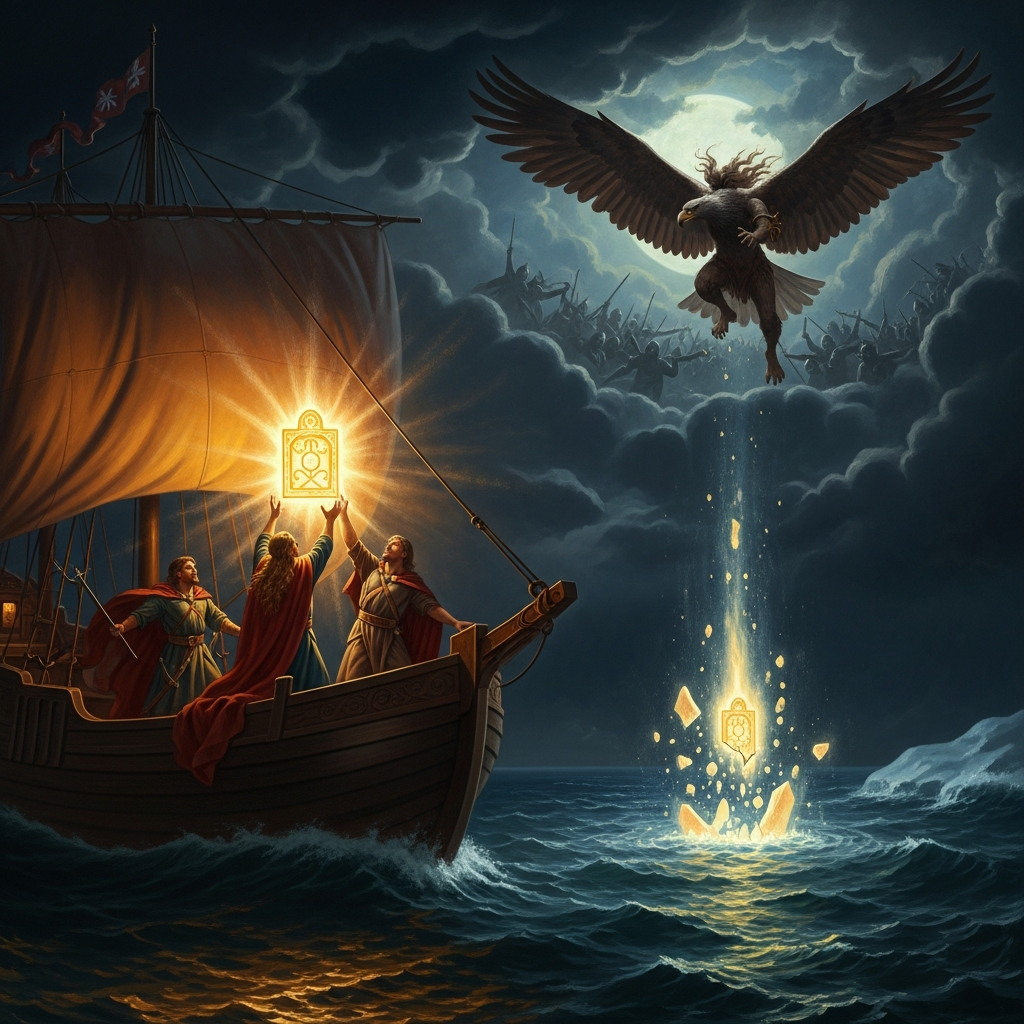
It also sings — quietly, not yet, but soon — about the boat that will sail north to take the Sampo back.
Echoes Across Traditions
Entities
- Ilmarinen
- Louhi (Mistress of Pohjola)
- The Maid of Pohjola
- Väinämöinen
- The Sampo


Sources
- Kalevala, runos 10–11 (compiled by Elias Lönnrot, 1849)
- Keith Bosley translation, *The Kalevala* (Oxford World's Classics, 1989)
- Eino Friberg translation, *The Kalevala: Epic of the Finnish People* (1988)
- Matti Kuusi, *Finnish Folk Poetry: Epic* (1977)
- John Martin Crawford, *The Kalevala: The Epic Poem of Finland* (1888 translation)
- Anna-Leena Siikala, *Mythic Images and Shamanism* (2002)