Combat Profile
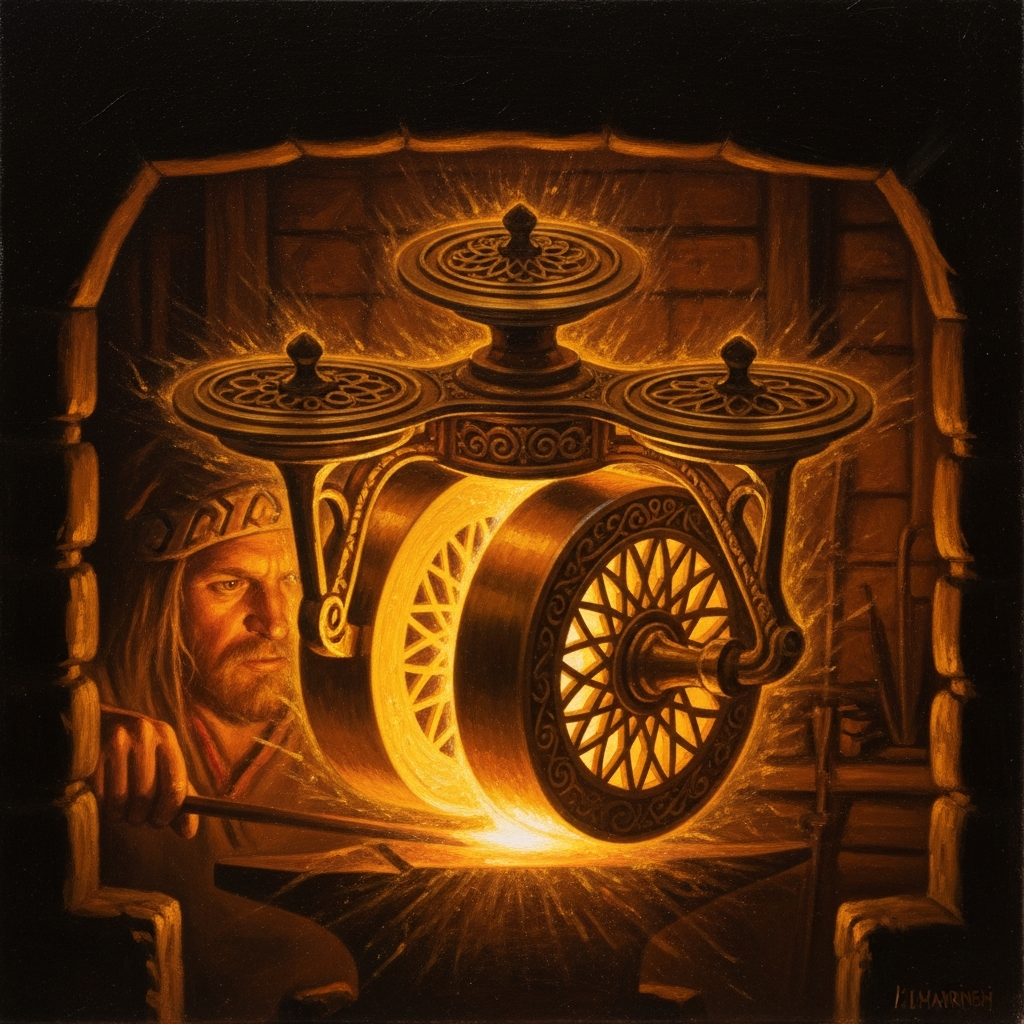
Mill of Plenty
Generates an endless stream of grain, salt, and gold while operating; one minute of operation feeds a village for a month and enriches its possessor's clan permanently
Indestructible Fragments
Even if the Sampo is shattered, its fragments retain their generative power; the realm in which the fragments come to rest becomes mineral-rich and fertile for ten thousand years
The Sampo is the central artifact of the Kalevala — and also the most mysterious, because the poem never fully explains what it is. It is a mill (samppo in some dialects = “pillar”), forged by Ilmarinen as bride-price for the Maiden of Pohjola, made from the tip of a swan’s feather, the milk of a barren cow, a single grain of barley, and the wool of a single ewe. It has a “many-coloured cover” (kirjokansi) and three sides that grind, respectively, grain, salt, and gold without end. It produces wealth so abundant that Pohjola becomes rich beyond reason while the southern Kaleva starves.
The heroes — Väinämöinen, Ilmarinen, Lemminkäinen — sail north to steal the Sampo back. They lull Pohjola to sleep with Väinämöinen’s kantele-music, take the Sampo onto their ship, and sail south. Louhi pursues in the form of a great eagle, and in the battle the Sampo is torn from the ship and falls into the sea, shattering. Some fragments wash up on the shores of Kaleva and become the basis of agricultural prosperity; other fragments remain at the bottom of the sea, providing the mineral wealth that makes the deep waters fertile. The Sampo is gone — but not entirely. Its fragments are in the world.
Biblical Parallels: The Sampo parallels both the Ark of the Covenant (a divinely-crafted wooden artifact whose possession brings prosperity, whose theft brings disaster, 1 Samuel 4-6) and the manna-jar (Exodus 16:33, the inexhaustible source of food). Its destruction-but-not-quite-loss echoes the lost-but-still-active relics of Christian tradition.
Cross-Tradition: Parallels Norse Skíðblaðnir (Freyr’s magical ship that always has fair wind and folds into a pocket) and Mjölnir (Thor’s hammer), the Greek Cornucopia (horn of plenty), the Welsh Cauldron of Plenty (pair dadeni), and the Holy Grail. The “magical artifact of inexhaustible plenty, fought over and partially lost” is a powerful Eurasian motif.
1 min read