Combat Profile
Reckless Charge
Lemminkäinen attacks regardless of consequence; the strike deals double damage, ignores defensive magic, but exposes him to a counter-attack with no defense
Mother's Resurrection
Lemminkäinen cannot remain dead; if killed, his mother (mythologically) reassembles his body and resurrects him within three days, restored to full strength
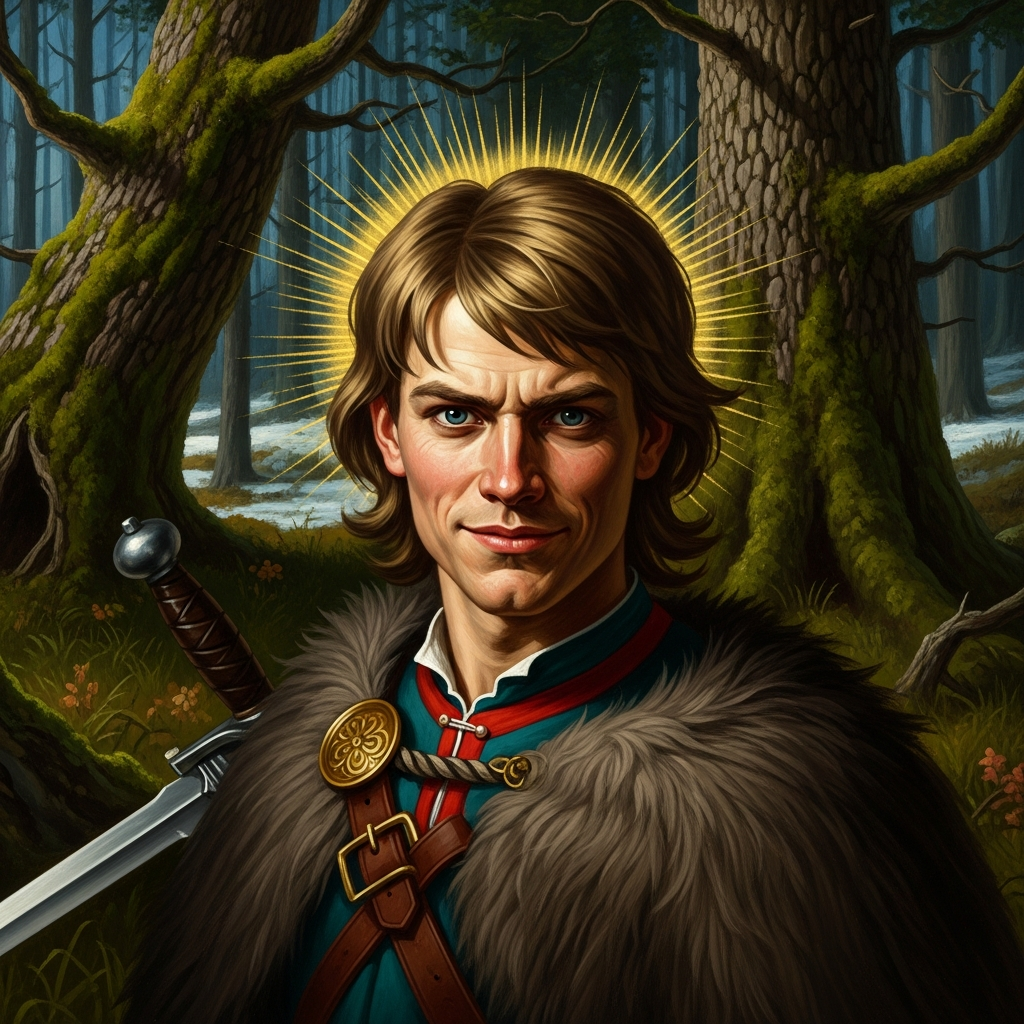
Lemminkäinen is the Kalevala’s reckless youth — a beautiful, vain, charming, and dangerous warrior-shaman who specializes in seducing other men’s wives, picking impossible fights, and surviving (mostly) through luck, his mother’s love, and an instinct for the saving incantation. He goes to Pohjola uninvited to win a bride, kills the master of the house in a singing-duel, and then must complete three impossible tasks: ski down the demon-elk of Hiisi, bridle the fire-breathing horse of Hiisi, and shoot the Swan of Tuonela on the river of the dead. The third task kills him; a poisoned arrow fired by a blind herdsman whom Lemminkäinen had once humiliated strikes him dead, and his body is hacked to pieces and thrown into Tuonela’s river.
His mother — perhaps the most quietly heroic figure in the Kalevala — searches for him until she learns his fate, then takes a great rake of copper, drags the river of Tuonela for the pieces of her son, sews the body back together with magic threads, and sings him back to life with charms that re-knit nerve, vein, and breath. Lemminkäinen returns to the world of the living, somewhat chastened but still incorrigible. He is the trickster-warrior, the fool who survives through grace, the eternally young man who refuses to learn caution.
Biblical Parallels: Lemminkäinen’s death-and-resurrection by maternal love is a strange and powerful parallel to the Christ-mother pietà tradition, though inverted — here the mother actively raises the son, where Mary in the Christian tradition mourns and the resurrection is the Father’s act. His character — the beautiful reckless youth who survives every disaster — has no direct biblical parallel; he is closer to the prodigal son of Luke 15 in the pattern of “loss, dismemberment of life, return through love.”
Cross-Tradition: Parallels Greek Adonis (beautiful young man, dies by violence, mourned and resurrected through divine love), Egyptian Osiris (dismembered, reassembled by his sister-wife Isis), and Norse Baldur (the beloved young god killed by treachery). The dismembered-and-reassembled-by-mother pattern is also found in the Egyptian Horus and in shamanic initiation traditions worldwide where the candidate is mythically torn apart and reconstituted.
2 min read