Hitchhiker's Guide to Religion
Finnish

Päivätär

Finnish Uralic and Finno-Ugric tradition, pre-Christian; documented in *Kalevala* oral tradition; the female solar deity is unusual in European traditions and likely very ancient Finland and Karelia; the female-solar tradition is shared with Norse *Sól*, Japanese *Amaterasu*, and Hittite *Arinniti* — a globally rare but ancient pattern
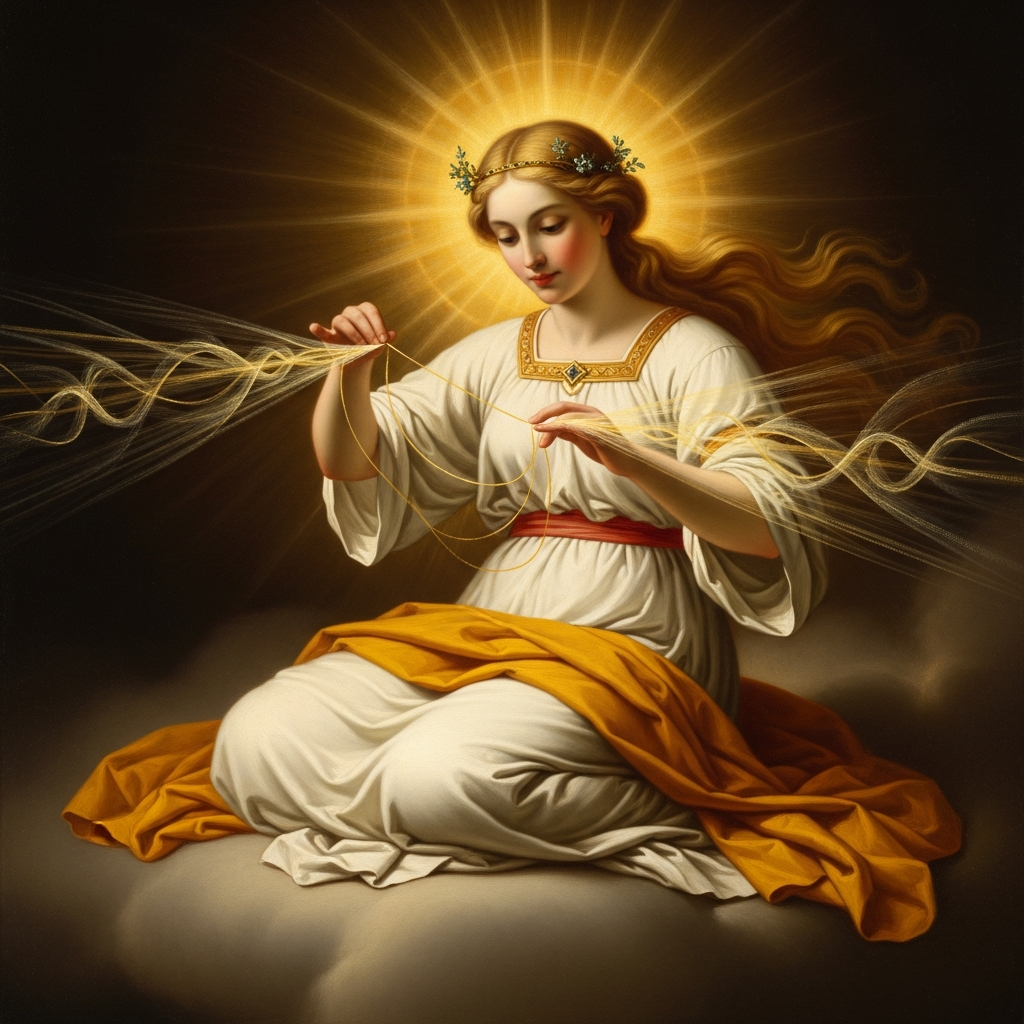
Portrait of Päivätär
Combat
ATK 5
DEF 7
SPR 9
SPD 9
INT 7
Element Light
Role Messenger
Rarity Legendary
Threat Low
LCK 8
ARC 9
Special Golden Thread — Päivätär weaves a thread of sunlight that, given as a gift, accelerates ripening, healing, and the warming of any cold thing; the gift cannot be re-gifted but works once for the recipient
Passive Solar Companion — While the sun shines, Päivätär's warmth protects the recipient from cold-magic, despair, and the influence of Pohjola; her presence is the daylight itself
Epithets "Sun Maiden" (Finnish: *Päivätär*, from *päivä*, "day/sun"); "Weaver of Gold"; "The Daylight Spinner"
Sacred Animals Lark (*leivonen*, the bird that rises highest into her domain); swallow (*pääskynen*, the first bird to herald her return after winter); eagle soaring in full sunlight
Sacred Objects Golden thread (*kultainen lanka* — the thread of sunlight she weaves, prototype of all golden embroidery and cloth-of-gold); the sun itself; her loom on the solar disc
Sacred Colors Gold and yellow (sunlight, grain-ripening, her thread); warm amber (late summer afternoon light)
Sacred Number 365 (the days of her solar year); also 6 (the months of long Finnish summer when she barely sets)
Consort(s) Kuutar (sister, the moon-maiden — their pairing governs day and night; the unusual fact of both being female is noted by scholars as a pre-Indo-European Uralic pattern)
Sacred Sites The sun (her celestial home); the Finnish open fields (*pelto*) where grain ripens in her long summer days; hilltops at midsummer when the sun barely sets
Festivals *Juhannus* / Midsummer (the great Finnish summer solstice celebration — bonfires, flower-crowns, and celebration of the sun at its peak; Päivätär is at her fullest power); dawn rites (*aamun loitsu*) invoking her warmth on cold mornings
Iconography Radiant young woman on the sun weaving golden thread; her work falling as sunbeams on fields and forests below; paired with her sister Kuutar on the moon
Period Uralic and Finno-Ugric tradition, pre-Christian; documented in *Kalevala* oral tradition; the female solar deity is unusual in European traditions and likely very ancient
Region Finland and Karelia; the female-solar tradition is shared with Norse *Sól*, Japanese *Amaterasu*, and Hittite *Arinniti* — a globally rare but ancient pattern

Päivätär is the maiden of the sun — sister-pair to Kuutar, weaving golden thread on the daytime sky as Kuutar weaves silver on the night. She is invoked for warmth, for the success of the daily work, for the ripening of grain. Like Kuutar, she is captured by Louhi in the great theft of the celestial lights, and her release is one of the climactic acts of the Kalevala.

The female solar deity is unusual in Indo-European traditions (where the sun is usually male: Helios, Sol, Surya), but is found in several Uralic and Baltic-Finnic mythologies. The Finnish Päivätär may preserve a very old religious pattern that predates Indo-European contact.

Biblical Parallels: Päivätär has no direct biblical parallel; like Kuutar, she belongs to a tradition that personifies the celestial lights that Hebrew religion deliberately depersonalizes.

Cross-Tradition: Parallels the rare female-solar tradition: Norse Sól (also female), Japanese Amaterasu (the supreme solar goddess and ancestress of the imperial line), Sami Beaivi, and Hittite Arinniti (the Sun Goddess of Arinna). The female-solar pattern may preserve a pre-Indo-European Eurasian tradition.


1 min read

Combat Radar

ATK DEF SPR SPD INT
← Back to Finnish