Hitchhiker's Guide to Religion
Finnish

Hiisi

Finnish Uralic shamanic tradition, pre-Christian; the original meaning "sacred grove" shifted to "demon" after Christianization; place-names preserve the original meaning across Finland All of Finland; Hiisi place-names are spread across the country, indicating ancient sacred-grove sites; strongest in the rocky lake-district of central and southern Finland
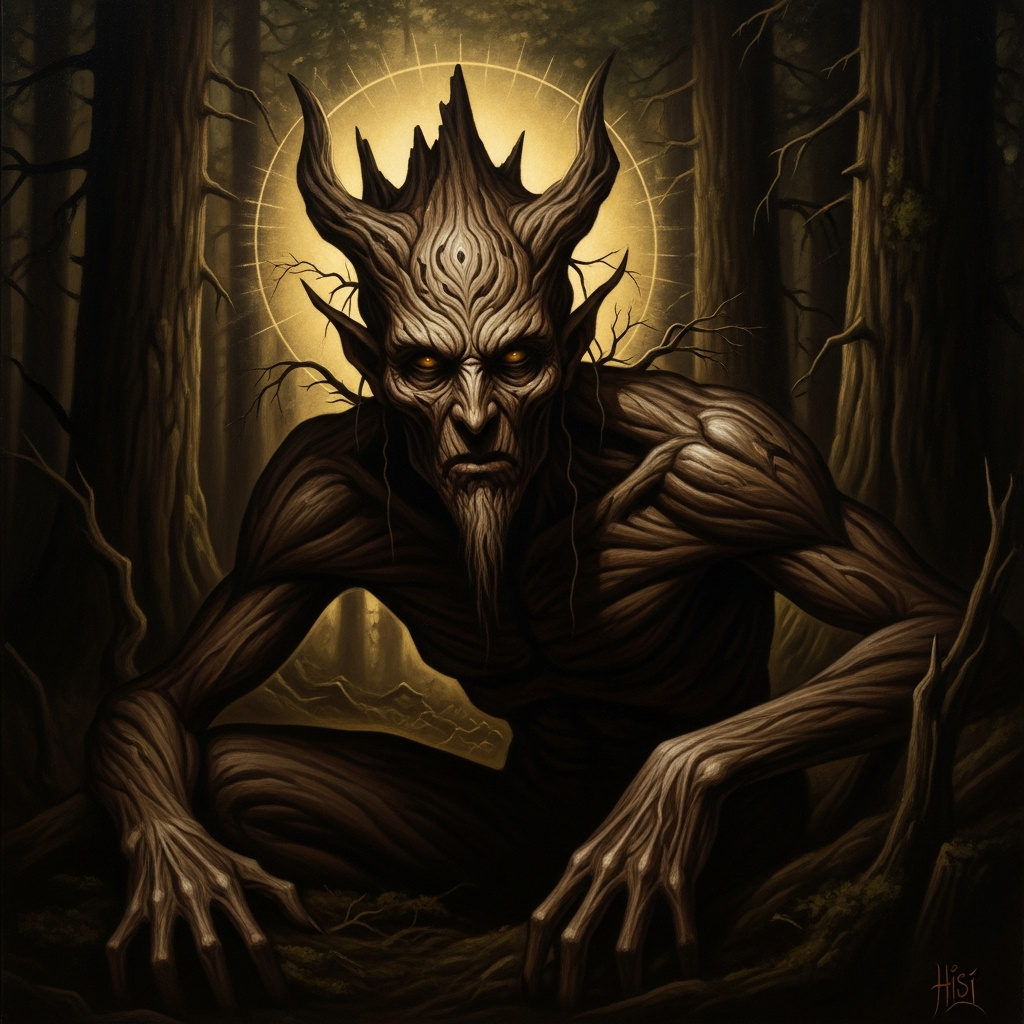
Portrait of Hiisi
Combat
ATK 8
DEF 7
SPR 5
SPD 8
INT 6
Element Shadow
Role Trickster
Rarity Uncommon
Threat High
LCK 3
ARC 8
Special Grove's Curse — The Hiisi sends an apparition (a demon-elk, a fire-horse, a malevolent bird) to hunt anyone who has trespassed against its sacred place; the apparition pursues until the trespasser dies or completes a propitiation
Passive Place-Bound Wrath — The Hiisi cannot leave its sacred grove or rocky outcrop, but within that bounded territory it is nearly invincible and aware of all intrusions instantly
Epithets "The Forest Demon" (Finnish: *Hiisi*, originally "sacred grove," later "evil spirit/demon"); "Demon of the Rocky Places"; *Lempo* (another name for dangerous forest spirits, often paired with Hiisi)
Sacred Animals The demon-elk (*Hiiden hirvi* — the impossible quarry sent after Lemminkäinen); fire-breathing horse of Hiisi; the pike that carries cursed magic in Hiisi waters
Sacred Objects The rocky outcrops and boulders that are their dwelling (*hiidenkivi*, "Hiisi's stones" — prehistoric dolmens and glacial erratics across Finland); cursed weapons forged at Hiisi's forge
Sacred Colors Dark grey and rust (stone and bog-iron); black (the shadow of dangerous places)
Sacred Number Variable — each place has its Hiisi, and each Hiisi's number is the number of rocks in its outcrop
Consort(s) None — the Hiisi are place-spirits, not relationship-entities
Sacred Sites Hiisi-named places across Finland: *Hiidenvesi* (Hiisi's water, a lake in Loppi); *Hiidenportti* (Hiisi's gate, a gorge in Sotkamo); *Hiidenmäki* (Hiisi's hill) — dozens of Finnish place-names preserve ancient sacred-cursed grove sites
Festivals No festival — Hiisi is propitiated by avoidance and apology, not celebration; travelers leaving an offering at a rock-pile invoke the spirit's neutrality
Iconography Invisible but present; when given form: a crouching grey shape in the shadows of a rocky outcrop; or a large stone that is inexplicably warm and seems to watch
Period Uralic shamanic tradition, pre-Christian; the original meaning "sacred grove" shifted to "demon" after Christianization; place-names preserve the original meaning across Finland
Region All of Finland; Hiisi place-names are spread across the country, indicating ancient sacred-grove sites; strongest in the rocky lake-district of central and southern Finland

Hiisi is a complex figure — originally a sacred grove or cult-place, then the spirit of that place, and finally, after Christianization, the term came to mean “demon” or “evil spirit” generally. In the Kalevala tradition, the Hiisi are dangerous forest-spirits who inhabit rocky outcrops, inhospitable bogs, and lonely places. They send the demon-elk that Lemminkäinen must hunt; their fire-breathing horse is set as one of his impossible bride-tasks; their forge produces cursed weapons.

Hiisi as singular evil-spirit eventually overlaps with the Christianized concept of “the devil” (hiisi) in Finnish folk-Christianity, but in the older shamanic stratum they are a class of place-spirits — neither uniformly hostile nor friendly, but powerful, easily offended, and best left undisturbed. Their original sacred-grove meaning is preserved in many Finnish place-names ending in -hiisi.

Biblical Parallels: Hiisi parallels the azazel-figure of Leviticus 16 — the wilderness-demon to whom the scapegoat is sent, dwelling in inhospitable places, dangerous but bounded. The “demoniac in the tombs” of Mark 5 shares the Hiisi pattern: an unclean spirit attached to a specific lonely place. Christianized Finnish folk-magic mapped Hiisi directly onto the Christian Devil with mixed results.

Cross-Tradition: Parallels Norse landvættir (land-spirits attached to specific locations), Greek nymphs of dangerous places, Slavic leshy in his hostile mode, and the Polynesian kapu concept of place-attached supernatural danger. The “spirit attached to a sacred-or-cursed place who must be propitiated” is a deep human pattern.


1 min read

Combat Radar

ATK DEF SPR SPD INT
← Back to Finnish