Contents
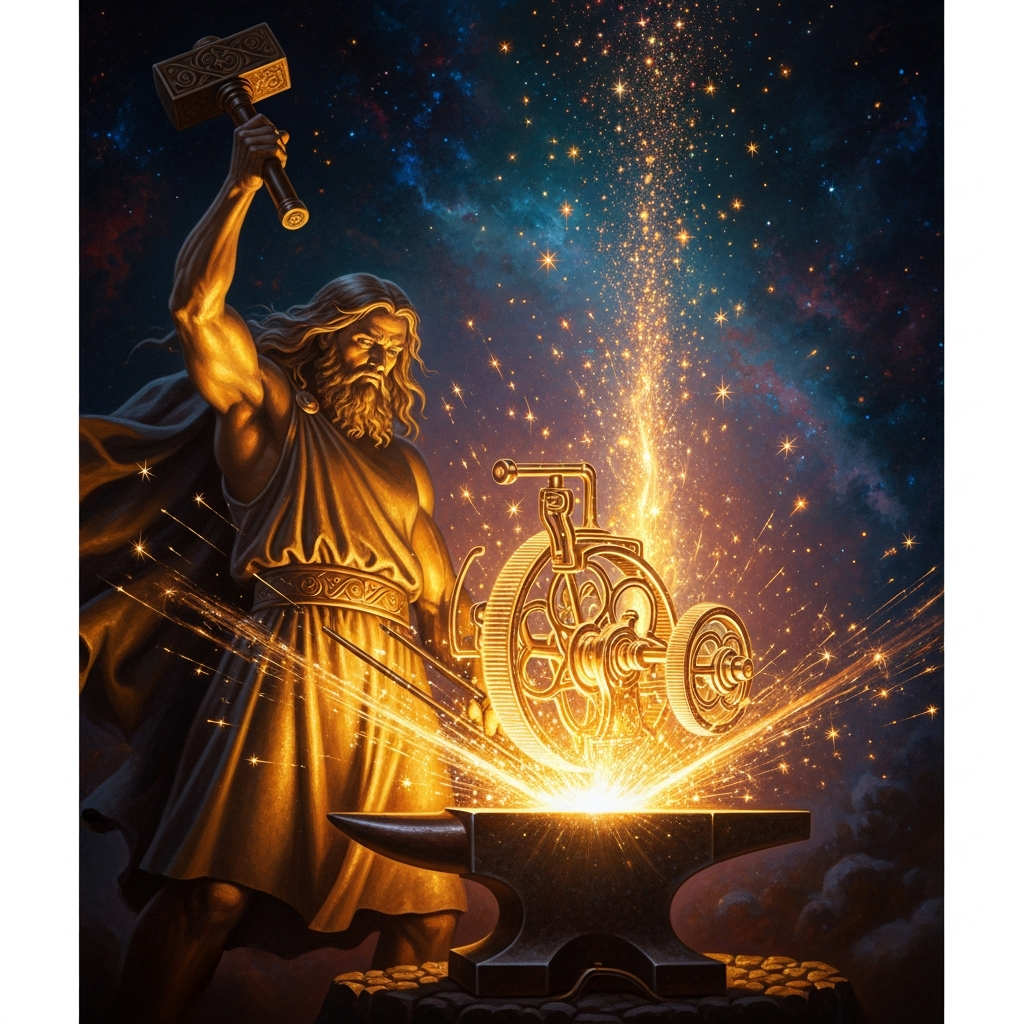
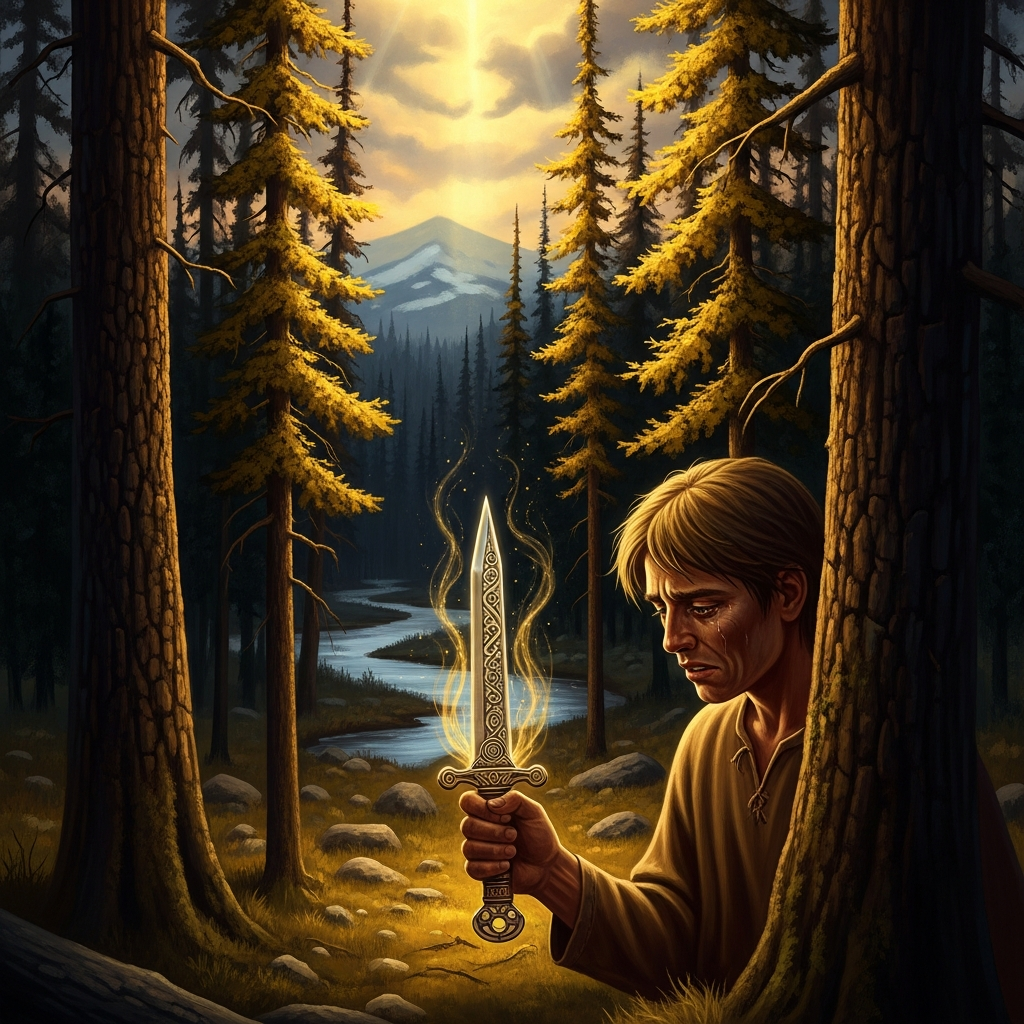
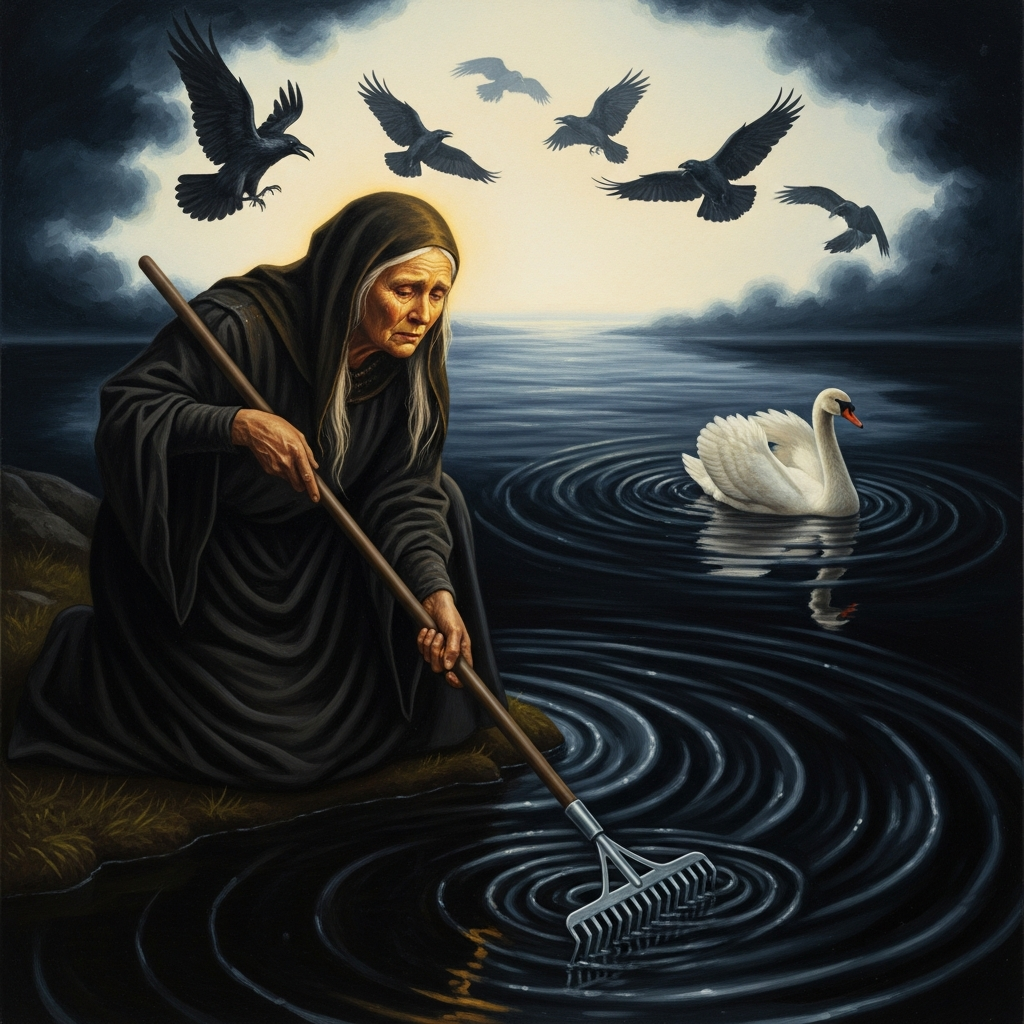
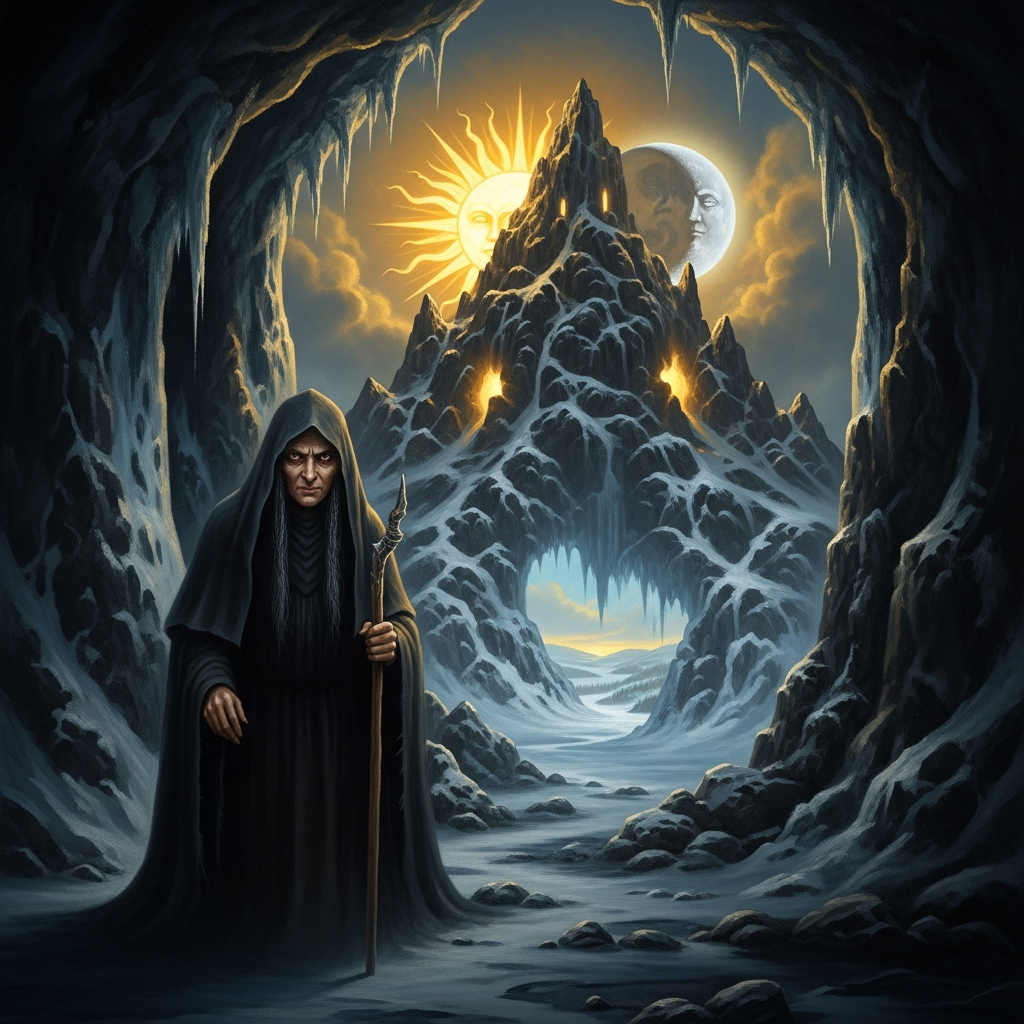
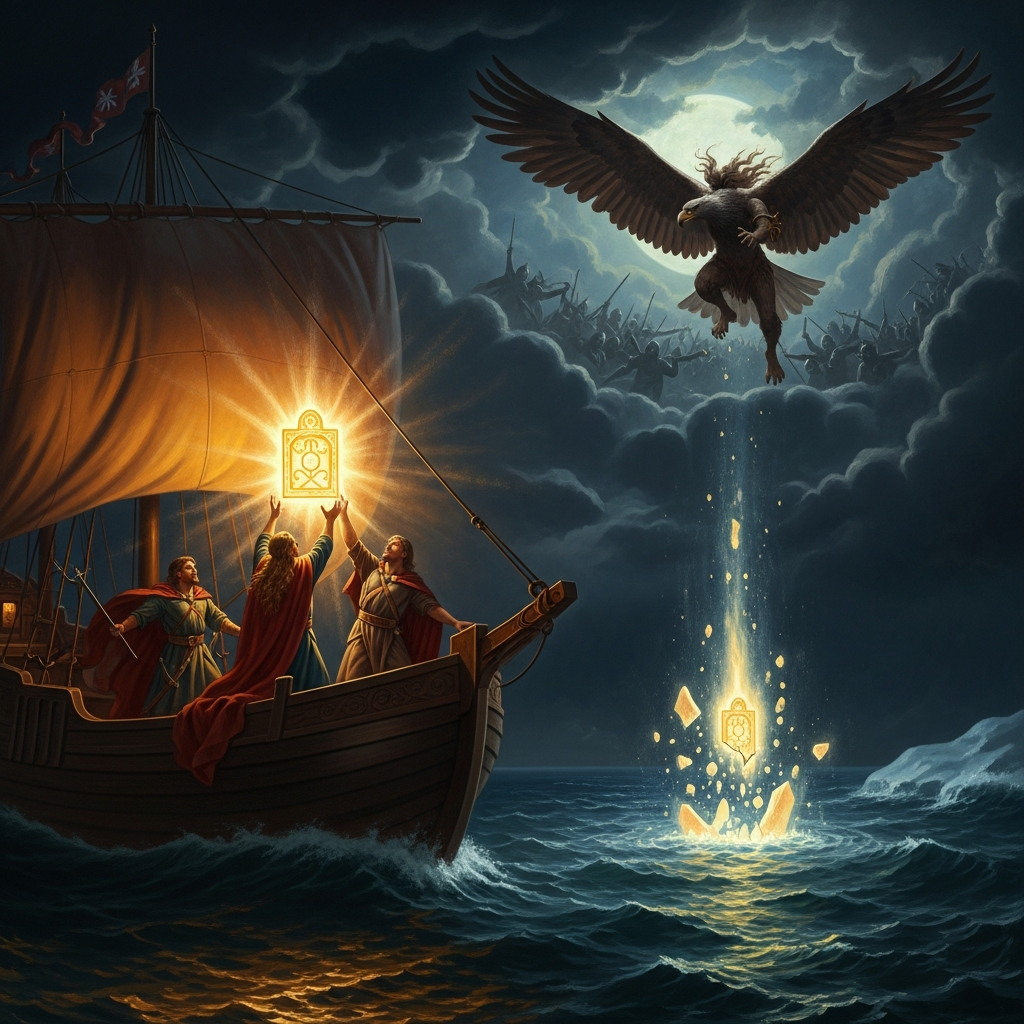
Väinämöinen, Ilmarinen, and the reckless Lemminkäinen sail north to steal back the Sampo. They put the guards of Pohjola to sleep with a song, lift the great mill from its nine-fathom roots, and flee south by sea — but Louhi pursues them as a giant eagle with a hundred warriors clinging to her wings, and in the battle on the waves the Sampo shatters and sinks, its fragments still salting the seabed and turning the dark sea fertile.
- When
- Mythic time, the great age of Kalevala heroes
- Where
- The voyage from Kalevala to Pohjola, the iron-bound vault under the dark farm, the open sea where the eagle attacks the boat
The boat is built in three days.
Väinämöinen has decided. The Sampo has been in Pohjola too long. The dark farm has grown rich on its grinding — the storehouses are full, the cattle are fat, the daughters of Louhi go in golden cloaks — while the country of Kalevala, where the Sampo was forged, has been growing poorer. The thing that was made there should be there.
He goes to Ilmarinen. He goes to Lemminkäinen. They agree, both of them, with little argument; Ilmarinen because he made the Sampo and feels its absence the way a smith feels a hammer that another man is using, and Lemminkäinen because he is Lemminkäinen — because the words steal and sail and fight are enough on their own.
They build the boat from a single oak. They build it carvel-style, low in the water, with a single mast and a square sail and benches for thirty oars, though only the three of them will row.
They sail north.
The voyage takes nine days.
The runo is brisk about it. The wind cooperates. The sea cooperates. The kantele — the second kantele, the birchwood one, since the pike-bone instrument has not yet been lost overboard — is on Väinämöinen’s lap as they row, and he plays softly to keep the rhythm, and the strokes of the oars fall into the time of the strings.
They come to Pohjola at evening.
The dark farm is still there. The iron-bound house, the smoke-blackened roof, the cattle in the yard, the outbuildings full of the gold the Sampo has been grinding for years. They beach the boat in a hidden cove. They climb up to the farm in the fading light. They lie in the heather watching the windows.
Louhi is at home.
She is sitting at her loom. The Maid of Pohjola — Ilmarinen’s wife, briefly, before she died — is no longer there; she has been dead for runos. Louhi is older, harder, with her gap-tooth showing when she frowns at the warp. The hall is full: warriors at benches, a sleeping bear chained by the door, two young men at the table eating, the cook at the hearth.
Väinämöinen takes the kantele out.
He plays the sleep-song.
It is a song the runos describe as having been composed by Väinämöinen on the boat that morning specifically for this purpose. It is slow. The notes are widely spaced. The pattern repeats and varies and repeats and varies, and the song is not unpleasant, it is not a curse — it is a lullaby, the kind a Finnish mother sings to a child at the end of a long day, but pitched at the frequency that the adult body has forgotten how to resist.
The cook falls asleep at the hearth.
The warriors slump on the benches. Their swords slide to the floor. The two young men at the table put their heads down on their forearms. The sleeping bear, who was already asleep, dreams more deeply. Louhi at her loom — Louhi, the witch, who knows what the song is doing — fights it for a moment, fights it harder than anyone else, and her eyes close and her head sinks onto the warp and she begins to snore.
The hall is asleep.
Väinämöinen keeps playing. He plays as he walks past the hall windows. He plays as the three of them slip down the path behind the house. He plays as they come to the great iron-bound vault where the Sampo is kept, the vault sunk into the rock under the back of the farm, with its nine locks and its nine bolts and its iron door three fingers thick.
The locks open at the song.
The bolts slide back. The door swings.
The three of them step inside.
The Sampo is in the dark.
It is humming. It has been grinding for the years it has been here, and the floor of the vault is two feet deep in flour, salt, and gold-dust — the slaves of Pohjola come down once a week to shovel it out — and the Sampo itself rises out of the heaped wealth like a tree, like a pillar, like the thing whose form the runos cannot quite agree on. Its nine roots have grown down into the bedrock of Pohjola. The roots have woven themselves through the stone. The Sampo is no longer something that can be lifted; it is part of the geology.
Lemminkäinen pulls.
He puts his arms around the lower trunk of the Sampo and he pulls. Nothing happens. He braces his feet. He pulls harder. He swears. He calls on his mother. He pulls until the veins stand out in his neck, and the Sampo does not move at all — not by the width of a hair.
Ilmarinen takes the bull.
This is the detail the runo wants. They have brought a bull from the boat — a young bull, a strong one — and Ilmarinen yokes the bull to the trunk of the Sampo with iron chains, and Lemminkäinen pricks the bull with his goad, and the bull pulls. The bull pulls until the chains are tight. The bull pulls until the chains begin to creak. The bull pulls until the muscles of his shoulders are trembling, and at last — slowly, with a sound like a tree coming up by the roots in a great wind — the Sampo begins to move.
It comes up out of the rock. The nine roots tear free one by one. Each root, as it breaks, makes a sound like a deep bell, and the sound travels through the rock of Pohjola, and the rock remembers it.
They drag the Sampo out of the vault. They lift it — three men and a bull together, just barely — onto a sled. They drag the sled down the path to the cove where the boat is waiting. They load it into the boat. The boat sinks lower in the water than it should; the Sampo is heavier than it looks.
They push off.
They sail south.
The first day, they sail well. The wind is with them. The Sampo is in the bottom of the boat, covered with sailcloth, and Lemminkäinen — who cannot help himself — keeps lifting a corner of the cloth to look at it. Ilmarinen tells him to stop. Lemminkäinen does not stop.
The second day, Lemminkäinen begins to sing.
This is what ruins them. He has been quiet for two days, which is a long time for Lemminkäinen, and on the second morning he stands up in the boat and begins to sing a victory song. The song is loud. The song is boastful. The song carries — across the water, north, against the wind, all the way back to Pohjola — and on the wind a crane that is sitting on a rock at the edge of the world hears it.
The crane shrieks.
The shriek is the alarm. The crane has been Pohjola’s sentinel for centuries; her shriek wakes the dark farm. The hall comes awake in an instant — the cook, the warriors, the two young men, the bear, and finally Louhi at her loom — and Louhi, the moment her eyes open, knows what has happened.
She runs to the vault.
The vault is empty. The Sampo is gone. There is only the hole in the rock where the nine roots tore out, and a long drag-mark down the path, and at the cove the marks of a boat pushing off.
She runs back to the hall. She calls her warriors. She calls every man on the farm. She calls — and this is the runo’s terrible image — the iku-turso, the great sea-monster, from his lair under the cliff. She does not have time for ordinary pursuit. She has to catch the boat before it crosses out of her waters.
She begins to change.
Louhi becomes the eagle.
The transformation is described in the runo with relish. Her arms become wings. Her fingers become flight-feathers. Her skin grows yellow with the iron pigment of an eagle’s flesh. Her face elongates into a beak — a beak the size of a longboat, with a hooked tip the color of weathered iron — and her body grows until she is larger than the largest tree in Pohjola, larger than the dark farm itself, an eagle the size of a small mountain.
Her warriors climb onto her back.
A hundred of them. They cling to her feathers, they sit on her shoulders, they grip her tail. They are armed. Some have spears; some have axes; some have nothing but their fists, but they are coming.
She launches.
She rises off the cliff with a sound like a great sail catching wind. She circles once over Pohjola — once, for the geometry of it — and then she beats southward, fast, faster than any ordinary eagle, the warriors clinging to her wings, the air shrieking past her beak.
She catches the boat at noon.
The shadow falls across the deck first.
It is a shadow the size of an island. Lemminkäinen, who is rowing, looks up. He looks up because the light has changed. He looks up because the gulls — who have been following the boat all morning — are suddenly gone. He looks up and he sees the eagle filling half the sky.
He sits down.
He has been the bravest of the three for the whole voyage. The eagle ends his bravery. He sits down on the bench and puts his oar in the water and he does not move.
Väinämöinen takes out a flint.
He throws it overboard. Become a reef, he sings, and the flint, hitting the water, becomes a long reef of sharp stones — a reef just the right depth to wreck a boat. He hopes the eagle will fly into it. The eagle does not. The eagle banks and rises higher.
She comes down on the boat.
Her talons hit the deck. The mast shatters. The sailcloth that was covering the Sampo is torn away. The Sampo is uncovered, exposed, gleaming in the sunlight on the floor of the boat. Louhi sees it. Louhi reaches for it with her great talons.
Väinämöinen draws his sword.
The fight on the deck takes a single page of the runo.
The sword strikes Louhi’s wing. Three of her flight-feathers come away. They drift down into the sea. (One of those feathers, the runo says, becomes the first crow. Another becomes the first cormorant. Finnish bird-origins are full of these throwaway lines.) Lemminkäinen finds his courage and stabs at her chest. Ilmarinen swings his hammer and breaks one of her talons.
But Louhi is enormous. She does not feel the wounds the way an ordinary creature feels them. She closes her remaining talon around the Sampo. She lifts.
The Sampo comes off the deck.
It is too heavy for her. Even at her enormous size, even with one talon — she has to use one because the other is broken — the weight of the Sampo is more than she can carry. She lifts it three feet. She lifts it five feet. She lifts it ten feet above the deck, and the Sampo’s weight is dragging her down toward the water, and her warriors are screaming, and her wings are beating uselessly, and at the height of her struggle the Sampo slips.
The talon opens.
The Sampo falls.
It hits the deck of the boat. The deck splits. The Sampo continues through the deck, into the hull, through the hull, into the sea. As it falls it hits the gunwale on the way and it breaks — it breaks into pieces, the many-colored lid in one direction, the milling stones in another, the trunk in three pieces, the nine roots scattering — and the pieces, falling separately, hit the water in a long line of splashes and sink.
This is the famous moment.
The runo lingers on it. The pieces sink, and as they sink they fertilize the sea. The big pieces of the Sampo go down to the deepest seabed, where they remain — Finnish folklore is sure of this — to this day, sometimes glimpsed by fishermen as a dim glow in the water on still nights. The smaller pieces drift on currents. The dust of the Sampo, the salt and the flour and the gold-dust that had been clinging to it, dissolves in the water and salts the whole Baltic Sea, makes the Baltic fertile for fish, makes the fish fertile for Finns, and from that day forward — the runo says — the sea has fed Finland the way the Sampo fed Pohjola.
The Sampo is broken.
But the Sampo is also, in a different way, multiplied.
Louhi screams.
She screams the scream of a creature who has lost everything she came for. She rises into the air. She circles the boat once. She drops a small handful of dust from her broken talon — the last of what the Sampo had been making — and the dust falls into the boat and onto the surviving deck-planks, and that small dust is what becomes the only Sampo-fragment that ever lands in Kalevala. Väinämöinen sweeps it up. He carries it home in his cap.
The eagle flies north. The warriors on her back are dead, mostly; the rest cling silently. She lands on the cliff at Pohjola. She becomes a woman again. She walks back into the hall. She sits down at her loom. She weaves nothing for a long time.
Väinämöinen sails home.
The boat is half-wrecked. The mast is broken. The deck is split. They row most of the way. They reach Kalevala at dusk on the ninth day, and Väinämöinen carries the cap full of Sampo-dust up to the highest hill in the country, and he scatters it.
The dust falls into the soil.
The soil — wherever the dust touches — becomes fertile in a way it was not before. The barley grows thicker. The cows give more milk. The bees produce more honey. It is not the Sampo. It is not abundance without limit. But it is enough — and enough, the runo argues, is what most countries actually have, and what most countries call wealth.
The Finns who sang this song understood what the myth was telling them.
You can steal back what was stolen. You can sail north and take it from the witch’s vault. You can outwit the guards and put the dark farm to sleep and load your prize into the boat. But the prize will not survive the journey. Something will go wrong on the second day. Someone will sing too loud. The eagle will come. The fight will happen. The thing you came for will fall into the water in the middle of the fight, and what you bring home will be a cap of dust, not a mill.
And the cap of dust, scattered, will be enough.
This is the Finnish theory of history. The Sampo lies broken on the seabed of the Baltic. The Baltic feeds Finland. The world is, at all times, working with the fragments.
Echoes Across Traditions
Entities


Sources
- Kalevala, runos 39–43 (compiled by Elias Lönnrot, 1849)
- Keith Bosley translation, *The Kalevala* (Oxford World's Classics, 1989)
- Eino Friberg translation, *The Kalevala: Epic of the Finnish People* (1988)
- Matti Kuusi, *Finnish Folk Poetry: Epic* (1977)
- Lauri Honko, *Religion, Myth, and Folklore in the World's Epics: The Kalevala and Its Predecessors* (1990)