The Teal's Egg and the Making of the World
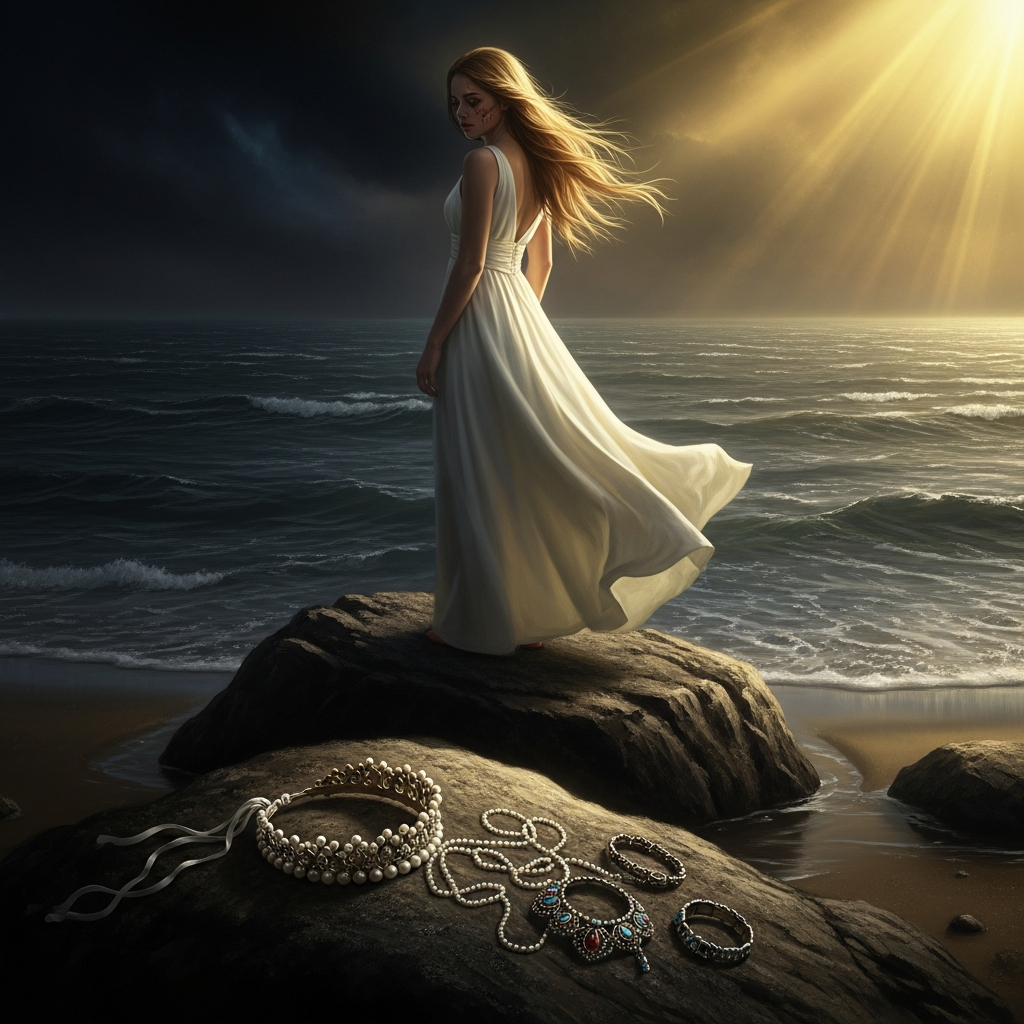
Before time, the cosmic sea where Ilmatar floated for seven hundred years · The cosmic ocean before the world existed, the upturned knee of the Air-Maiden, the place where the egg fell and broke
Contents
Before there was sky, before there was earth, the maiden Ilmatar floated alone in the cosmic sea while Väinämöinen lay unborn in her womb. A teal — searching for a place to nest — laid seven eggs on her upturned knee. The eggs grew hot, the maiden flinched, and the eggs fell and broke; from their fragments came the sky-dome, the earth, the sun, the moon, and the stars.
- When
- Before time, the cosmic sea where Ilmatar floated for seven hundred years
- Where
- The cosmic ocean before the world existed, the upturned knee of the Air-Maiden, the place where the egg fell and broke
Before anything, there is water.
The runo opens with this. It opens with an emptiness — not even darkness, because darkness is something, and the runo wants to begin earlier than something. There is water. There is sky above the water. There is no land. There is no light. There is no time, because there is nothing for time to happen to. The water goes on forever in every direction. The sky above it is the same color as the water. The horizon, if there is one, is not visible.
There is a maiden in the water.
Her name is Ilmatar — the Air-Maiden, the daughter of the air. She has no parents that the runo names. She is one of those figures the runo simply gives us, fully grown, without explanation; she is a young woman, alone, floating face-up on the surface of the cosmic sea. She has been there for a long time. She is not unhappy. She is simply waiting, the way a person waits for something she cannot quite remember.
She is also pregnant.
This is the part the runo introduces with the kind of casualness that masks its strangeness. She is pregnant — by the wind, by the water, by some combination of the two — and the child she is carrying is Väinämöinen. He has been in her womb for seven hundred years. He is not in a hurry to be born. He is waiting, the way she is waiting, for whatever the next thing will be.
The next thing is the bird.
The teal is a small duck. The runo calls her sotka — the female teal, brown-feathered, with a little iridescent green patch on the wing — and she is flying across the cosmic sea looking for a place to nest.
She has been flying for a long time.
There is no land. There is no tree. There is no rock to lay an egg on. The teal is becoming desperate; the eggs in her body are ripe, they will not wait, she has to lay them somewhere or they will be lost. She flies in long circles over the water. She flies low, looking for anything — a floating log, a tuft of weed, a single dry place — and she finds nothing.
Then she sees the maiden’s knee.
Ilmatar has been floating on her back, and her knee — bent up out of the water — is the only thing rising above the surface in the entire cosmos. It is a smooth, brown-skinned knee, warm in the cold sea, the highest point in creation. The teal is exhausted. She circles down. She lands on the knee. The knee is just barely large enough to be a nest.
The teal builds.
She builds a small nest of nothing — there is no grass, no twigs, nothing to build with — out of her own breast-feathers. She plucks them out one by one and arranges them in a circle on the maiden’s knee, and when the nest is shaped she settles into it, and she lays.
She lays seven eggs. Six of them are gold. The seventh is iron.
She begins to brood.
This is the part the runo lingers on, because it is the part that determines what comes next. The teal sits on the seven eggs on the maiden’s knee, and she sits, and she sits, and she warms them with her body, and the eggs grow warm. They grow warmer. They grow hot.
The maiden’s knee begins to feel the heat.
It is a small heat at first — the warmth of any brooding bird’s body — but the eggs are not ordinary eggs, and the heat increases past ordinary. The maiden — Ilmatar, who has been holding still for seven hundred years, who has been still as the water itself — feels her knee begin to burn.
She tries to hold still. She knows the bird is laying. She knows the bird needs the knee. She has waited seven hundred years; she can wait a few more days for a bird.
The heat increases.
The skin of her knee reddens. The skin of her knee blisters. The heat goes into the bone. The bone of her knee begins to ache. She bites her lip. She holds still. The heat goes deeper. The eggs are now the color of metal in a forge — the gold ones glowing yellow, the iron one glowing red — and the heat is unbearable.
She flinches.
It is a small flinch. It is the involuntary flinch of a person who can no longer hold still. Her knee twitches. The nest tips. The seven eggs roll off.
They fall.
They fall through the long air between the maiden’s knee and the surface of the cosmic sea, and they break — but they do not break the way ordinary eggs break. They break the way the universe breaks: into precise, deliberate pieces, each piece becoming what it was always going to become.
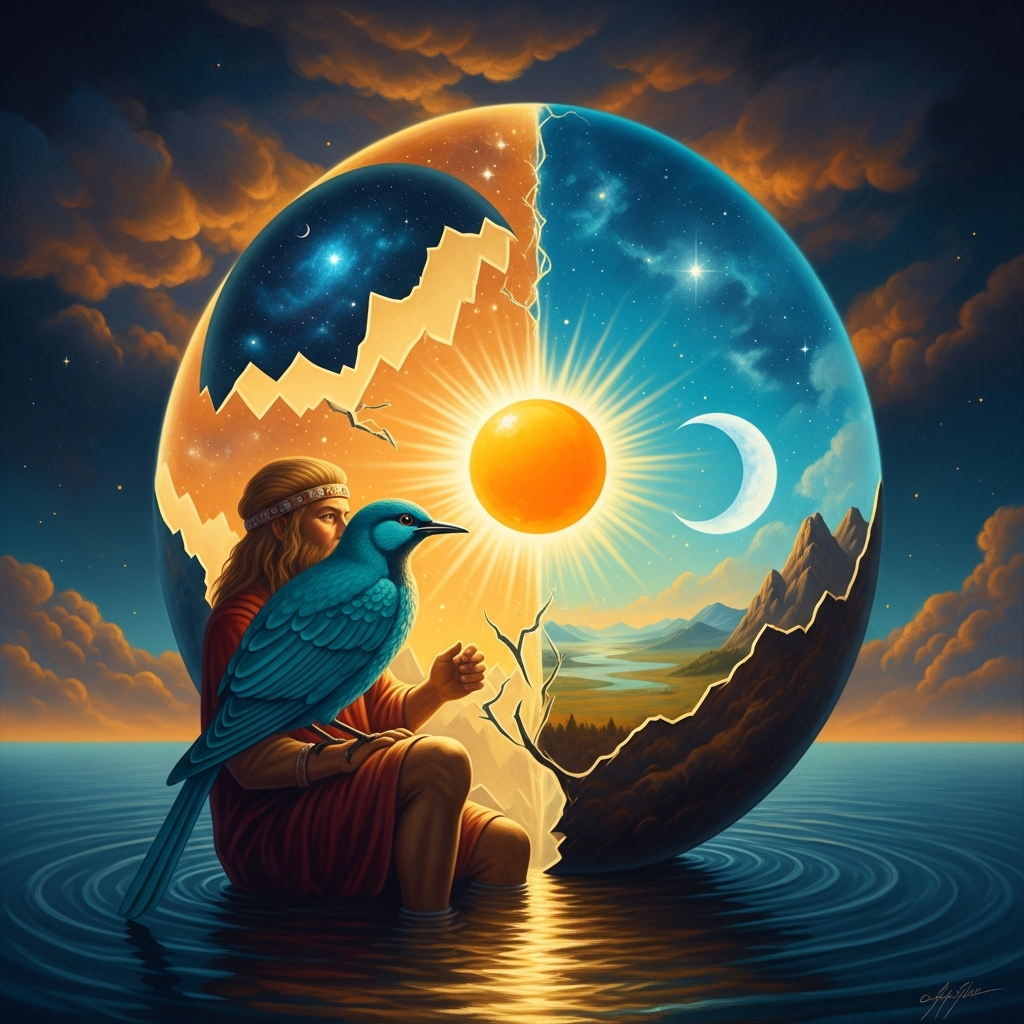
The lower half of the shell of the first egg becomes the earth.
It hits the water and instead of sinking it spreads, the way a pancake spreads in a hot pan, and it keeps spreading until it is the floor of the cosmic sea — until the sea has a bottom for the first time. The earth has been made.
The upper half of that same shell becomes the sky.
It rises. It rises into the air above the maiden, and it spreads outward, and it becomes the dome of the heavens. It is the color of pale stone. It is curved. It encloses everything below it. The runo says the seam where the two halves of the shell were once joined is still visible at the edge of the world, where the sky meets the sea, and the seam is what we call the horizon.
The yolk of the egg becomes the sun.
It rises into the sky and stays there, golden, hot, the source of light for all subsequent days. The runo does not explain how a yolk becomes a sun; the runo treats this as obvious. Yolk is the right material for sun. They have always been the same substance, only at different scales.
The white of the egg becomes the moon.
It also rises into the sky, but it goes higher and farther — and it is paler, and cooler, and it does not give the same kind of light. The moon will turn out to be the night-light of the world. The runo notes, in passing, that this is why the moon is sometimes thinner and sometimes fuller: the egg-white was uneven, and the moon retains the inconsistency.
The mottled fragments of the shell become the stars.
The fragments scatter. Some of them are large; some of them are small; some of them are bright, and some of them are barely visible. They scatter across the new sky-dome and embed themselves there. They become the constellations. The runo does not name them all, but it implies that every star in every Finnish star-myth came from a particular fragment of a particular eggshell that fell from the maiden’s knee.
The seven eggs become the cosmos.
The teal — who has been hovering above the wreckage, distressed, watching her unborn children become the universe — flies up and away. She does not get to brood her chicks. Her chicks have become the world. She is, in a sense, the mother of everything; in another sense, she has had no children at all. The runo does not pretend to resolve this.
She flies into the new sky and disappears among the new stars.
Ilmatar — whose flinch caused all of this — is still floating in the sea.
She has been changed by the falling of the eggs. She is now the mother of the cosmos. She did not intend this. She had been planning to be the mother of Väinämöinen, who is still in her womb, and now she is also the mother of the world by accident.
She rolls onto her stomach.
The runo describes her doing this carefully, slowly, the way a pregnant woman rolls over near term. She does not want to spill anything else. She is being more careful now that she knows her body’s movements have consequences. She begins to swim — to move through the water with her arms — and as she swims her body shapes the new earth.
This is the part the runo enjoys.
Wherever she sweeps her hand against the seabed, a bay forms. Wherever she presses her foot, a deep trench appears. Wherever her hip brushes the bottom, a coastline curves. Wherever her belly drags through the silt, a shallow shelf is left behind. The geography of Finland — the ten thousand lakes, the long fingers of the Baltic, the granite islands, the rocky coast — is the impression of Ilmatar’s body in the cosmic seabed, made during the slow afternoon when she was teaching herself how to move without breaking anything else.
She makes the islands. She makes the coves. She makes the long peninsulas. She makes the deep-water lakes. She makes the shallows where reeds will grow. She makes the rocks that fishermen will run their boats onto for the next ten thousand years.
She is, the runo says, the slowest and most thorough geologist who ever lived.
Väinämöinen is still inside her.
He has been there for seven hundred years. He has been listening, in the way unborn beings listen — through the wall of the womb, through the muffling of the amniotic fluid — and he has heard the teal lay her eggs, and the heat rising, and the flinch, and the fall. He has heard the cosmos being made.
He decides it is time to be born.
He pushes against the wall of the womb. The wall holds; Ilmatar is not yet a mother who knows how to give birth, because no one has ever been born before. He pushes again. He uses his fingers to find the way out. He pushes against the bone. He pushes against the muscle. He works for a long time — three years, the runo says, though the runo’s numbers are mythic — and finally he finds an opening.
He is born into the sea.
He emerges already old. He has been waiting seven hundred years; he has the beard of an old man and the body of an old man and the wisdom of a singer who has had nothing to do for centuries but compose his first song in his head. He swims for a while. He swims for years, the runo says — eight years, on the surface of the sea — and at last he washes up on a sandy beach, on one of the new islands his mother has just shaped, and he steps onto land.
He sits down.
He sits down on the sand and he begins to sing.
This is the song that the rest of the Kalevala is.
Every other runo — the song-duel with Joukahainen, the death of Aino, the journey to Pohjola, the forging of the Sampo, the dismemberment of Lemminkäinen, the theft, the sea-battle, the cursed life of Kullervo, the final voyage in the copper boat — every one of them is a verse in the great song that Väinämöinen begins to sing on the beach the day he is born.
The runo says he sings for nine days without stopping.
The trees grow up around him as he sings. The grass comes up. The flowers open. The first birds — the children of the teal who flew away, who returned to nest in the new world — begin to call to each other. The first fish swim. The first reindeer step onto the new land. The world is being filled in, runo by runo, song by song, and Väinämöinen is the singer doing the filling.
He sings the world the way the Finns will later sing the runos in the smoky cottages of Karelia: slowly, in the trochaic tetrameter that the language wants, with the second singer leaning forward to take the line as the first singer ends it, the song passing back and forth like a ball, never dropping, never ending, going on through all the nights of all the winters to come.
The Finns who sang this runo understood what the myth was telling them.
The world was not designed. The world was an accident — a beautiful one, a complete one, but an accident, made because a pregnant woman flinched when a bird’s eggs got too hot on her knee. There was no plan. There was no architect. There was a sea, and a maiden, and a tired teal, and a moment of unbearable warmth, and the cosmos fell out of the moment.
This is one of the most psychologically honest cosmogonies in any tradition.
The world is what fell when someone could no longer hold still.
The world is the consequence of a body’s limit.
And the world is, despite this — because of this — beautiful, and worth singing about, and the song that begins on the beach the day Väinämöinen washes up is the song that has not stopped being sung.
It is being sung, somewhere, still.
In a cottage in Karelia. In a concert hall in Helsinki. In a translation in Oxford. In an opera in Stockholm. The teal flew. The eggs fell. The maiden flinched. The sky and the earth and the sun and the moon and the stars came into existence, and the singer was born, and he sat on the sand, and he sang.
Echoes Across Traditions
Entities
- Ilmatar
- Väinämöinen
- The Teal
- The Cosmic Sea

Sources
- Kalevala, runo 1 (compiled by Elias Lönnrot, 1849)
- Keith Bosley translation, *The Kalevala* (Oxford World's Classics, 1989)
- Eino Friberg translation, *The Kalevala: Epic of the Finnish People* (1988)
- Uno Harva, *Die religiösen Vorstellungen der altaischen Völker* (FF Communications, 1938)
- Anna-Leena Siikala, *Mythic Images and Shamanism: A Perspective on Kalevala Poetry* (FF Communications, 2002)