Contents
Aino, a young woman whose brother has gambled her hand away to the old singer Väinämöinen, refuses the marriage and walks down to the shore. She wades into the sea, climbs onto a great rock, and disappears beneath the water — becoming a fish in the cold currents. When Väinämöinen catches her on his line the next day and she slips through his fingers, he sits on the shore and weeps for the bride he won and could not keep.
- When
- Mythic time, ancient Karelian-Finnish oral tradition
- Where
- The forest path between Aino's house and the sea, the rock at the edge of the water where she leaves her clothes, the open sea where she becomes a fish
It is settled at her brother’s house.
Joukahainen comes home in the late afternoon. He is muddy to his knees. He has just been pulled out of a bog by Väinämöinen, who sang him into it up to his armpits in the famous song-duel a few days earlier — Joukahainen had challenged the old man to a contest of runos and lost so badly that Väinämöinen began to sing him into the ground, and the only way Joukahainen could buy his release was by promising the old singer his sister.
He has not asked his sister.
He sits down at the table. He pulls off his boots. He says, to his mother and to Aino who is at the loom in the corner, I have promised Aino to Väinämöinen.
Aino’s hands stop on the shuttle.
Her mother claps her hands together — not in horror, in delight. Väinämöinen, her mother says. The greatest singer in the world. The wisest man in Kalevala. My daughter will be the wife of Väinämöinen. She is smiling. She has been worrying for years about this daughter, about who would marry her, about whether the family is rich enough, well-connected enough — and now her son has come home with the news that Aino will marry the most famous man alive.
Aino does not turn around.
She pulls the shuttle through. She pushes the beater. She begins another row. She does not say anything for the rest of the meal. She does not say anything when her mother brings out the cloth-of-gold and begins planning her wedding-clothes. She does not say anything when her brother, embarrassed, tries to apologize. She finishes the row of weaving she is on. She rolls up the cloth. She goes to bed.
She does not sleep.
The runo is precise about this. She lies in the dark of the loft above the hall and she does not sleep, and she does not weep — not yet — and she does not pray. She lies with her eyes open and she thinks about Väinämöinen.
She has seen him once. He came through the village three years ago for a funeral. He was old then. He was older than her grandfather; he had a beard the color of dirty snow that fell to his belt; he was already a hundred when her own mother was born. The runos he sang at the funeral made the older women cry, and the younger women avoid his eye. He looked at Aino when he passed her on the path — looked at her the way an old man looks at a young girl who is going to be told to marry him — and walked on.
She thinks about her mother’s face this evening, her mother who is happy.
She thinks about the wedding-clothes.
She thinks about her brother in the bog up to his armpits, trading her like a basket of fish to escape.
She gets out of bed before dawn.
She does not pack.
She walks out of the house in her ordinary dress. She does not take the cloth-of-gold. She does not take the silver brooch her grandmother left her. She does not take food. She walks down through the yard, past the well, past the cattle-shed, onto the forest path that leads to the sea.
The forest is not afraid of her.
This is the way Finnish runos describe a soul going toward a decision: the forest does not interfere. The pines do not whisper. The birches do not bend. The squirrels do not chatter. The path is the path she has walked since she was old enough to walk, the path her mother walked, the path her grandmother walked. It is not a strange path. The strange thing is what she will do at the end of it.
She walks for the whole morning.
She comes to the sea at noon.
The shore is a long curve of grey sand. There is a great rock at the water’s edge — a rock she remembers from when she was a child, where she used to sit and watch her grandfather mending nets — and on the rock there is a little flat place at the top where a person could stand. The sea is calm. The sea is grey. The sea has small white birds on it, far out, where her eyes can barely see them.
She takes off her clothes.
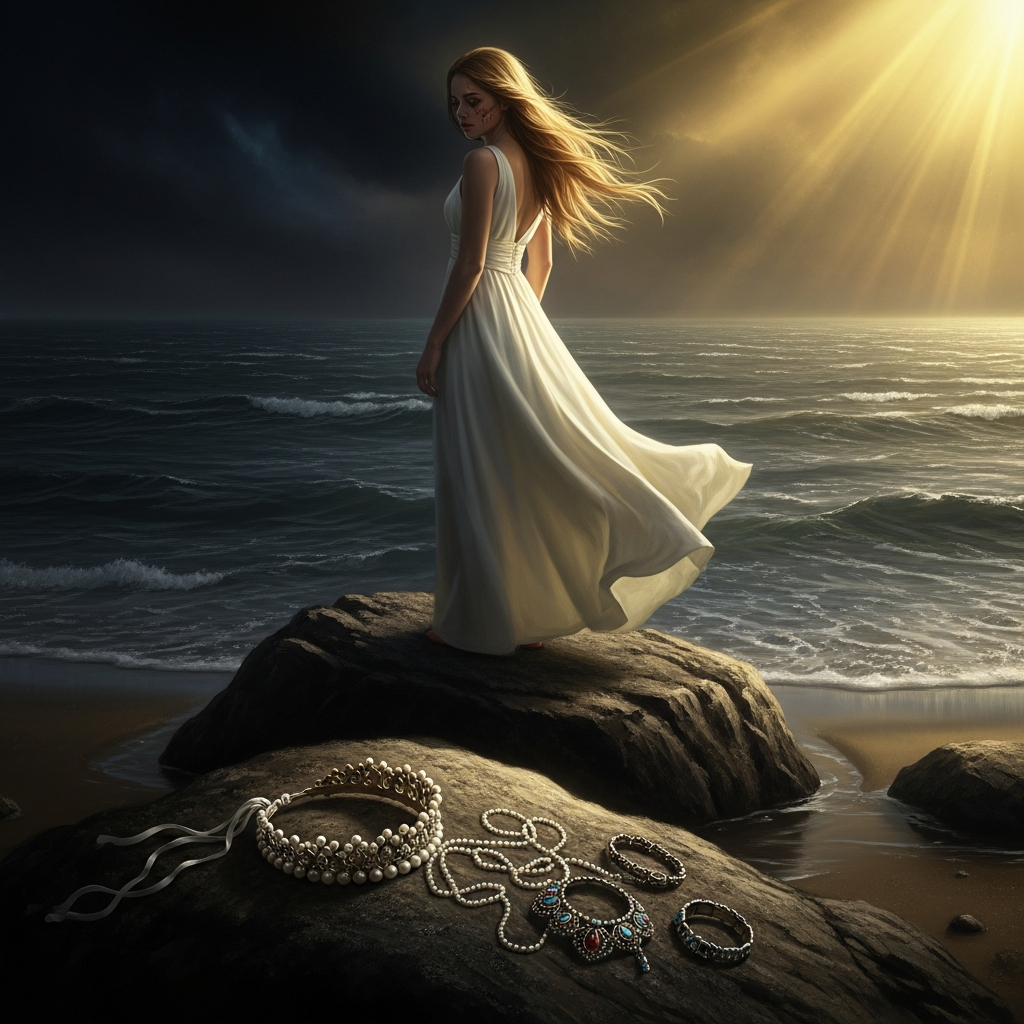
This is the part the runo dwells on. She takes off her shift, and she folds it. She takes off her belt of red wool, and she lays it on top of the shift. She takes off her embroidered apron, and she folds it. She takes off her brass hair-rings, all six of them, and she puts them on top of the apron. She takes off her shoes. She lays everything in a careful pile on a flat stone above the tide-line.
She stands naked on the sand.
She walks down to the water.
She walks into the water. The water is cold. The water is the cold of the Baltic in early summer, which is colder than any sea has the right to be. She walks until the water is at her knees, then at her hips, then at her chest. The cold is everywhere now, in her ribs, in her teeth, in the small bones of her hands. She keeps walking. She walks until her feet leave the sand, and she begins to swim.
She swims out to the rock.
She climbs the rock.
The rock is bigger up close than it looked from the shore. Its sides are slippery with weed. She pulls herself up. She cuts her hand on a barnacle. She does not stop. She climbs to the flat place on top — the place she remembered from childhood — and she stands there.
She looks back at the shore.
Her clothes are still folded on the stone. The forest is behind them. Somewhere up the path, somewhere over the crest of the hill, her mother is waking up and not finding her, and going down to the beach to look for her, and seeing the folded pile, and understanding.
Aino does not wait for her mother to arrive.
She steps off the rock.
She does not jump. The runo is exact about the verb. She steps. She steps off the rock the way a person steps off a doorstep at dawn to start a day’s walking. There is no flailing. There is no last cry. There is only the step, and the falling, and the sea closing over her head.
She does not come back up.
The water around her becomes the new world she lives in. She is not breathing — but she is also not dying, the way a drowning person dies. The runo does something subtle here. It does not say she drowns. It says she changes. The sea takes her. Vellamo, the sea-queen, who has been watching this whole walk from below, opens the water under Aino’s body and accepts her, and what comes out the other side of the acceptance is not a corpse.
It is a fish.
A pale, slim fish. The runo does not name the species exactly — different singers said different things; some said a salmon, some said a whitefish — but it is a fish unlike the other fish in the water. It moves more quickly. It moves more sadly. It has Aino’s eyes.
It swims away.
Her mother arrives on the beach an hour later.
She finds the clothes. She finds the brass hair-rings. She walks down to the water’s edge and stands looking out at the rock and at the calm sea beyond it, and she begins to weep.
She weeps for three days. The runo lingers on this weeping; this is one of the great laments of the Kalevala. The mother sits on the beach and weeps and asks the sea, where is my daughter, and the sea does not answer. She asks the wind. She asks the sun. She asks the rocks. They do not answer. On the third day she stands up and walks home alone, and she does not speak to her son for a year.
Väinämöinen does not learn until the next day.
He has been on the road. He has come back to claim his bride. He arrives at Aino’s house and finds the mother in mourning and the brother silent, and he is told — coldly, by the mother — what has happened. He does not say much. He turns around. He walks down to the sea.
He brings his fishing tackle.
This is the part the runo is hardest on. He goes fishing. He is an old man, and an old singer, and he has just been told that the girl he was promised has walked into the water rather than marry him, and his response is to take a boat and a line and a hook and to row out to the rock where she disappeared.
He fishes for a day.
On the second day he catches a fish.
It is the strangest fish he has ever caught. It is pale. It is slim. It does not struggle on the line the way an ordinary fish struggles. He pulls it into the boat. He looks at it lying on the floorboards. He picks up his knife to scale it.
The fish speaks.
This is the most famous moment in the runo.
The fish — lying on its side on the wet wood of the boat-floor, with the knife above it — looks up at Väinämöinen with one wet eye, and speaks. I am not a fish for eating, the fish says. I am Aino, the sister of Joukahainen. I am the bride who refused you. I came down to the sea rather than be your wife. Vellamo took me. I am now her companion. Why have you caught me?
Väinämöinen drops the knife.
He reaches for the fish to lift her, to apologize, to put her back into the water — and the fish slips through his fingers. Old men’s hands are not as strong as young men’s hands. The fish is pale and slick. She slides over the gunwale, hits the water with a small splash, and is gone.
He sits in the boat. He stares at the place where she went.
He calls her name.
The runo gives us his calling. He calls Aino, Aino, into the water. The water does not answer. He calls again. He calls a third time. He calls her until his voice gives out.
He picks up his oar. He rows back to shore. He pulls the boat onto the sand. He sits down on the beach next to the rock — the same rock she stepped off — and he begins to weep.
The weeping of Väinämöinen is the strangest part of the runo.
He is the greatest singer in the Kalevala. He is the wisest man. He is the figure who, in every other runo, has the right answer and the right song and the right instrument and the right word. Here, on the beach, he has nothing. He weeps the way old men weep — silently, with his face in his hands, with his beard wet — and he weeps for a long time. He weeps for Aino, who did not want him. He weeps for himself, who wanted her. He weeps for his own age, which he cannot undo. He weeps for the fact that he caught her once and let her slip and will not catch her again.
His tears fall into the sand. They roll down the slope into the sea.
The runos that follow this one have Väinämöinen looking for other brides — the Maid of Pohjola, the daughters of the north — and being refused by all of them. The Aino episode is the moment he loses something. He never quite recovers it. He becomes a wiser old man after the beach. He becomes a sadder old man. The greatest singer in the Kalevala has been told no by a girl who would rather be a fish than be his wife, and the no is a song he cannot sing his way out of.
The Finns who sang this runo understood what the myth was telling them.
They sang it at weddings, sometimes — at the wedding-eve ceremony, when the bride was being prepared to leave her mother’s house, when the women would gather around her and weep with her and sing her itkuvirret, her wedding-laments. The laments were sung in Aino’s voice. I do not want to go. I do not want him. I would rather walk into the sea.
The mother in the lament would answer.
You will go anyway, the mother would sing. Your brother has promised you. Your father has agreed. The cloth-of-gold is sewn. The wagon is at the door. You will go to the husband’s house and you will live there and you will become his wife.
And then the women would weep together, the bride and the mother and the cousins and the aunts, and the weeping was not metaphor — it was a real grief — and they would sing Aino’s name into the night, and they would hope that the daughter would not actually walk down to the sea, and most of the time the daughter did not walk down, and the wedding the next morning would happen, and the daughter would go to the husband’s house, and the marriage would begin.
But sometimes a daughter would.
The runo does not condemn her when she does. The runo blesses her. The runo says: if you walk down to the sea rather than be his wife, the sea will take you. Vellamo will give you a fish-body. You will swim. Your brother will be ashamed for the rest of his life. Your husband will sit on the beach and weep. And no one will be able to undo what you did, and no one — not even Väinämöinen, the greatest singer in the world — will be able to sing you back.
It is one of the oldest songs we have about consent.
The Finns kept singing it for two thousand years.
Echoes Across Traditions
Entities
- Aino
- Väinämöinen
- Joukahainen
- Aino's Mother
- Vellamo (sea queen)


Sources
- Kalevala, runos 4–5 (compiled by Elias Lönnrot, 1849)
- Keith Bosley translation, *The Kalevala* (Oxford World's Classics, 1989)
- Eino Friberg translation, *The Kalevala: Epic of the Finnish People* (1988)
- Senni Timonen, *Minä, tila, tunne: Näkökulmia kalevalamittaiseen kansanlyriikkaan* (2004)
- Aili Nenola, *Inkerin itkuvirret* (Karelian-Finnish lament tradition, 2002)