Amirani: The Man Who Stole Fire
Ancient Georgian oral tradition; earliest written recordings 19th century CE · The Caucasus mountains; the high peaks above the human world
Contents
Amirani, the Georgian culture hero, stole fire and knowledge from the gods and gave it to humanity. His punishment: he is chained to a mountain in the Caucasus, where an eagle (or demon) eats his liver each day, and it grows back each night. His dog Kursha gnaws constantly at his chains — almost freeing him — but every Shrove Tuesday, when blacksmiths strike their anvils, the chains are renewed.
- When
- Ancient Georgian oral tradition; earliest written recordings 19th century CE
- Where
- The Caucasus mountains; the high peaks above the human world
Before there was fire in the human world, men and women lived in a particular kind of darkness that was not metaphorical.
No warmth in winter. No cooked food. No metal, because metal requires the forge. No pottery, because pottery requires the kiln. The whole architecture of human civilization — everything that makes a house different from a cave and a community different from a herd — requires fire at its foundation. Amirani understood this. Whether the gods had withheld fire deliberately, or whether fire was simply not yet available in the lower world, the result was the same: humanity was cold and exposed and dying faster than it should have been.
He went to get fire.
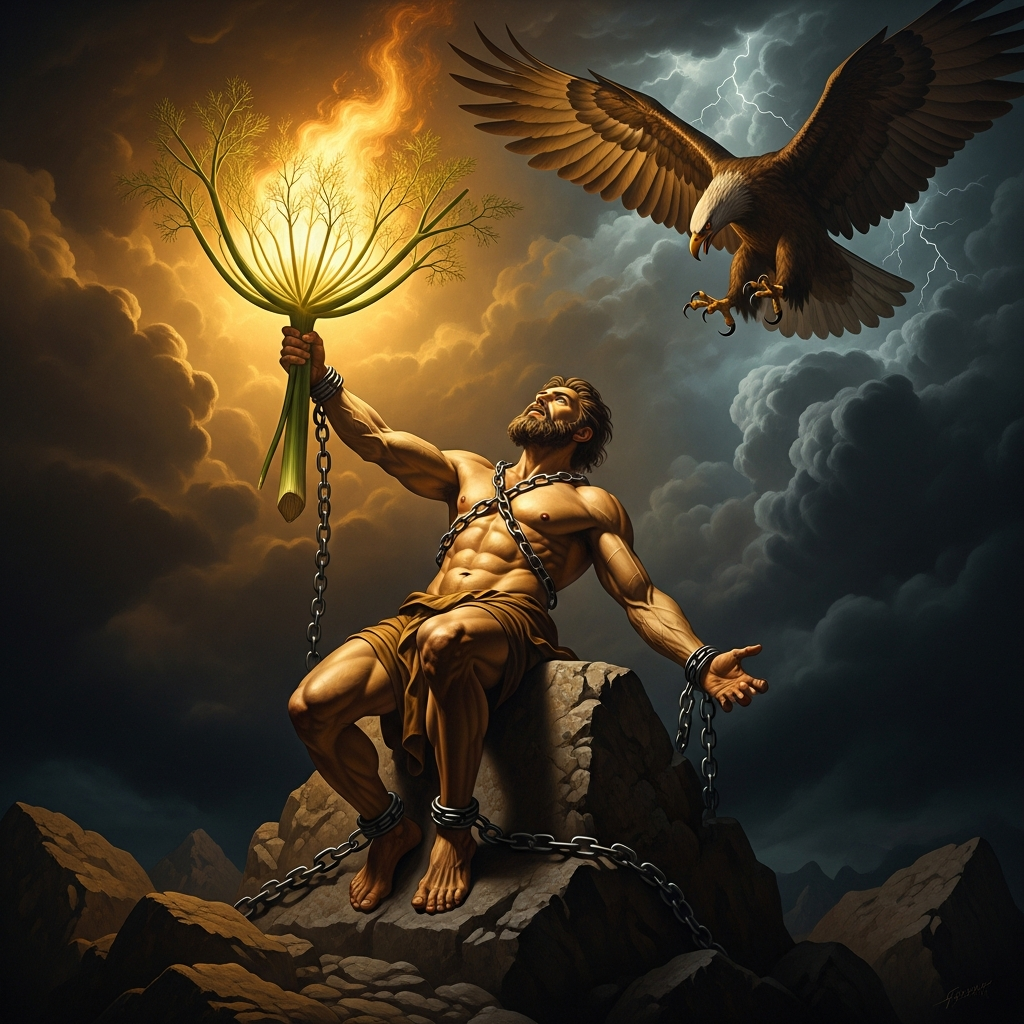
The Georgian tradition preserves multiple versions of where he found it. In some tellings, fire was kept by a deity in the sky, and Amirani stole it in a hollow reed — the reed-theft that appears also in the Prometheus tradition and in the Vahagn birth-hymn, a trans-Caucasian motif about the carrying of sacred fire in a vessel that is almost nothing. In other versions, he found it in a cave guarded by a demon or a devi. In others still, he was given knowledge and fire together by a single act of transgression — taking the thing that was not meant for human hands.
What is consistent across every version: he brought it down from the mountain. He gave it to people. He was captured and chained in punishment.
He was born to a woman named Dali — or near Dali, or through Dali’s intervention. Dali is the Georgian mountain goddess, the huntress of the high places, the deity associated with wild animals and the vertical landscape of the upper Caucasus. She is connected to the hunter in the specific way that the great mountain deities are connected to those who pursue their sacred animals: a bond that is intimate and that the hunter must maintain through specific prohibitions, above all the prohibition against boasting of or sharing the divine connection.
Amirani’s origin in Dali places him in the tradition of the semi-divine hero: not a god, but touched by the divine on his mother’s side; not fully human, but human enough to die, which is the relevant vulnerability.
He did many things before the chains. He was a civilizer-hero in the fullest sense: he fought demons, he slew monsters, he freed captives from the power of the devi who controlled the high mountain passes. He was, in the Georgian world, the answer to a category of need that the ordinary human world cannot address — the category of problems that require someone bigger than human but more vulnerable than god.
The chains found him eventually.
The chaining is described differently in different villages of the Georgian oral tradition. In some versions, it was the gods he had robbed who imprisoned him. In others, it was the demons he had defeated who finally caught him through trickery. In others still, it was the consequence of breaking a prohibition connected to Dali — the hunter who reveals his divine connection is punished by the loss of everything, including freedom.
The location is consistent: a peak in the Caucasus, above the treeline, in the permanent cold. The chains are iron. The eagle descends daily — in some versions, it is not an eagle but a devi, a particular type of Georgian supernatural being with demonic characteristics — and opens the same wound and consumes the organ that regenerates overnight, so that tomorrow’s consumption can begin from the same starting point.
The geometry of the punishment is deliberate. It is not designed to kill him; death would be a resolution. It is designed to suspend him permanently in the cycle of wound and regeneration — to make his extraordinary resilience (the regenerating liver) into the mechanism of his own torture. The quality that makes him heroic is exactly the quality that makes his imprisonment eternal.
Kursha does not sleep.
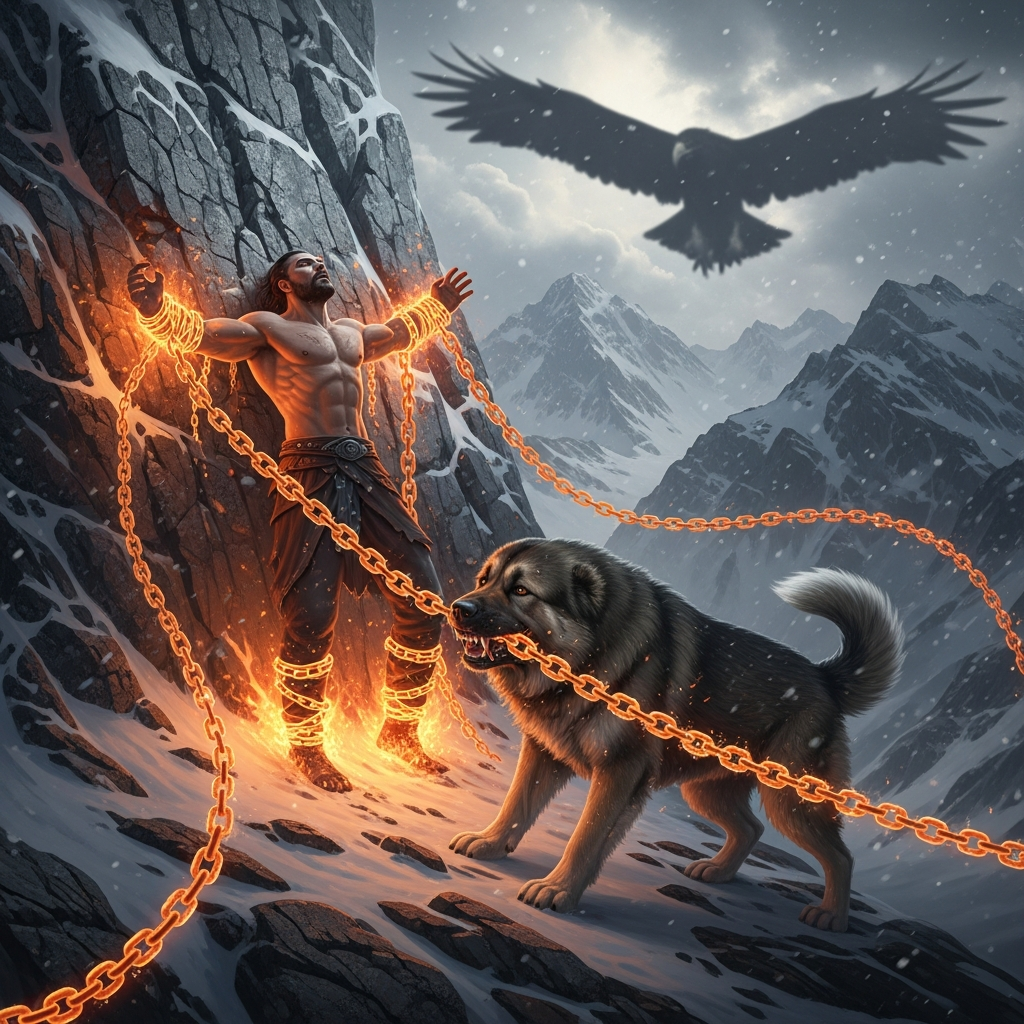
The dog gnaws at the chains. He gnaws without ceasing, night and day, in the cold of the high peak, and the chains thin under the patient attention of the dog’s teeth. The chains are heavy; the progress is slow; but Kursha is loyal in the way dogs in the Caucasian tradition are loyal, which is without the awareness of futility that would limit a human effort.
He almost makes it every year.
By the time of the spring festival — Shrovetide, in the Georgian Orthodox calendar, the feast before Lent — the chains have been thinned to almost nothing. Almost. The dog has come within a breath of freeing the hero. And then the blacksmiths take their hammers and strike the anvils in celebration, and the iron resonates, and the chains are renewed — not repaired but cosmically reinstated, as if the striking of iron on iron in the world below reaffirms the binding on the mountain above.
This is the myth’s most disturbing observation.
The blacksmiths are not Amirani’s enemies. They are not evil. They are celebrating their feast; they are honoring their craft; they are doing what their tradition requires of them on the holy day of their trade. They do not think about Amirani on Shrovetide. They think about iron and fire and the good work of the hammer. And in doing so, they extend his imprisonment for another year.
The body of Amirani is visible in the mountain, in the Georgian telling. Not as a visible figure on the exterior cliff face, but present in the stone itself — the way some things are present in what contains them. Climbers in the high Caucasus, in bad weather, have reported sounds. The Georgian tradition does not specify what the sounds are.
There is an eschatological dimension: Amirani will eventually be freed. This is asserted in some versions, implied in others. When Kursha finally succeeds — when the chains give way before the next Shrovetide renewal — Amirani will come down from the mountain and the world will change. What it will change into is not specified with comfort. The freeing of a bound culture-hero is never simply a happy event; it is the end of one order and the beginning of an unknown next one.
Meanwhile, Kursha gnaws. The chains thin. The winter passes and the spring festival comes, and the blacksmiths who know nothing of what they’re doing take their hammers and restore the iron, and Kursha begins again.
Amirani’s liver has healed before the eagle arrives in the morning. He is completely restored, intact, prepared for the day’s consumption. The eagle is punctual.
This is what the stolen fire cost. Every fire in every Georgian hearth is warm partly because this man is cold on a mountain. The traditions do not ask whether the trade was worth it. They simply maintain both ends of it simultaneously: warmth below, suffering above, and between them the chains that the blacksmiths keep strong.
Echoes Across Traditions
Entities
- Amirani
- Dali (the mountain goddess)
- the eagle
- Kursha the dog
- the blacksmiths
Sources
- Marjory Wardrop, *Georgian Folk Tales* (1894) — early English collection including Amirani variants
- Georges Charachidzé, *Prométhée ou le Caucase* (Flammarion, 1986) — definitive comparative study
- Kevin Tuite, 'The Delivery of the Human Soul in Georgian and Related Myths' in *Journal of the American Oriental Society* (1998)
- David Marshall Lang, *The Georgians* (Thames and Hudson, 1966)
- Encyclopaedia Iranica, s.v. 'Amirani' (online edition)