The Navel of the World: Axis Mundi Across World Mythology
Yggdrasil in Norse Eddas compiled c. 1220 CE; Mount Meru described in Mahabharata (c. 400 BCE) and Puranas; Omphalos at Delphi active as oracle site from c. 800 BCE; Kaaba in Mecca from pre-Islamic antiquity, central to Islamic practice from 630 CE; Black Hills Lakota traditions documented from 19th century · The center of everything: the Norse cosmological tree at the middle of the nine worlds, the mountain at the geometric center of the Hindu universe, the stone at the exact middle of the Greek world, the first house built on earth (the Kaaba), the heart of the Lakota world in what is now South Dakota
Contents
Yggdrasil, Mount Meru, the Kaaba, the Omphalos at Delphi: every culture placed a world-center at its own location. The cosmic pillar connects heaven, earth, and underworld.
- When
- Yggdrasil in Norse Eddas compiled c. 1220 CE; Mount Meru described in Mahabharata (c. 400 BCE) and Puranas; Omphalos at Delphi active as oracle site from c. 800 BCE; Kaaba in Mecca from pre-Islamic antiquity, central to Islamic practice from 630 CE; Black Hills Lakota traditions documented from 19th century
- Where
- The center of everything: the Norse cosmological tree at the middle of the nine worlds, the mountain at the geometric center of the Hindu universe, the stone at the exact middle of the Greek world, the first house built on earth (the Kaaba), the heart of the Lakota world in what is now South Dakota
Odin is hanging on Yggdrasil. He has hung himself there — “gave myself to myself,” the poem says — wounded by a spear, without food or water, for nine days. What he is after is not death but knowledge: the runes, the sacred scripts that encode the structure of reality, which are visible only from the particular perspective of the world-tree’s center, in the particular condition of near-death.
On the ninth day, he sees the runes. He cries out, takes them up, and falls from the tree.
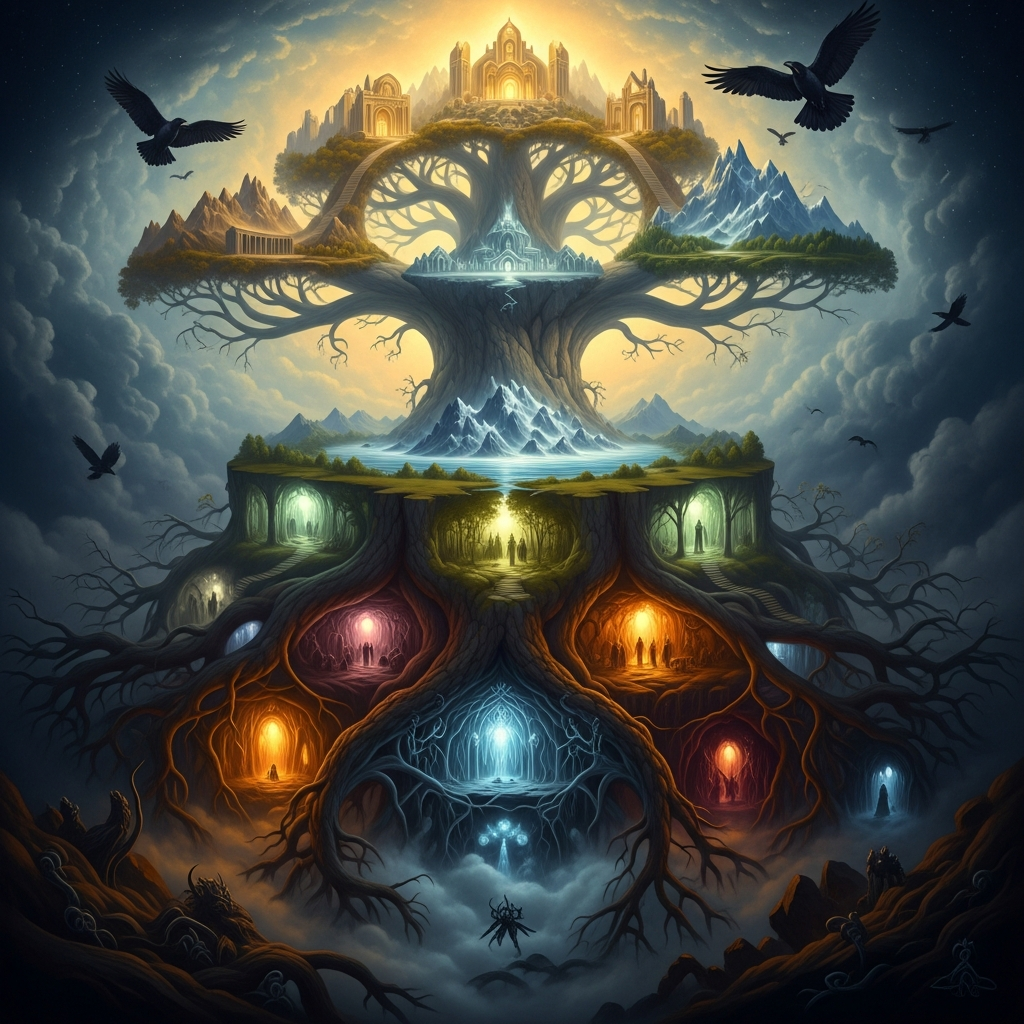
The tree is the right place to hang. The tree is the center of everything — its roots in the underworld, its trunk in the middle world, its crown in the realm of the gods. From the center of the axis mundi, all of reality is simultaneously visible. The universe has a center, and from the center, everything makes sense in a way it cannot from any other vantage.
This is the cosmological claim that every tradition’s axis mundi makes: there is a center, and at the center, you can see clearly.
Why Every Civilization Is the Center
Mircea Eliade, in The Sacred and the Profane (1957), identified the axis mundi as one of the most universal structures in religious thought. He noted that every culture that has ever been studied places its own sacred site at the center of the world — and that these sites are not competing claims about geographic fact but are all, in some sense, correct.
The axis mundi is not a point in space. It is a quality of sacred space. A site is the center of the world not because it is geometrically central but because it is the place where the different levels of the cosmos — heaven, earth, underworld — are most directly accessible to one another. The center is where the traffic between worlds is heaviest.
Every Hindu temple is Mount Meru. Every Christian church is, in some sense, Jerusalem, because it is the place where the sacrifice of Calvary is made present. Every mosque faces Mecca, and Mecca contains the Kaaba, which is directly beneath the angels’ house in heaven. The centering is relational, not cartographic.
What makes this observation profound rather than merely cultural relativism is what it implies about the human relationship to space. Humans do not inhabit uniform space. They inhabit oriented space — space that has a center (the sacred site), axes (the cardinal directions), and therefore structure. Without the axis mundi, space is disorienting in the most fundamental sense: there is no up, no down, no here versus there. The axis mundi is what makes the world habitable.
Yggdrasil: The Most Complete Cosmic Anatomy
The Norse world-tree is unique in the specificity of its cosmological detail. Nine worlds are organized around and within it. Three wells attend its three roots. Named creatures inhabit specific positions: the eagle at the summit (whose name, some sources give as Hraesvelg), the four stags who eat its leaves, the dragon Nidhogg gnawing its roots, the squirrel Ratatoskr running between them carrying insults to maintain the tension.
The squirrel is a detail of unusual mythological precision. The cosmic tension between the eagle (sky, order, the above) and the serpent (earth, entropy, the below) must not be resolved — the tree’s cosmological function depends on the opposition being maintained. The squirrel who carries messages between them is not solving the problem; it is ensuring the problem continues. The tension that threatens to destroy the tree is also the tension that keeps the tree standing.
The wells are the axial specificity. Urdr’s Well, tended by the three Norns (Urd, Verdandi, Skuld — Past, Present, Future), is where the gods hold their daily court. The Norns water the tree from this well daily with sacred water and white clay, which is why Yggdrasil’s wood stays white and fresh despite the cosmic gnawing. Mimir’s Well contains the wisdom of everything that has ever happened or will happen. Odin’s eye is in it — the price he paid for one drink.
Hvergelmir, the third well, is the source from which eleven rivers flow through all the nine worlds. The axis mundi is not just the center of space; it is the source of movement, of the flow that makes space dynamic rather than static.
Mount Meru and the Temple as Cosmos
The Hindu cosmological mountain, Meru, has a specific and detailed geography: 84,000 yojanas high (a yojana being roughly 8-15 km, depending on the tradition, giving Meru a height that dwarfs the physical universe), surrounded by seven ranges of lesser mountains, set at the center of Jambudvipa (the southern continent, which includes the human world). Its peak is a paradise of divine palaces. Its flanks are the dwelling places of semi-divine beings.
The architectural consequence of this cosmology is the Hindu temple — arguably the most systematic spatial embodiment of a cosmological diagram ever built. The central tower (shikhara in north Indian temples, vimana in south Indian) represents Meru. The temple faces east (the direction of the rising sun and of cosmological order). The inner sanctuary (garbha-griha, “womb-chamber”) is the summit of the mountain, the point where the deity is most present.
Entering a Hindu temple is not entering a building. It is ascending a mountain. The spatial experience is designed to move the worshipper from the outer, ordinary world through progressively more sacred zones toward the divine center. The porch is the foothills. The hall is the approach. The inner sanctum is the summit.
Every temple-builder in the Hindu tradition was modeling the cosmos in stone. Every worshipper who circumambulated the inner sanctum was, in structural terms, performing a cosmological orbit.
The Kaaba: Circumambulation as Cosmic Order
The Tawaf — the seven-circuit counterclockwise circumambulation of the Kaaba — is the spatial enactment of what happens in the heavens. In Islamic cosmology, the angels circumambulate the Bayt al-Ma’mur (the celestial Kaaba) in the same pattern. The pilgrim performing Tawaf on earth is aligning their movement with the movement of the angelic realm above.
The direction — counterclockwise — is also, in Islamic tradition, the direction in which the planets orbit, the direction of the cosmic order. To perform Tawaf is to join the universal movement, to insert oneself into the rotation of the cosmos around its center.
The Black Stone in the eastern corner of the Kaaba marks the beginning and end of each circuit. Pilgrims kiss it if they can reach it, or simply point to it as they pass. The stone is understood to have been white when it descended from paradise — a fragment of the pre-creation divine realm, blackened by millennia of human sin absorbed from pilgrim touch. The center of the world holds, in its very material, the accumulated moral history of every human who has visited it.
Black Elk and the Portable Center
In John Neihardt’s recording of the Oglala Lakota holy man Black Elk (1932), Black Elk describes the great vision he received as a child and its spatial structure: “I was standing on the highest mountain of them all, and round about beneath me was the whole hoop of the world… And I saw that the sacred hoop of my people was one of many hoops that made one circle, wide as daylight and as starlight, and in the center grew one mighty flowering tree to shelter all the children of one mother and one father.”
What is most theologically sophisticated about Black Elk’s vision is his later gloss on it: “The center of the earth is everywhere.” The center is not a geographic location that must be pilgrimed to. It is a quality of attention and orientation that can be achieved anywhere by anyone who stands in right relationship to the cosmos. The world-tree can flower at any spot if the person standing there is spiritually oriented.
This is the cosmological culmination of the axis mundi concept: having been located at specific sacred sites throughout the tradition, it finally becomes portable. The center is everywhere because you carry the centering capacity within you. The tree grows where you are, if you have learned how to stand at the center.
The pilgrim goes to Mecca, to Delphi, to the Black Hills — and comes back having learned, at the world’s center, something about how to find the center in themselves.
Echoes Across Traditions
Entities


Sources
- Snorri Sturluson, *Prose Edda*, 'Gylfaginning' 15-16 (Yggdrasil)
- *Mahabharata*, Book 6 (Bhishma Parva), on Mount Meru
- Pindar, *Pythian Odes* IV.74 (Delphi as omphalos)
- Quran, 3:96-97 (on the Kaaba as first house)
- John G. Neihardt, *Black Elk Speaks* (1932)
- Mircea Eliade, *The Sacred and the Profane* (1957)
- Paul Wheatley, *The Pivot of the Four Quarters* (1971)
- Adrian Snodgrass, *The Symbolism of the Stupa* (1985)
- Kim TallBear, *Native American DNA* (2013) — on the Black Hills as sacred geography