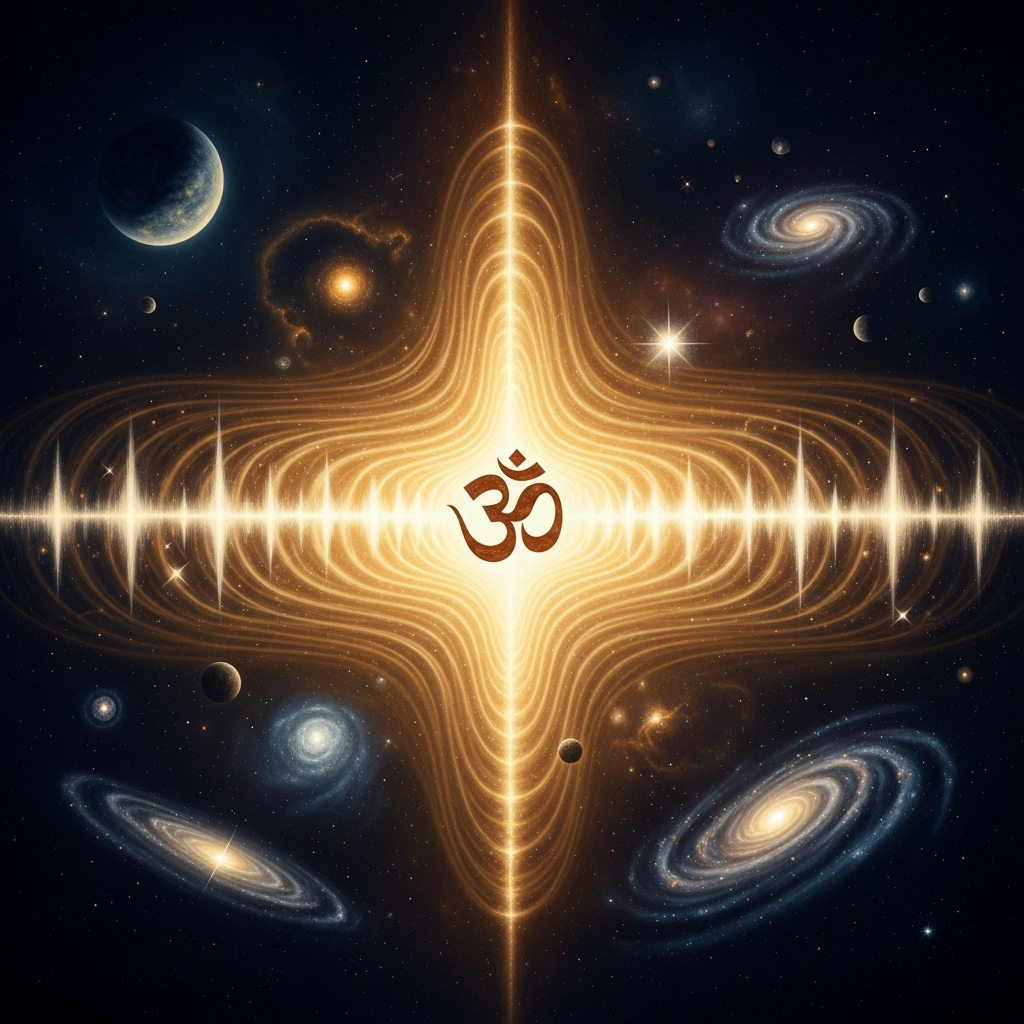
In the Beginning Was the Word: Creation by Speech Across World Mythology
Egyptian Memphite Theology (Ptah) in extant form from c. 700 BCE but likely much older; Genesis 1 compiled c. 6th-5th century BCE; Gospel of John (Logos) c. 90-100 CE; Popol Vuh oral tradition pre-Columbian, codified c. 1550 CE; Om doctrine from Chandogya Upanishad c. 800-600 BCE · The formless void before creation — the not-yet-space where the first word is spoken into nothing and produces everything
Contents
Genesis, the Logos, Om, Ptah's tongue, the Popol Vuh — across a dozen traditions, the universe begins not with a physical act but with a sound, a word, a vibration.
- When
- Egyptian Memphite Theology (Ptah) in extant form from c. 700 BCE but likely much older; Genesis 1 compiled c. 6th-5th century BCE; Gospel of John (Logos) c. 90-100 CE; Popol Vuh oral tradition pre-Columbian, codified c. 1550 CE; Om doctrine from Chandogya Upanishad c. 800-600 BCE
- Where
- The formless void before creation — the not-yet-space where the first word is spoken into nothing and produces everything
Before anything existed, there was a problem: there was nothing to exist in.
The void, by definition, has no space, no time, no medium through which a physical force could propagate. A hand reaching into the void to shape it would have nowhere to be. A fire igniting in the void would have nothing to burn. Even light, traveling in the void, would have no space to travel through.
But a word — a word can be spoken into nothing. Speech does not require a preexisting medium. Speech, the great creation myths seem to intuit, is the one act that could take place before place existed.
This is why, across a remarkable number of independent traditions, the universe begins not with a physical event but with a sound.
What Language Does That Nothing Else Can
In the beginning was the Word. The first sentence of the Gospel of John is one of the most carefully constructed theological statements in ancient literature. Every word in the Greek original — En arche en ho Logos — is doing multiple jobs.
Arche means beginning, but also principle, foundation, origin. The Logos does not merely appear first in time; it is the principle that makes time possible. En (was) uses the imperfect tense — continuous past action — rather than the aorist (point in past time), implying that the Logos did not begin at a moment but was already there, continuously, before any beginning could be identified. And Logos — which translators render as “Word” — carries the full weight of the Greek philosophical tradition: not merely speech but the rational structure underlying all existence, the cosmic grammar that makes the universe intelligible.
The author of John, writing near the end of the first century CE, was doing something precise: taking the Hebrew creation-by-speech from Genesis 1, the Greek philosophical Logos from Heraclitus and the Stoics, and the Wisdom literature of the Hebrew Bible (Proverbs 8: “The Lord possessed me at the beginning of his work… I was beside him like a master workman”) and synthesizing them into a single opening claim. The synthesis is so elegant that it is still impossible to say which tradition contributes most.
Genesis: Seven Days of Sentences
What is structurally distinctive about the Genesis 1 creation narrative, compared to other Ancient Near Eastern creation stories that were clearly its literary neighbors, is what it removes.
The Babylonian Enuma Elish (c. 1700-1100 BCE) has Marduk creating the earth from the body of the slain goddess Tiamat — cutting her in half, making the sky from one half and the earth from the other. There is material. There is conflict. There is a body to work with.
The Egyptian traditions generally involve a pre-existing watery chaos (Nun) from which the first hill emerges. There is material — water, chaos — and the creation is the ordering of it.
Genesis 1 strips all of this away. There is no pre-existing material, no divine conflict, no chaos-body to cut up. There is a void (tohu wa-bohu, “formless and empty”) and the Spirit of God hovering over the waters — and then God speaks.
Theologians would later formalize this as creatio ex nihilo — creation from nothing — and argue over whether it was philosophically possible. But the narrative itself simply presents it as the structure of how things begin: God says it, it exists. Each day opens with “And God said,” and closes with “And there was evening and there was morning.” Creation is not shaped; it is spoken. The universe is a text.
Ptah and the Theology of the Creative Mind
The Memphite Theology, inscribed on the Shabaka Stone in the 25th Dynasty (c. 700 BCE), is believed by Egyptologists to be the preservation of a much older text — possibly from the Old Kingdom period, over a thousand years earlier. Its argument is the most philosophically sophisticated creation account in Egyptian religion.
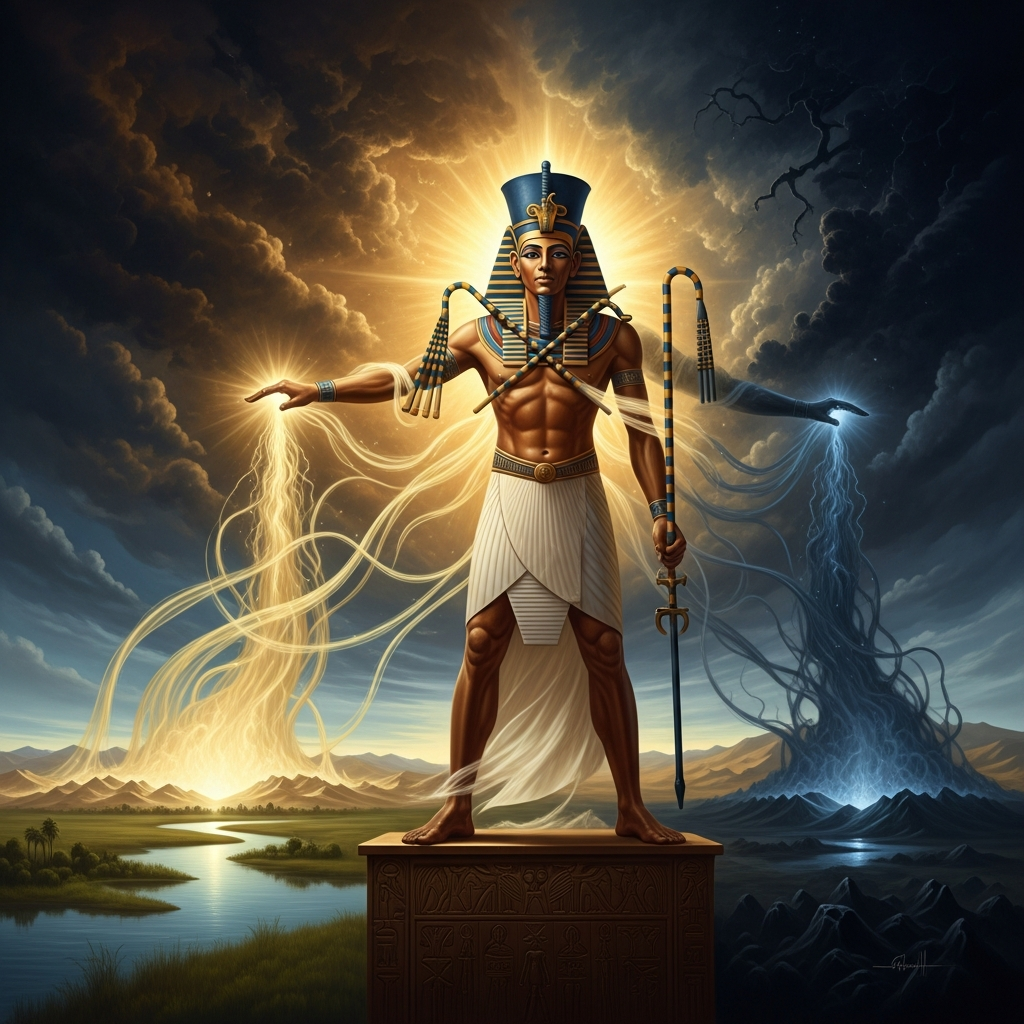
Ptah creates by “the heart and the tongue” — the heart conceiving the idea, the tongue speaking it into existence. The text then makes its most radical claim: every god who exists does so because Ptah’s heart conceived them and Ptah’s tongue named them. Ptah is the meta-creator — the principle by which creation of any kind occurs. He is, in an almost Platonic sense, the Form of Creativity itself.
The contrast with the rival Heliopolitan theology (in which Atum creates by masturbating, generating the first divine pair from his own body) is explicit and intentional. The Heliopolitan creation is physical, reproductive, embodied. The Memphite creation is intellectual and linguistic. The Memphite theologians were arguing — in a theological debate that would have been recognizable to any later philosopher — that mind and language are more fundamental than body and biology.
This is a striking argument to have been made in ancient Egypt, and it suggests that the philosophical observation linking language to the structure of reality is genuinely ancient and not the product of Greek rationalism alone.
Om: The Sound Before Sound
The Mandukya Upanishad, one of the shortest and most concentrated texts in the entire Upanishadic corpus, consists of twelve verses entirely devoted to the syllable Om. The first verse: “Om! This imperishable word is the whole of the visible universe. The explanation is: whatever was, whatever is, whatever shall be — all this is Om.”
Om is not a word in the ordinary sense. It does not refer to something else. It is the sound of existence itself — the vibration that precedes and underlies all other sounds and therefore all other things. In the Chandogya Upanishad, it is called the “udgitha” (the high chant) and described as the sound with which the ritual begins, before any content is introduced.
The acoustic reality of Om — the three phonemes A, U, M flowing together into a continuous resonance that the body produces by beginning with the open throat, rounding to the mid-position, and closing to the lips — maps onto the Upanishadic cosmology. A is the waking state (the open, manifest world). U is the dream state (the inner, imagined world). M is deep sleep (the formless). The silence after M is the fourth, unnamed state — the turiya — that underlies all three. The syllable contains the structure of consciousness.
In the Rigvedic hymn to Vac (Speech), the goddess who is speech itself makes the most remarkable claim: “I move with the Rudras and the Vasus… I sustain both Varuna and Mitra… I am the queen, the gatherer-up of treasures, knowing, the first of those worthy of worship.” Speech is not a tool. Speech is a god. Speech was there before the world it now describes.
Tepeu and Gucumatz: Creation as Conversation
The Popol Vuh’s opening is often translated without capturing how conversational it is. The two creator-gods — Tepeu (Sovereign Plumed Serpent) and Gucumatz (the Heart of the Sky) — create the world through dialogue. They discuss it. They consult. They say what they want. The universe is the result of what they agreed on.
“It was still rippling, still murmuring, rippling, still sighing, still humming, and it was empty under the sky. There was nothing yet. Only the pooled sea, alone under all the sky… Let it be this way, they said, letting the light arise. It arose. Earth! they said… And only from their word came the forming, the shaping of the earth: Earth they said, and instantly it was made.”
The Maya creation is collaborative speech. Neither god creates alone; both must agree. The universe requires a consensus. This is a cosmological endorsement of dialogue itself: the world was made by two minds agreeing on what they wanted, and speaking it together.
Why Speech and Not Hands
Every physical mode of creation requires materials. Shaping requires clay. Building requires stones. Weaving requires thread. Every physical act of creation is transformation: what existed before remains, in some form, in what is made.
But speaking requires only intention and air. And a word, once spoken, cannot be unspoken. The meaning of a word does not exist in the air molecules that carry the sound; it exists in the relationship between speaker and listener, in the structure of meaning itself. A word is, in a precise sense, made of nothing but pattern.
What the word-creation myths are grasping at, across their enormous cultural variation, is this: the universe is made of pattern. It is not made of material substrate, which is itself made of pattern. The word — the unit of meaningful pattern — is a more accurate description of what the universe fundamentally is than any physical substance you could name.
Whether this is cosmological insight or a very persistent and eloquent error has been the question at the intersection of physics, philosophy, and theology for the entire history of human thought. The myths got to the question before any of the formal disciplines did.
And the question is still open.
Echoes Across Traditions
Entities


Sources
- Genesis 1:1-2:3, Hebrew Bible (creation by speech)
- Gospel of John 1:1-14 (Logos)
- Shabaka Stone inscription (Memphite Theology of Ptah, c. 700 BCE text, earlier original)
- Rigveda 10.125 (Vac hymn)
- *Chandogya Upanishad* 1.1 (Om as first sound, c. 800-600 BCE)
- *Mandukya Upanishad* (On Om and the four states)
- *Popol Vuh* I.1 (Maya K'iche' creation, oral tradition codified c. 1550 CE)
- C.H. Dodd, *The Interpretation of the Fourth Gospel* (1953)
- Jan Assmann, *The Search for God in Ancient Egypt* (2001)
- Wendy Doniger, *The Rig Veda: An Anthology* (1981)