Lemminkäinen's Mother Gathers Him from the River
Mythic time, ancient Karelian-Finnish oral tradition · Pohjola in the far north, the River of Tuonela where it crosses the cattle-pasture, Lemminkäinen's mother's farm where the hairbrush bleeds
Contents
Sent to shoot the black swan of Tuonela as a bride-price, the reckless hero Lemminkäinen is killed by a blind cattle-herder he once insulted, hacked into pieces, and thrown into the River of Death. His mother — sensing the wrong from across the world when his hairbrush begins to bleed — takes a copper rake to the underworld and pulls his body out of the water piece by piece, then sings him back together.
- When
- Mythic time, ancient Karelian-Finnish oral tradition
- Where
- Pohjola in the far north, the River of Tuonela where it crosses the cattle-pasture, Lemminkäinen's mother's farm where the hairbrush bleeds
The brush hangs from a peg above the hearth.
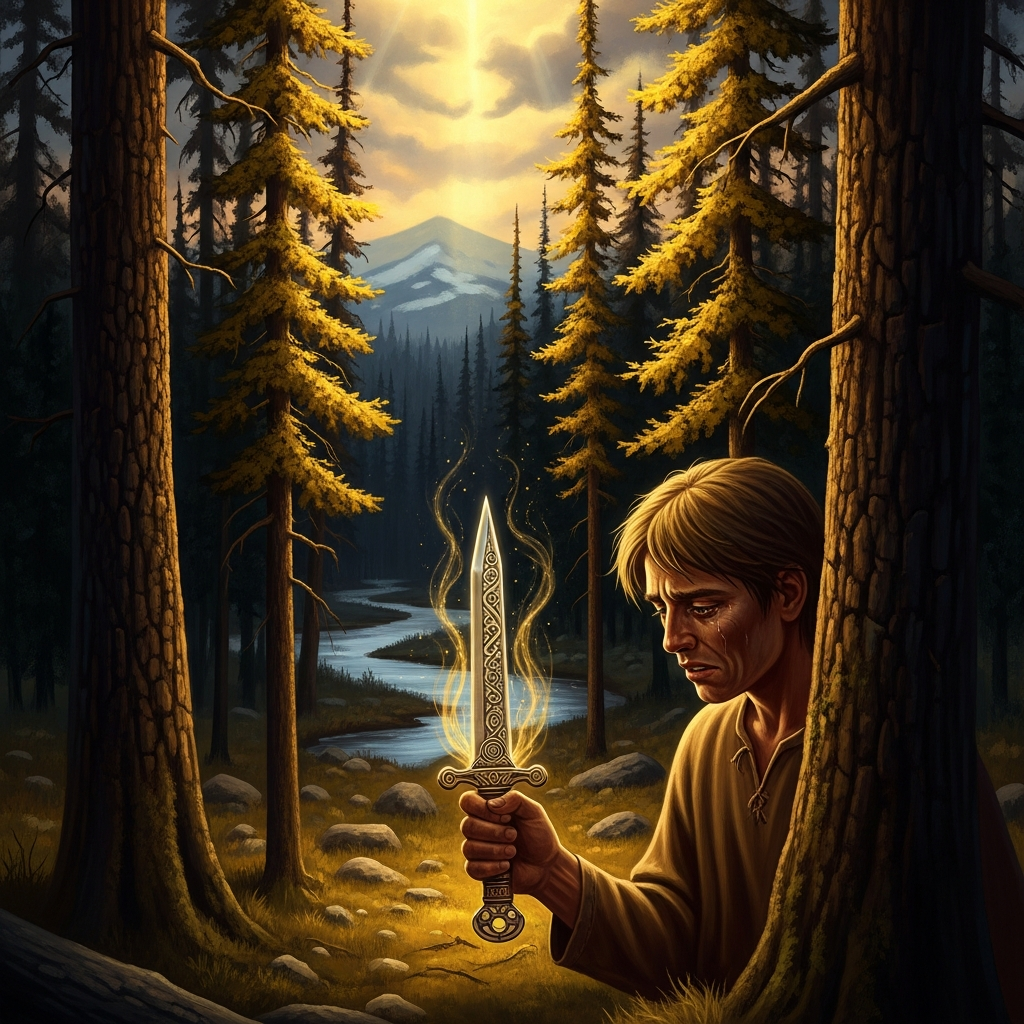
It is a hairbrush carved from horn. Lemminkäinen’s mother has had it for years; her son made it for her before he left, and he made it with a peculiar property — when he is well, the brush is dry; when he is dying, it bleeds.
She is at the loom. She is weaving a length of grey wool. The afternoon sun is coming in slantwise through the smoke-hole in the roof, and the cat is asleep on the floorboards by her feet, and she is humming a runo to herself in time with the shuttle. She does not look at the brush. She has not looked at it for weeks. Lemminkäinen is somewhere in the north — at Pohjola, the dark farm at the edge of the world — and she has been telling herself, he is fine, he is fine, he always comes back fine.
A drop falls into the wool of her weaving.
She looks at it. It is red. It is a single drop of dark red on the grey wool, and at first she thinks she has cut her finger, and she looks at her hands and her hands are clean, and she looks up.
The brush is bleeding.
It is bleeding from the tines, the way a ruined finger bleeds — a slow, continuous welling — and the blood is running down the wall and onto the bench and onto her loom. She stands up so suddenly the cat jumps. She looks at the brush. She knows what it means. She has known what it would mean since the day her son carved it.
She picks up her rake.
The rake is copper.
She made it years ago, or had it made — the runo is unclear about which — for exactly this purpose. It is not the rake she uses for hay. It is the rake she keeps in the back of the storehouse, and its tines are long, and the metal is the heavy reddish copper that does not rust, and she has oiled it every spring of her life without telling her son why.
She walks to the door. She pauses there. She looks at the loom with the bloody wool, and she looks at her cat, and she walks out into the yard and shuts the door behind her, and she begins the journey north.
She walks for nine days.
She walks past forests where the wolves let her pass. She walks past rivers where the boatmen do not ask payment. She walks past inns where the innkeepers, seeing her face, give her bread and water and ask no questions. The runo says she walks until her shoes wear out and she walks barefoot, and she walks until her skin hardens from the cold, and she walks until her hair turns whiter at the temples than it was when she left, and at the end of the ninth day she comes to the cattle-pasture above the River of Tuonela.
She knows where to begin looking.
She knows, the way mothers know, that her son is in the river. She does not know yet what condition he is in. She walks down to the bank.
What happened, she will piece together from the rake.
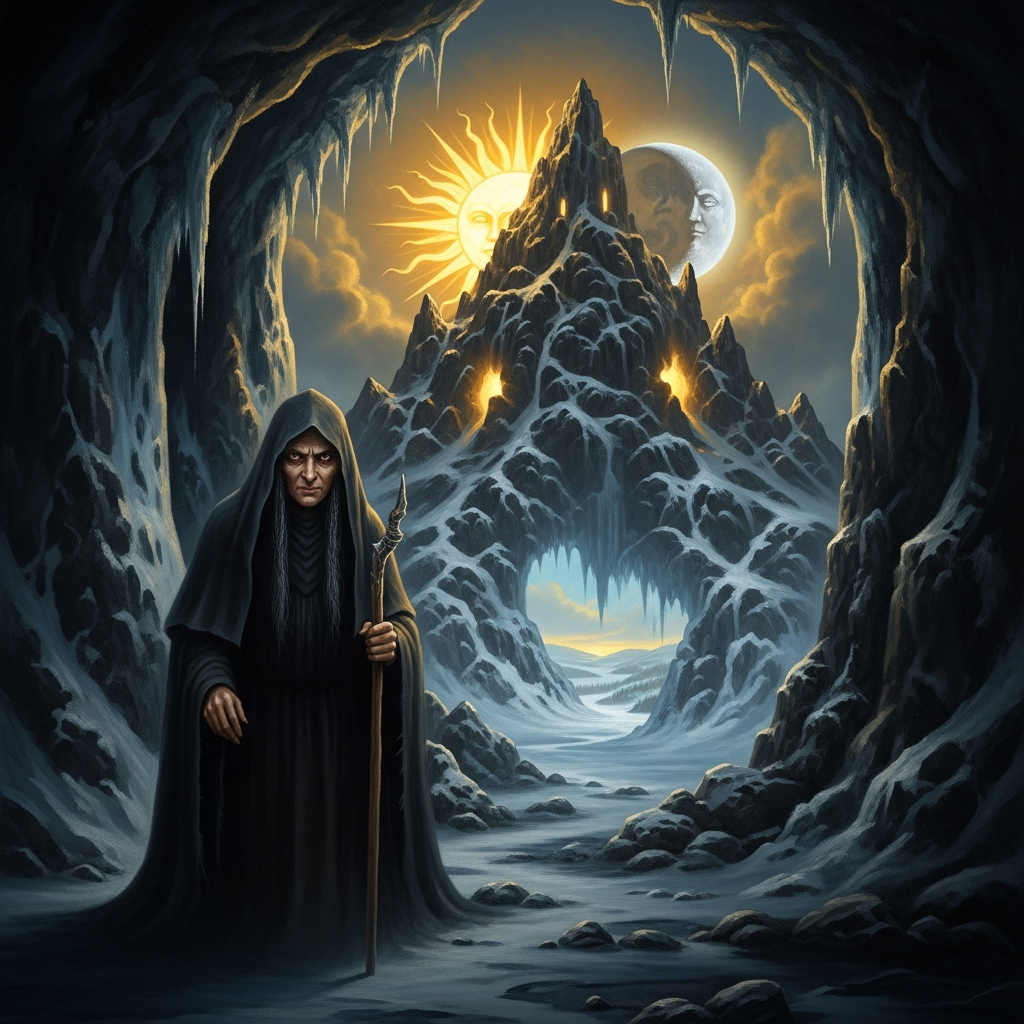
Lemminkäinen had come to Pohjola asking for the hand of Louhi’s daughter. Louhi — the gap-toothed witch-mother of the north, the keeper of the Sampo, the woman who has set every hero an impossible task — had given him three. The first task: catch the elk of Hiisi. The second task: bridle the fire-breathing horse of Tuoni. The third task, the one she was sure would kill him: shoot the black swan of Tuonela on the River of Death.
He had set out for the third task at dawn. He had carried his bow and his single arrow.
But on the cattle-pasture above the river there had been a herder. The herder was a blind old man, a märkähattu, a wet-hat — Lemminkäinen had insulted him on the way north, had passed him without greeting, had laughed at his blindness, had committed the sin in Finnish ethics that has no name in English: he had failed in courtesy to a man with no eyes, and the herder had remembered.
The herder had been waiting beside the river.
When Lemminkäinen passed, the herder threw a water-snake at him — not with his hands but with a song; he sang the snake out of the river and into Lemminkäinen’s chest, and the snake bit him through the heart, and Lemminkäinen fell into the river, and the herder — patient, methodical, blind, smiling — drew his knife and went into the shallows and cut the body into eight pieces and threw the pieces one by one into the current.
The pieces drifted downstream into Tuonela.
The black swan, which had been sleeping on the far bank, did not even raise its head.
His mother begins at the upstream end.
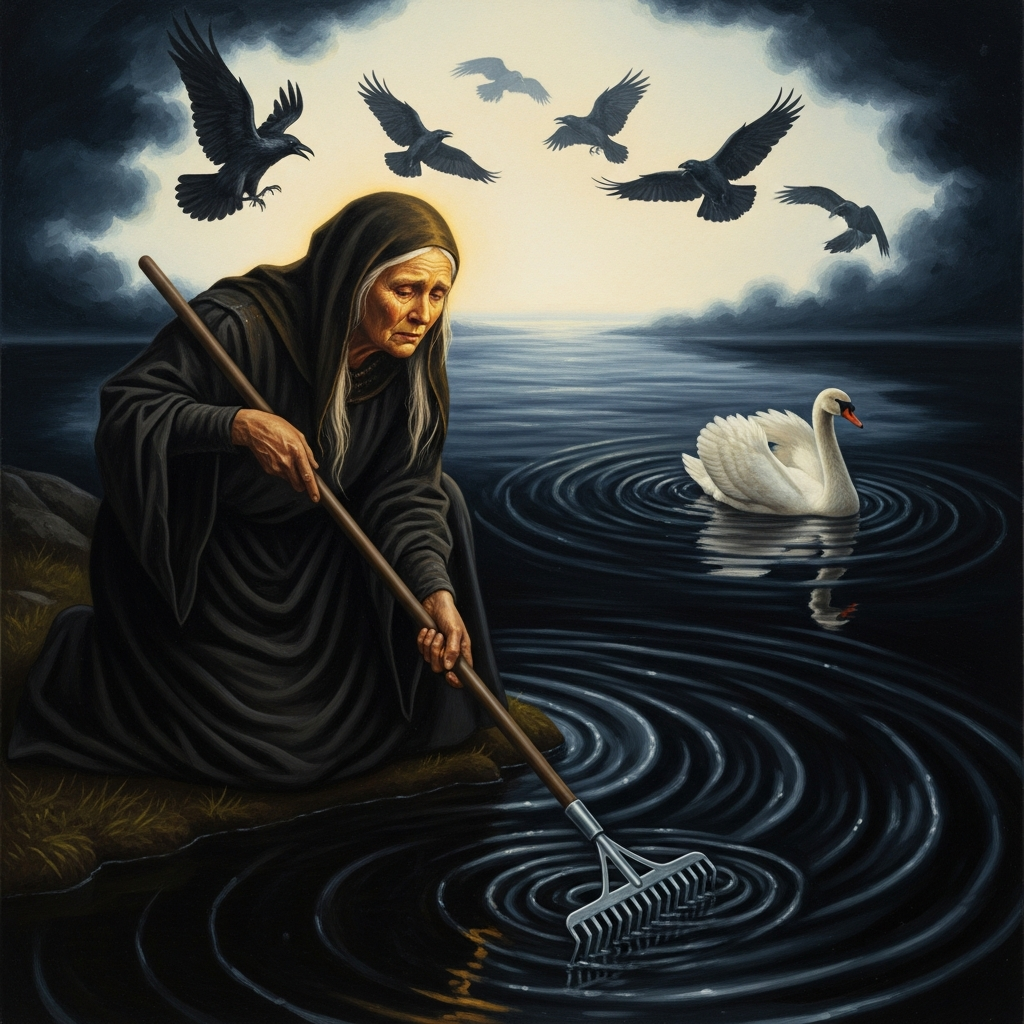
She walks into the river. The water of Tuonela is cold beyond ordinary cold — it is the cold of a place that does not know about warm, where the concept of warmth has not been invented — and her feet go numb instantly and she does not stop. She wades in up to her hips. She lifts the copper rake. She drags it through the water along the riverbed, slow and methodical, the way you drag a hayfield.
The first thing she finds is a hand.
It is her son’s right hand. She knows the shape of his fingers. She lifts it from the water and lays it on the grass on the bank, and she goes back into the river.
She finds the left hand twenty yards downstream.
She finds the right foot at a bend where the water slows. The left foot is caught in a snag of birch-roots; she has to work the rake into the roots to get it out. She finds a piece of his torso lodged against a stone. She finds his other piece of torso further down. She finds his arms — one in the river, one on the bank where it had washed up — and she carries them back, and she finds his legs in two different shallows, and she finds his hips where the river runs over a gravel bar, and she lays each piece carefully on the grass, and she walks back into the water for the last piece, which is the head.
The head is the hardest.
It has drifted further than the others. She walks the riverbank for a full day looking for it. She finds it caught in the reeds where the river enters the lake of Tuonela — and the eyes are open, and the mouth is open, and one of her son’s eyebrows is gone, washed away by the current. She picks the head up in both hands. She walks back upriver to the place where she has been laying out the pieces, and she sets the head at the top of the row, and she stands looking at her son.
He is in eight pieces on the grass.
She sits down.
She has the rake across her knees. She has the eight pieces of her son in front of her. She is muddy to the chin. She has not eaten in two days. She has not slept in nine.
She begins to sing.
The runo she sings is the song of joining. It is a song her own mother taught her, who learned it from her mother, who learned it from a woman in Karelia who learned it from Väinämöinen himself when the world was young. It is the oldest song in Finnish — older than the runos, older than the language — and what it does is it teaches the body’s pieces how to find each other again.
She sings the hands to the wrists.
She sings the wrists to the arms.
She sings the arms to the shoulders. She sings the shoulders to the torso, the torso-piece to the other torso-piece, the hips to the torso, the legs to the hips, the feet to the legs. She sings each joint into place the way a carpenter pegs a beam. The body is reassembling on the grass under her hands. The seams close. The skin grows over them. She sings the eyebrow back. She sings the head onto the neck.
But the body does not breathe.
It is whole. It is intact. Her son is lying in front of her in his own shape, with his own face. But there is no breath in him, and no heartbeat in him, and his eyes — which are open — are not seeing anything.
She has gathered him. She has not yet woken him.
She prays to the bee.
This is the detail the Finns insist on. She does not pray to the gods of Pohjola, who arranged the killing. She does not pray to Tuoni, who is keeping her son. She prays to a small thing — a bee, the mehiläinen, the honey-maker — and she asks the bee to fly to the highest god, to Ukko in the sky-vault, and to bring back from his hall a single drop of the honey that gives life.
The bee flies.
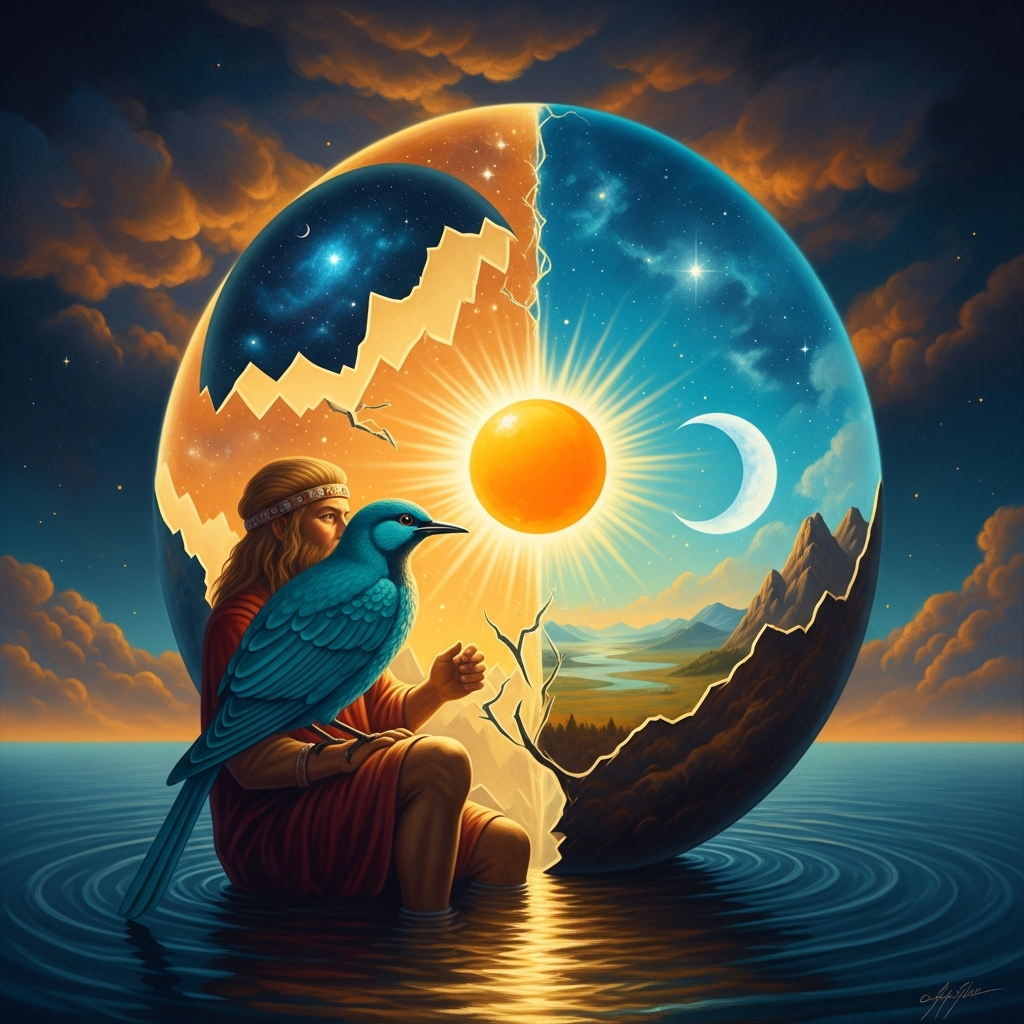
The bee crosses the moon. The bee crosses the sun. The bee crosses the seven cosmic vaults that Finnish cosmology stacks above the world, and at the top, in the hall of Ukko, the bee finds a single jar of the honey that the runos call the salve of life. The bee fills its small body with one drop. The bee flies back. The journey takes — the runo says — a day, a week, a moment, the durations of myth where time and space behave as they need to behave.
The bee delivers the honey.
Lemminkäinen’s mother takes the honey on her finger. She touches it to her son’s lips. She touches it to his eyelids. She touches it to the place above his heart. She waits.
His chest rises.
It rises slowly, the way a sleeping man’s chest rises in deep sleep, but it rises. The eyes blink. The mouth, which had been slack, closes. The fingers — which had been still — flex.
Lemminkäinen wakes up.
He sits up on the grass. He looks at his mother. He looks at the rake. He looks at the river, and at the cattle-pasture above it, and at the eight places on the grass where the eight pieces of him had been laid out, and he says — the runo gives us his exact words — Mother, what a long sleep I had.
He does not remember the dismemberment.
He remembers the snake. He remembers falling into the water. The long sleep is what the Finns call the time the soul spends in Tuonela: it is not nothing, but it is not memory either; it is the cold place where the dead lie still and the rivers are slow and the swans are black, and you do not remember it after, the way you do not remember being inside the egg.
She takes him home.
She has to lead him. He is unsteady on his legs — the joints, freshly sung together, do not quite know each other yet — and she walks beside him with the copper rake on her shoulder and her son leaning on her arm. They walk the nine days back. The forests are still there. The wolves still let them pass. The innkeepers still give bread.
When they reach home, the brush above the hearth is dry.
She takes it down from its peg. She washes it in cold water. She rehangs it. She looks at it for a long time. She does not throw it away. She knows her son. She knows there will be other journeys, other Pohjola tasks, other blind herders he will fail to greet. The brush will bleed again. She will go again.
This is what mothers do, in the runos.
The Finns who sang this song understood what the myth was telling them. They sang it in the long northern nights, in the houses where the doors froze shut and the children died of fevers and the husbands did not come back from the sea. The song was not a lie about death. The song was a description of the only thing in the world that had ever been seen to argue with death and win — and what the song called that thing was äiti. Mother.
Mother with her rake, walking down to the river of the dead, gathering her child piece by piece from the cold water.
It is the oldest story we have.
It may, in fact, be the only story.
Echoes Across Traditions
Entities
- Lemminkäinen
- Lemminkäinen's Mother
- Louhi (Mistress of Pohjola)
- The Blind Herder of Pohjola
- The Black Swan of Tuonela
- Tuoni

Sources
- Kalevala, runos 13–15 (compiled by Elias Lönnrot, 1849)
- Keith Bosley translation, *The Kalevala* (Oxford World's Classics, 1989)
- Eino Friberg translation, *The Kalevala: Epic of the Finnish People* (1988)
- Juha Pentikäinen, *Kalevala Mythology* (1999)
- Lotte Tarkka, *Songs of the Border People: Genre, Reflexivity, and Performance in Karelian Oral Poetry* (FF Communications, 2013)