The Simurgh's Child
Shahnameh of Ferdowsi, c. 977–1010 CE; echoes in Avestan tradition · Mount Alborz, the cosmic mountain; the nest of the Simurgh above the world
Contents
When Sam the hero-warrior sees that his newborn son has hair as white as snow, he abandons the child on Mount Alborz. The great Simurgh, a bird so ancient it has watched three destructions of the world, finds the infant and raises him as her own. She names him Zal. When he finally returns to the world of men, she gives him three feathers to burn if he ever needs her.
- When
- Shahnameh of Ferdowsi, c. 977–1010 CE; echoes in Avestan tradition
- Where
- Mount Alborz, the cosmic mountain; the nest of the Simurgh above the world
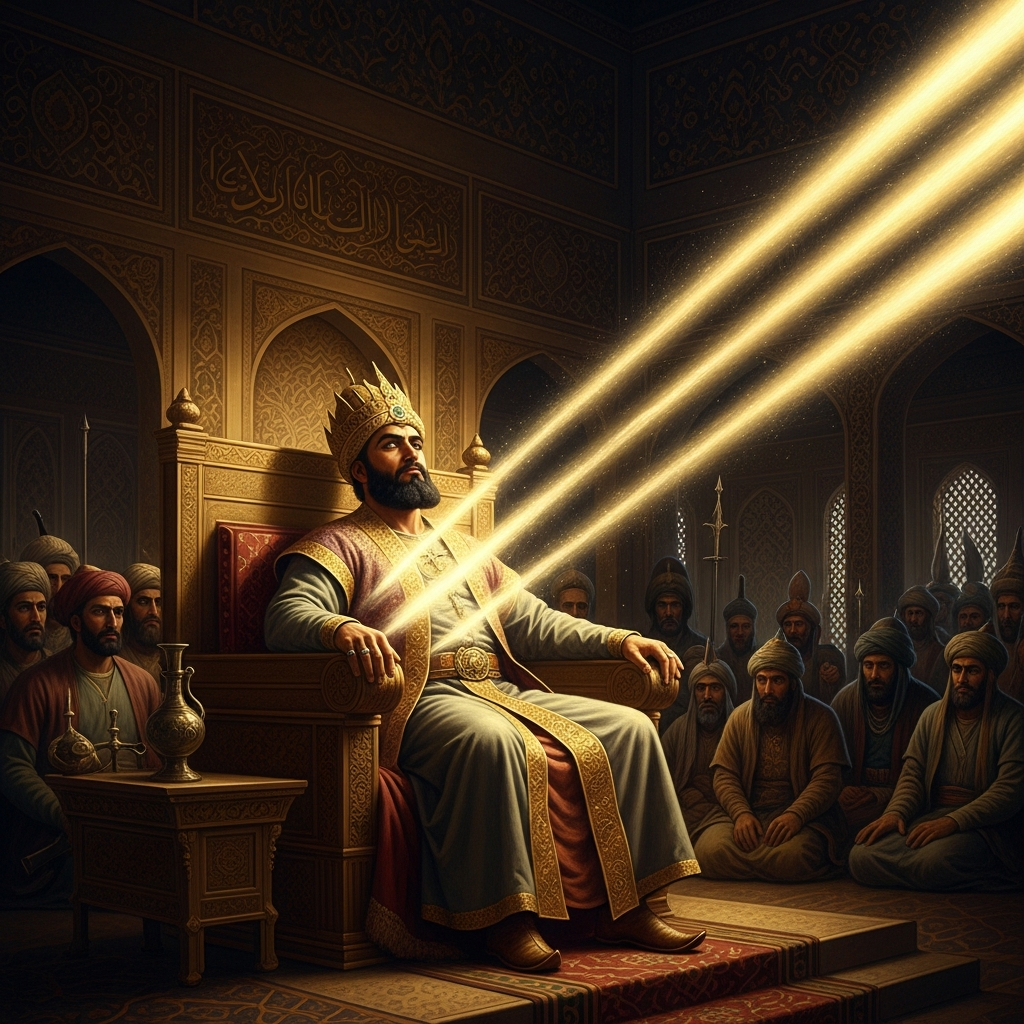
Sam is one of the great warriors of the Persian world. He has fought at the edges of the known lands; he has carried a lance so heavy it requires two ordinary men to lift it; the king of kings has honored him before his court. He is not a man given to uncertainty. His hands have never trembled.
The hands tremble when they bring him his firstborn son.
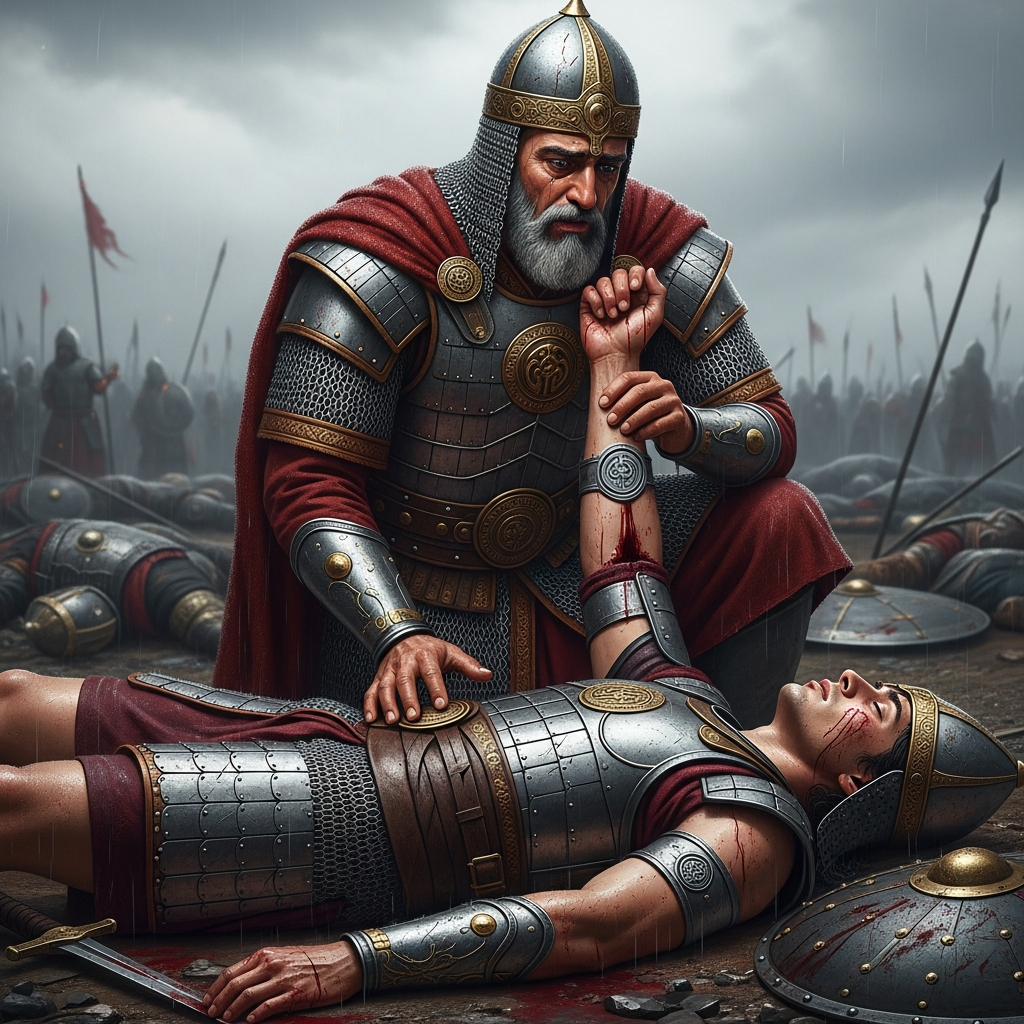
The midwives have washed the child and wrapped him and are presenting him in the way midwives present, with a small ceremony of words about the parents’ good fortune, when Sam sees the hair. He stops hearing the words. The child’s hair is not the dark hair of his tradition, not the black or deep brown of every face he has known — it is white. White as winter, white as bone, white as the hair of an old man, on an infant’s head.
It is not a mark of blessing in the tradition Sam carries. It is a mark of the uncanny. Something has touched this birth. Something from outside the ordinary spectrum of the world.
Sam has the child taken away. He does not look at the boy again.
He orders the child exposed on Mount Alborz.
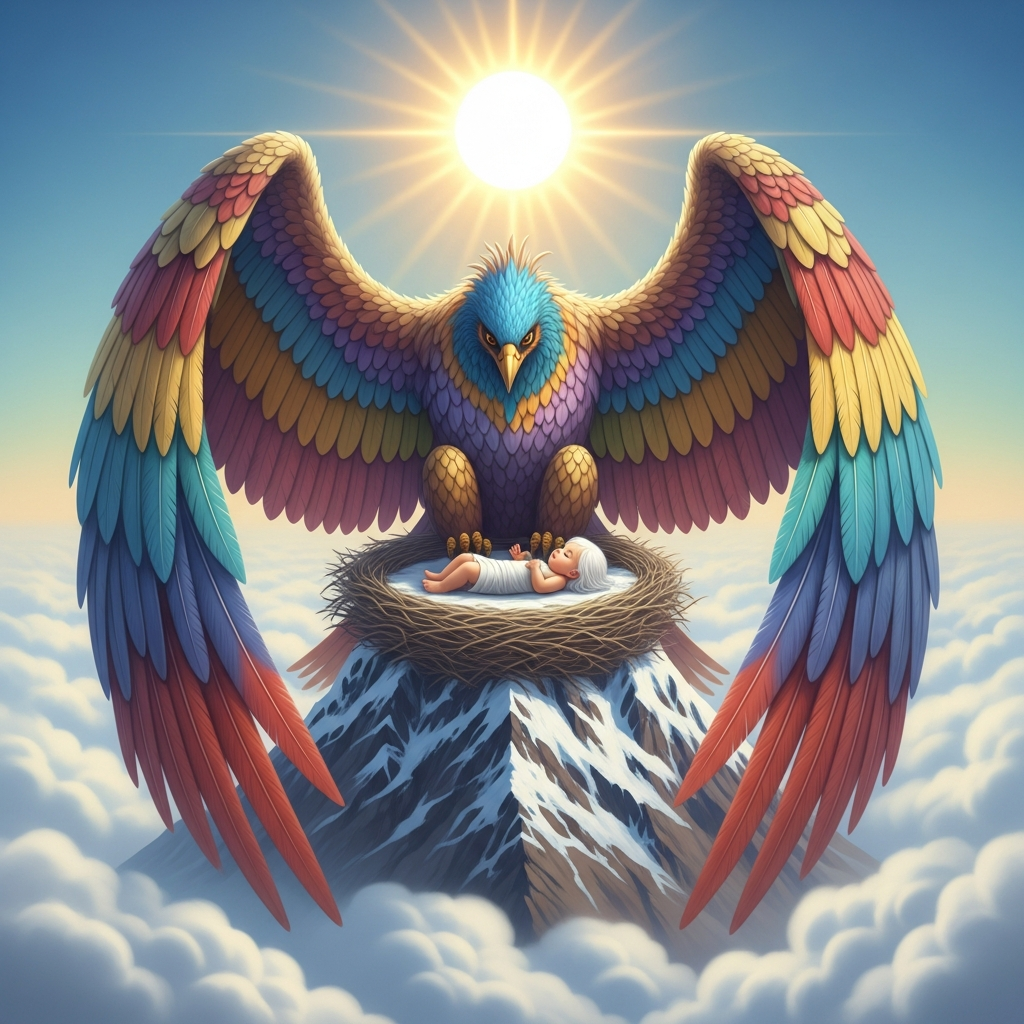
Mount Alborz is the cosmic axis of the Persian world. It is the mountain at the center, the mountain that connects earth and sky, the mountain whose roots descend to the foundations of the world and whose peak is above the atmosphere. On its upper slopes, the Simurgh has her nest.
The Simurgh is older than she appears.
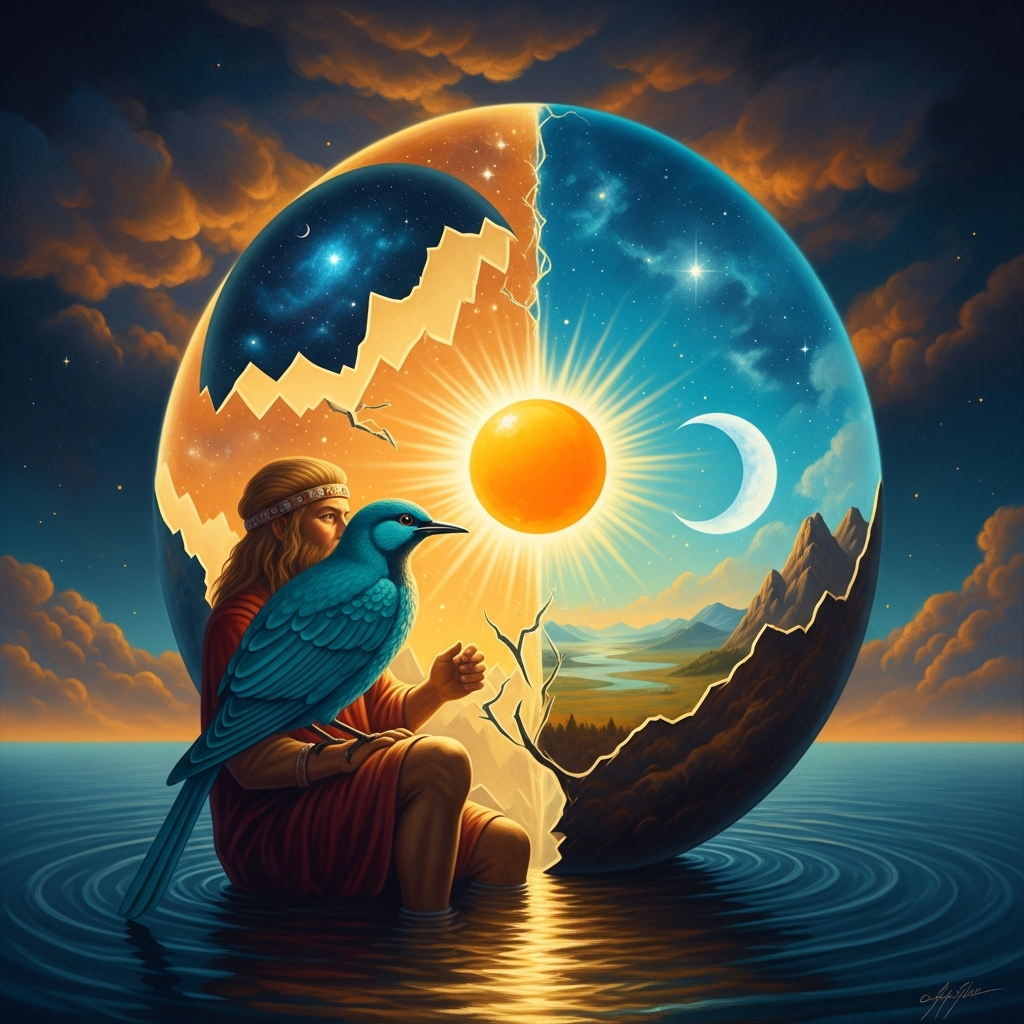
She has appeared as a great peacock-bird with feathers the color of copper and gold and the iridescence of oil on water. She has a beard like a sage’s. Her wingspan casts a shadow over valleys. The nest she has built on Alborz is constructed from the tallest trees she has carried from every forest in the world, and the bones of whatever she has hunted over centuries are woven into the structure as ribs.
She has watched three destructions of the world. She has seen species appear and vanish. She has watched the oceans shift. She is not immortal in the way gods are immortal — she is mortal, but so long-lived that mortality and immortality have become an academic distinction. She is the keeper of all knowledge that was alive in previous ages: she knows the names of every plant that has ever existed and what it can cure; she knows the positions the stars held when the world was younger.
When the soldiers leave the infant on the slope, she sees it from the nest.
She watches for a moment. She has the intelligence to know what she is seeing — an abandoned human infant, the fact of abandonment not obscure — and she descends.
She does not eat the child. This would be the obvious reading of a giant bird of prey descending on an exposed infant, but Ferdowsi is clear: she circles once and sees the child’s white hair and sees in the white hair something that requires a different response. The white is not a corruption. It is a sign, though of what the myth does not say directly. She lands. She picks the child up in her talons with the precision and care of a falcon moving eggs — nothing broken, nothing torn.
She carries him to the nest.
She names him Zal. She feeds him herself in the way birds feed their young, and then, as he grows, she brings him the game she hunts. He grows in the nest above the world. He learns the language of the bird — not speech exactly, but communication; the Simurgh’s intelligence is accessible to the child in her care in ways that are not translatable into Persian or any other human tongue.
He grows up knowing the properties of every plant on the mountain. He knows which root closes wounds. He knows which bark relieves fever. He knows which stone face holds warmth longest after sunset. He knows the stars by their individual characters rather than their patterns. He does not know what a city is. He does not know what a court is.
He knows that somewhere below the mountain there are people who look like him. He has seen them, distant, in the valleys. He has wondered.
Sam dreams.
He is an older man now, and the court has kept him busy, and he has not thought about the white-haired child in some years. The child has been successfully removed from consciousness. And then: the dream.
In the dream, a young man on the slopes of Alborz looks down from a great height, and his hair is white, and his eyes are his father’s eyes. The dream is not subtle. The dream involves a horseman arriving with the message that the Simurgh has raised his son and that his son has grown into a wonder. Sam wakes with the dream-message still audible.
He assembles his army and rides to the mountain.
The Simurgh sees him coming from the nest. She has known this moment was approaching — she knew it when she took the child, in the way she knows everything that will follow from a given cause. She does not fight for him. She does not posture. She calls Zal to her and she tells him what is happening, and she tells him who the men below are, and she tells him that he will go with them.
Zal does not want to go.
She speaks to him for a long time. She tells him about the world below, about his father’s lineage, about the destiny that attaches to white hair and a mountain upbringing when they are combined in the same person. She tells him about a woman named Rudabeh whose hair will fall like rope from a window, about a son who will be born from a wound, about a hero so large the world will not know what to do with him.
She tells him: Take three feathers from my wing. If you are ever in a place beyond your own power — not merely danger, but genuine extremity — burn one feather. I will come.
She pulls three feathers from her left wing and places them in his hands.
He goes down the mountain.
Sam sees his son descending and his heart, which is his father’s heart and therefore not easily moved, does what it does: it moves. He dismounts. He goes to the boy on foot. He takes the white head in his hands and holds it against his chest. The army watches the great hero weep into the hair of a young man who smells of the Simurgh’s nest — of high altitude and ancient feathers and the blood of mountain game.
He brings Zal to court. The king receives him with amazement and delight; the astrologers cast his chart and find extraordinary things. A life that will produce the greatest warrior in Persian history. A lineage that will defend the world through cycles of kings.
Zal grows into a man of extraordinary counsel — scholar, statesman, the kind of advisor who sees three moves past the present crisis. He marries Rudabeh of Kabul. He travels on the adventures the Shahnameh requires of him. He burns the feathers at the appointed times.
The first feather: when Rudabeh is in a labor so difficult that both mother and child are dying. The Simurgh descends immediately and instructs the midwife to open Rudabeh’s side — a cesarean, three thousand years before the name — and the child is lifted out alive. That child is Rostam. He is the size of a small adult at birth. He is the reason the Simurgh gave the feathers.
The second feather: at a battle Zal cannot see his way through.
The third feather: the tradition does not agree on when he burns it, or whether he burns it at all. Some versions say he keeps the last feather until he dies, and it is burned at his funeral, and the Simurgh descends one final time to receive it back.
The Simurgh endures in Persian and Sufi thought long after the Shahnameh’s narrative closes. The Sufi poet Attar wrote The Conference of the Birds in the twelfth century, in which thirty birds make a pilgrimage across seven valleys to find the Simurgh — and discover, in a famous pun on the Persian, that si morgh (thirty birds) and Simurgh (the bird) are the same word. The seeker and the sought are the same being. The birds who survive the quest look into the lake at the journey’s end and see themselves.
This is the Simurgh’s deepest character: not merely an external helper with knowledge to lend, but a mirror of the pilgrim’s own depth. When she gave Zal her feathers, she was not giving him alien power. She was giving him a way to call on what was already in him — formed on her mountain, under her wing, above the ordinary world.
The nest is gone. Mount Alborz is still there. Climbers in winter, above the snowline, sometimes hear something.
Echoes Across Traditions
Entities
- The Simurgh
- Zal
- Sam (Zal's father)
- Rudabeh
- Rostam (Zal's son to come)
Sources
- Abolqasem Ferdowsi, *Shahnameh* (Book of Kings), c. 977–1010 CE, trans. Dick Davis (Penguin, 2016)
- Annemarie Schimmel, *The Mystery of Numbers* (Oxford University Press, 1993)
- Encyclopaedia Iranica, s.v. 'Simurgh' (online edition)
- Sadeq Hedayat, *Neyrangestan* (1933) — on the Simurgh in Iranian folklore
- Henry Corbin, *The Man of Light in Iranian Sufism* (1971)