Combat Profile
Hammer of Ukko
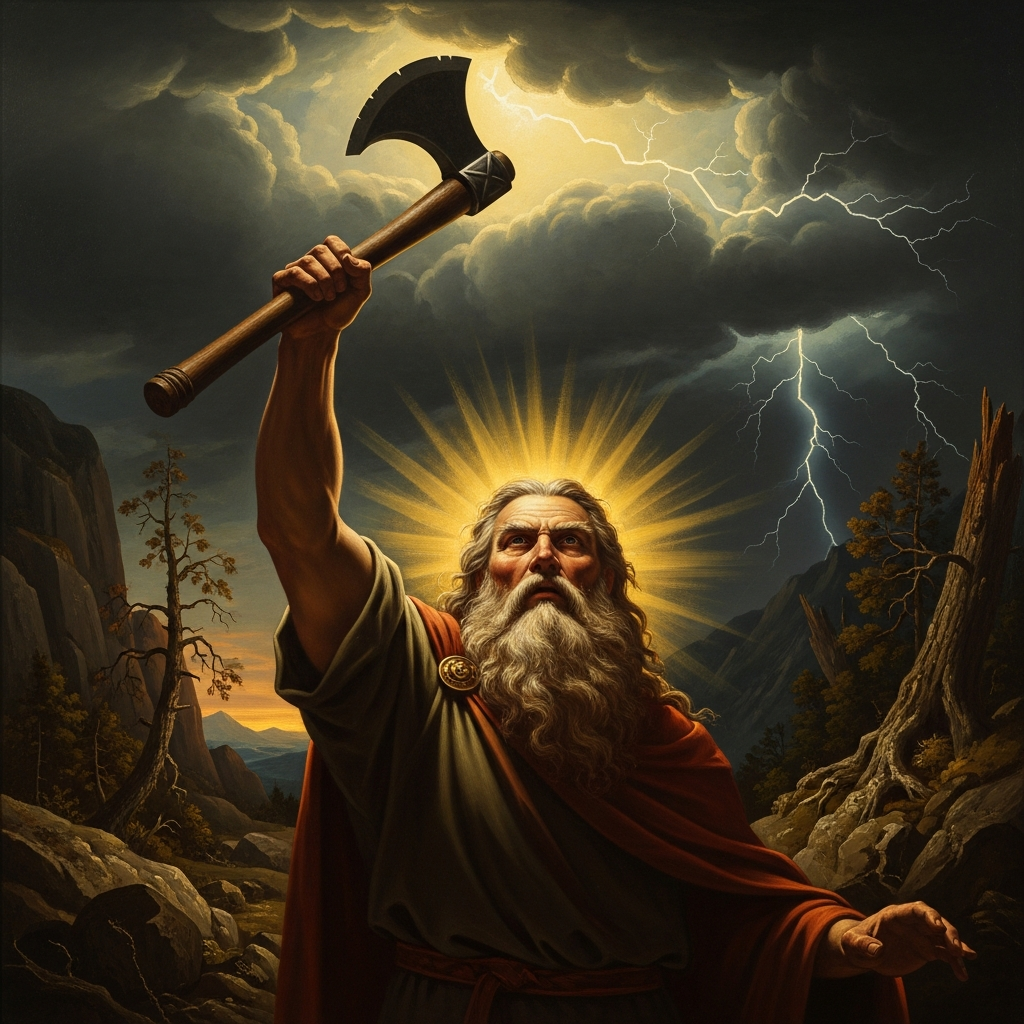
Ukko hurls his stone hammer (*Ukonvasara*); the strike deals lightning damage and the stone returns to his hand. The thunderclap itself paralyzes any spirit of disorder within hearing
Sky's Guarantor
While Ukko reigns, the basic cosmic cycles (rain, thunder, the seasons) cannot be permanently disrupted; chaos-events affecting weather are reversed within one full lunar cycle
Ukko is the supreme god of the Finnish pantheon — the thunderer, the sky-father, the rain-bringer, and the most consistently invoked deity in the surviving spell-tradition. His name simply means “old man,” used as a respectful epithet, the way English speakers say “the Almighty” rather than uttering the proper name. He is sometimes called Ylijumala (“highest god”) or Iso-Ukko (“great old man”). He wields a hammer (Ukonvasara) and an axe, and his hammer-blow is the lightning-strike. The thunderclap is Ukon ilma, “Ukko’s weather.”
In the surviving folk tradition, Ukko is invoked at every spring planting (Ukon vakka, the festival where beer-bowls were dedicated to him to ensure rainfall) and whenever rain is needed for crops. He is more distant than the woodland and water spirits — heroes do not converse with him directly the way they bargain with Tapio or Ahti — but he is the ultimate guarantor of cosmic order and the one whose anger manifests as the thunderstorm. The Christianized peasants of nineteenth-century Karelia were still discreetly invoking Ukko alongside their Lutheran prayers when the rain failed.
Biblical Parallels: Ukko parallels Yahweh in his thunder-aspect — the Yahweh of Exodus 19 descending on Sinai in cloud and lightning, the Yahweh whose voice is “upon the waters” and “breaks the cedars” (Psalm 29). His hammer parallels nothing biblical directly, but the divine warrior with celestial weapon is a recurring biblical image (Habakkuk 3:9-11).
Cross-Tradition: Direct cousin of Norse Thor (hammer, thunder, stone-axe weapon, name Þórr = “thunder”), Slavic Perun, Lithuanian Perkūnas, Greek Zeus, Roman Jupiter, and Vedic Indra. The “hammer-wielding sky-thunderer” is the most secure archetype in Indo-European reconstruction; the Finnish Ukko (a Uralic, not Indo-European, deity) likely absorbed substantial influence from Norse-Baltic neighbors during the Iron Age.
1 min read