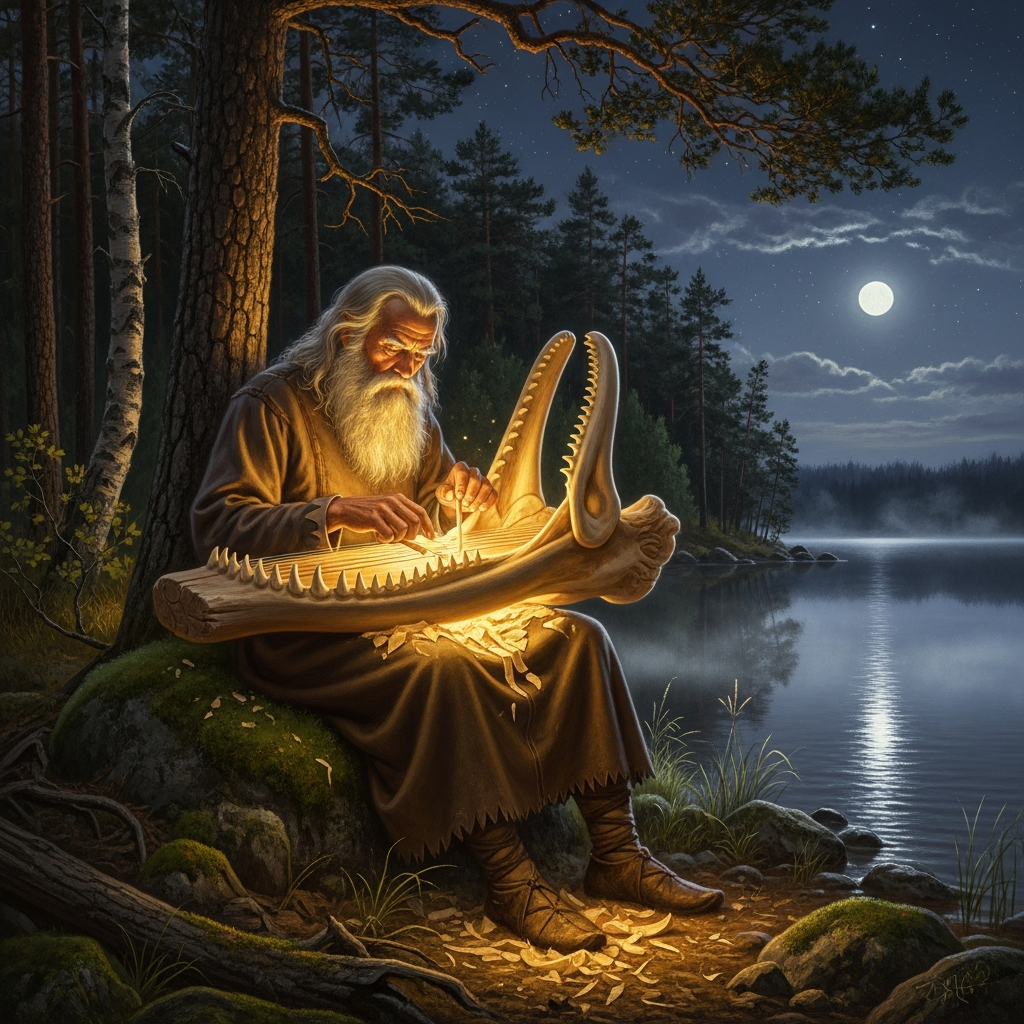
Väinämöinen and the Kantele of Pike-Bone
Mythic time, songs preserved in oral Finnish-Karelian tradition until Lönnrot's compilation in the 19th century · The lake-country of Kalevala, the boat on dark water, the shore where the kantele is first heard
Contents
After a failed fishing expedition where his boat strikes the back of a monstrous pike, Väinämöinen pulls the great fish from the lake and carves its jawbone into a stringed instrument. When he plays the first kantele, the rivers stop, the bears come down from the forest, and the sun and moon lean closer to listen — and Väinämöinen himself weeps so hard his tears become pearls on the seafloor.
- When
- Mythic time, songs preserved in oral Finnish-Karelian tradition until Lönnrot's compilation in the 19th century
- Where
- The lake-country of Kalevala, the boat on dark water, the shore where the kantele is first heard
The boat scrapes against something in the dark water.
Väinämöinen has been fishing all morning. His hooks have come up empty. His net has come up empty. The lake of Tuonela — which is one of the lakes that touch the underworld at their deepest place — has given him nothing all day, and he has been about to row back to shore when the keel of his boat strikes a long, smooth shape under the water and the boat tilts and almost goes over.
He stops rowing.
He looks down. The water is black. He cannot see what struck him. But he feels — through the wood of the boat, through his hands on the oars — the slow turning of an enormous body in the lake beneath him.
It is the great pike. The pike of Tuonela. The fish that has been growing in this lake since the first runo was sung, whose back is broad as a barn-door and whose jaw is the size of a sled. He has heard the songs about it. He did not know it was real.
He throws the iron hook.
The fish comes up only at the third throwing.
It rises from the water with the slow inevitability of a mountain breaking the surface — first the back, then the dorsal fin, then the head, then the jaw the size of a doorway, the jaw lined with teeth like inverted hatchets. The water falls off it in sheets. The boat is rocking violently. Väinämöinen is bracing his feet against the gunwales and hauling on the line with both hands, and the pike comes up beside the boat and looks at him with one eye the size of a millstone.
He kills it with the song he sings. Not with the spear. The spear is for show. He sings the pike’s death-song into its open mouth, and the great body shudders once, and the eye goes flat, and the pike rolls onto its side on the surface of the lake and floats there.
He tows it to shore.
The body is too heavy to lift. He has to butcher it on the beach.
When he gets to the head, he stops.
The jawbone is shaped like the curve of a boat. It is white, polished, perfect. The teeth have fallen out in the killing; what remains is a long arc of bone with seven small holes along its length where the nerves used to run, and Väinämöinen — sitting on the wet sand with the jaw across his knees — understands suddenly what he is looking at.
He has been a singer his whole life without an instrument. The runos have been carried in his mouth alone, on the breath, accompanied only by the rhythm of his hands on his thighs. He has never needed more than that. But here in his hands is the curved bone, and the seven holes for strings, and he knows — the way a craftsman knows a tool he has never seen before — that this is the first kantele.
He carves it that night by the fire.
He uses the hair of a young horse for the strings. He uses pine resin to seal the joints. He fits five strings to begin with, then later seven, then later as many as nine, and the body of the instrument is the curve of the pike’s lower jaw and the soundbox is hollowed from the bone of its skull. When the moon rises over the lake he is finished. He sits with the instrument across his knees. He plucks one string.
The string sings.
He plays.
He has never played anything in his life. He has only sung. But the kantele is teaching him as he plays it — the way a horse teaches a rider on the first ride, by being already what it is — and what comes out of the instrument under his fingers is not music in any sense Väinämöinen has heard before. It is the sound the pike’s bone wanted to make all those centuries it was alive. It is the sound the seven holes had been holding. It is the sound of the lake itself, given hands.
The lake hears it first.
The water stops moving. The wind stops on the surface. The reeds stop their swaying. The stars in the water stop trembling and become, briefly, the same stars as the ones in the sky — perfect and still.
Then the forest hears it.
The bears come down out of the trees. They sit at the edge of the clearing on their haunches and they do not move and they do not threaten; they listen. The wolves come behind them and lie down with their snouts on their paws. The lynx comes. The reindeer come. The hare and the fox lie down beside each other and do not look at each other; they look at Väinämöinen.
Then the sky hears it.
The moon, who has been moving across the sky on her steady track, slows down. She bends a little closer to the lake to hear. The sun, who is somewhere on the other side of the world, lifts her face and listens. The stars stop their slow wheeling. The aurora — which the Finns call the revontulet, the fox-fires — flares once and goes still, hanging across the northern sky like a curtain that has stopped breathing.
Even the dead hear it.
In Tuonela, in the great hall of the death-goddess Tuonetar, the souls of the dead pause in their grey work and turn their faces toward the upper world. They have not heard music in a long time. They remember, briefly, the lives they used to have. They weep, briefly, the way the dead weep — without sound, without tears, the weeping that is only memory moving inside a body that no longer has feeling.
And then Väinämöinen weeps.
This is the part of the story the Finns are careful about.
The first kantele-player, who has just produced the most beautiful music in the history of the world, who has stopped the moon and quieted the bears and made the dead remember themselves, sits on the shore beside the carcass of the pike and begins to cry. He cries for a long time. He cries for the pike, who is dead. He cries for the song he just played, which he will not be able to play again exactly — first songs are unrepeatable. He cries for Aino, who walked into the sea rather than marry him. He cries for Joukahainen’s mother. He cries for the years he has been alive without this instrument, and for the people who died before he had it. He cries for the world that is now permanently changed because the kantele exists in it.
His tears fall into the lake.
They fall into the lake and they sink. They sink past the surface. They sink past the reeds. They sink past the depth where light can reach. They sink to the seabed of Tuonela’s lake, and there — in the dark, in the cold, in the layer of silt that has been settling for centuries — the tears of Väinämöinen become pearls.
The Finnish songs are emphatic about this. The pearls are still down there. They are blue, the color of weeping. They cannot be retrieved. Anyone who dives for them will not come up; the water claims them. The pearls are the cost of the first music, lying on the seafloor of the underworld, where they will remain until the kantele plays its last song and Väinämöinen’s tears stop falling.
The kantele itself, in the runos that follow, is lost.
It falls overboard in a storm during the journey to steal back the Sampo. It sinks into the sea. Väinämöinen weeps over its loss, and from that second weeping he carves a second kantele — this one from the wood of a weeping birch tree, with strings of a maiden’s golden hair, because the pike-bone instrument was not the kind of instrument you can make twice. The second kantele is also beautiful. It is not the same.
The Finns who sang the runos in the long winter nights, in the smoke-blackened cottages of Karelia, in the centuries before Lönnrot wrote them down, understood what the myth was telling them. They sang it sitting on benches in firelight. They sang it with the kantele on the singer’s lap, the curved instrument that was once a pike’s jaw, the seven strings under the fingers, the soundbox carved from the cosmos’s body.
They sang it because they had learned what Väinämöinen learned on that beach.
The fish you cannot catch becomes the instrument you cannot stop playing.
The failure becomes the song.
And the tears that fall while you make the song become, in time, the pearls that prove the song was real.
Echoes Across Traditions
Entities
- Väinämöinen
- The Pike of Tuonela
- Ahti (lake spirit)
- Vellamo (sea queen)

Sources
- Kalevala, runos 40–41 (compiled by Elias Lönnrot, 1849)
- Keith Bosley translation, *The Kalevala* (Oxford World's Classics, 1989)
- Eino Friberg translation, *The Kalevala: Epic of the Finnish People* (1988)
- Juha Pentikäinen, *Kalevala Mythology* (Indiana University Press, 1999)
- Anna-Leena Siikala, *Mythic Images and Shamanism: A Perspective on Kalevala Poetry* (FF Communications, 2002)