The Song-Duel of Väinämöinen and Joukahainen
Mythic time, ancient Karelian-Finnish oral tradition · A narrow forest road in Kalevala where two sleds meet, the bog where Joukahainen sinks, the threshold of his mother's house where Aino learns her fate
Contents
The young braggart Joukahainen meets the old singer Väinämöinen on a forest road and demands a duel of runos. The duel turns out to be one-sided: Väinämöinen sings the boy into the bog up to his armpits, sings his sled into willows and his horse into rocks, and only releases him when Joukahainen offers his own sister Aino as a bride-price for his life.
- When
- Mythic time, ancient Karelian-Finnish oral tradition
- Where
- A narrow forest road in Kalevala where two sleds meet, the bog where Joukahainen sinks, the threshold of his mother's house where Aino learns her fate
The road is narrow.
It is a forest road in early winter. The snow is just deep enough to cover the ground but not deep enough to slow a sled. There are spruce trees on either side, dark green, heavy with snow. There is a single track where sleighs have passed in the morning. The track is wide enough for one sled.
Two sleds are coming toward each other on the track.
One of them is moving south. It is driven by an old man — Väinämöinen, with his white beard, his fur cloak, his calm hands on the reins. His horse is a quiet brown gelding. His sled is small. He is going somewhere or coming back from somewhere; the runo does not say. He is humming to himself.
The other sled is moving north. It is driven by a young man — Joukahainen, with his thin black mustache, his fox-fur hat at a sharp angle, his hands tight on the reins. His horse is a young white stallion that he has been driving too hard. His sled is large and ornate, with brass fittings, with a high prow carved into a serpent’s head. He is muttering to himself. He is in a bad mood.
They see each other.
They both keep coming.
Neither slows down.
This is the problem. Neither of them gets out of the way. The road is wide enough for one sled. They both have to stop or one of them has to back up, and Joukahainen — who is twenty-three, who is a chieftain’s son from the far north, who has heard about Väinämöinen but never seen him — does not believe in backing up.
The sleds collide.
The shafts crack. The horses scream. The brass fittings of Joukahainen’s sled tear into the wood of Väinämöinen’s. The two horses rear up and almost go over backward, and the two men are both thrown forward, and there is a bad moment when the whole tangle could go off the road into the snow.
It does not. Both sleds stop.
Both men stand.
The runo gives them a long pause to look at each other. They look at the damage. They look at the horses. They look at each other. Then Joukahainen — who is angry, who has been angry all morning, who is now angrier than he was — says the wrong thing.
He says: Move your sled, old man.
Väinämöinen does not answer at first.
He looks at Joukahainen. He looks at the boy’s hat. He looks at the boy’s hands on his hips. He looks at the boy’s expensive sled. He says, mildly, Who are you, that an older singer should move for?
Joukahainen pulls himself up.
This is the part the runo dwells on, because the runo loves this kind of foolishness. Joukahainen lists his accomplishments. He says — in the meter the runo uses for boasting — I am Joukahainen, son of Loutohella, of the great farm at the end of the great lake. I am young, but I am wise. I have learned the runos. I know how the world was made; I know where the wind comes from; I know why the salmon swims upstream and the swan is white. I have studied with the masters. I am not to be moved off the road by any old man.
Väinämöinen lets him finish. He waits.
Then he says, quietly: Tell me one thing about how the world was made, then, and I will move my sled.
Joukahainen begins.
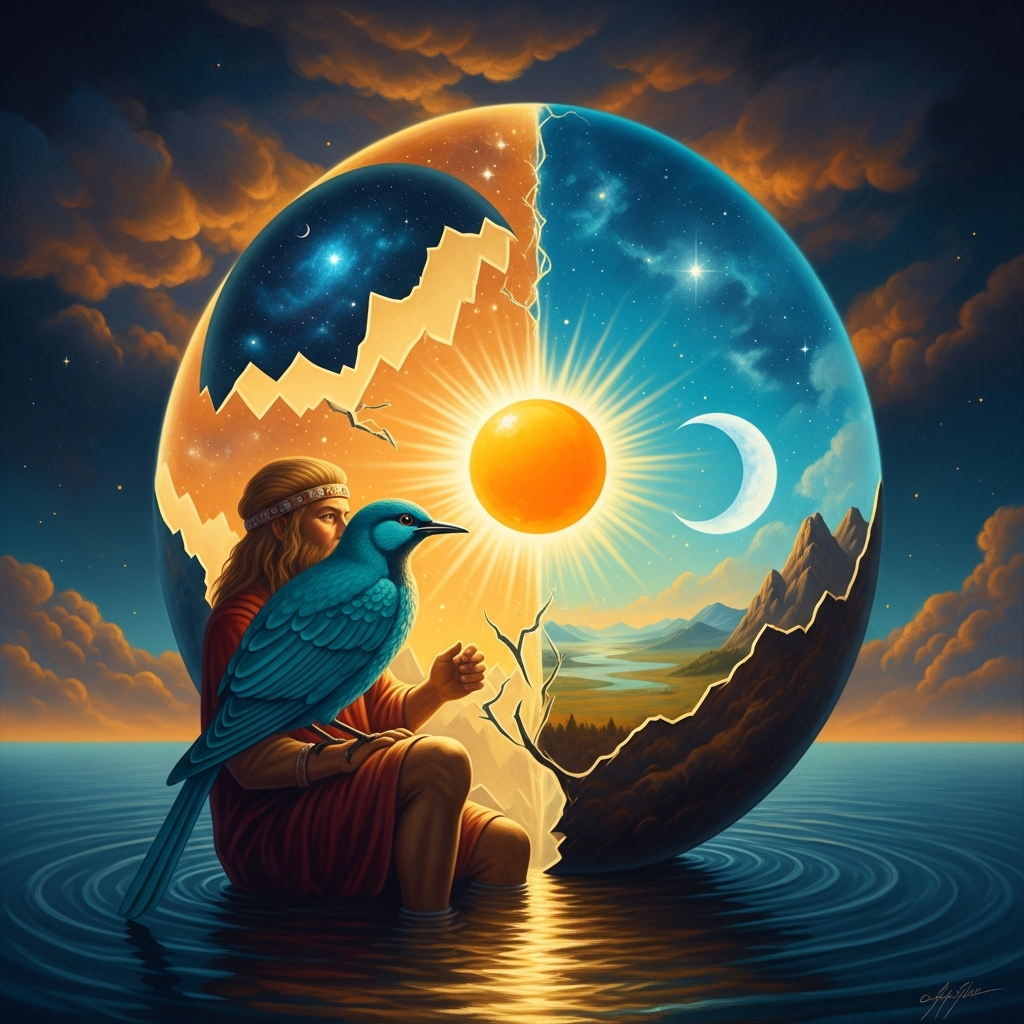
He tries to recite the cosmogony — the runo of the world-egg, the maiden Ilmatar, the teal — but his version is wrong in small ways. He has the order of the eggs wrong. He has the colors mixed up. He says the yolk became the moon and the white became the sun, when it is the other way around. He gets confused about which knee the teal landed on. He says the maiden was floating face-down when she was face-up. He recovers, mostly, but his recovery is unconvincing, and Väinämöinen — who was there, who has actually been the unborn child in the maiden’s womb during the events being described — listens with the patient face of an old teacher hearing an examination he is going to fail the student on.
Joukahainen finishes.
He looks at Väinämöinen expectantly. Väinämöinen does not move his sled.
That was incorrect on six points, Väinämöinen says. Try again.
Joukahainen tries again. He tries the runo of the great oak — the cosmic tree that grew so high it blocked out the sun, until a little man rose from the sea and chopped it down with a small axe. Joukahainen has the species of the tree wrong, and the height wrong, and he forgets the small man entirely. Väinämöinen lets him finish. Väinämöinen does not move his sled.
Joukahainen — who is now red-faced, who has lost his composure — does the only thing he can think of. He challenges Väinämöinen to a song-duel.
The song-duel.
This is the formal contest. It is a real institution in Finno-Karelian culture; the runos describe it in many places. Two singers face each other, and they sing alternating runos, and whichever singer’s runos are stronger — judged not by audience but by physical effect, by what the song actually does to the world — wins.
Väinämöinen agrees.
He gets out of his sled. He sits down on a rock at the side of the road. He folds his hands in his lap. He says, Sing.
Joukahainen sings.
He sings the runo of the iron-mountain. He sings about how iron was discovered, about the three maidens who walked across the sky and dripped milk into the bog, about how the milk became iron-ore. He sings well; he has practiced this runo. He gestures at the rock he is sitting on, expecting it to soften, to become iron, to demonstrate the song’s power.
Nothing happens.
The rock is still a rock. The runo is correctly sung but it has no effect. Joukahainen looks at the rock. He looks at Väinämöinen. He sings the runo of the fire — about how Ukko struck a spark from his sword and the spark fell from the sky into a tree and started the first fire. He sings well. He gestures at a fallen branch on the ground, expecting it to ignite.
Nothing happens.
The branch lies there cold. Joukahainen sings a third runo, and a fourth, and a fifth — all of them well-known runos, all of them correctly sung, all of them metrically clean. None of them has any effect on the world. Joukahainen is reciting; he is not singing in the magical sense. The difference between Väinämöinen and Joukahainen is now visible to both of them and to the trees.
Väinämöinen has not yet sung a single line.
Joukahainen sits down.
He has run out of runos. He sits on his sled, breathing hard, his fur hat tilted, his face the color of old brick. He looks at Väinämöinen. He says — in a voice that has lost all the morning’s bravado, that has become a small voice, a boy’s voice — now you sing.
Väinämöinen sings.
He sings two lines.
The two lines are about Joukahainen’s sled. The runo records the lines: they are short, plain lines, of the kind any singer would dismiss as ordinary. But the lines turn the sled into willows. The carved prow becomes a willow stump. The brass fittings become willow knots. The runners become willow saplings. The whole thing is a small thicket of willows growing in the middle of the road, swaying slightly in the cold wind.
Joukahainen stares.
Väinämöinen sings two more lines.
These are about the white stallion. The horse becomes a rock. A long, smooth, granite rock, in the harness, with the harness still on it but the horse-shape gone, just the stone with the leather hanging.
Joukahainen says, Stop.
Väinämöinen sings two more lines.
These are about the harness. The harness becomes briars — long, thorny briars, growing where the leather used to be, twining themselves around the willow-thicket and the granite-rock.
Joukahainen says, Please stop.
Väinämöinen does not stop.
He sings about the saddle: it becomes a duck-pond, a small still pond of cold dark water in a depression in the road, with one duck on it. He sings about Joukahainen’s whip: it becomes a reed in the duck-pond. He sings about the dog that Joukahainen had been carrying in the sled, a small terrier: the dog becomes a stone with paws drawn on it.
He sings about Joukahainen’s sword.
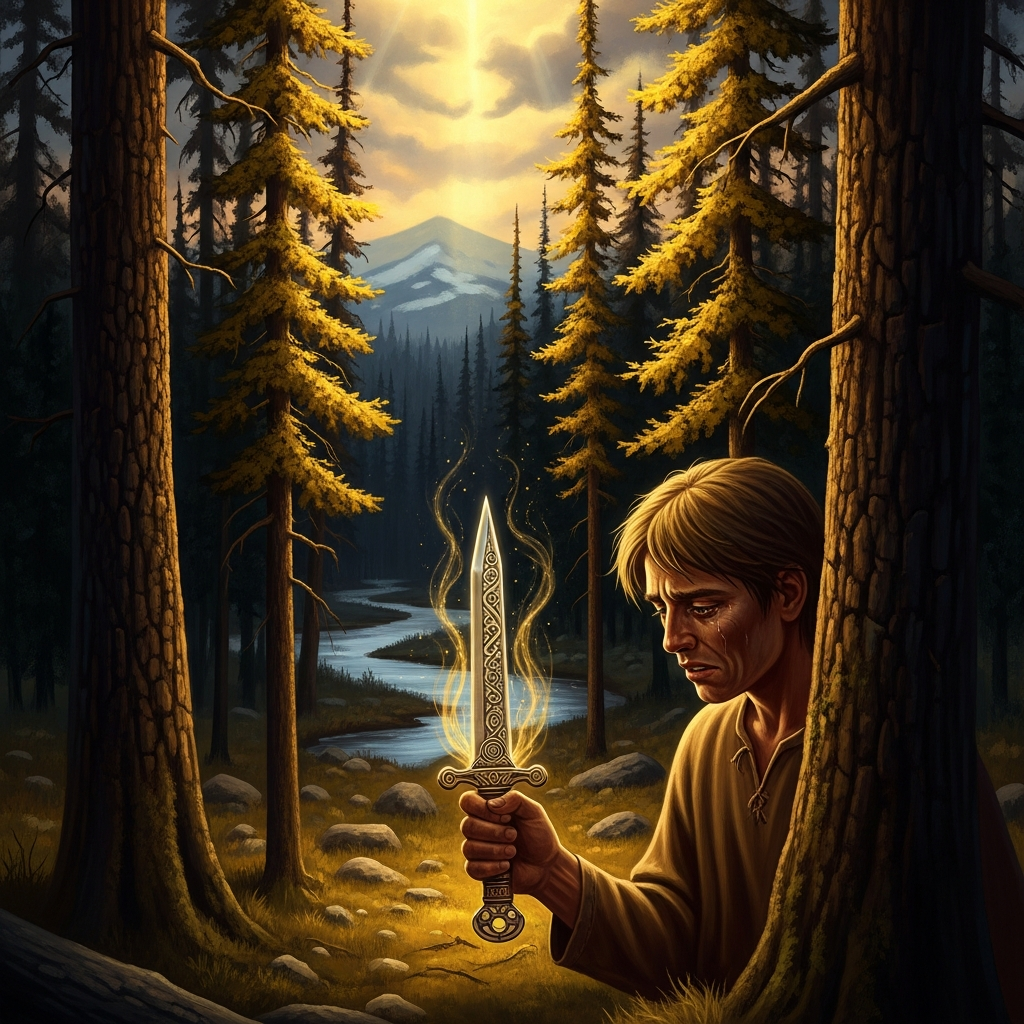
The sword becomes a flash of lightning, captured in the air, hanging above the road, motionless. (The runo says the lightning is still there, in some accounts. Karelian travelers in the 19th century reported seeing it.)
He sings about Joukahainen’s hat.
The hat becomes a cloud. Just a small white cloud that drifts up out of the duel-area and joins the other clouds in the sky and is gone.
He sings about Joukahainen’s mittens.
The mittens become two water-lilies, floating on the duck-pond, white and yellow and quiet.
He sings about Joukahainen’s belt.
The belt becomes a snake. A small green snake that slides off into the underbrush and is not seen again.
He sings about Joukahainen’s coat.
The coat becomes black water — a thin layer of black water, spreading out over the snow at Joukahainen’s feet, refusing to soak in, just lying there shiny and cold.
He sings about Joukahainen’s shoes.
The shoes become two black stones in the snow.
Joukahainen is now standing in the road in his shirt and his trousers, in the snow, with no horse, no sled, no sword, no coat, no hat, no shoes. He is shaking. He is not yet sure if it is from cold or from terror.
Väinämöinen sings about the road.
The road softens.
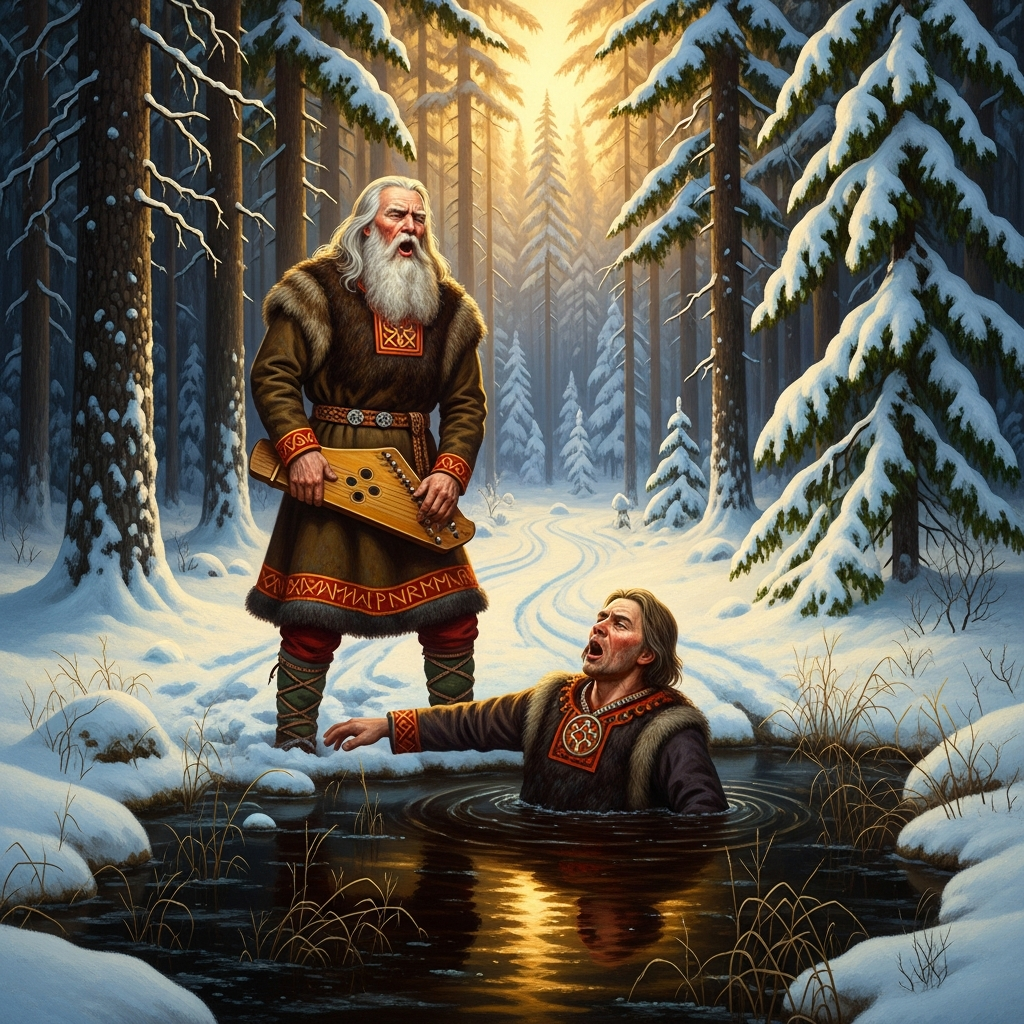
This is the moment the runo has been building toward. The hard-packed snow under Joukahainen’s feet softens into something that is no longer ground. It becomes mud. It becomes deeper mud. It becomes bog. It becomes a deep, sucking, peat-bog of the kind Finland has thousands of, where a man can sink and not come back up. Joukahainen feels his feet go in. He feels his ankles go in. He feels his shins go in. He is sinking. He cannot pull his feet out. He cannot hold himself up.
He sinks to his knees.
He sinks to his thighs.
He sinks to his hips.
Väinämöinen, on the rock, is still singing. He is singing slowly, no faster than a man humming to himself. He is not gloating. He is not enjoying it. He is simply singing the song that the situation requires, the way a carpenter saws a board, with attention but without emotion.
Joukahainen sinks to his waist.
He sinks to his chest.
He sinks to his armpits.
Then Väinämöinen pauses.
He looks at the boy in the bog.
He waits.
Joukahainen, with his head and shoulders sticking out of the wet peat, his arms barely free, says — in a voice that has become high and broken — Stop. Please. I will give you anything. Take my sleds. I have many sleds at home. Take my horses. Take my swords. Take my hats. Take my dogs. Take my mother’s silver. Take my father’s barley-stores.
Väinämöinen does not answer. He waits. He has all the time in the world. He is the older singer.
Joukahainen, panicking, says — and the runo gives us his exact words — Take my sister. Take Aino. She is beautiful. She is unmarried. She will be your wife. I will speak to my mother. The marriage will be arranged by tomorrow. Only get me out of this bog.
Väinämöinen pauses.
This is the part of the runo the audience has been waiting for, because the audience already knows what is going to come of it — knows about Aino, knows what she will do, knows the long disaster that begins with this offer. But Väinämöinen does not know it. Väinämöinen is an old man who has been alone for a long time. He has been told that a beautiful young woman will be brought to him, and the old singer’s loneliness — the loneliness that even his magic cannot sing away — answers before his wisdom does.
He says, I accept.
He sings the bog back into a road.
Joukahainen climbs out.
He is muddy to his hair. He is not wearing shoes; he is not wearing a coat; he has nothing left of his expensive equipage. The willow-thicket is still on the road. The granite-rock that was his horse is still in the harness. The duck-pond is still there with its single duck. He walks home barefoot, in the snow, on the long road north, for two days, weeping and shivering and rehearsing the speech he will have to give his mother.
He arrives at his mother’s house in the evening.
His mother — who has been making bread, who is waiting for her son to come back from his trip — sees him at the door, sees the state of him, runs to embrace him. He pushes her gently away. He sits down at the table. He says, Mother, I have promised Aino to Väinämöinen.
The next runo — runo 4 — is the runo of Aino.
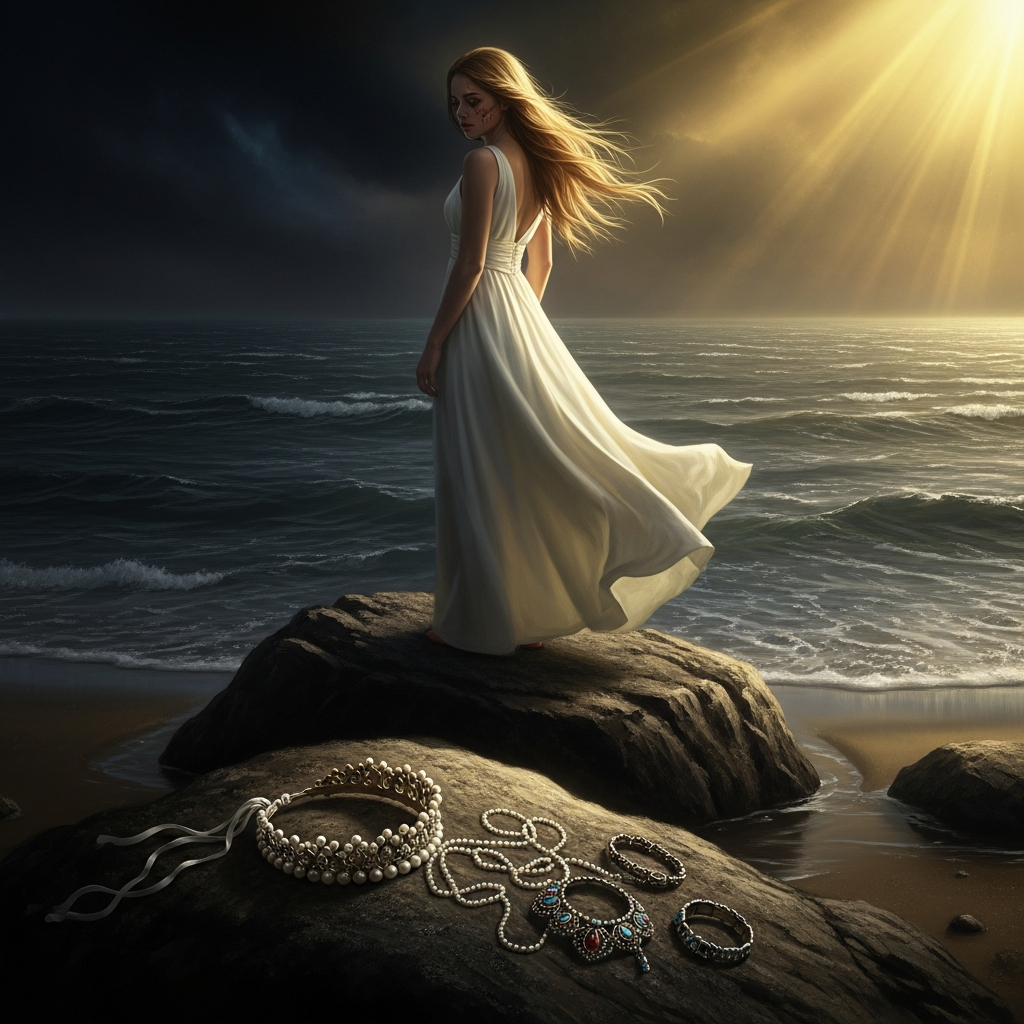
The runo of Aino is the one where she walks down to the sea.
The Finns who sang this song understood what the myth was telling them.
They sang it as comedy at first — the young braggart sunk to his armpits, weeping in the bog, was funny. The audience laughed at him. The audience laughed at his hat-becoming-a-cloud and his coat-becoming-black-water. It was a slapstick episode. It was the runo equivalent of a young man slipping on ice in front of his date.
Then the laughter would slow.
Because the audience knew where this was going. The audience knew that the price the panicked boy offered to save his life was not actually his to offer. He was selling someone who did not want to be sold, and the someone — his sister, who was at home weaving when the deal was struck — was going to walk into the sea rather than be the bride this contest had purchased for her.
The whole tragedy of the Kalevala starts with this episode.
Two men in sleds, on a narrow road, refusing to let the other pass.
A boy who lost a song-contest and bought his way out by selling someone he did not own.
An old man who accepted, because he was lonely, because the magic could do many things but could not undo loneliness, because he was an old man and a young woman had just been promised to him.
The runo that begins as comedy ends as the longest tragedy in Finnish literature.
This is what the runo is teaching: do not bargain in panic, do not promise what is not yours, do not accept what is offered in fear. The road that begins at the song-duel ends at the sea where Aino disappears, and the duel and the disappearance are the same event, played out in slow motion across two runos and a lifetime of consequences.
Echoes Across Traditions
Entities
- Väinämöinen
- Joukahainen
- Aino


Sources
- Kalevala, runo 3 (compiled by Elias Lönnrot, 1849)
- Keith Bosley translation, *The Kalevala* (Oxford World's Classics, 1989)
- Eino Friberg translation, *The Kalevala: Epic of the Finnish People* (1988)
- Lauri Honko, *Religion, Myth, and Folklore in the World's Epics* (1990)
- Matti Kuusi, *Finnish Folk Poetry: Epic* (1977)