Hayk and the Fall of Bel
Movses Khorenatsi, *History of Armenia*, c. 5th–8th century CE; underlying myth much older · Babylon; the road north; the Armenian highlands (Lake Van region)
Contents
Hayk, the giant patriarch and great-grandson of Noah, refuses to submit to the tyrant Bel of Babylon — and leads his clan north to the mountains. When Bel follows with his army, Hayk shoots a three-feathered arrow from an extraordinary distance, pierces Bel's breastplate and his heart, and founds the Armenian people on the land where Bel falls.
- When
- Movses Khorenatsi, *History of Armenia*, c. 5th–8th century CE; underlying myth much older
- Where
- Babylon; the road north; the Armenian highlands (Lake Van region)
After the Flood, when the world began again from the high ground where Noah’s ark had settled, the families of the survivors spread across the earth and named the places they settled and began the work of civilization a second time. Among Noah’s descendants was a man called Hayk — a giant by the measures of his era, tall and broad-shouldered, with the eyes of a man who makes decisions and keeps them.
The world was filling with people again. It was filling unevenly, the way water fills a container: pooling in the low places, in the river valleys, in the great plains where grain could be grown without effort. And in the greatest of the river valleys — the land between the Tigris and the Euphrates — there was a man named Bel.
Bel is identified by Movses Khorenatsi, the fifth-century Armenian historian who is the primary source for this myth, with Nimrod of Babylon — the great-hunter, the builder of the tower, the first man to attempt to consolidate all human beings under a single authority. He was a man of enormous force: the kind of intelligence that sees every resource and is immediately preoccupied with organizing it. He saw the scattered tribes and he saw inefficiency and he set about correcting it.
He sent messengers to Hayk.
The message was simple. Bel was the master of the world. The world included Hayk. Hayk should come to Babylon, acknowledge Bel’s sovereignty, and take his appointed place in the order that Bel was constructing.
Hayk considered the message.
He was not, by temperament, a rebel. He was a patriarch — the head of a clan that included his children and their children, a community of several hundred souls that had been living in the lands near Babylon, doing the work that families do. He was not looking for a confrontation. He was not young.
But the message asked for something he could not give. Not because of pride in the conventional sense — although pride was certainly present — but because of the specific nature of what Bel was demanding. Bel did not want acknowledgment of his strength; the strong acknowledge the stronger without dishonor, and Bel was stronger. What Bel wanted was a different kind of submission: the submission of the will, the interior capitulation that says I accept that your organization of the world is the correct one and that I have no standing to organize it otherwise. That Hayk would not give.
He gathered his clan and told them they were leaving.
They went north.
The journey was a long one — weeks, then months, following the mountain ridges, climbing steadily away from the flat lands of Mesopotamia into the foothills and then the highlands. The mountains were real: the volcanic plateau of what is now eastern Turkey and Armenia, above two thousand meters, cold even in summer, the landscape of a people who do not intend to be pushed any further.
Hayk settled his clan at a place near a great lake — Lake Van, in the Armenian tradition — and built.
He was not there long before Bel’s messengers arrived again. The message was the same. Bel’s tone was unchanged. He was not angry; he did not do anger in the first message. He simply restated the situation: the world was his. Hayk was in the world. The conclusion was obvious.
Hayk sent the messengers back with his answer.
The answer was no.
Bel came personally.
This is the detail the myth insists on. Bel did not send a general or a punitive expedition. He came himself, with his army, along the same road Hayk had taken north. The journey to Hayk’s highlands was not easy terrain for an army — the mountain passes narrow, the cold reliable even in the campaign season, the supply lines long and difficult — but Bel was not a man who delegated the things that mattered to him.
Hayk saw the army coming from the heights.
He had fewer men. This is consistently stated in all versions. He had his family — his sons and grandsons, warriors by heredity — and whatever force they could muster, which was not comparable to Bel’s host. He had the terrain. He had his bow.
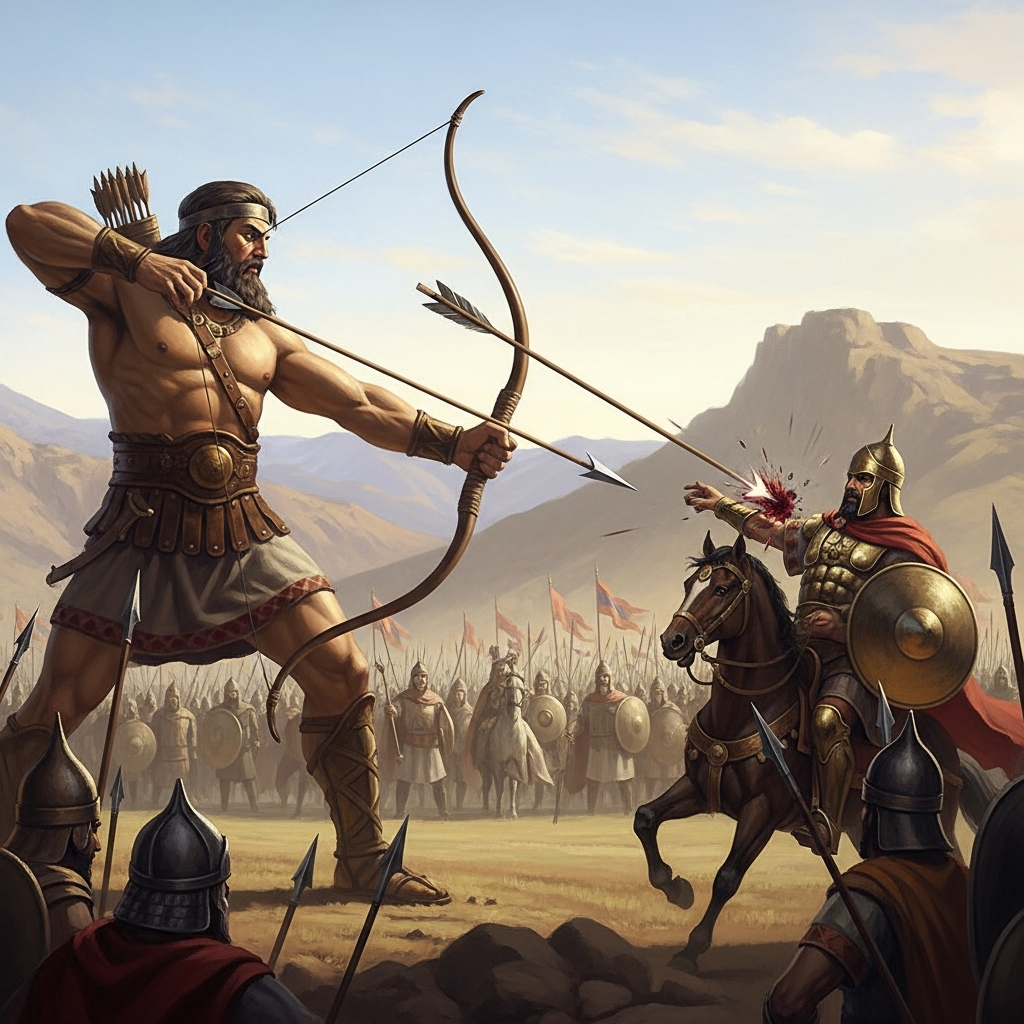
The Haykazuni tradition is precise about the bow: it was a massive weapon, requiring more strength than ordinary men possessed to draw. The arrows were three-feathered. The range was extraordinary.
On the morning Bel’s army entered the highland valley, Hayk was already positioned at distance on the ridgeline.
The battle, such as it was, turned on a single shot.
Bel was at the front of his army, visible in his armor, commanding in the way commanders command: presence, voice, the clarity that comes from a man who has spent decades being obeyed. The distance between Bel and the ridgeline was the distance an ordinary archer’s arrow could not cover.
Hayk drew.
The arrow was a three-feathered shaft, the specific kind the Armenian tradition associates with the shot: three feathers for stability over extreme range, head designed to penetrate armor. He drew the massive bow to its full extent. He held the alignment.
He released.
The arrow crossed the valley. Bel was wearing breastplate armor — the full military armor of a Babylonian king-general — and the arrow went through it. It went through the breastplate and into his heart. Bel fell. The army, which had been a machine organized around his will, ceased to function as a machine. Armies built on personality do not survive the personality’s exit.
They withdrew.
Hayk came down from the ridgeline and stood over Bel’s body.
The Khorenatsi account is specific about what he did not do: he did not exult. He did not make a speech. He looked at the fallen king of the world for a moment and then he turned back to his clan and began the work of establishing the settlement permanently.
He named the land Hayk — the root of the Armenian name for Armenia, Hayasdan, which the Armenians still use. Every Armenian who has ever lived is, in the tradition, a descendant of this man who would not go to Babylon.
The name Armenia itself comes from the outside — from the Persians and Greeks who came later and named the land for a figure they knew by a different name. The Armenians call their country Hayasdan and themselves Hay. The etymology is the man and the arrow.
The constellation Orion is identified in Armenian astronomical tradition with Hayk. The giant figure with the belt and the bow, visible in winter skies, is the patriarch standing on the highland, bow drawn, watching the southern horizon for whatever comes next from the direction of Babylon.
The arrow is still in flight, in this reading. The three stars of Orion’s belt are the three feathers. The great hunter is waiting, as he has always waited, on the heights above the plain, prepared to shoot again at whatever comes up the pass.
Bel is in the valley below. The valley is still there. The pass is still there. The lake is still there.
The Armenians have been there since the arrow landed.
Echoes Across Traditions
Entities
- Hayk
- Bel (Nimrod)
- Hayk's clan
- the three-feathered arrow
Sources
- Movses Khorenatsi, *History of Armenia* (*Patmut'iwn Hayots'*), trans. Robert W. Thomson (Harvard University Press, 1978)
- Cyril Toumanoff, *Studies in Christian Caucasian History* (Georgetown University Press, 1963)
- Nina Garsoïan, *Armenia between Byzantium and the Sasanians* (Variorum, 1985)
- Vahan Kurkjian, *A History of Armenia* (Armenian General Benevolent Union, 1958)
- Encyclopaedia Iranica, s.v. 'Armenia — Pre-Christian Period' (online edition)