Inanna Steals the Divine Decrees from Enki
c. 2500 BCE (mythic time) · Eridu (the oldest city, on the Persian Gulf), the river leading to Uruk, the abzu (the freshwater abyss)
Contents
The young goddess Inanna sails to her grandfather Enki's city of Eridu and lets him drink her under the table. Drunk, generous, half-flirtatious, he hands over the *me* — the hundred-odd divine decrees on which civilization runs. When he sobers up, the boat is already halfway home.
- When
- c. 2500 BCE (mythic time)
- Where
- Eridu (the oldest city, on the Persian Gulf), the river leading to Uruk, the abzu (the freshwater abyss)
There was an old god in Eridu who knew everything.
His name was Enki. He lived at the head of the Persian Gulf, in a temple built directly over the abzu — the freshwater abyss beneath the world, the source of every spring and well. He was the god of wisdom and of crafts and of sweet water. The Sumerians said he had given humanity their laws, their rituals, their tools, their writing. The hundred-odd divine decrees that made civilization possible — the me, pronounced may — were stored, by long tradition, in his keeping.
The me were the operating principles of every institution. There was a me of kingship and a me of priesthood. There was a me for the office of high priest, of priestess, of en-priest, of lagar-priest. There was a me for shepherding and a me for the leather-worker’s craft. There was a me for the smithy, a me for the scribal art. There was a me for music and a me for sexuality and a me for prostitution and a me for marriage. There was a me for kindness and a me for hostility, a me for descent into the underworld and a me for return. There was a me for falsehood as well as for truth — the Sumerians knew that civilization required both. There was a me for the city itself.
All of them were in Enki’s house. He held them. He was generous in disbursing instructions but careful in disbursing the things themselves.
Inanna was his granddaughter.
She was the goddess of Uruk — a younger city, ambitious, growing, downstream from Eridu. She was the goddess of love and of war, the morning and evening star, the patron of the great urban temple of Uruk and of its young king, Dumuzi the shepherd. She was beautiful and she was hungry. She wanted Uruk to be the greatest city in Sumer. To be the greatest city, Uruk needed the me.
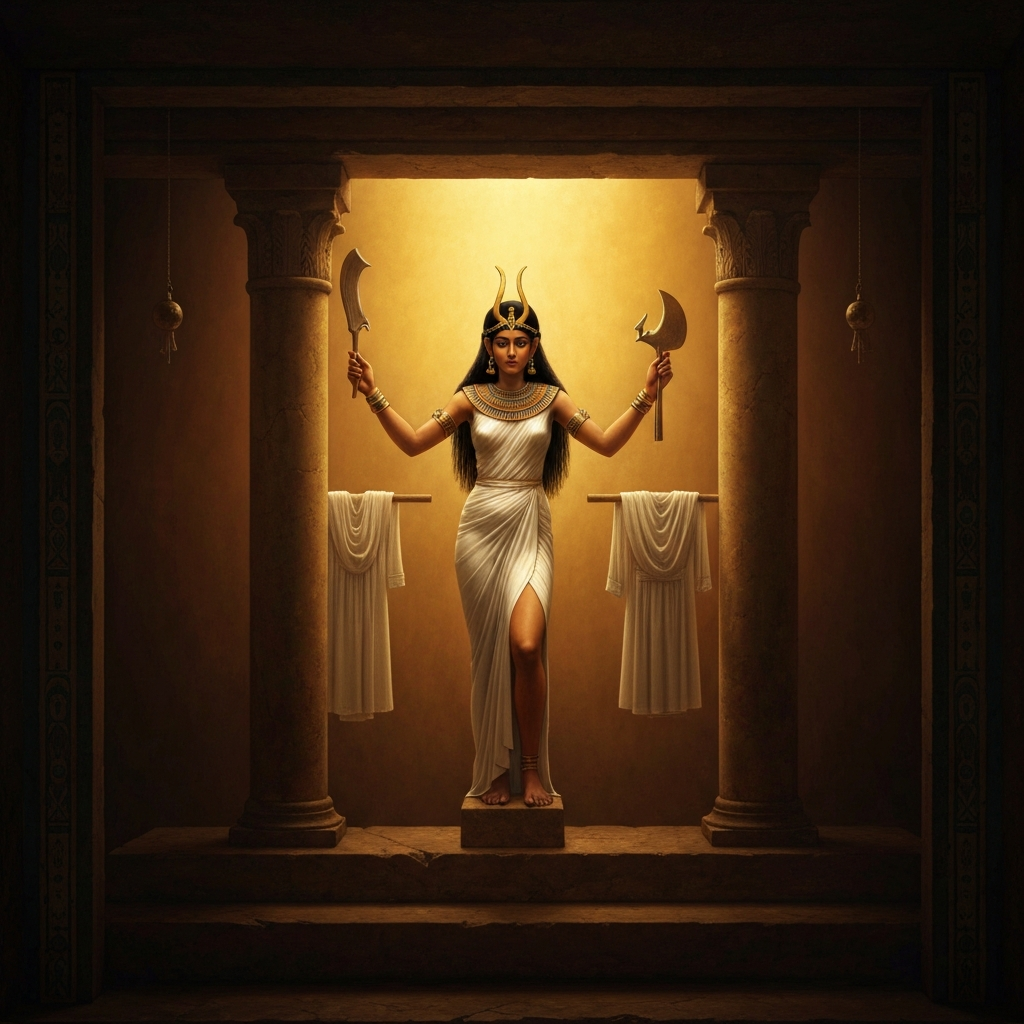
She sailed to Eridu. She wore the shugurra — the crown of the steppe, the high horned headdress of a goddess. She came in her painted boat, the boat of heaven, with her musicians and her servants. She sent word ahead to her grandfather: I am coming for a visit.
Enki was pleased. He was old. He was fond of her — she was the granddaughter who came to see him, who brought music, who brought charm. He told his vizier Isimud — Isimud who had two faces, one looking forward and one looking back, the perfect counselor — to prepare a feast. Bring out the cake of butter. Bring out the cold water for sweetness. Bring out the beer.
She came up from the dock. She entered his hall. She greeted him with the formal respect of a younger goddess to an elder god. She sat down at his table.
The drinking began.
It was beer, mostly. Sumerian beer, drunk through long reed straws from a common vessel. It was strong. The vessel was deep. They began to drink, and Enki, charmed and showing off, began also to talk. He praised her. He grew expansive. He raised his cup, looked across at his beautiful granddaughter, and made an extravagant gesture.
He said: In the name of my power — in the name of my abzu — I give to Inanna my daughter the me of supreme lordship. I give the me of the kingship of the gods. I give the me of the high throne. I give the me of the great staff. I give the me of the noble crown.
She accepted them gravely. She took them and stowed them, conceptually, in her boat at the dock.
Enki drank more. He grew more generous. He raised the cup again. I give the me of the enship. I give the me of the lagarship. I give the me of divinity. I give the me of the great tiara, the noble throne, the shepherd’s staff, the office, the seat.
She took them.
He kept going. The poem lists about a hundred me — perhaps more were originally listed; the tablets are damaged in places — and the structure of the text becomes incantatory. Enki gives them, group by group, in a ritual rhythm: he names them, she accepts them, she takes them to the boat. He gives the me of truth and falsehood, of judgment and counsel, of weariness and of running. He gives the me of the smith, the leather-worker, the scribe, the builder. He gives the me of music — the lyre, the flute, the drum — and the me of jubilation and sorrow. He gives the me of love-making and prostitution, of marriage and of family. He gives the me of the city.
The cups keep being filled. He keeps drinking. Each new gift produces another raised cup and another gift.
She accepts every one.
When the last me has been bestowed, Enki, very drunk now, very pleased with himself, falls into a deep sleep at the table.
Inanna stands up. She gathers the me — they are imagined as objects, perhaps tablets, perhaps physical tokens of some kind — and she carries them down to the boat. The boat of heaven. Her musicians take their oars. The boat pushes off into the river. The current is with them. They begin the return voyage to Uruk.
In Eridu, several hours later, Enki wakes up.
He looks around his hall. He is hungover. He looks at the table. He looks at the storeroom of me. The storeroom is empty.
He calls Isimud.
Where is the me of supreme lordship? Where is the me of kingship of the gods? Where is the me of the high throne? He goes through the inventory. Each one is gone. Isimud, looking forward and looking backward at once, replies in a kind of refrain: My king has given them to his daughter Inanna. My king has given them to his daughter Inanna.
Enki understands what he has done.
He cannot directly take it back — he has given the me under his own oath of giving — but he can pursue. He sends Isimud after the boat with the great sea-monsters, the galla demons of the deep, to overtake the boat and bring it back if possible. Tell my daughter, he says, that I want a word.
Isimud catches the boat at the first quay downstream from Eridu. My princess, he says, your grandfather sends his regards. He requests that you pause briefly. He has had a thought.
Inanna’s vizier, Ninshubur — her ever-loyal vizier, the goddess who runs interference for her queen — steps forward. No, she says. Enki gave these to Inanna in his own hall, by his own word, of his own free will. The galla will not take them back.
The galla lunge for the boat. Inanna raises her hand and Ninshubur drives them off. The boat moves on.
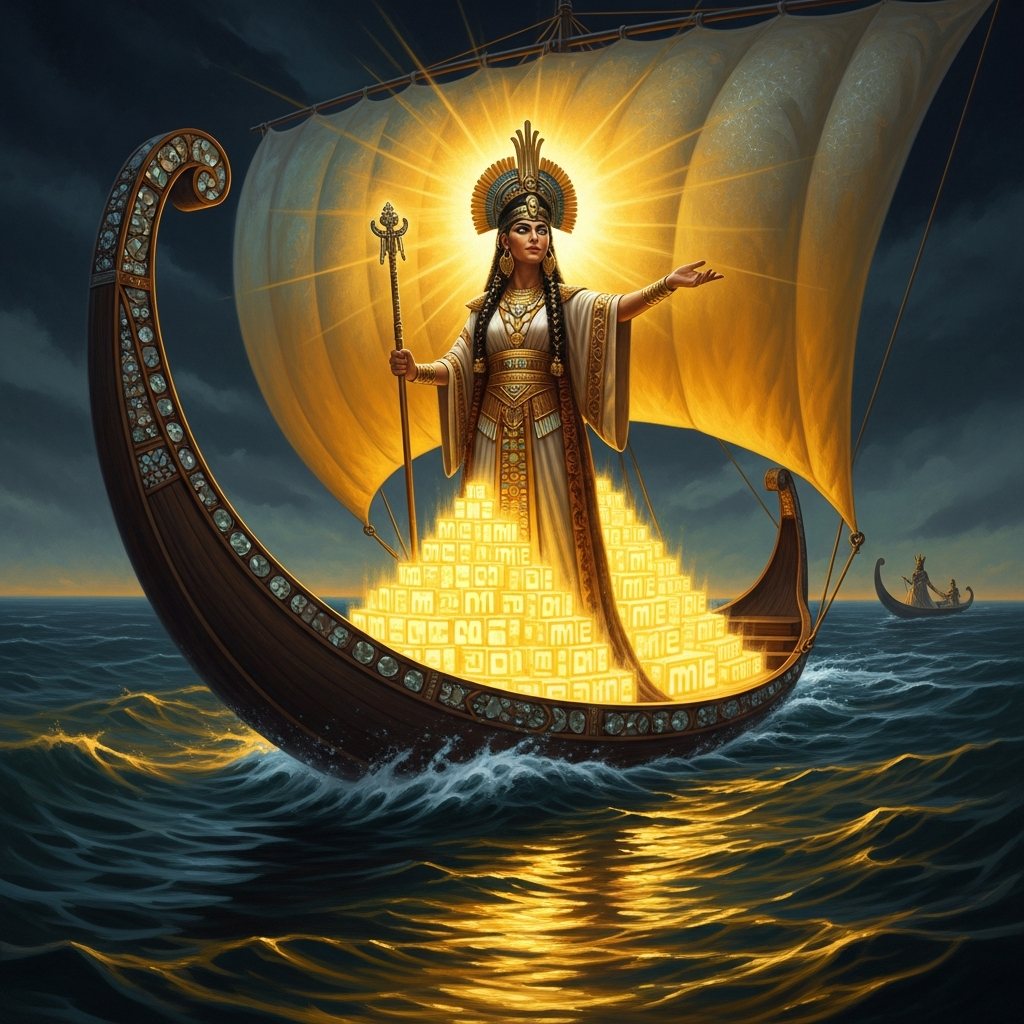
There are seven quays between Eridu and Uruk. At each quay Isimud arrives with new demons, more powerful than the last. At each quay Ninshubur drives them off. Inanna stands in the prow with the me at her feet. The galla fall away one wave behind another.
At the seventh quay, the demons fall away for the last time.
The boat reaches Uruk.
The whole city has come down to the dock. Inanna unloads the me one by one, calling out their names. I bring to my city the me of supreme lordship. I bring the me of kingship of the gods. I bring the me of the high throne. The crowd answers each gift with shouts. The temple priests come out and receive them. Uruk receives the institutions on which it will build itself into the central city of Sumer.
Enki, in Eridu, accepts what has happened. He had given them in good faith — drunk, but in good faith. The forms of giving cannot be revoked. He blesses the boat at the end. The poem closes with Inanna standing in the new center of the world, surrounded by the operating system of civilization, and Enki — old, hungover, but at last clear-eyed — receiving the news that his granddaughter has done what he, in some part of himself, had perhaps known all along she would do.
This is the world’s earliest extant story about a generation transferring institutional power. It is also, perhaps not coincidentally, the world’s earliest extant story to take seriously how often that transfer happens because the elder, in a moment of drink and pride and family love, simply hands over the keys.
Scenes
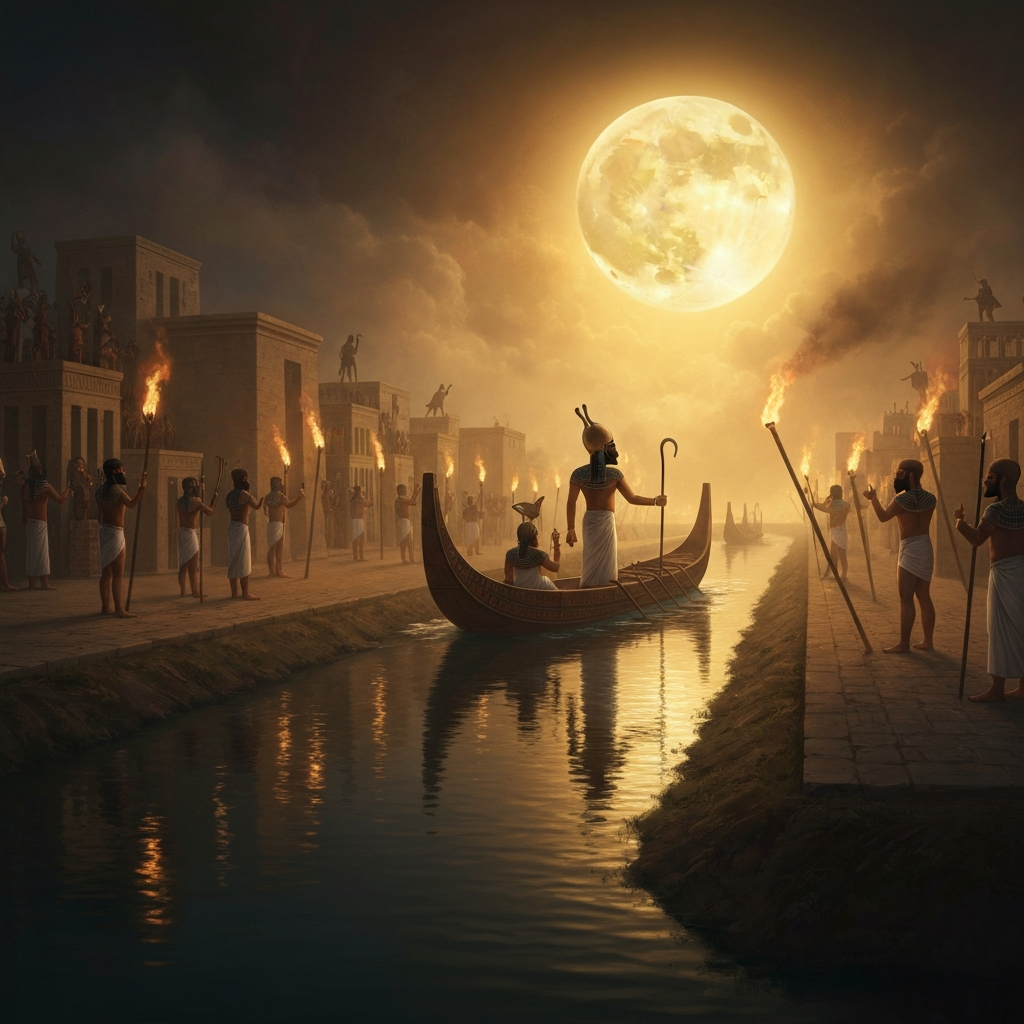
Inanna's painted boat at the dock of Eridu
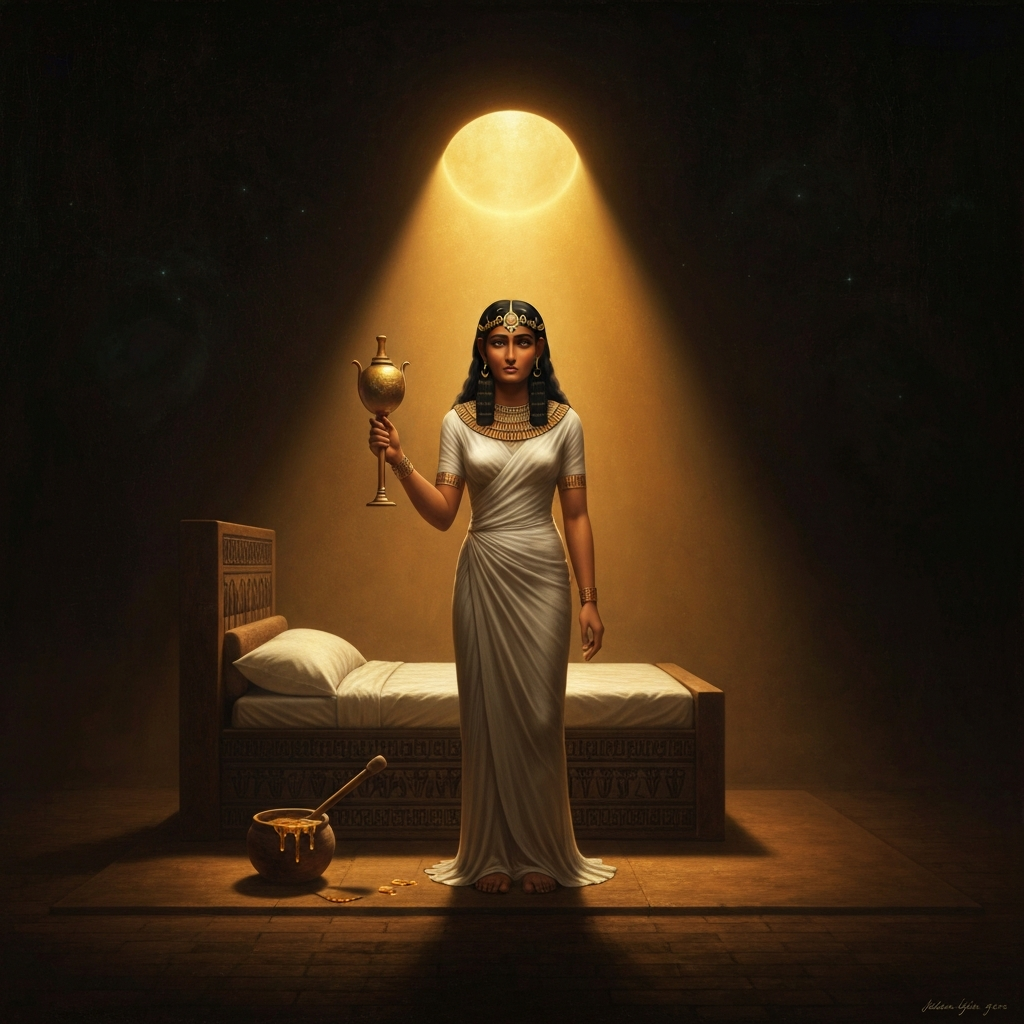
In Enki's hall, the young goddess and the old god face each other across a table piled with dishes
On the river, Inanna stands in the prow of the *boat of heaven* as her musicians row hard
Echoes Across Traditions
Entities
- Inanna
- Enki
- Isimud
- The galla demons
Sources
- Sumerian poem 'Inanna and Enki' (c. 2000 BCE, surviving on tablets from Nippur)
- Samuel Noah Kramer, *Sumerian Mythology* (1944, rev. 1961)
- Diane Wolkstein and Samuel Noah Kramer, *Inanna, Queen of Heaven and Earth* (1983)
- ETCSL t.1.3.1