Contents
The world had ten suns once, sons of the eastern god Dijun, and they took turns crossing the sky one at a time. One morning, in a fit of brotherly mischief, all ten rose together. The crops burned. The rivers boiled. Children cooked in their cradles. The emperor sent for the great archer Hou Yi, who climbed a mountain with a bow of mulberry wood and a quiver of red arrows, and began to shoot.
- When
- c. 2000 BCE (mythic time of Emperor Yao)
- Where
- The court of Emperor Yao; the burning earth; the high mountain from which Hou Yi takes aim at the sky
In the beginning, the sun rose in shifts.
The eastern god Dijun and his consort Xihe had ten sons. The sons were not human boys. They were suns — jin wu, the golden three-legged crows that the Chinese sky-myth always identifies with the sun’s body. Each crow was the size of a small island and burned at the temperature of a furnace. The ten of them lived together in a great mulberry tree — Fusang — that grew at the edge of the eastern sea, its roots in the salt water, its branches stretching halfway to heaven.
Every morning, Xihe drove a chariot to Fusang. She bathed one of her sons in the eastern ocean. She lifted him into the chariot. She drove him across the sky from east to west, the others remaining at home in the tree, until at evening she let him down at the western edge of the world. Then she returned to the tree by the underground rivers and prepared the next son for the next day. Each crow had his turn once every ten days.
This was the order of the world.
It worked for a very long time.
—
What went wrong is variously reported.
Some texts say the ten brothers became bored. Some say they conspired. Some say it was a single morning’s prank that escalated. The Huainanzi simply states it: one morning, the ten suns rose together.
Xihe did not lift them. They lifted themselves. They flew up out of the mulberry tree side by side and climbed into the eastern sky as a single white wall of light. The horizon, which had previously dawned softly, exploded.
The first effect was that day became unbearable.
In the cool latitudes of north China, where the climate had been temperate, the temperature in the morning hours was already at a level where birds fell out of the sky stunned. By midday, rivers were steaming. By afternoon, lakes had begun to boil. The crops in the field — millet, rice, the early experiments of the agricultural revolution — turned to ash on their stalks. People ran into rivers to escape the heat and the rivers were already too hot to enter.
Forests began to burn. The fires merged. The smoke darkened parts of the sky but the rest of the sky was suns; ten of them, now spread across the heavens at slightly different points, each one casting its own shadow. There were now ten shadows under every tree, and the shadows themselves were illuminated, and there was nowhere to stand that was cool.
Children died first. Old people next. The cattle. The wild animals. The fish in the shallow rivers. The birds that had stayed in the canopies. The frogs in the wetlands. Then the humans of the lowlands. Within a few days, whole regions of the empire had become uninhabitable. Refugees walked north into the mountains, looking for snow. The snow had melted.
The emperor of the human world was Yao. He was a sage-king of the legendary high antiquity — the period the Chinese tradition remembers as the golden age, before the dynasties — and he was famously good. He was also helpless. He could not negotiate with the suns. He could not order them down. The tools of governance did not work on celestial bodies in revolt.
He prayed.
He prayed to Dijun, the father of the suns. Dijun was an older god, august, distant. He heard. He understood that his sons had broken the order of the world. He understood, also, that he could not bring himself to discipline them severely; they were his sons.
Dijun did the diplomatic compromise of the divine bureaucracy. He sent down, to Emperor Yao, a champion. A man capable of dealing with the situation by force.
He sent Hou Yi.
—
Hou Yi was a strange figure even before his great deed.
The texts disagree about his origin. Some say he was a mortal man, born in the eastern provinces, raised as the strongest archer of his generation. Others say he was a minor god of the celestial bureaucracy — a divine huntsman, capable of hitting any target — sent down by Dijun to do what was necessary.
What everyone agrees is that he carried two distinguishing items: a bow made of mulberry wood, gifted by Dijun himself; and a quiver of arrows tipped with red feathers, ten of them.
He arrived at Yao’s court. He was small, by the standards of legendary heroes — wiry, square-shouldered, dark-faced from years in the sun. He bowed. He listened to Yao’s account of the disaster. He looked out the palace window at the white-hot sky.
He said: I will see what I can do.
He left the palace and walked to the foot of the highest mountain near the capital. He climbed it.
The climb itself, the texts note, was difficult. The mountain was already half on fire. The heat at higher altitudes was actually worse, because the air was thinner. The rocks burned his hands. The mulberry bow, miraculously, did not burn — Dijun’s gift was proof against its source.
He reached the summit at midday. The ten suns were directly overhead, ten white discs spread across a hundred and twenty degrees of sky.
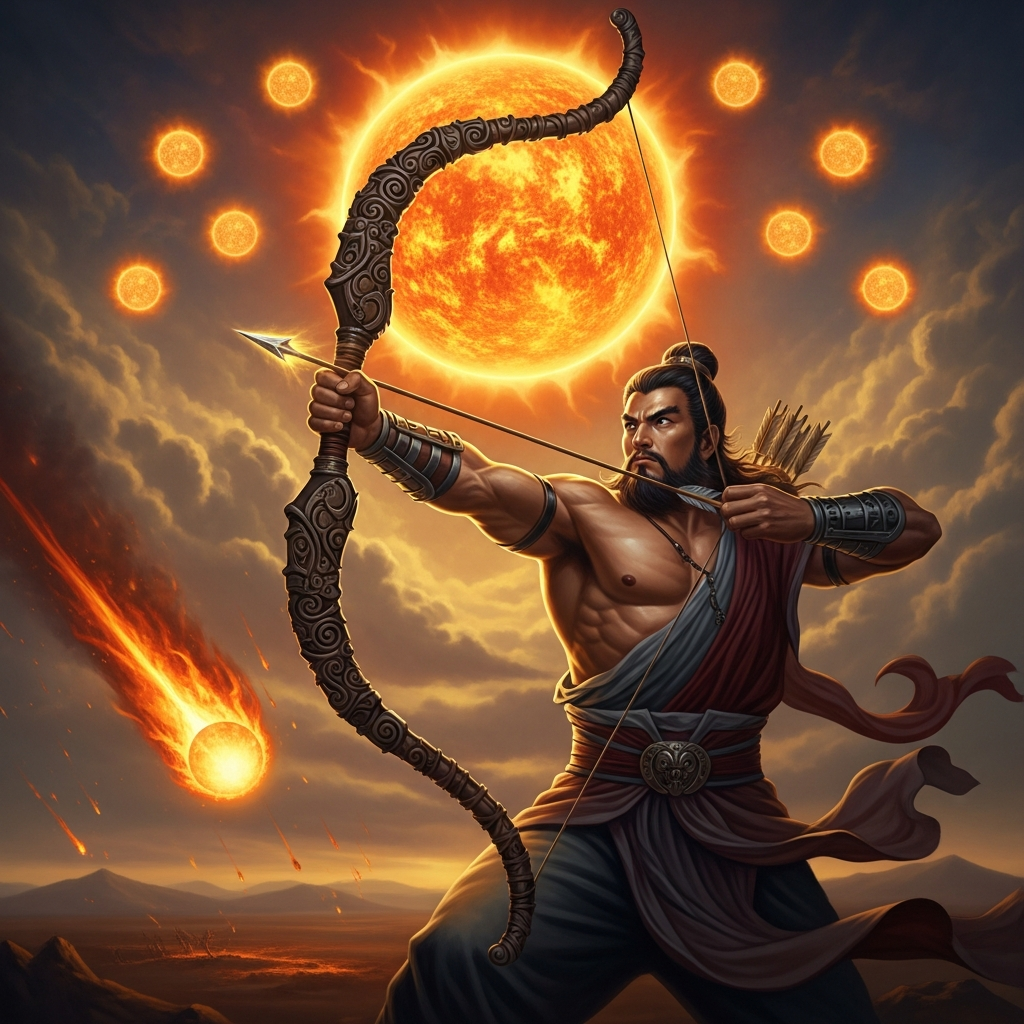
He took the bow off his shoulder. He notched the first red-feathered arrow.
—
He aimed.
The texts spend a moment on this — not on the technique, which they assume the reader trusts, but on the audacity. No one had ever notched an arrow at the sun before. The thought had not occurred. The sun was where the sun was. To aim a weapon at it was to aim a weapon at heaven itself, and the cosmos contained a thousand traditions warning against the consequence.
Hou Yi drew. He held. He sighted along the shaft at the leftmost sun.
He released.
The arrow flew with the speed of arrows but did not stop at the limit of arrow-flight. It kept going. It crossed the lower atmosphere. It crossed the upper atmosphere. It climbed into the region where the suns were burning. It struck the leftmost sun in the chest.
The sun screamed.
The Chinese cosmology contains, here, a moment of beautiful specificity. The sun’s mortal form was a three-legged crow. Hou Yi’s arrow, striking the sun, destroyed the celestial form and dropped the corpse — a great burnt three-legged crow, the size of an elephant — out of the sky. It fell to earth in a long arc, trailing smoke, and crashed somewhere in the western mountains. Steam rose where it landed.
Where the sun had been, there was now a hole in the sky. The total light of the heavens dimmed by a tenth.
A wind moved through the parched fields.
Hou Yi notched the second arrow.
—
He shot the second sun. It fell.
He shot the third. It fell.
He shot the fourth, the fifth, the sixth, the seventh, the eighth, the ninth.
Each crow fell flaming. Nine three-legged corpses dropped through the cloud-line. The mountainsides where they fell are still, in some Chinese folktales, identified — places where the soil is unusually red, plants do not grow, water tastes of iron, all because a sun’s body is buried below.
The temperature dropped. The sky began to look like a sky again. The fires in the forests, no longer fed continuously, began to die back. The first cool wind in days reached the imperial capital and the surviving people stepped out of their houses and looked up.
Hou Yi had nine arrows. He had used nine arrows.
He had one arrow left, and one sun left.
He drew the tenth arrow.
—
He aimed at the last sun.
He held.
He held a long time. The texts note this with care. Some say he held because he was tired. Some say because the bow had been lightening and he was steadying his arm. The most common version says he held because — at the last moment, before releasing — Emperor Yao called out from the foot of the mountain.
Stop! Stop, archer!
Yao had come up after him. Yao had seen the suns falling. Yao had counted. He had realized, with the cold clarity of a sage-king, that if Hou Yi shot down the tenth sun, the sky would be empty. The world would have no sun. The crops would freeze. Life would end the other way.
The old story, in its simplest form, says the emperor begged Hou Yi to leave one sun in the sky. Hou Yi heard. He hesitated.
A more complicated version says that Yao, calculating in advance that Hou Yi might not leave a sun, had quietly sent a servant up the mountain ahead of the archer to steal one arrow from the quiver — so that Hou Yi, when he reached the summit, would have only nine arrows and would be unable to finish the job. Both versions exist in the textual tradition, side by side, and Chinese readers are supposed to enjoy the ambiguity. Either Hou Yi spared the last sun voluntarily; or fate, in the form of a sneaky servant, decided for him.
Hou Yi lowered his bow.
The tenth sun, who had watched its nine brothers fall flaming, was not stupid. It saw the bow lower. It understood that it was being given a gift — its life, in exchange for behavior. It bowed in midair to Hou Yi. It accepted the new schedule. From that day forward, this last sun rose alone, every morning, on time, without showing off, without bringing siblings.
The world had one sun. It still has one sun. We have, in the long memory of mythology, eight more sun-corpses buried in the mountains and one well-behaved survivor. The deal has held for four thousand years.
—
Hou Yi came down from the mountain.
He was, at first, a hero. Yao gave him territory and a wife — Chang’e, beautiful and serious — and the title of king of a small region. The people honored him with festivals.
But he had killed the sons of Dijun. The other gods — the celestial bureaucracy — had quietly withdrawn from him. The Jade Emperor would not see him. Dijun himself, even though he had sent Hou Yi to do exactly this work, found, when it was done, that he could not look at the archer without thinking of nine three-legged crows.
Hou Yi was not invited back to heaven.
He lived on earth. He governed his small territory. He hunted. He grew, slowly, restless. He did not like that he, who had saved the world, was earthbound. He began to think about how to return to the heavens. He began, eventually, to seek the elixir of immortality from the Queen Mother of the West.
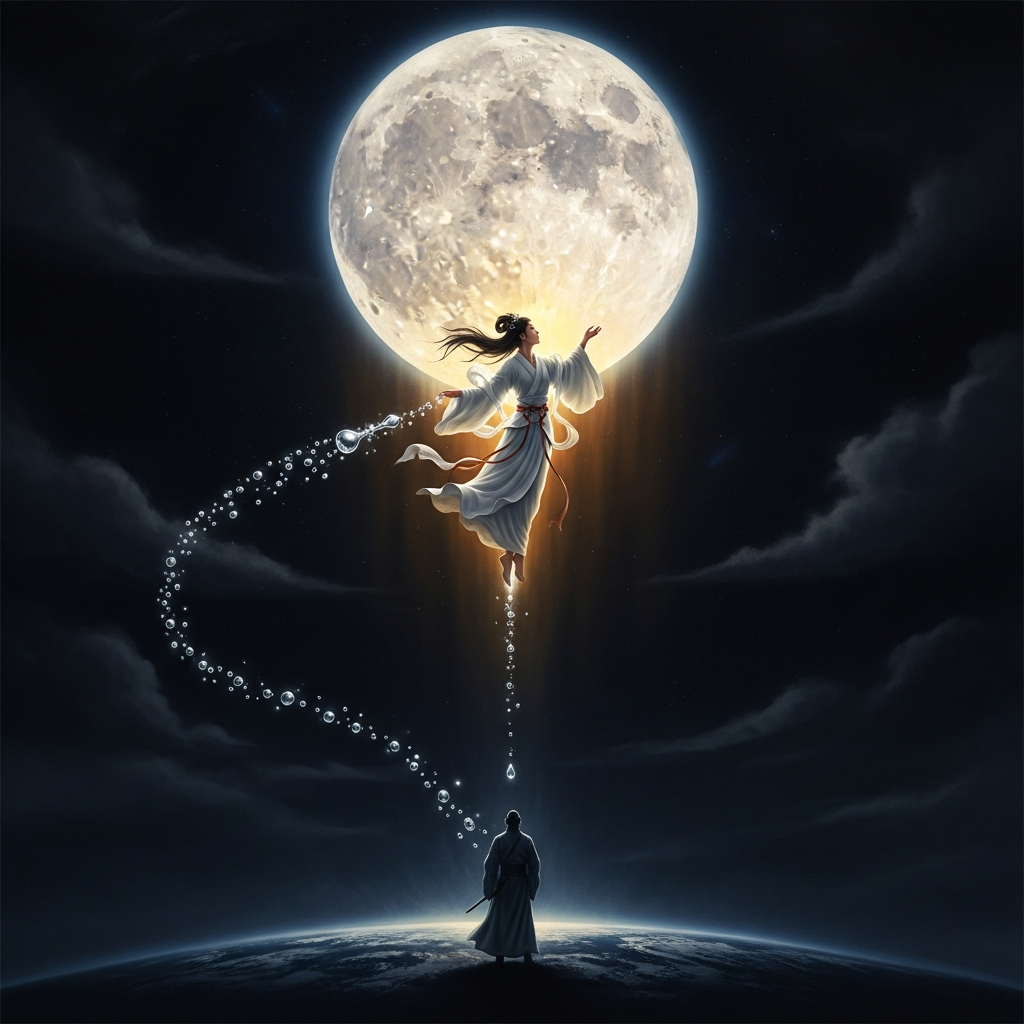
That is the next story. It ends with his wife on the moon and Hou Yi alone in the courtyard at the full moon for the rest of his life.
But that comes later. Tonight, in the story we are telling, Hou Yi is on the mountain. The last sun has just bowed to him. Nine corpses are still smoking in the western ranges. The first cool breeze in days is coming up the mountainside. He puts the bow over his shoulder. He starts the climb down. The world is saved, and one sun in the sky has learned that it can be persuaded.
Scenes
Ten suns rise simultaneously from the mulberry tree at the edge of the eastern sea, each one a flaming bird-shape, the horizon white with their combined heat
Hou Yi on the summit of a high mountain, mulberry-wood bow drawn, an arrow notched
Nine three-legged crows fall flaming from the sky, leaving smoke trails
Echoes Across Traditions
Entities
- Hou Yi
- Yao
- Dijun
- The Ten Suns
- Xihe
Sources
- *Huainanzi* (c. 139 BCE)
- *Shanhaijing* — Classic of Mountains and Seas (c. 4th c. BCE)
- Anne Birrell, *Chinese Mythology: An Introduction* (1993)
- Yuan Ke (ed.), *Dragons and Dynasties: Chinese Mythology* (1993)