Chang'e Flies to the Moon
c. 2000 BCE (mythic time) · The earth — Hou Yi's house, the courtyard where Chang'e lifts off — and the moon, where she lands and is given a palace of cold jade
Contents
Hou Yi the archer has been given the elixir of immortality by the Queen Mother of the West — one pill, enough for one. He hides it in the rafters, planning to share it with his wife Chang'e somehow. A thief breaks in while Hou Yi is hunting. To keep the elixir from falling into wrong hands, Chang'e swallows it herself — and the pill, made for one, lifts her so violently that she rises through the roof and keeps rising until she lands on the moon.
- When
- c. 2000 BCE (mythic time)
- Where
- The earth — Hou Yi's house, the courtyard where Chang'e lifts off — and the moon, where she lands and is given a palace of cold jade
Hou Yi has been a hero too long.
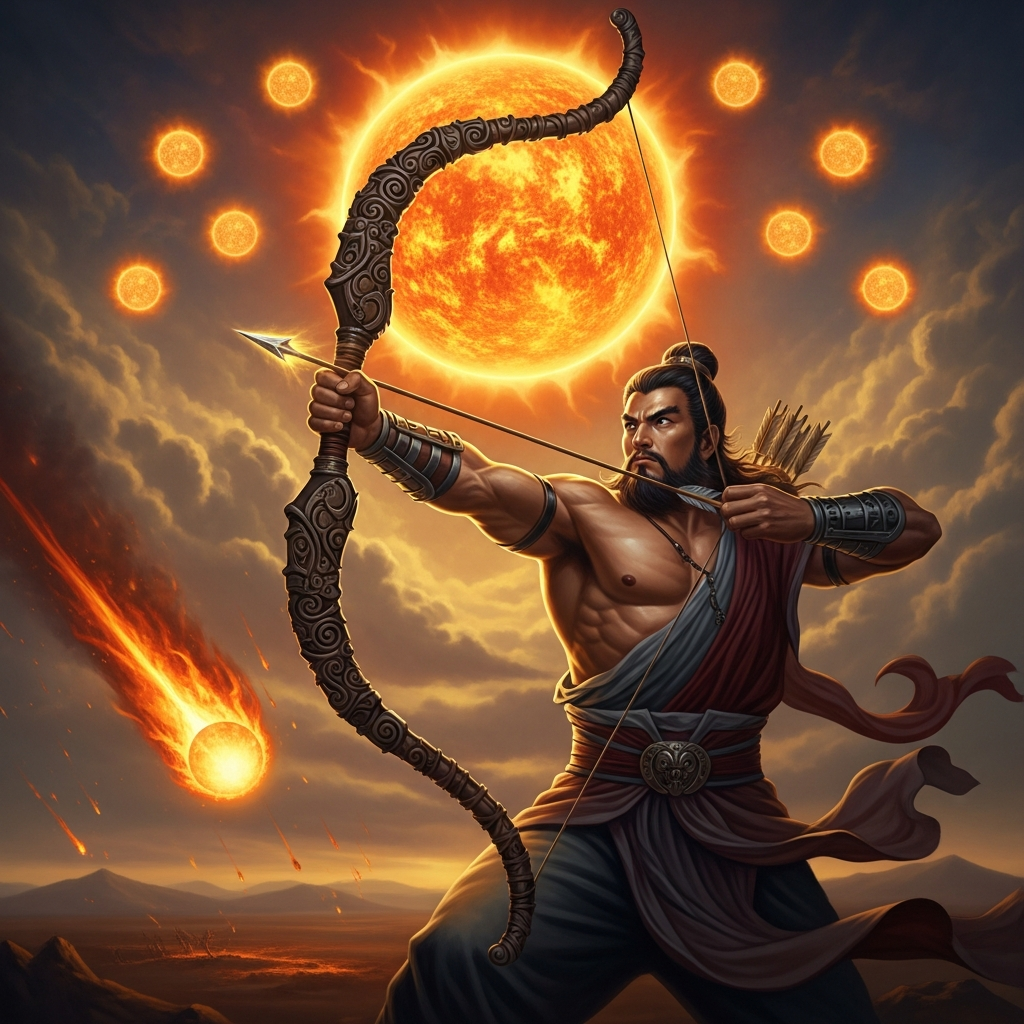
He is the great archer of Chinese antiquity — the man who, in the days when the world had ten suns and they all rose at once and the crops burned and the rivers boiled, climbed a high mountain with his bow and shot down nine of them. The Jade Emperor honored him for the rescue, but the Jade Emperor was also unsettled — Hou Yi was, by then, a mortal who had killed nine sons of heaven, and the heavens had certain rules about that.
Hou Yi was sent down to live among humans. He was given a wife — Chang’e, beautiful and serious, a woman of the high court — and a home, and the title of king of a small territory. He hunted. He governed. He was, for a long while, content.
But he had killed nine suns. He had stood on a mountain and dropped immortal beings out of the sky. The taste of that, once you have tasted it, does not leave the mouth easily. Hou Yi began to want, more than anything, the one thing the heavens had not given him back: immortality itself.
He went to the Queen Mother of the West.
—
The Queen Mother of the West — Xiwangmu — lives on Mount Kunlun in the far west. She tends a garden of peaches that ripen once every three thousand years. She has the elixir of immortality stored in jade vials in a cave beneath her palace. She does not give it out lightly.
Hou Yi traveled to her. He brought tribute. He told his story. He asked for the elixir.
She considered him.
She gave him a vial.
But she gave him only one. She told him the rules: there was enough in the vial for one full dose of immortality, or two half-doses. A full dose lifted the drinker into the heavens — beyond aging, beyond death, beyond the human realm entirely. A half-dose — splitting the vial between two people — gave each of them long life, perhaps several centuries, but kept them on earth.
Hou Yi understood. He bowed. He took the vial home.
He did not drink it immediately.
He was thinking. He had not yet decided what to do. To take the full dose alone would mean leaving Chang’e behind. To split it would mean both of them aging slowly — perhaps for a thousand years, but eventually dying. He could not decide. So he hid the vial in the rafters of his house, behind a beam where Chang’e would not look, and he told himself he would think it through carefully and decide at his leisure.
He did not tell her about the vial.
—
Hou Yi had a student.
His name was Feng Meng. He had come to study archery. Hou Yi had taught him almost everything Hou Yi knew. Feng Meng had been waiting for the day when his master would teach him the last and best secret — the trick that would have allowed Feng Meng to be the world’s archer himself.
Hou Yi never taught it to him.
There are different versions of why. The simplest is that Hou Yi knew Feng Meng’s character: ambitious, restless, willing to kill. Hou Yi withheld the final teaching not from greed but from prudence.
Feng Meng resented him for it. He had begun to imagine Hou Yi out of the way. He had begun to listen at doors.
He had heard about the vial.
He waited for a day when Hou Yi was away — out hunting, gone since dawn, not expected back until evening. Feng Meng came to the house with a sword at his belt. He pushed through the gate. The servants tried to stop him; he cut them down. He kicked open the inner door of Chang’e’s chamber.
Chang’e was at her loom.
She looked up. She saw the sword. She understood immediately what was happening.
Feng Meng demanded the elixir. He told her — perfectly calmly, almost politely — that he had come for the vial, that he knew where it was, that she was to retrieve it for him, and that if she did not, he would kill her and find it himself.
Chang’e set down the shuttle. She rose. She walked across the room to the ladder against the wall.
She climbed.
—
She found the vial behind the beam exactly where her husband had hidden it. It was small — palm-sized — pale green jade, stoppered with a sliver of cinnabar. She could feel the weight of it in her hand. She knew, immediately, what it was.
Below her, Feng Meng was shouting up the ladder. Bring it down. Bring it down or I will come up.
Chang’e looked at the vial.
The version of the story I am most fond of — and the one most often told in Chinese households on the eve of the Mid-Autumn Festival — has her stand on the rafter and think for one long second. She has the vial. She knows what it does. She knows that if Feng Meng gets it, an immortal Feng Meng will be loosed on the world — a man with bad character given infinite time to express it. She knows that if she pretends to be unable to find it, he will kill her anyway and search.
She has, in this moment, two choices. She can split the vial — half for her, half for him — and hope. Or she can take the whole thing.
She uncorks the vial.
She drinks.
—
The dose was made for one.
She has taken it whole.
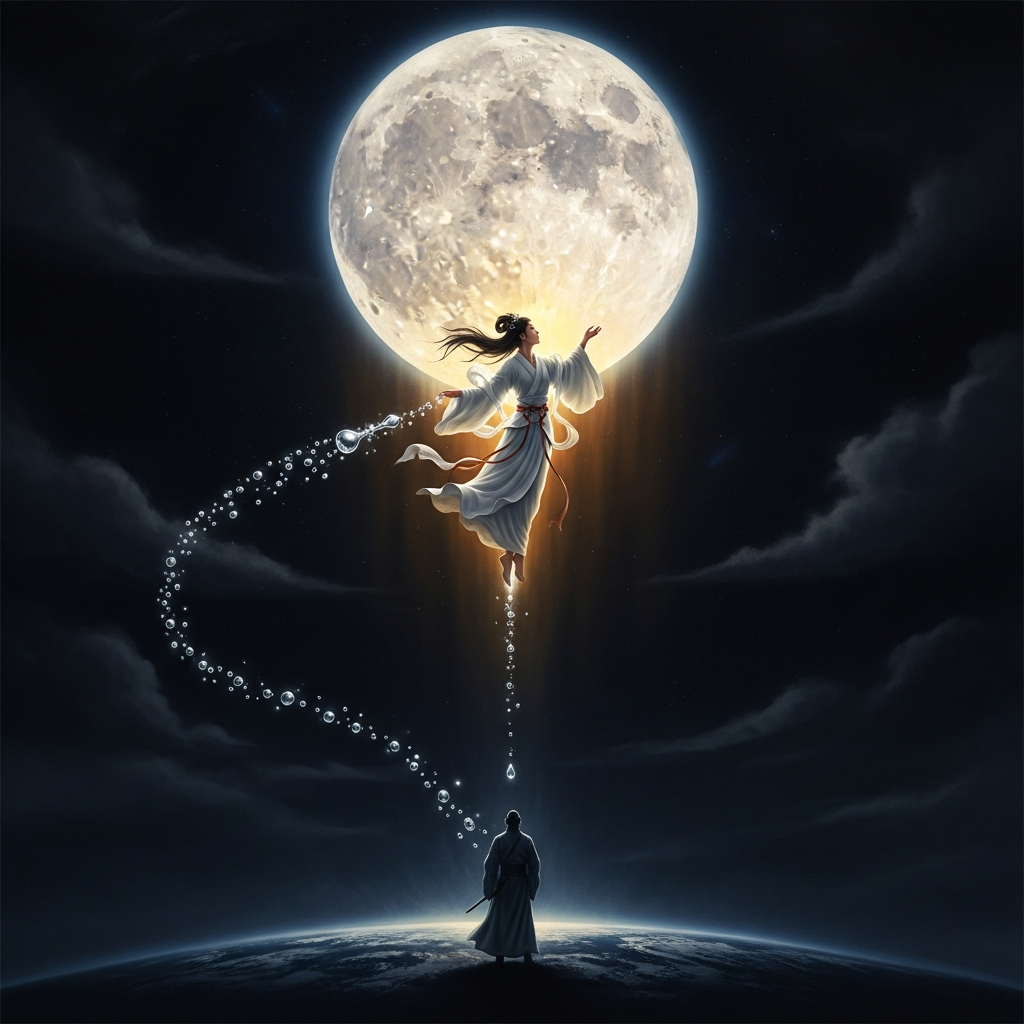
The effect is immediate. She feels her body lighten. She feels her feet leave the rafter. She feels her clothes lift around her — sleeves rising as if pulled upward by invisible threads — and then her whole body rises, slowly at first, then quickly, lifting through the rafters, through the roof of the house, up into the sky over her courtyard.
Below her, Feng Meng — in the doorway now, the empty vial on the floor — sees her ascending and screams in fury. He fires an arrow at her in the air. The arrow falls back without reaching her. She is already past human range.
She rises.
She rises through the cloud cover. She rises past the highest mountains. She passes through the cold thin air of the upper sky. She is heading, the texts say, for the heavenly realm — for the company of the immortals, for the courts of the Queen Mother of the West — and she would have arrived there, in another version of the story, except that she pauses.
She looks down.
She can see, now, the whole of the world below her — the rivers, the cities, the patchwork of fields, and the small dark dot in the courtyard of her house that is her husband, just now returning from the hunt, dropping his bow, running out of the gate, looking up.
She cannot bear to go all the way to heaven. To fly past her husband forever, to live in the immortal courts where he can never reach her, is more than she can stand. She must stop somewhere on the way.
She picks the moon.
She steers — by what mechanism the texts do not explain, but the gravitational metaphor is irresistible — toward the lunar disk hanging white in the dusk sky. She lands on its silver surface. She finds, when she arrives, that the moon already has a palace. It is built of cold jade. There is a single courtyard. There is a cassia tree growing in the courtyard, evergreen, sweet-scented. There is a rabbit, white as snow, sitting beside a stone mortar in which it pounds the ingredients of immortality elixir for the Queen Mother of the West. There is a woodcutter, far older than her, who is condemned to chop the cassia tree forever — but the tree heals each cut as fast as he makes it.
These are now her companions. She has eternity. She has the moon palace. She has a rabbit who will, in time, be called the Jade Rabbit, and a tree, and a woodcutter who never speaks.
She does not have her husband.
—
Hou Yi, when he reached the courtyard, looked up and saw a small figure rising into the sky. He saw it dwindle to a point. He saw the point land on the moon.
He understood, all at once, what had happened. He knew the vial was missing. He knew she had taken it. He knew why she had taken it. Some versions say Feng Meng was already gone; some say Hou Yi found him and killed him. The detail varies.
What does not vary is what Hou Yi did afterward.
He set up an offering table in the courtyard. He laid out his wife’s favorite foods — round cakes, fruits, sweet wine. He waited until the moon rose full. He looked up and bowed. He spoke aloud to her.
He did this every full moon for the rest of his life.
The story spread — first as a private grief, then as a custom — and over centuries, all of China began doing it. On the night of the full moon closest to the autumn equinox, when the harvest is in and the moon at its largest and most luminous, Chinese families set out tables in their courtyards. They put out round mooncakes — round like the moon, round like Chang’e’s face — and pomelos and tea. They eat together. They look up.
Couples hold hands. Children are taught to find Chang’e in the lunar shadows — there, the sleeve, there, the rabbit, there, the cassia tree. Lovers separated by distance — the soldier on the frontier, the husband on the road, the daughter married into another family — are taught to look at the moon at the same hour and know that the other is also looking, that the moon is the meeting place of those who cannot meet.
Hou Yi died on earth. Chang’e is still on the moon. They have not seen each other except across that distance for four thousand years.
When the Apollo 11 mission was preparing to land, NASA radioed up a teasing message from a Chinese astronomer: Look out for a beautiful woman in white and a rabbit, please. The astronauts laughed and promised they would. They did not see her, of course; she lives on the far side of the moon, where the missions did not go. She is still up there. The next time you look up at a full moon, the legend says — and Chinese grandmothers have been saying for centuries — look carefully. The shape on the surface that looks like a woman holding a small animal is her, looking down, watching for her husband to come home, watching, waiting.
Scenes
Hou Yi at sunset returns from hunting and climbs the ladder to the rafters, hiding a small jade vial above the beam, looking back to make sure his wife has not seen
The thief Feng Meng breaks down the door with a sword raised
Chang'e rises through the roof in a slow spiral of silver light, her sleeves trailing like banners
Echoes Across Traditions
Entities
- Chang'e
- Hou Yi
- Queen Mother of the West
- Feng Meng
- The Jade Rabbit
Sources
- *Huainanzi* (c. 139 BCE)
- *Shanhaijing* — Classic of Mountains and Seas (c. 4th c. BCE)
- Anne Birrell, *Chinese Mythology: An Introduction* (1993)
- Lihui Yang & Deming An, *Handbook of Chinese Mythology* (2005)