Contents
After a great flood drowns humanity, only a brother and sister survive — Fuxi and Nüwa — sheltered inside a hollow gourd. They emerge to an empty world. To repopulate it they must marry, but a marriage between siblings is taboo. They roll two halves of a millstone down opposite mountains: if the stones meet at the bottom, heaven approves. The stones meet. They marry. Nüwa later kneels by a riverbank and begins forming the first humans out of yellow clay.
- When
- c. 2000 BCE (mythic time)
- Where
- A primordial Chinese landscape: two mountains across a wide valley; a river with banks of soft yellow loess; the silent flooded world below
The flood is coming.
In the high antiquity of Chinese myth, before the dynasties, before the sage-kings, the world had grown crowded and the heavens had grown impatient. The waters were rising. The texts disagree about why; some say a celestial pillar broke and the river of heaven began pouring through the crack, some say the rains fell for a hundred days, some say the sea simply remembered itself and reclaimed the lowlands. What everyone agrees on is that the lowlands flooded, then the highlands flooded, then the mountains flooded, and the small remnant of humanity that had not drowned was clinging to the highest peaks watching the water still come.
In a small village on the side of a mountain, two children — a brother and his younger sister — lived with an aged father. The father had received warning. Some accounts say the warning came in a dream. Others say a small white-bearded immortal appeared at his door and told him plainly. The warning said: Plant the seed of a gourd. The gourd will grow large enough to shelter your children. When the rains come, put them inside it and seal them in.
The father planted. The gourd grew, fast, with the sudden density of plants that have been touched by the immortal world. By the time the rains began, it was as large as a small grain-shed.
The father split it. He hollowed out the inside. He stocked it with a small store of food and water. He put his two children — the boy Fuxi, the girl Nüwa — into the gourd and closed the top.
The rains came.
The water rose. The gourd lifted off the ground. It began to drift. It rose with the water, level by level, past the highest hills, past the highest peaks. The rest of the village drowned. Their father, who had given them his only place of safety, drowned with the rest.
The gourd floated for a hundred days on a featureless gray sea.
—
The water receded.
The gourd settled, finally, on top of a high mountain. The siblings inside felt it lurch as it touched ground; they pushed open the stopper and climbed out.
The world was empty.
Below them, a wide valley — drying now, the water still glinting in low places — stretched to the horizon. There were no humans visible. Not on this peak. Not in the valley. Not on the next mountain. Not anywhere they could see. The flood had taken all of them.
Fuxi and Nüwa were, by the texts’ tally, the only humans left in the world.
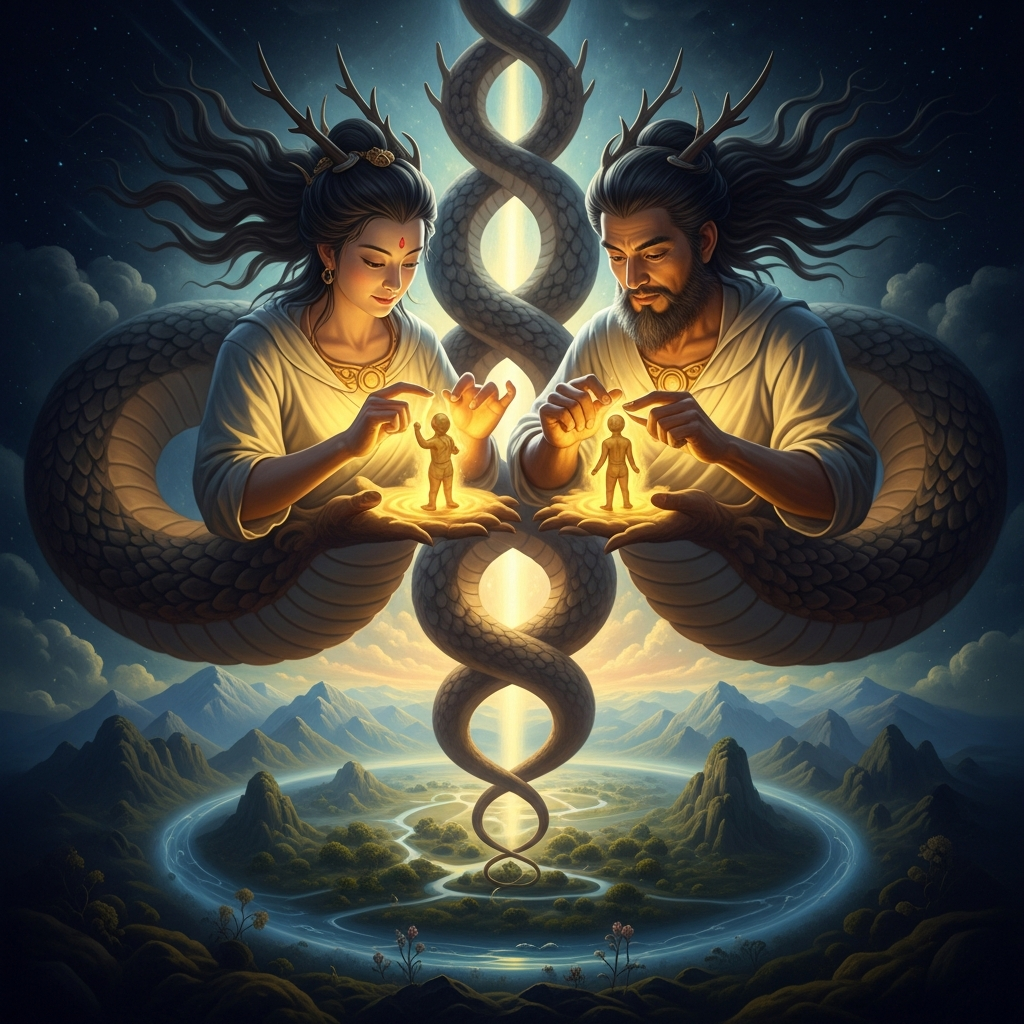
The texts give them, here, a feature that becomes their distinctive iconography: from the waist down, they were not entirely human. Their lower bodies tapered into long serpent tails. They were the first humans, but not yet fully separated from the beast-realm; the cosmic distinction between humanity and the rest of nature had not yet been finalized. In ancient Chinese tomb paintings, particularly the Han dynasty murals at the Mawangdui burial complex, you can still see them depicted this way: two crowned figures with human upper bodies and intertwined serpentine lower bodies, holding the carpenter’s square and the compass — the tools they would later give to humanity.
For now, they were two children alone on a mountain.
—
They built a small shelter. They ate roots. They watched the seasons change. They grew older.
After several years, they realized the implications of their situation.
If the human race was to continue, they were the only ones who could continue it.
They would have to marry each other.
This thought, when it occurred — and the texts give it credit for occurring as a thought, not a desire — disturbed them deeply. The taboo against sibling marriage already existed, in some form, in their inner sense. They were not merely brother and sister; they had been each other’s only family for years. The idea of crossing that line filled them with shame.
But the alternative was the extinction of humanity.
They debated. They prayed. Eventually, in some versions of the myth, Fuxi proposes a test. They will let heaven decide.
They climb to opposite peaks of a great valley, each carrying half of a great millstone. They stand at the cliff edges, half a millstone each. We will roll these, Fuxi calls across to Nüwa. If they meet at the bottom of the valley — if they come together as if drawn — heaven has accepted the marriage. If they do not meet, we will not marry, and humanity will end.
Nüwa agrees.
Each of them pushes their half-millstone over the edge.
The stones roll. They gather speed down the long slopes. They roll across the wide valley floor.
They meet at the exact center.
They come together edge-to-edge with a single ringing crack of stone on stone, and they fit. They join into a complete millstone, perfectly aligned, as if they had been one stone all along.
The siblings, on their separate peaks, watch this happen and weep.
They marry.
—
A different version of the myth — the southern Miao and Yao traditions, in particular — adds a stone lion to the test. As the children grow up, the stone lion at the foot of their mountain begins to speak to them, warning them of dangers, advising them through hard winters. The lion, in this version, is the one who tells them they must marry. The siblings doubt it. The lion proposes the millstone test itself; it is a friendly test, a way to give them permission. The lion is, in fact, the spirit of their father — disguised in stone, watching out for them from the next world.
In every version, the test is passed. The siblings marry. They build a fire. They make a home together at the base of the mountain.
The next problem arrives quickly. They are two adults. To repopulate the world, they need to make children. The first attempts are slow — they do have children, the way humans have children, but the rate is too slow for cosmic urgency. Generations are short, but generations are plural. The world needs a population now.
Nüwa goes down to the river.
—
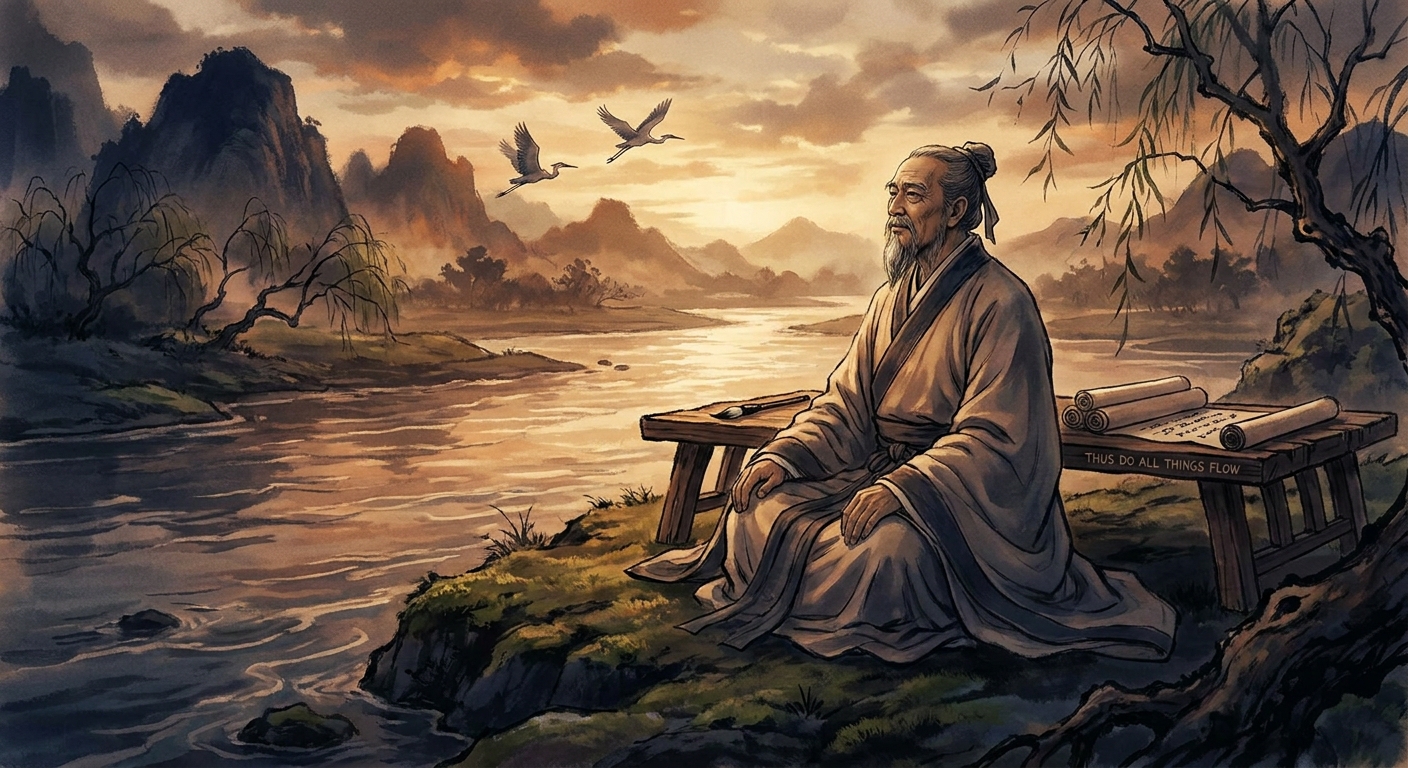
The river runs through banks of soft yellow loess — the famous yellow soil of the Chinese north plain, which gives the Yellow River its name and color. Nüwa kneels at the river’s edge. She picks up a handful of the wet mud. She begins to shape it.
She shapes a small human figure. She gives it a head, two arms, two legs. She presses tiny indentations for eyes, a mouth. She carves small hands and small feet. She blows on the figure.
It moves.
The little clay person, no larger than her palm, blinks, stretches, climbs to its feet, and walks off her hand into the grass. It begins to grow as it walks. By the time it has gone ten paces it is the size of a small child. By the time it has reached the trees it is fully grown.
She has made the first new human.
She makes another. She makes a third. She kneels by the riverbank for a long time, sculpting figure after figure, blowing on each one, watching it walk away into the world.
These first humans are made carefully. Nüwa takes time over their proportions. She makes their faces individual. She gives them grace. They become, the legend says, the founding aristocracy of the Chinese world — the elegant clans, the families with refined features, the lineages that produce sages.
But she has been working for hours. Her hands ache. Her back aches. The world is still vast and still nearly empty. At her current rate, she calculates, she will be sculpting until the seasons turn.
She picks up a vine.
—
She dips the vine in the wet yellow mud at the river’s edge. She lifts it. She flicks it across the grass.
Drops of mud fly off the vine and land on the ground. Where each drop lands, a person springs up — fully formed, fully grown, but rougher than the hand-made ones, less individual, more uniform. They are perfectly functional humans. They have the same number of arms and legs and hopes and fears as the sculpted ones. But they were made by the flick of a vine, not by the careful work of a goddess’s hands.
She flicks the vine again. More humans. Again. More.
In an afternoon, she has populated a region. By the end of a week, the world has people again.
These vine-flicked humans are, the legend says, the common people — the peasants, the laborers, the great mass of humanity that does the work of the world. The traditional Chinese class system, the texts hint, traces its hierarchy back to this distinction. The aristocrats are sculpted; the commoners are flicked. Both are human. Both are made by Nüwa. The difference is in the handiwork.
Modern Chinese readers, with the discomfort modern readers have for class essentialism, sometimes elide this part of the myth. Older texts dwell on it. The myth is honest, in that older form, about the implication: humanity has always been unequal at the level of its origin, and this has been justified mythologically.
—
Fuxi, meanwhile, was not idle.
While Nüwa populated the world, Fuxi taught the world to live. He invented the tools and techniques humans needed: the trigrams of the I Ching (which he saw on the back of a dragon-horse rising from the Yellow River), the rules of marriage (so that future generations would not have to repeat the millstone test), the methods of writing, the principles of music, the techniques of fishing with nets, the breeding of livestock. He was the first culture-hero of China — the figure to whom the Chinese tradition attributes the founding inventions.
His and Nüwa’s children, and the children flicked from her vine, became the population of China. The dynasties that followed — the Yellow Emperor, the Yan Emperor, all the legendary rulers — descended, in the genealogies, from this couple.
The serpent-tails are still visible in old paintings. They remind the Chinese viewer that humanity began in a partial state — half-human, half-otherwise — and that the full separation from the beast-world was a project, not a starting point. Fuxi and Nüwa stand at the base of the family tree, brother and sister, husband and wife, the two halves of a stone that fit, holding the carpenter’s square and the compass — the tools by which the human world was measured into being.
Scenes
A vast hollow gourd floats on the receding floodwaters at sunrise
On opposite mountains across a misty valley, Fuxi and Nüwa each push the half of a millstone over a cliff
Nüwa kneels at a yellow riverbank, sculpting tiny human figures from the mud, setting them on the grass to dry
Echoes Across Traditions
Entities
- Fuxi
- Nüwa
- The Stone Lion
- The Yellow Emperor (later)
Sources
- *Huainanzi* (c. 139 BCE)
- *Fengsu Tongyi* (Ying Shao, c. 200 CE) — Nüwa's clay humans
- Tang dynasty oral retellings of the brother-sister flood
- Anne Birrell, *Chinese Mythology: An Introduction* (1993)