The World That Hatched: Cosmic Egg Creation Myths Across Five Traditions
Mythic time — from earliest Vedic texts through Finnish oral tradition · The pre-cosmic void — before any world existed
Contents
Before the universe existed, there was an egg. The Orphic tradition, the Hindu Hiranyagarbha, the Chinese Pangu myth, the Finnish Kalevala, and Egyptian cosmology each describe a cosmos that hatched from a pre-cosmic void. The convergence is extraordinary.
- When
- Mythic time — from earliest Vedic texts through Finnish oral tradition
- Where
- The pre-cosmic void — before any world existed
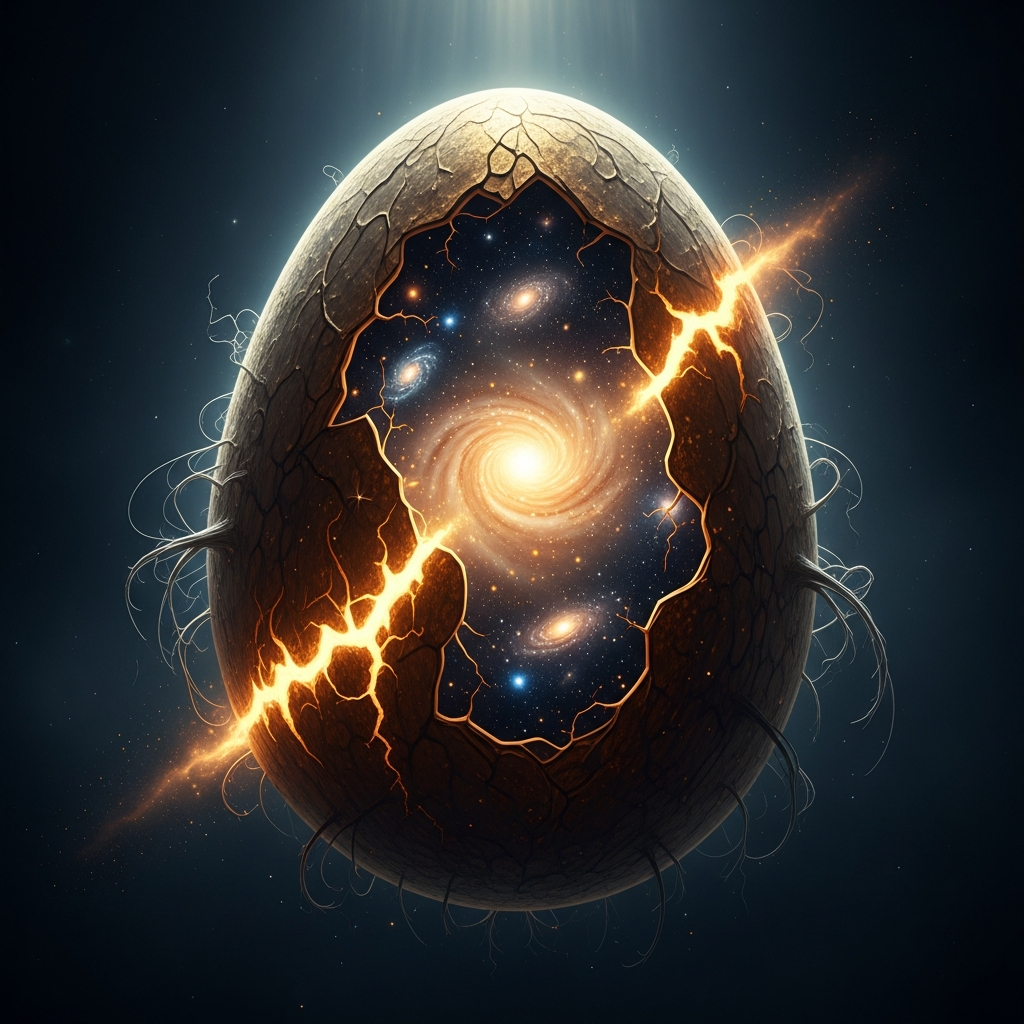
Before the universe, there was an egg.
This sentence appears, in different forms, in the creation myths of ancient Greece, ancient India, ancient China, ancient Egypt, ancient Finland, and at least a dozen other traditions. Cultures separated by oceans and thousands of years of isolation each arrived at the same image: the world did not begin with a decree, a battle, a thought, or an emanation from a divine being already in existence. It began with an egg that contained everything, in a darkness that contained nothing else, and the world as we know it emerged when the egg hatched.
The convergence of the cosmic egg across unconnected traditions is one of comparative mythology’s most persistent puzzles. The image is too specific to be coincidental — it is not simply “the world was dark before it began,” which any tradition could generate independently. The egg image implies a closed potential, a self-contained pre-cosmological state, a boundary between the nothing-before and the something-after, and the hatching event as the transition between them. Every one of these traditions chose this specific image to describe the same transition.
The Orphic Egg: Light Hatching from Darkness
The Orphic creation tradition — named for the mystical religious movement centered on Orpheus, which flourished in the Greek world from the sixth century BCE onward — presents one of the most elaborate cosmic egg cosmogonies in world mythology.
In the Orphic account, the beginning is Chronos (Time, not to be confused with the Titan Kronos), who fashions an egg from Aether and Chaos. The egg is silver. It floats in the primordial darkness of Erebus. Within it grows Phanes — also called Protogonos (“First-Born”) and Eros — the first divine being, hermaphroditic, carrying within his body the seeds of all gods and all creation.
When Phanes hatches, he brings light. He is, in some accounts, the first light itself — the cosmic illumination that makes the subsequent acts of creation visible and possible. He creates the other primordial gods, who then create the material world in layers. His emergence from the egg is not the creation of the world but the beginning of the process of creation: the hatching of the first being who will generate the others.
The Orphic egg tradition has a theological sophistication that its simple cosmological setting might disguise: it locates creative potential not in any existing divine will but in a process that precedes divinity itself. Phanes hatches from the egg before the gods exist as such. The world does not begin with a creator; it begins with the creation of the creator.
Hiranyagarbha: The Golden Womb
The Rig Veda’s Hiranyagarbha hymn (10.121) is among the oldest surviving cosmic egg texts, and it is characteristically enigmatic: “In the beginning arose the Golden Germ; he was born as the one Lord of all that is. He established the earth and this sky — to which god shall we pay homage with our oblations?”
The Golden Germ (Hiranyagarbha) floats in the cosmic waters before any deity exists, before any world is formed. Within it is Brahma — or the divine creative principle that will become Brahma — gestating in the golden shell. When the egg breaks, the two halves become heaven (the gold shell above) and earth (the gold shell below). The yolk becomes the sun. The fluid within becomes the ocean.
The later Puranas elaborate this into an explicit cosmic egg (Brahmanda — “Brahma’s egg”) that is the entire universe: heaven and earth inside it, the oceans between, Brahma born inside it and breaking it open. The universe is the broken shell of the Brahmanda, the world that emerged when the primordial egg cracked.
What the Hiranyagarbha tradition emphasizes that others do not is the egg as container of all potential divine creativity. Brahma does not pre-exist the egg and lay it. He grows inside it, contained by it, waiting for the moment when the shell breaks. The creator god is not prior to the creation process but emerges from the same event that creates everything else.
Pangu: The Giant Who Became the World
The Chinese Pangu myth has a different relationship to the cosmic egg from the others in this survey: Pangu does not simply hatch from the egg. He grows inside it until he fills it entirely, then breaks it apart, and ultimately dies to become the world.
The primordial state is chaos — the universe undifferentiated, with no distinction between sky and earth. In this chaos, an egg forms. Pangu grows inside it for eighteen thousand years, filling the egg completely with his body. When the egg finally breaks, Pangu himself holds the two halves apart: his head supports the sky, his feet rest on the earth, and he grows ten feet taller each day to keep them separated.
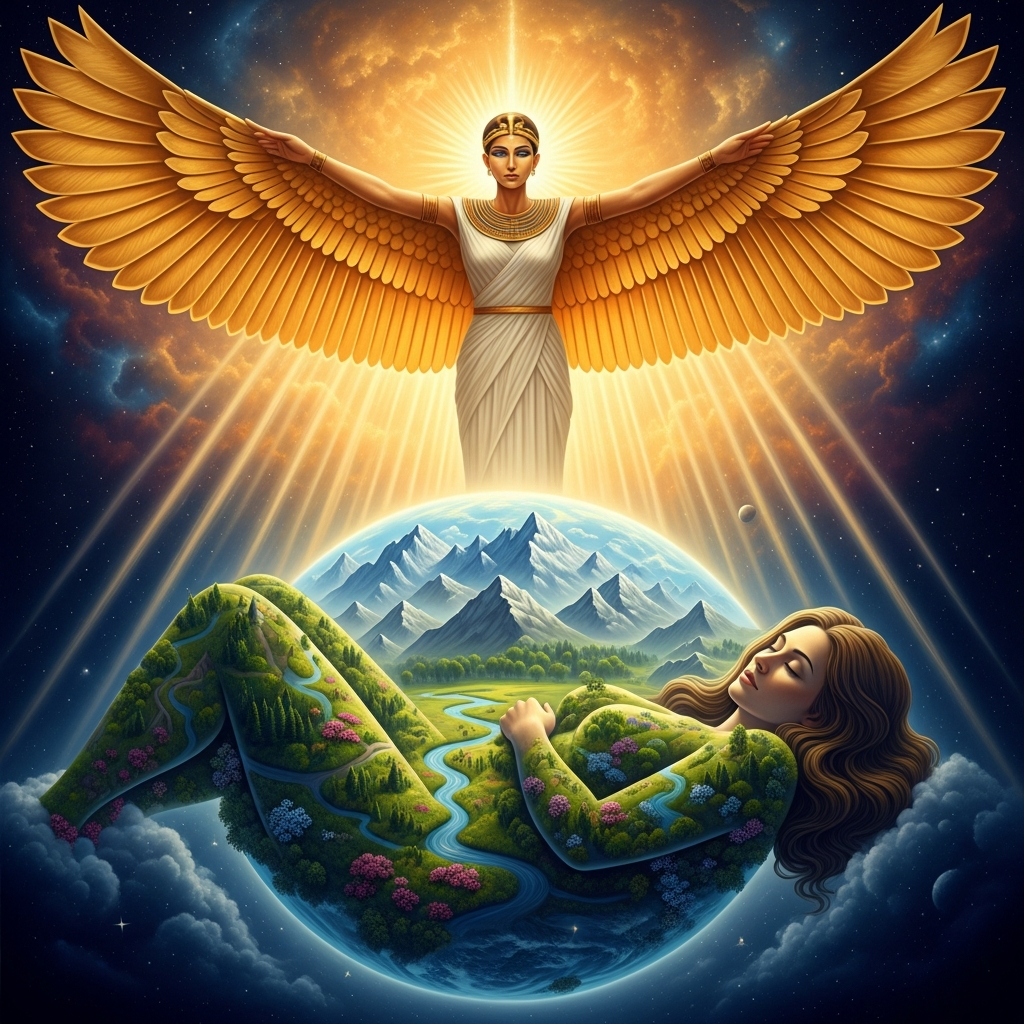
After another eighteen thousand years, Pangu dies. His death is the completion of the creation. His breath becomes the wind and clouds. His eyes become the sun and moon. His voice becomes thunder. His body hair becomes forests and meadows. His bones become mountains. His blood becomes rivers. His sweat becomes rain. Every element of the natural world is a part of Pangu’s body.
This is the most thoroughgoing version of the cosmic egg myth as creation through divine sacrifice: the being that hatches from the egg does not make the world — he becomes it. The world is not a product of Pangu’s activity but the substance of his body. We live inside the remains of the primordial giant who grew inside the primordial egg. The egg cosmogony and the body-cosmogony are the same event.
The Kalevala’s Egg: Creation by Accident
The Finnish Kalevala’s creation myth — assembled by Elias Lönnrot from Finnish oral tradition in the nineteenth century — has a quality that no other cosmic egg myth shares: the creation of the world is accidental.
The cosmogony begins with Ilmatar, the Air Spirit, who floats on the primordial ocean. She is a virgin spirit, alone in the void before the world exists. A teal (a waterfowl) descends and, finding no land, lands on Ilmatar’s knee — the only solid surface available — and lays six golden eggs and one iron egg.
The eggs hatch and fall into the water. The shells break and from them the world is made: the lower shell becomes the earth, the upper shell becomes the sky, the yolk becomes the sun, the white becomes the moon, the mottled parts become the stars and clouds.
None of this was planned. Ilmatar did not intend to be a nest. The teal did not intend to create a cosmos. The eggs fell accidentally. The world is made from what happens when cosmic potential gets warm in the wrong place and hatches. The Kalevala’s creation is the most anthropologically fascinating version of the cosmic egg because it refuses the framework of divine intention. The world began because something needed somewhere to land.
What the Egg Means
The cosmic egg myth recurs across traditions that had no historical contact because the egg image solves a specific problem in creation theology.
The problem is the boundary between nothing and something. Every creation myth must account for the moment before creation — the state that preceded the world. But describing the state before the world existed is, by definition, impossible from inside the world. The egg myth solves this by locating the origin in a bounded potential: the egg is nothing in the sense that it has not yet become anything — it is closed, undifferentiated, not yet hatched. And the act of hatching is the transition from potential to actual, from closed to open, from the nothing-that-contains-everything to the something-that-has-begun.
The egg is the most vivid available image for a state of maximum potential before any actualization. Every culture that watched birds hatch had the same object lesson: inside that small, still, sealed thing is a living being, and the moment of hatching is the moment of becoming. The question “what was there before the world?” finds its most intuitive answer in the question “what was there before the bird?”
An egg. A closed potential. A held breath. And then, one day, everything.
Echoes Across Traditions
Entities


Sources
- Hesiod, *Theogony* (c. 700 BCE)
- W. Norman Brown, 'The Creation Myth of the Rig Veda,' *Journal of the American Oriental Society* 62 (1942)
- Anne Birrell, *Chinese Mythology: An Introduction* (1993)
- Elias Lönnrot, *Kalevala* (compiled 1835, from Finnish oral tradition)
- Jan Assmann, *The Search for God in Ancient Egypt* (2001)