Contents
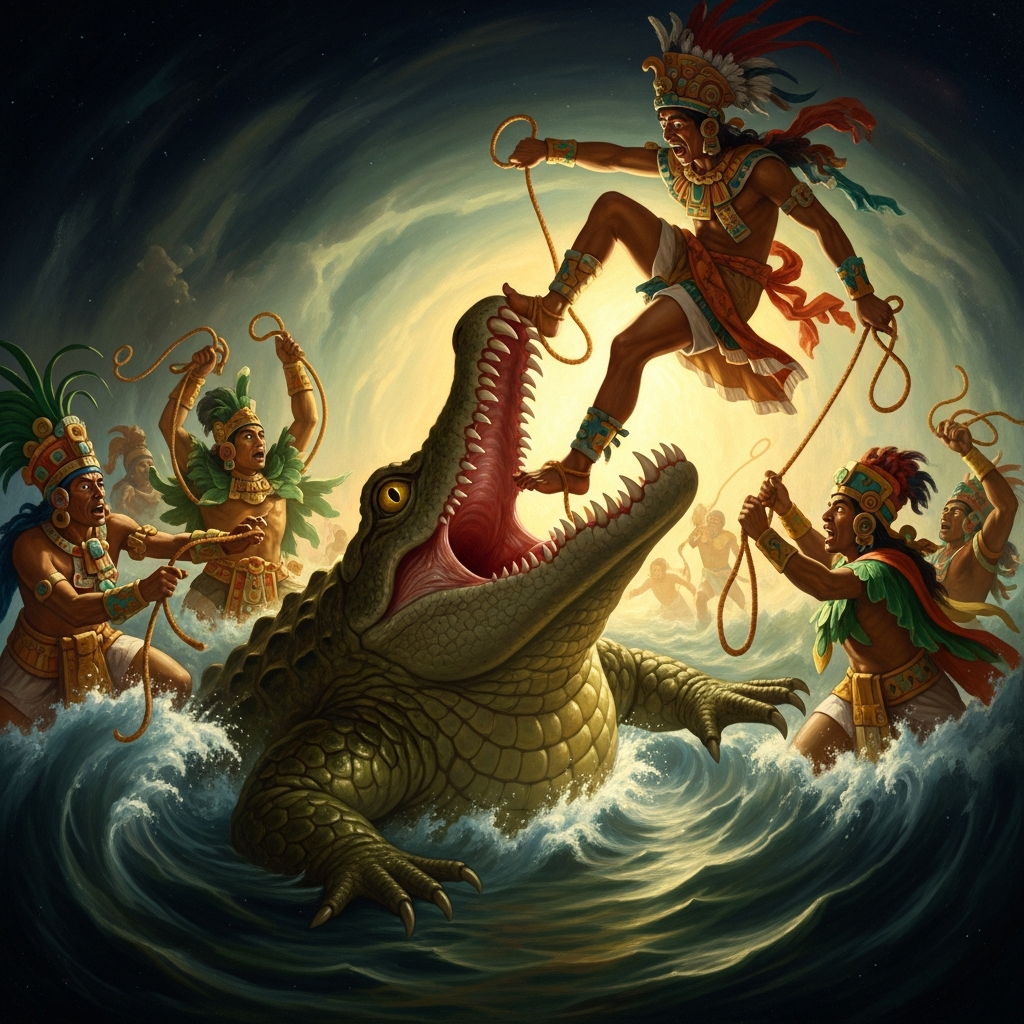
Before the world existed there was only water, and in the water swam Cipactli — part fish, part crocodile, part toad, ravenous and immense. Tezcatlipoca lured her with his foot as bait; she bit it off; the gods then tore her body into the earth. Mountains are her spine. Caves are her open mouth. She still hungers.
- When
- Beginning of the world, before the First Sun
- Where
- The primordial sea; the body of the earth itself
In the beginning there was no beginning, only the sea. The sea had no shore because there was no land for a shore to meet. The sky had no floor because there was no earth for it to rest on. There was only water above and water below, and the water was not empty.
In the water swam Cipactli. Her name means “spiny one” or “alligator,” but she was no alligator the world has since seen. She was a thing assembled out of every hunger: the long jaws of a crocodile, the slick scaled body of a great fish, the warty skin and pulsing throat of a toad, and along every joint a row of teeth — teeth at her elbows, teeth at her knees, a mouth at every place where her body bent. She did not eat to live; she lived to eat. There was nothing for her to eat in the empty sea, so she swam and swam and was hungry and was angry, and the water churned with her hunger.
The gods, in the high places before there were high places, looked down at this monster and understood that they could make nothing while she lived. As long as Cipactli swam in the universal sea, anything they laid on her back she would tear apart. So they came down to do what gods sometimes have to do.
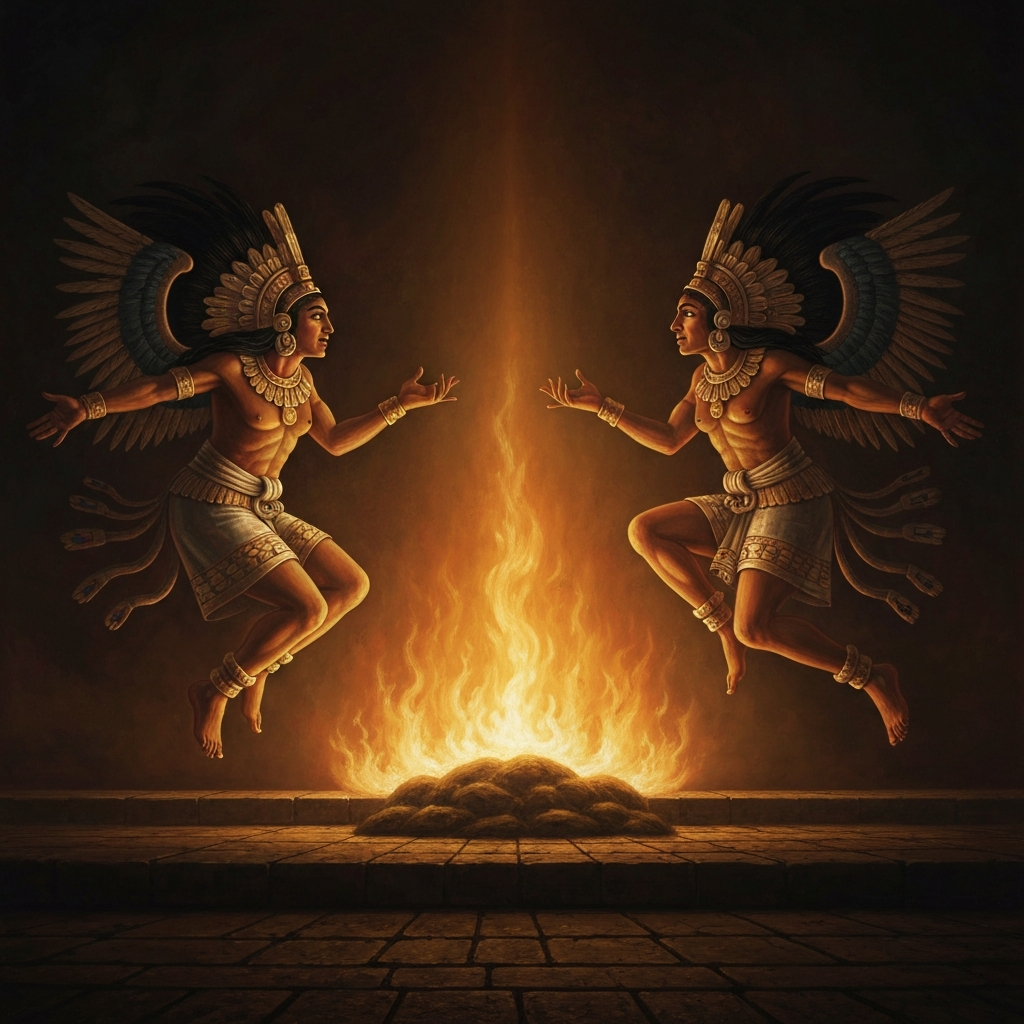
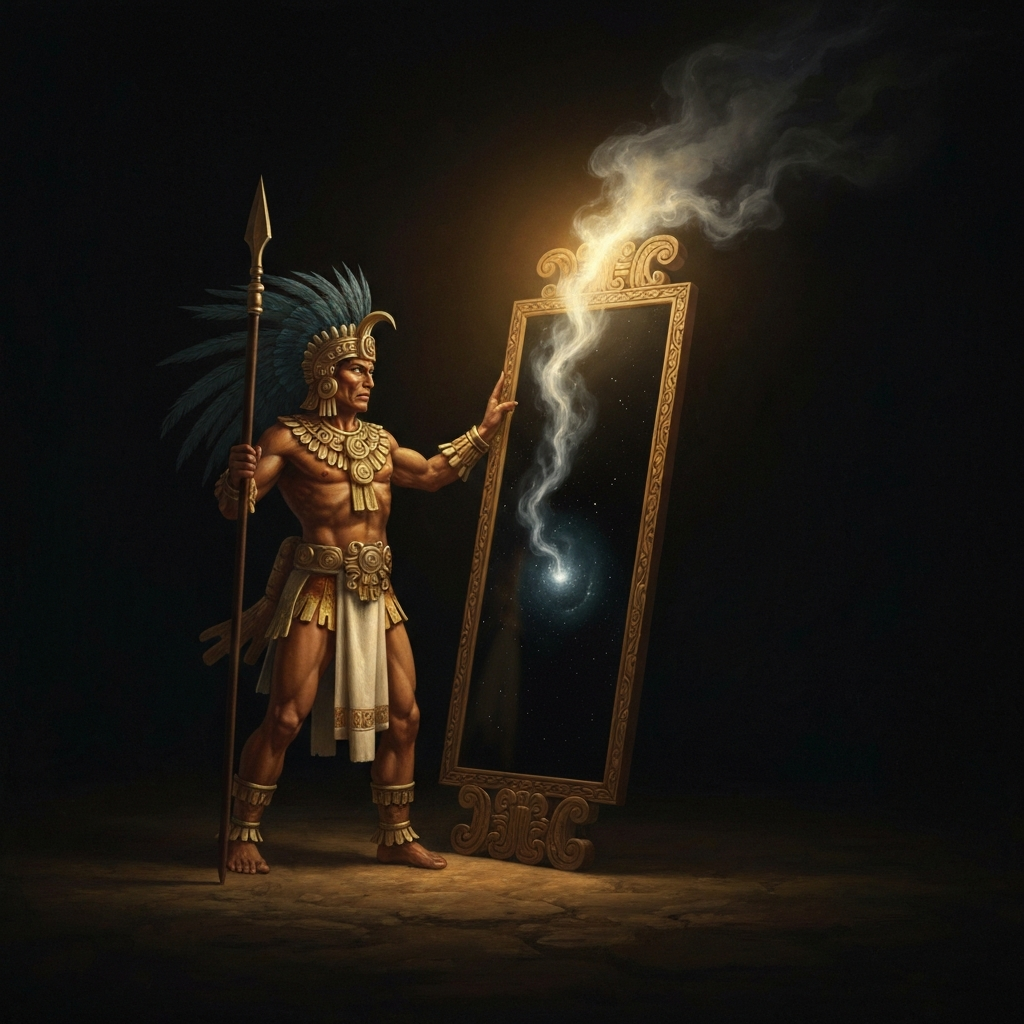
Tezcatlipoca went first. He stood at the edge of the water — though there was no edge — and lowered his right foot into the sea as bait. Cipactli came. Cipactli always came, for anything moving. She rose from the dark water with her three sets of jaws yawning, and she bit. She took Tezcatlipoca’s foot off at the ankle. He did not cry out. (This is why, in every codex that shows the Smoking Mirror, his right foot is missing or replaced with a black mirror or a bone — the original wound of creation, never healed, because creation is not the kind of thing that heals.) But while she was busy with the foot, Quetzalcoatl came at her from the other side, and the two brothers, who would be enemies through every age, were here for one moment allies, and they killed her.
They killed her, and now they had her body, and her body was vast. The codex called Historia de los Mexicanos por sus Pinturas says they tore it in two. From the upper half they made the sky — but it was a body, so the sky has the texture of skin, and stars are pinpricks in it where the light from beyond shines through. From the lower half they made the earth. They laid her face-up on the water, and her great body became the ground.
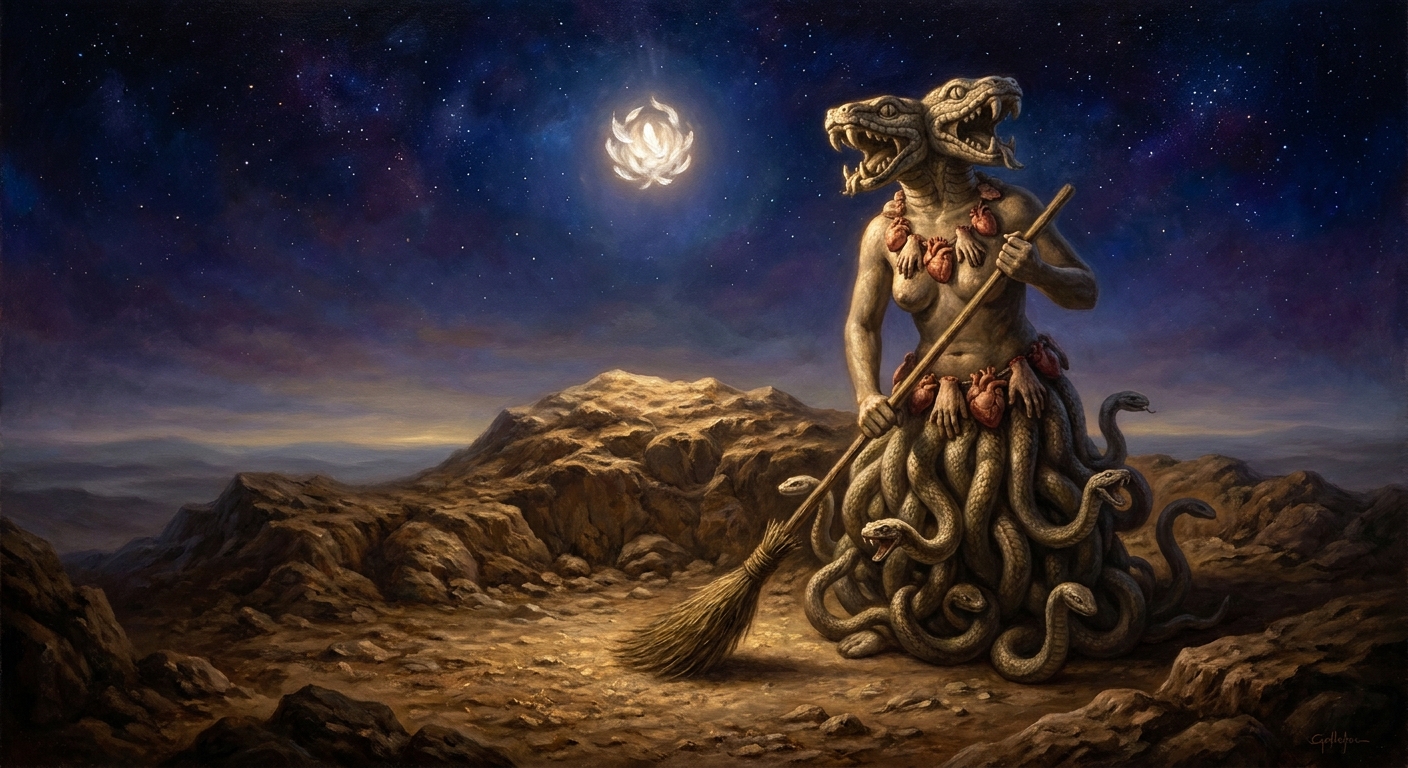
Where her spine bent upward, mountains rose. Where her ribs sank, valleys formed. Her open mouth became the caves, of which the Aztecs said: every cave is a mouth, and to enter a cave is to enter Cipactli, and to enter Cipactli is to risk being chewed. Her many other mouths, the ones along her body, became the springs and the cenotes and the places where the rivers come up from below. Her hair became the trees, her scales the rocks, her tears the salt lakes. Her body did not stop being hungry just because it was now the earth. It was still hungry. It is still hungry now.
This is why, the priests said, the earth must be fed. The maize you cut takes from her flesh; the obsidian you knap is a chip of her tooth; the well you dig is a small wound. She gives, but she does not give freely. Cipactli was killed, but she was not made into a thing that does not feel killing. The Aztecs understood that they walked, every day, on the body of an angry god whose mouth was beneath them. The blood from the sacrificial stone did not go up to the sky to feed the sun only. Some of it ran down through the cracks. Some of it went into the ground. That portion, they knew, went to her. They did not feel guilty about this. They felt obliged. They had eaten her body for breakfast; she had earned a share back.
Echoes Across Traditions
Entities
- Cipactli
- Tezcatlipoca
- Quetzalcoatl


Sources
- Historia de los Mexicanos por sus Pinturas (1543)
- Leyenda de los Soles (1558)
- Codex Vaticanus A