The Salmon People Who Are Also Us
Foundational time — when the relationship between humans and salmon was established · The rivers and the Pacific Ocean of the Northwest coast; the Salmon People's underwater houses
Contents
The Salmon People live in great houses beneath the ocean and every spring they voluntarily put on their salmon bodies and swim upriver as a gift — and if a human receives the bones properly and returns them to the water, the Salmon People can come back.
- When
- Foundational time — when the relationship between humans and salmon was established
- Where
- The rivers and the Pacific Ocean of the Northwest coast; the Salmon People's underwater houses
The Salmon People are not fish.
They live in great houses beneath the ocean, wearing their human forms, and their houses are organized by clan and family just as the people’s houses are organized on shore. They have chiefs and ceremonies and marriages and the particular social obligations of a people who live close together and know everyone’s business.
Every spring they make a decision.
The Salmon chief calls the people together and says: it is time. The human people need us. They are hungry from the winter and the rivers are calling. We will put on our salmon bodies and go upriver.
This is a voluntary sacrifice. The Salmon People know what happens when they swim upriver: the bears eat them, the eagles eat them, the human people catch them in weirs and smoke them and eat them through the winter. They know this. They go anyway, because the relationship is old and the covenant is clear.
The covenant has conditions.
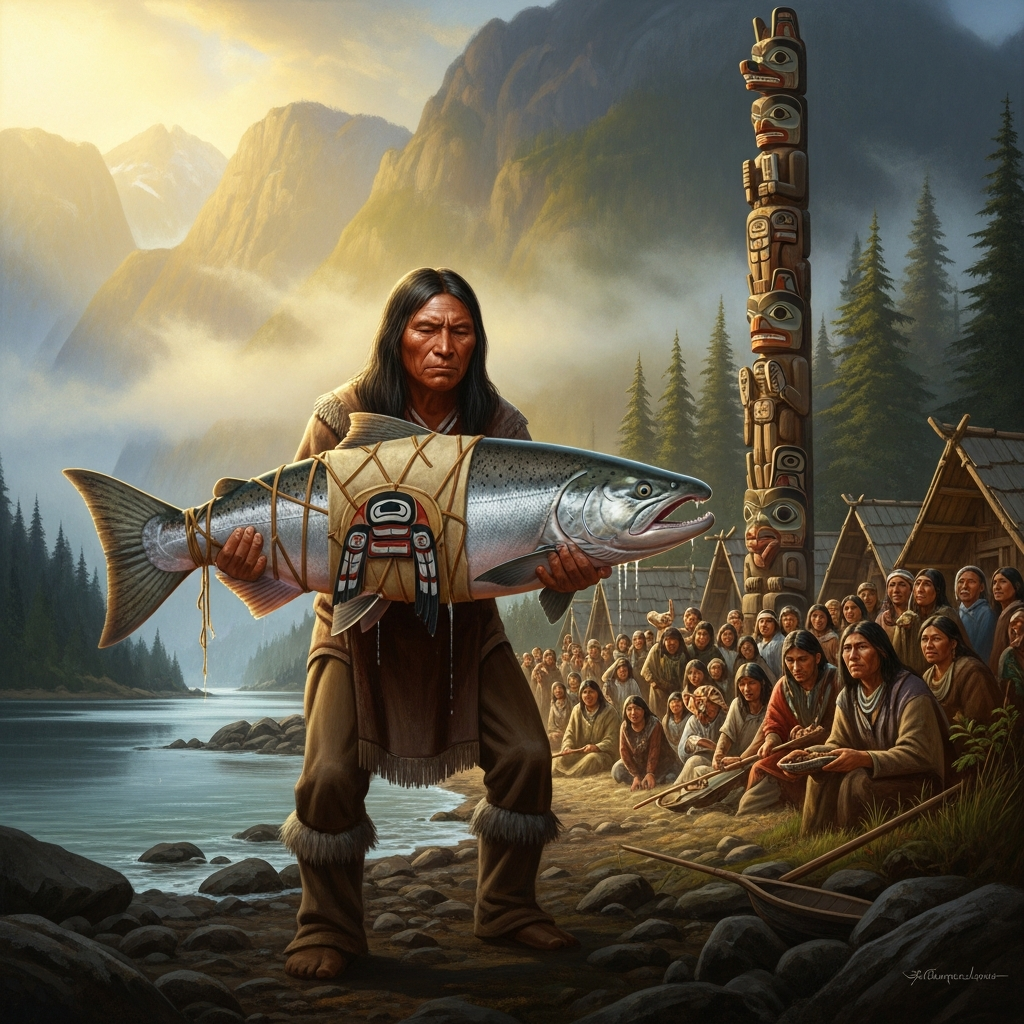
When a human person eats a salmon, every bone must be returned to the water. Not carelessly thrown back, but returned properly, oriented toward the sea, so that the Salmon Person can reassemble its bones in the ocean and live again. If the bones are treated carelessly — scattered, left on the bank, given to dogs — the Salmon Person cannot come back whole. The soul is intact but the body is broken.
If enough bones are lost, the Salmon People stop coming.
This is not a punishment. It is not anger. It is the logical consequence of a broken relationship: if the humans cannot hold their side of the covenant, the exchange cannot continue. The Salmon People do not die if the bones are lost — they simply return to their houses and decide to offer themselves elsewhere, to a people who will receive them properly.
This is why the First Salmon Ceremony exists. This is why the bones go back to the river.
A young man once followed the salmon.
He drowned — or appeared to drown — and found himself in the Salmon People’s houses, welcomed as a guest, fed and given a place to sleep. He watched how the Salmon People lived. He saw the gaps in their numbers where the ones whose bones had not been returned could not reconstitute themselves. He saw the sadness of the incomplete families.
He carried this back when he was returned to his people.
He said: they are persons. They give themselves. We must receive them as persons give things — with acknowledgment, with care, with the full attention of someone who understands what is being offered.
The rivers of the Pacific Northwest have been running pink with salmon for thousands of years, and the covenant has held for thousands of years, because the people held their side of it. The ceremony exists because the relationship requires maintenance. The bones go back to the water because the Salmon People deserve to be whole.
What we eat eats us back.
That is not a problem. That is a relationship.
Echoes Across Traditions
Entities
- the Salmon People
- the Chinook Salmon chief
- the fisherman who is taught the proper relationship
- Raven

Sources
- Franz Boas, *Kwakiutl Ethnography* (University of Chicago Press, 1966)
- Robin Wall Kimmerer, *Braiding Sweetgrass* (Milkweed Editions, 2013)
- Nora Marks Dauenhauer and Richard Dauenhauer, *Haa Shuka, Our Ancestors* (University of Washington Press, 1987)