The First Salmon Ceremony
Annual — every spring when the first salmon runs begin; established in mythic founding time · The rivers of the Pacific Northwest coast — the Columbia, the Fraser, the Skeena, the Copper
Contents
When the first salmon of the season is caught, it is carried to shore with honors, welcomed like a returning chief, fed, sung to, and its bones returned to the water — because the first salmon carries word back to the Salmon People of how they were received.
- When
- Annual — every spring when the first salmon runs begin; established in mythic founding time
- Where
- The rivers of the Pacific Northwest coast — the Columbia, the Fraser, the Skeena, the Copper
The fisherman knows it the moment the first salmon of the season comes to the weir.
Not just any salmon — the first one. The one who comes before the others, who leads the run, who is in this tradition the representative of all the Salmon People coming this year. He does not simply take it out of the water and add it to the basket.
He speaks to it.
He thanks it. He acknowledges that it has come a long way, from the deep ocean to this river, through the falls and the bears and the eagles, to this weir where a human person is waiting. He acknowledges that this is a sacrifice — that the salmon is giving its life and its bones so that the people can eat through another winter. He says the words his grandfather said, which are the words his grandfather’s grandfather said, which are the first words that were taught to the people when the relationship between humans and salmon was established.
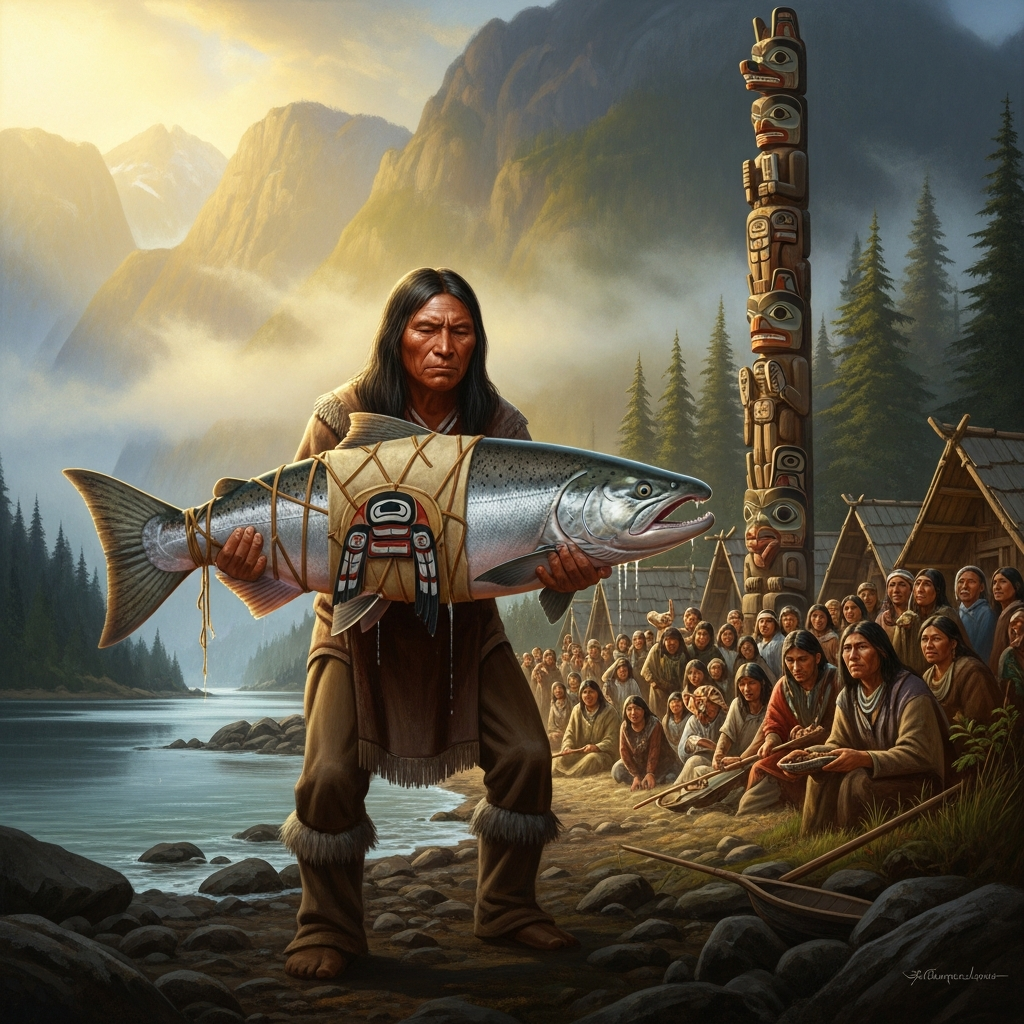
Then he carries the fish to shore, not in the basket but in his arms, carefully.
The village gathers.
The ceremony varies by tradition and by village, but the essential elements are the same across the coast. The first salmon is laid on cedar bark, its head pointed upriver — toward the mountains, toward the source — and the chief addresses it formally. Some traditions feed the fish fresh water, because it has been in salt water and is offered fresh water as hospitality. Songs are sung, the specific songs that belong to this ceremony, that only belong to this ceremony.
Then it is cooked and shared. Every person in the village receives a piece — every person, not just the important ones, because the first salmon’s blessing is not ranked. It is the first food of the new season, the food that says: the salmon have kept their side of the relationship. They have come again.
After eating, every bone is collected.
Every bone, carefully. The bones are laid out in the correct order — head bones together, spine bones together, tail bones together — and carried back to the river. They are placed in the water with the head pointing downstream, pointing toward the ocean. This is the return: the bones going back to the sea so that the Salmon Person can reconstitute itself and report to the rest of the Salmon People how it was received.
The report matters.
If the first salmon is received with honor, returned whole, treated as a person who gave itself willingly — the Salmon People hear this report and they come. The runs are full. The weirs are heavy. The people have enough.
If the first salmon is received carelessly, its bones left on the bank, its body wasted — the Salmon People hear this too. And they make other arrangements.
This is not superstition. This is an accurate description of a relationship.
The rivers of the Pacific Northwest coast ran with more salmon for more centuries than any European mind can easily hold, and they ran because the people who lived beside them understood that the salmon were persons who required relationship, not resources that could be extracted without acknowledgment. The ceremony sustained the ecology, and the ecology sustained the ceremony, and the people lived in the space between them, receiving abundance by knowing how to receive.
Echoes Across Traditions
Entities
- the First Salmon
- the fisherman
- the village chief
- the Salmon People beneath the ocean
Sources
- Nora Marks Dauenhauer and Richard Dauenhauer, *Haa Shuka, Our Ancestors* (University of Washington Press, 1987)
- Philip Drucker, *Cultures of the North Pacific Coast* (Chandler, 1965)
- Robin Wall Kimmerer, *Braiding Sweetgrass* (Milkweed Editions, 2013)