Contents
A knight is sent to bring his uncle's bride home from Ireland. On the boat, by accident, the two of them drink the love potion meant for the wedding night. They cannot stop. He marries another woman with the same name and dies of a wound that needs the wrong sail to be lifted.
- When
- c. 500-1200 CE (mythic time, written 12th century)
- Where
- Cornwall, the sea between Ireland and Britain, Brittany, the chamber where Tristan dies
Tristan was the nephew of King Mark of Cornwall.
He had come to his uncle’s court as a young man, and he had distinguished himself almost at once. The Irish king had been demanding tribute from Cornwall — a tribute of children, sent every seven years, taken into Ireland and not returning — and the tribute had been collected by a giant called Morholt, brother of the Irish queen. Morholt was a champion no one in Cornwall would face. Tristan, newly arrived, offered to fight him in single combat.
He won. He killed Morholt. But Morholt’s spear had been envenomed, and a fragment of the spearhead had broken off in Tristan’s wound. The wound would not heal. He grew weak. The Cornish doctors could do nothing.
He was placed, at his own request, in a small boat with a harp and no oars and pushed out to sea. He drifted. He drifted for many days. He came at last, by chance — or by something stronger than chance — to the coast of Ireland.
He landed near the court of the Irish king. He did not say his real name. He said he was a wandering harpist named Tantris. His harp was magnificent and his playing was extraordinary. The Irish queen, who happened to be expert in herbs and in the healing of wounds, took him in and treated him. Her daughter — Isolde, the white-handed, the gold-haired — assisted her. The wound healed. Tristan, his identity intact, returned to Cornwall.
There, his uncle King Mark was being pressed by his nobles to marry. They wanted an heir. Mark had no taste for marriage. He resisted. Then, one day, two swallows flew through the window of his hall carrying between them a single long golden hair. Mark held the hair against the light. He said — to put off the nobles, who he thought were not capable of meeting the condition — that he would marry the woman to whom that hair belonged.
Tristan, who had seen Isolde’s hair, said quietly: I know whose hair this is. I will go and get her for you.
He sailed back to Ireland. This time he was received as a Cornish prince. He overcame various tests — including the killing of a great dragon that had been ravaging the Irish coast, which won him the king’s gratitude — and the marriage was arranged. Isolde would sail with Tristan back to Cornwall to marry King Mark.
Her mother, the queen, knew her daughter’s reluctance. The queen brewed a love-potion. She gave it to Brangaine, Isolde’s chief lady-in-waiting, with strict instructions: On the wedding night, before the consummation, give a cup of this to King Mark and a cup of this to Isolde. They will fall in love. The marriage will go well.
Brangaine took the potion aboard the ship. She stowed it carefully.
The ship sailed. The voyage was long. Tristan and Isolde, on deck and below, spent much time in each other’s company. They did not, at this point, love each other. They had reasons for tension — Tristan had killed her uncle Morholt, after all — but they had grown into a kind of cool civility.
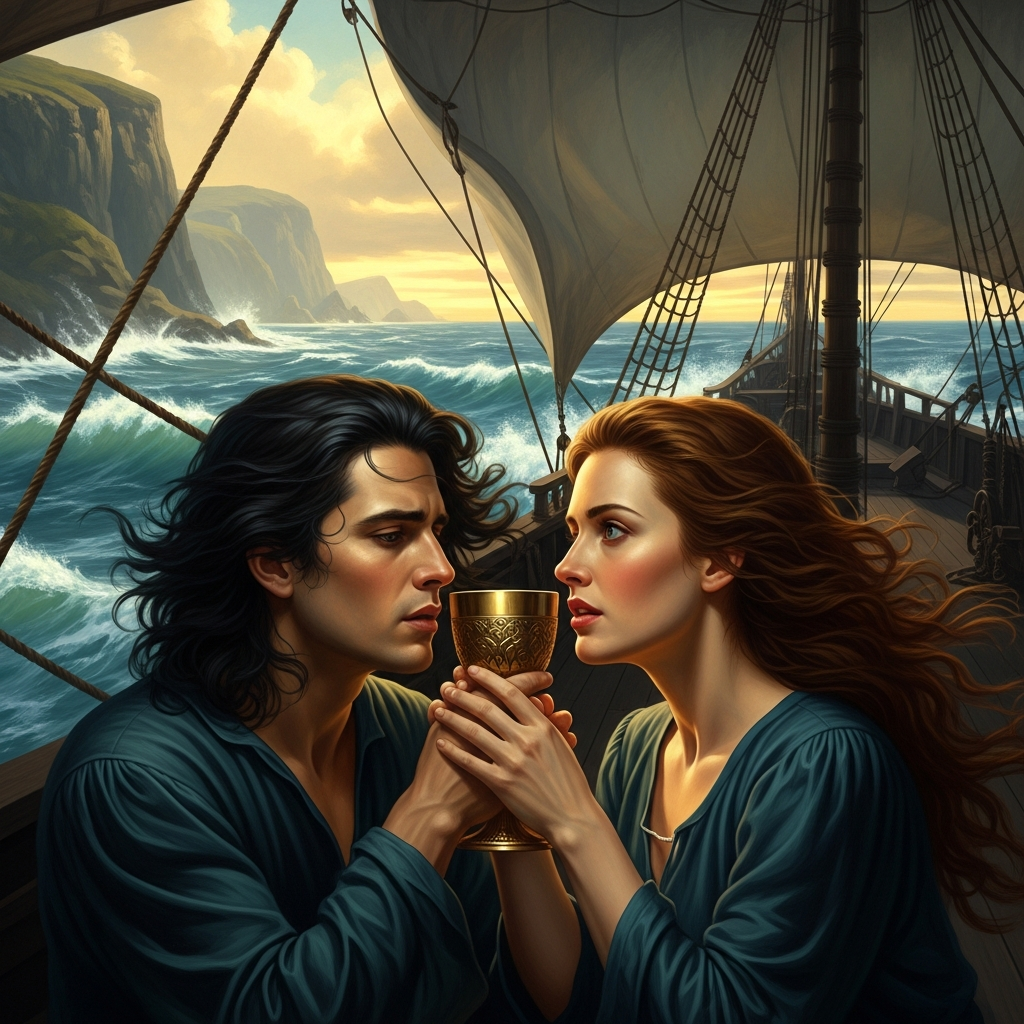
One hot afternoon, somewhere in the open sea between Ireland and Cornwall, they were thirsty. They were sitting in a private cabin. Brangaine was elsewhere on the ship. Tristan looked through the cabin’s stores and found a flask. He did not know its purpose. He called for Isolde to share a drink. She came in. He poured the contents of the flask into a cup. They each drank.
The flask was the love-potion.
When Brangaine returned to the cabin and saw the cup and saw the flask and saw the faces of the two of them, she understood at once. She fell to her knees. She wept. We are all undone, she said. That was the potion meant for the king. There is no antidote. You will love each other now until you die.
The two of them looked at each other in the cabin. The thing was already happening. The cool civility was gone. There was nothing between them now but a force they did not recognize as their own.
They became lovers on the ship. By the time the ship docked in Cornwall, the affair was established. Isolde was married to King Mark, by the planned wedding, four days after they arrived. On the wedding night Brangaine — at Isolde’s request, to disguise the loss of virginity — substituted herself for Isolde in Mark’s bed. The deception worked. The marriage was consummated, technically, with the maid. Isolde and Tristan continued.
The court, eventually, began to suspect.
There were spies. There were court magicians. There were jealous knights — three barons in particular, who did not love Tristan and who did love trouble — who set about catching the lovers. They were caught. They were uncaught. They were caught again. The story passes through episode after episode of suspicion, denunciation, ordeals, escapes, returns. There is the famous scene of the orchard — Tristan and Isolde meeting beneath the tree where Mark is hidden, and conducting a calculated public conversation that convinces Mark of their innocence. There is the scene of the flour scattered around Isolde’s bed, designed to record Tristan’s footprints — and Tristan, leaping from his bed to hers across the gap, leaves no print. There is the scene where Tristan, disguised as a leper, carries Isolde across a ford and is rewarded with a kiss the court mistakes for charity.
The court does not catch them definitively for a long time. Mark himself oscillates — sometimes furious, sometimes tender, sometimes refusing to believe what his counselors tell him. He loves both Tristan and Isolde. He is the figure in the romance whom the audience always pities most. He keeps being given evidence and keeps choosing not to see it.
Finally, evidence becomes overwhelming. Tristan flees. Isolde retreats to a convent or back to her marriage, depending on the version. Tristan goes to Brittany. He cannot return to Cornwall on pain of death.
In Brittany, in despair, in long absence from his Isolde, Tristan does the thing this kind of literature requires its protagonist to do. He marries another woman. The other woman is named Isolde — Isolde of the White Hands — a different Isolde of similar features, sister to the lord of Brittany. He marries her partly out of grief, partly out of confusion, partly because the name itself draws him. He does not consummate the marriage. He cannot. He spends his nights remembering the other Isolde.
Isolde of the White Hands knows. She is loyal but not stupid. She watches her husband’s distance and reads it correctly. She begins, slowly, to hate him.
Tristan, in some battle in Brittany, is wounded by a poisoned spear. The wound, like the first wound of his youth, will not heal except with the herbs of one healer in the world — Isolde of Ireland, who is now Isolde Queen of Cornwall. He sends a messenger to her. He instructs the messenger: If she is willing to come, hoist a white sail when you return. If she will not come, hoist a black sail.
He waits in his bed in Brittany. He grows weaker. The fever rises. He cannot get up; he cannot see the harbor from his window.
Isolde, in Cornwall, reads the message. She drops everything. She comes.
The ship returns. It approaches the coast of Brittany. The sail is white. The Cornwall queen is on board.
Isolde of the White Hands is at the window. She sees the ship. She sees the sail. She knows what the sail means, because the messenger and Tristan together, before the ship had sailed, had agreed the signal in front of her — perhaps thinking she did not understand the language of the message, perhaps simply careless. She knows.
Tristan, in his bed, calls to her: What is the color of the sail?
She has a moment. She has a long moment, and she has a long marriage’s worth of grief, and she has the truth in her mouth. She says: The sail is black.
Tristan, on hearing this, gives up. He turns his face to the wall. He dies.
Isolde of Ireland, an hour later, lands in the harbor. She comes up to the house. She runs through the rooms. She arrives at his chamber. He is dead. She lies down on the bed beside him. She does not weep. She presses her face against his face. After a few minutes, she dies as well.
They were buried, on King Mark’s order — Mark having forgiven everything, weeping for them — in a single tomb in Cornwall. From Tristan’s grave a tree grew. From Isolde’s grave a vine grew. The tree and the vine met above the joined graves and entwined. They were cut down. They grew again. They were cut down. They grew again. After three cuttings, the priests and the king let them be. They grew together.
The Tristan story has been retold more than any romance in the European tradition except possibly the Grail. Wagner’s opera ends with Isolde’s Liebestod — the love-death, the soprano’s transfigured ending — and crystallizes the myth’s dark proposition: love that has reached this intensity is incompatible with the continuing of life. The lovers do not survive. The lovers cannot survive. The story’s power, across eight centuries, lies in the fact that the audience accepts this. The audience does not say: they should have lived, they should have compromised, they should have settled. The audience says: of course they died. What else could they have done?
The potion is the metaphor that holds the whole structure up. Without the potion, the story is a sordid affair — knight beds king’s wife, gets caught, runs. With the potion, the story is a tragedy — knight and lady are administered to one another, against their will, by an accident on the boat, and spend the rest of their lives unable to do anything except love each other and watch the world fail around that love.
Modern psychology has a different vocabulary for what the medieval romance was talking about. Modern psychology calls it limerence, infatuation, neurochemical pair-bonding, dopamine and norepinephrine. The romance called it a flask, drunk by accident, on a hot afternoon, in a cabin on a ship between Ireland and Cornwall, before either of them had any idea what they had taken. The flask is the better image. The substance is real. The cup has been drunk. The ship has not yet docked. By the time it does, it is too late for everyone — for Tristan, for Isolde, for King Mark, for Isolde of the White Hands, and for the eight hundred years of European literature that has been trying ever since to talk about what it feels like to drink the wrong cup on the wrong afternoon.
Scenes
On the deck of the ship from Ireland, Tristan and Isolde face each other across a cup
In a forest clearing, Tristan and Isolde sleep on the moss with a sword between them
Tristan's chamber in Brittany, his deathbed
Echoes Across Traditions
Entities
- Tristan
- Isolde of Ireland
- King Mark
- Isolde of the White Hands
- Brangaine
Sources
- Béroul, *Roman de Tristan* (c. 1170-1190)
- Thomas of Britain, *Tristan* (c. 1170, fragmentary)
- Gottfried von Strassburg, *Tristan* (c. 1210)
- *Tristan en prose* (13th century)
- Wagner, *Tristan und Isolde* (1865)


