The Thunderbird and the Whale
Timeless — the ongoing cosmic combat that generates weather · The skies and ocean depths of the Pacific Northwest coast — Vancouver Island, the Olympic Peninsula
Contents
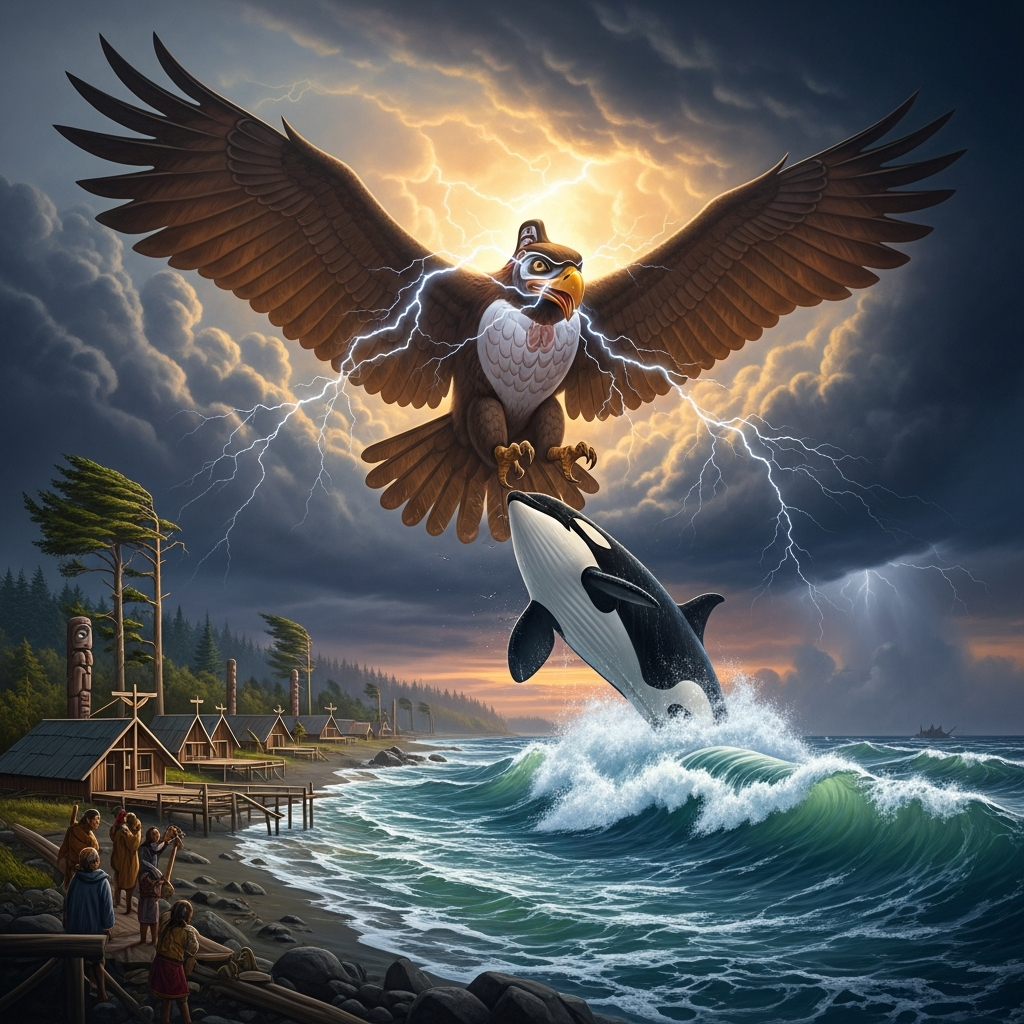
The great Thunderbird hunts the Killer Whale in the deep ocean, and their eternal combat — lightning flashing, waves crashing — is the explanation for storms, for the sounds of the sky, and for the power that shakes the Pacific coast.
- When
- Timeless — the ongoing cosmic combat that generates weather
- Where
- The skies and ocean depths of the Pacific Northwest coast — Vancouver Island, the Olympic Peninsula
When the sky darkens over the ocean and the thunder shakes the fir trees and the lightning cuts the water, the elders say: Thunderbird is hunting.
The Thunderbird lives in the mountains, in the high peaks where the clouds form and where no person has climbed and returned to describe what is there. It is enormous — its wings when it spreads them cover the sun, its feathers are arrows of lightning, its eyes are flashes. When it flies, the sound of its wings is the thunder. When it blinks, the light is the lightning. It is not exactly a bird. It is the sky moving.
It hunts the great Killer Whale.
The Whale lives in the deep ocean, in the cold dark water where light does not go, where the pressure is enormous and the creatures have learned to live without what the upper world considers necessary. The Whale is also not quite what it appears: its dorsal fin is a sharp blade, its breath is the storm surge, its dive is the trough of the wave. It is the sea moving.
The combat between them has been going on since before memory.
Thunderbird dives from the sky and strikes the Whale with its lightning talons, seizing the great creature from the surface. The Whale sounds, dragging Thunderbird into the water. The sea erupts. The sky tears open. The rain comes sideways and the waves build to heights that make the canoes on the shore irrelevant and the people in the lodges grateful for cedar plank walls.
This is what a storm is: the ongoing struggle between sky and sea.
The people of the coast do not watch the storms passively.
They know what the combat means. They know that the Thunderbird and the Whale are not fighting over the ocean — they are fighting over the boundary between the sky world and the sea world, and the people live on that boundary. The shore is the line between two enormous powers, and every person on the coast is living at the exact place where the powers meet.
This is not a bad place to live. The boundary is also the most productive place in the ecosystem: the shore where the sea creatures come close to the land, where the rivers bring the salmon from the mountains to the sea, where the cedar and the spruce grow thick and tall because the rain from Thunderbird’s combat waters them. The violence generates the abundance.
Thunderbird is carved on the top of every totem pole.
Not at the bottom, not in the middle, but at the very top: the highest point, the nearest to the sky. The families who trace their origin to Thunderbird are the families with the greatest prestige, because to descend from the combat at the top of the world is to carry the power of the boundary in your blood.
When the storms come and the lightning walks on the water and the thunder rolls through the forest, the people know the combat has not stopped. They know the world is being renewed by the same violence that made it. The sound of Thunderbird’s wings overhead is terrifying and also correct.
The world requires its combats.
Echoes Across Traditions
Entities
- Thunderbird (Kw'unkw'unaat)
- the Killer Whale (Tloo-kwana)
- the people of the coast
Sources
- Franz Boas, *Kwakiutl Ethnography* (University of Chicago Press, 1966)
- Edward Curtis, *The North American Indian*, Vol. 9 (1913)
- Martine Reid, *Indian Legends of the Pacific Northwest*, ed. Ella E. Clark (University of California Press, 1953)