Raven and the First People in the Clamshell
Shortly after the world was made — the first morning with light · A beach of the Pacific Northwest coast — Rose Spit (Naikoon) on Haida Gwaii
Contents
Walking on the beach of a newly made world, Raven hears tiny voices coming from a giant clamshell — and finds the first human beings inside, small and frightened, needing to be coaxed into the enormous and terrifying world.
- When
- Shortly after the world was made — the first morning with light
- Where
- A beach of the Pacific Northwest coast — Rose Spit (Naikoon) on Haida Gwaii
The world is new and very quiet.
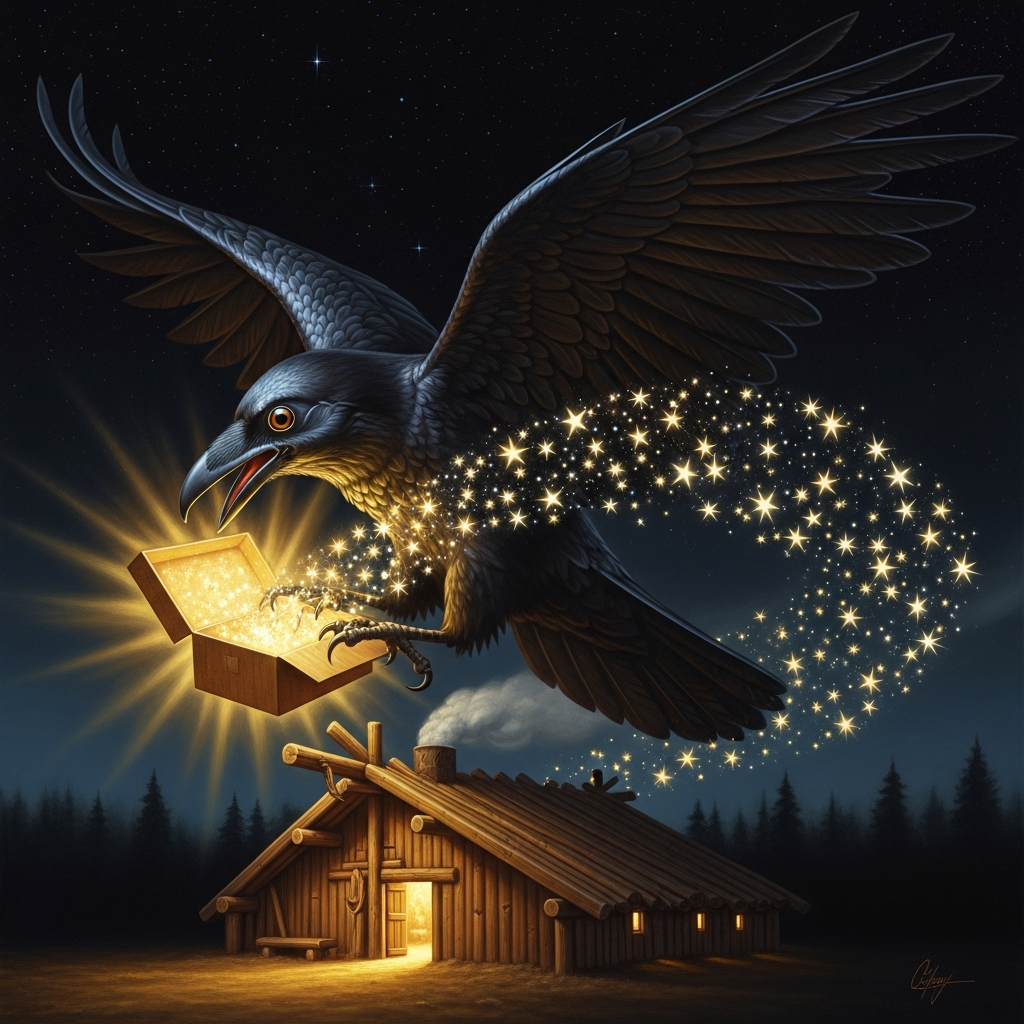
Raven has been responsible for some of the quiet: he is the one who let the light out of the box, and the light has arranged itself into sun and moon and stars, and the world has taken on the shapes that light reveals — the mountains, the water, the forests, the long beaches of the Pacific coast. It is all there. It is all correct. But it is empty in a way that begins to bother Raven.
He is walking on the beach at Rose Spit, the northern tip of Haida Gwaii, where the island ends in a long sandbar and the sea comes at the land from two directions at once.
He hears something.
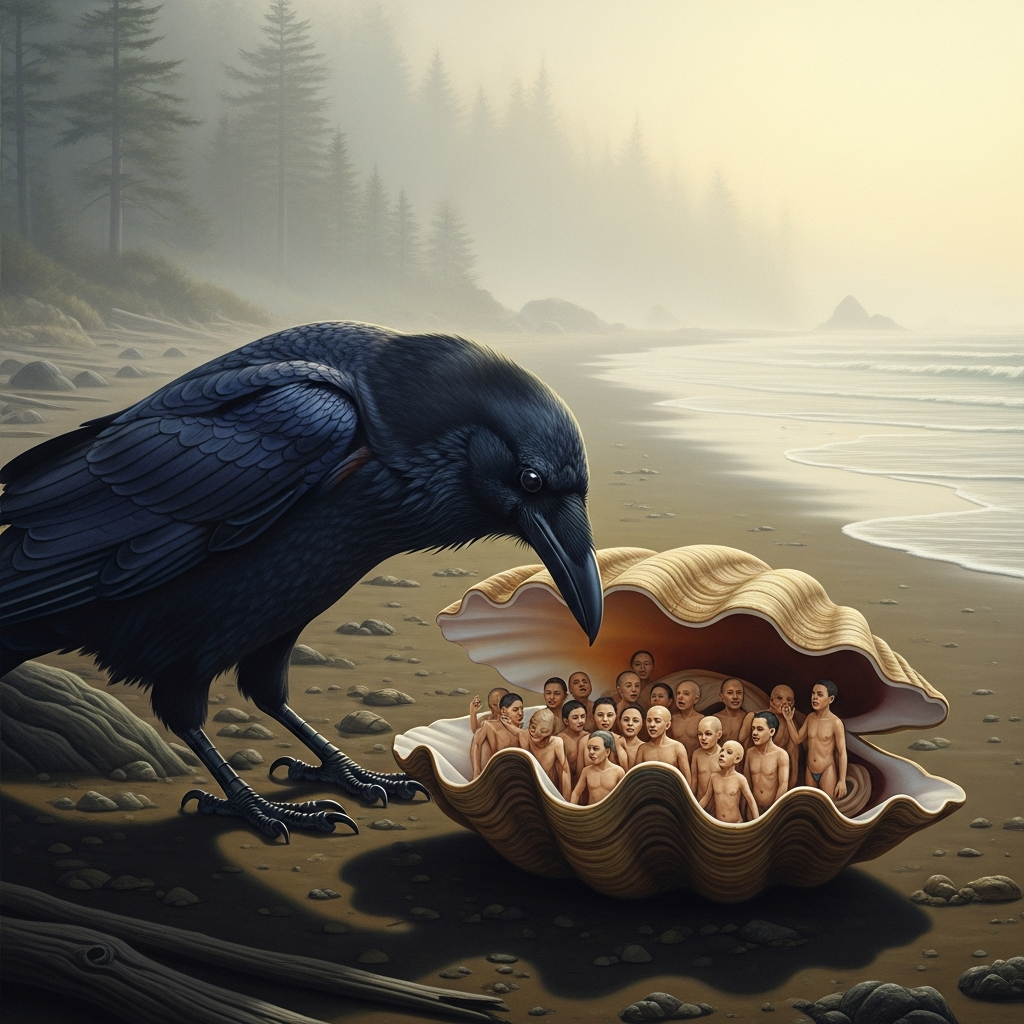
Small voices. Very small, coming from beneath his feet, from a giant clamshell half-buried in the sand. He lowers his beak to the shell and the voices get clearer: many small voices, speaking in something that is almost a language, speaking with the particular anxiety of beings who have been enclosed for a very long time and can feel that the enclosure has become too small.
Raven opens the shell.
Inside are the first people. They are small and pale, pale as the inside of a clam, having never been in sunlight. There are many of them, packed together, and they are extraordinary in the way that new things are extraordinary — unfamiliar to themselves, unsure of their own edges, looking out at the world with the eyes of beings who have never seen sky.
Raven looks at them. They look at Raven.
Some of them want to stay in the shell. The world outside is enormous and incomprehensible: the sky is too high, the water is too loud, the light is too much after the dark of the shell. Raven understands this. He is patient in a way he usually isn’t. He calls to them in the voices of birds, in the sound of the wind, in sounds that are almost words and are in fact words that the first people can understand in their bodies even if they cannot understand them in their minds.
He coaxes them out.
He shows them the beach, which is where they will live. He shows them the forest, which will give them everything they need if they know how to ask. He shows them the sea, which is full of food. He shows them each other — shows them that they are not alone, that the shell produced many of them, that they are kin whether they know it yet or not.
Then he walks away.
The first people stand on the beach in the first morning of the world. The light is coming across the water and the sand is cold under their feet and everything is new and frightening and extraordinary. They are small and pale and not yet sure what they are supposed to do, and Raven is already down the beach looking for clams, his shining black head dipping and his beak working.
The world begins.
They figure it out the way everything figures it out: slowly, with errors, with the particular knowledge that comes from making mistakes that you survive. The forest teaches them what to eat. The sea teaches them how to move. The other people teach them what they cannot learn alone.
Raven glances back once and sees them moving on the beach and is satisfied.
Then he finds a clam and eats it and does not look back again.
Echoes Across Traditions
Entities
- Raven (Yéil)
- the first human beings
- the giant clamshell
Sources
- Bill Reid and Robert Bringhurst, *The Raven Steals the Light* (Douglas and McIntyre, 1984)
- John Swanton, *Haida Texts and Myths* (Bureau of American Ethnology, 1905)
- Martine Reid, *Bill Reid: The Making of an Indian* (Douglas and McIntyre, 2014)