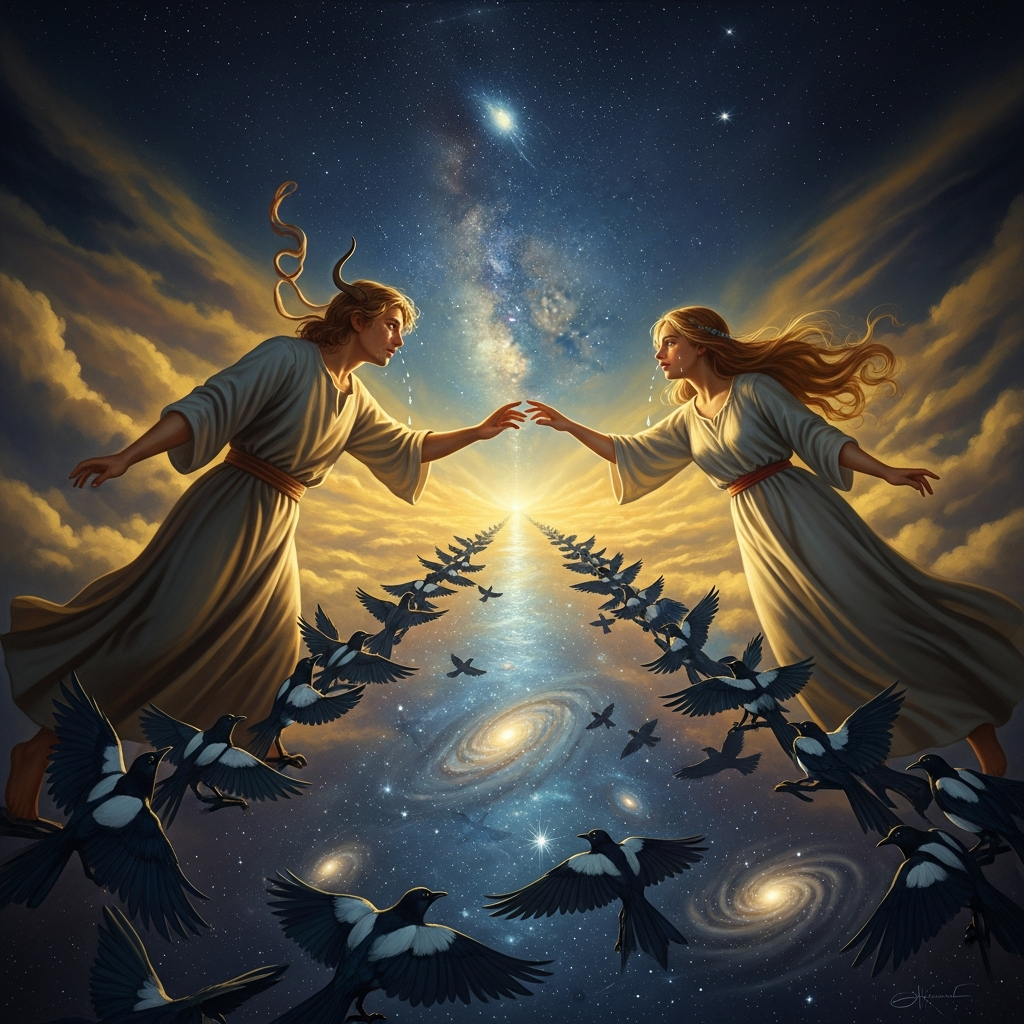
The Cowherd and the Weaver Girl: A Bridge of Magpies
c. 1000 BCE (legend recorded in Shijing); festival of Qixi celebrated since c. 200 BCE · A small farm by a river in northern China; the heavens above, where the Milky Way is the river that divides the lovers' two stars
Contents
A young farmer falls in love with the youngest daughter of the Jade Emperor, who descended to bathe in his river. They marry. They have two children. They are too happy. The Jade Emperor's court will not stand a heavenly princess living in a peasant's cottage forever — and the Queen Mother draws her silver hairpin across the sky to separate them, opening a river of stars between their two banks.
- When
- c. 1000 BCE (legend recorded in Shijing); festival of Qixi celebrated since c. 200 BCE
- Where
- A small farm by a river in northern China; the heavens above, where the Milky Way is the river that divides the lovers' two stars
There was once a boy named Niulang who had nothing.
His parents had died young. His older brother had inherited the family farm and had, at his wife’s urging, thrown Niulang out with only one possession: an old ox. The brother and his wife had calculated that the ox was useless — too old to pull a plow, too stringy to be eaten — and had given the animal to the younger brother as a parting cruelty disguised as generosity.
Niulang did not mind. He had loved the ox since boyhood. He took the ox and a small cooking pot and walked away from the family land. He found a piece of rough ground at the edge of a river — some say in Shanxi, some say in Henan, the regional traditions disagree — and he built himself a small thatched hut and a small thatched shed. He grew vegetables. He fished. He talked to the ox in the long evenings.
The ox listened.
Then, one night — and the texts are not embarrassed to say this — the ox spoke back.
—
The ox was an old immortal in disguise. He had been one of the celestial cattle of the Jade Emperor’s herds, banished to earth long ago for some forgotten transgression, condemned to live out a mortal life in animal form. He had been patient. He had waited. He had observed Niulang for years and concluded that this was a young man worth helping.
He told Niulang, in plain Mandarin, Boy. Listen carefully.
Niulang dropped his cooking pot.
The ox went on. On the seventh night of the seventh month, the seven daughters of the Jade Emperor descend to earth to bathe. They come to a clear pool in a forest not far from this river. They take off their feathered robes and hang them on a willow branch. They bathe. Then they put their robes back on and fly back to heaven. The youngest daughter is the most beautiful. Her name is Zhinü, the Weaver Girl. She weaves the clouds of the heavens on a great loom. Go to that pool, hide behind the willow, and steal her robe. Without it she cannot fly back to heaven. She will have to come home with you.
Niulang stared at the talking ox.
The ox added: I am old. I have not much longer. Let me give you this gift before I go.
Niulang went to the pool.
—
He hid in the bushes at sunset on the seventh night of the seventh month. As the moon rose, seven streaks of light came down out of the sky and resolved into seven young women. They alighted at the edge of the pool. They took off their feathered robes — robes woven of cloud and starlight — and hung them on the willow branches. They stepped into the water laughing.
Niulang reached out from the bushes and took the smallest of the robes — soft as fog, light as the breath of a sleeping child — and hid it under his shirt.
The maidens bathed. They came out of the water. They reached for their robes. Six of them put theirs on. The seventh, the smallest, the youngest, looked at her empty branch in panic.
Her sisters waited as long as they dared. The dawn was coming. They could not be caught on earth. One by one, weeping, they rose into the sky and left her.
Zhinü was alone at the pool, naked and shivering, when Niulang stepped out of the bushes with her robe.
He did not give it back to her. He gave her his own outer cloak. He told her, awkwardly, that he had taken her robe and that he meant her no harm and that he would treat her well if she would stay. The custom of the time — and the custom of every time — gave him this much: she was alone, far from heaven, with a strange man who had done a strange thing. She agreed.
She did not, the texts make clear, marry him out of love at first. She married him because the ox was right: without her robe she could not fly home. But she did, in the years that followed, come to love him. The version that survives most strongly in Chinese tradition is unequivocal on this. They were quietly, undramatically happy.
—
For seven years, the cowherd and the weaver girl lived in the small thatched hut by the river.
He worked the field. She set up her loom in the corner of the cottage and began to weave. Her cloth was unlike any other cloth made on earth — fine as morning mist, the colors changing with the angle of the light. The neighbors began coming to her for cloth. Their household became modestly prosperous. The old ox grew old, finally too old to walk, and lay down one day in the shed and told Niulang to keep the hide after he died — the hide of a celestial ox, the ox said, was not an ordinary hide; it would, in some emergency, lift the wearer into the sky. Niulang wept and promised. The ox died.
Two children were born. A boy and a girl. The cottage filled with their voices. Zhinü’s robe was kept folded in a chest under the bed. She had stopped looking at it years ago. She was — she had decided — at home.
—
The Queen Mother of the West noticed.
The Jade Emperor’s court had not been actively looking for the missing daughter. The seven maidens descend, they bathe, they return; one fewer occasionally is not, in the slow time of heaven, immediately catastrophic. But Zhinü was the weaver of the celestial cloud-cloth. The clouds had begun to thin. The sunsets had grown ragged. The Queen Mother — Zhinü’s grandmother, in some accounts; her mother, in others — sent attendants down to investigate.
They found her on earth. They found her in a cottage. They found her — and this part of the myth is dwelt on with unusual moral weight — with two human children.
The Queen Mother was furious.
To her, Zhinü’s marriage to a peasant was not a tender story. It was an offense against the order of the heavens. Mortals and immortals do not mix. A daughter of the Jade Emperor cannot live as a farmwife. The cosmic distinction between earth and heaven exists for reasons; to allow it to be eroded by sentiment is to invite the unraveling of the whole arrangement.
She came down personally.
—
She arrived at the cottage one morning while Niulang was in the field. She did not knock. She walked through the door. She looked at her granddaughter at the loom, at the two children playing on the floor, at the goats outside, at the simple pots and the simple bedding. She said:
You are coming home.
Zhinü, who had heard the rumors of the attendants but had hoped the matter would die down, knew she could not refuse. She begged for time. She asked to see her husband one last time. She asked to bring her children.
The Queen Mother refused all of it. She lifted Zhinü by the wrist. She walked her out of the cottage and into the air. Zhinü struggled, called out — but the Queen Mother was the Queen Mother. They rose into the sky together.
The children, abandoned, ran out into the field screaming for their mother.
Niulang heard them.
He came running. He saw, in the sky overhead, two figures rising — his wife and an unfamiliar woman in white silk. He understood instantly. He ran to the shed. He pulled out the hide of the old ox, which he had kept all these years. He wrapped it around himself. He picked up his children, one in each shoulder-basket — the texts say one in each end of his carrying pole, the bamboo pole farmers use to balance loads — and he ran out and pushed off the ground.
The ox-hide caught the air.
It carried him up. He rose, barefoot, with two children swinging from his pole, faster and faster, after his wife.
He was gaining.
He was almost in reach. Zhinü, looking back, saw him climbing through the lower clouds, and she nearly broke free.
The Queen Mother turned her head and saw the cowherd coming.
She reached up to her hair. She pulled out one of her silver hairpins — long, thin, shaped like the half-moon. She drew it across the sky between Zhinü and Niulang.
—
Where the hairpin passed, a river opened.
It was a river of stars. A torrent of celestial light, miles wide, running in a vast pale band across the sky from the eastern horizon to the western. Niulang flew up to the bank of it, his children clinging to his pole, and could not cross. The current was the current of the heavens themselves; not even the ox-hide could carry him through it.
On the far bank, Zhinü was set down. She turned. She saw her husband and her children on the other side. They saw her. The river ran between them.
This is the Milky Way.
In Chinese astronomy and in Chinese poetry, it is called Yinhe — the Silver River — and it has marked the divide between Niulang and Zhinü ever since. The cowherd, with his two children, is fixed on one bank as the star Altair, with two smaller stars on either side that are, by tradition, the children. Zhinü is fixed on the opposite bank as the star Vega. Both are bright. Both are visible on summer nights. They look at each other across an unbridgeable distance.
—
The Queen Mother, having drawn her line, was satisfied.
But the Jade Emperor — Zhinü’s father — was a more flexible god than his consort. He saw, from his throne, the cowherd weeping on his bank with two small children clinging to him. He saw Zhinü weeping at her loom on the other side, no longer able to weave. The clouds remained ragged.
He compromised.
He decreed that on the seventh night of the seventh month — the same night, every year, on which Zhinü had first descended to bathe and Niulang had first stolen her robe — the lovers would be allowed to meet for one night.
There was no bridge. They would have to provide their own.
The magpies provided it.
This is the part of the myth that Chinese children love best. On the seventh night of the seventh month — Qixi, the seventh-of-the-seventh — every magpie in the world flies up to the Milky Way. They form, with their bodies, a bridge — a feathered span of black and white birds across the river of stars — and Niulang walks across it carrying his children, and Zhinü walks across from the other side, and they meet in the middle and embrace and have one night together.
In the morning, the magpies fly away. The river closes. The lovers return to their banks. They wait another year.
—
This is why, in China, the seventh night of the seventh month has been observed as a festival of lovers since at least the Han dynasty. Couples write letters, exchange gifts, eat round melons under the stars. Young women, since at least the Tang, perform the Qiqiao — the begging-for-skill — by threading needles by moonlight, asking Zhinü, the celestial weaver, to grant them domestic and craft skill in the year ahead.
In Japan, the festival traveled across the sea and became Tanabata — the same legend, the same lovers, the same bridge, observed in the same week. Children write wishes on strips of colored paper and hang them on bamboo branches in the hope that Vega and Altair will hear.
If the night of Qixi is rainy, Chinese tradition holds that the rain is the tears of the cowherd and the weaver girl meeting. If it is clear, you can step out into the courtyard, look up at the high summer Milky Way, find Vega on one side and Altair on the other, and know that on this one night they have crossed to each other on a bridge of birds. The cosmos itself bends, once a year, to give two lovers an evening — and most of East Asia has, for two thousand years, been quietly grateful that it does.
Scenes
Niulang the cowherd peers from behind a willow as seven heavenly maidens bathe in a moonlit pool, their feathered robes hanging from a low branch
On a small farm under a thatched roof, Zhinü sits at her loom while two small children play at her feet
The Queen Mother of the West draws a silver hairpin across the sky; a river of stars opens between Niulang and Zhinü
Echoes Across Traditions
Entities
- Niulang the Cowherd
- Zhinü the Weaver Girl
- The Old Ox
- The Queen Mother of the West
- The Jade Emperor
Sources
- *Classic of Poetry* (Shijing, c. 1000–600 BCE) — earliest reference
- *Records of the Grand Historian* (Sima Qian, c. 100 BCE)
- Tang dynasty Qixi festival texts (c. 700 CE)
- Wilt L. Idema, *Filial Piety and Its Divine Rewards* (2009)