Child of the Water Slays the Monsters
Apache oral tradition; recorded by Morris Opler, *Myths and Tales of the Jicarilla Apache Indians* (1938) · The Apache homeland (southwestern North America); the primordial earth
Contents
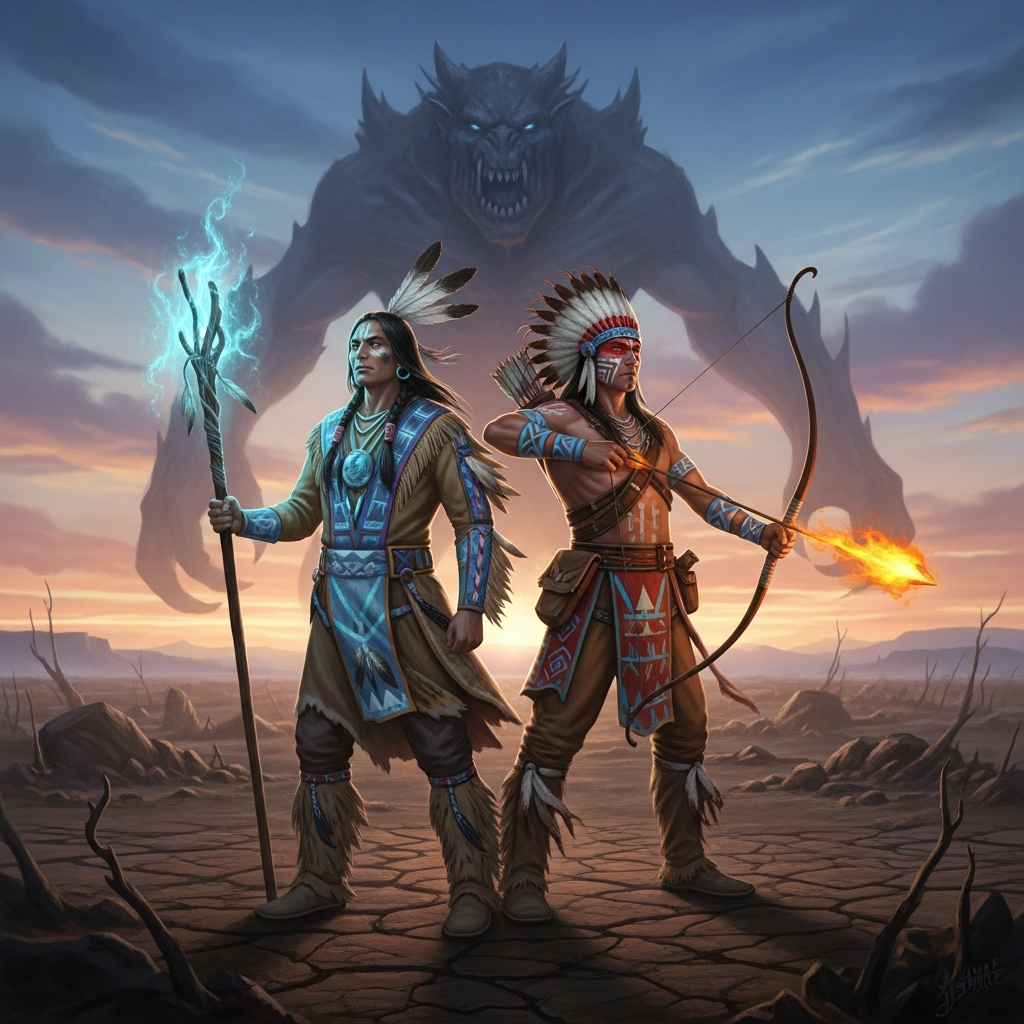
In the beginning, the world was ruled by monsters. Child of the Water, born from White Painted Woman and the water itself, and his twin Monster Slayer went out to kill the monsters that were devouring humanity — each requiring a different approach, a different wisdom, a different courage. The monsters were not only giants: some were darkness, wind, cold, poverty. Those they were told to leave alive.
- When
- Apache oral tradition; recorded by Morris Opler, *Myths and Tales of the Jicarilla Apache Indians* (1938)
- Where
- The Apache homeland (southwestern North America); the primordial earth
Before the people can live in the world, the world must be made safe.
This is the first task of the hero twins, and it is not a metaphor. The early world is full of monsters — the Jicarilla Apache call them Naiyenesgani, the alien beings, the ones who were here before the people and who eat them when they come. They are enormous. They are specific: each monster is the specific form taken by a specific kind of threat, and each one must be addressed differently, because the same weapon that kills one cannot touch another.
White Painted Woman is the mother.
She is called Changing Woman in the Navajo tradition, but in the Apache she is White Painted Woman — the earth mother, the woman who has existed from before the current world, who has given birth to the people and who will outlast them, who changes with the seasons but is always herself. She is pregnant twice, by two different fathers. The first child comes from the Sun — his father is the great lord of light, and this son is Monster Slayer, fierce and strong, the one who moves through the world in direct attack. The second child is born from water — from the rain that fell on White Painted Woman as she lay in a streambed, and this son is Child of the Water, gentler and more cunning, the one who finds the angle the direct approach cannot.
They grow up quickly, as twins in founding myths always do.
The first monsters to be killed are the largest.
Yietso — the Big Giant — is the most terrible. He is enormous, he devours everything, and he stands between the people and any possibility of safety. The twins go to him. Monster Slayer confronts him directly, with the power of the Sun behind him; the lightning arrows gifted by the Sun Father strike the giant and he falls. His blood flows across the land and turns to lava. The hardened lava fields of New Mexico are, in this telling, Yietso’s blood — the land itself carries the mark of the first great killing.
The Rock Monsters are next. They are beings who blend with the stone, who drop the unsuspecting off cliff edges. Then the Kicking Monster, who uses a tree as a spring to throw people into a chasm. The Knife-Feather Monster, whose wings shear the wind into weapons. Each one requires a different solution, a different combination of the twins’ complementary gifts.
Between the battles, Child of the Water does what his name suggests: he finds the water. The route to each monster runs through a landscape, and the landscape has been made by White Painted Woman, and the water in it is his father’s gift, and he reads both of these with an attention that his brother’s strength-first approach would miss. He is the one who knows when to approach and when to wait. He holds the thread of the journey together.
They reach the hardest monsters last.
These are not monsters of size or ferocity. These are monsters of condition: Cold, Hunger, Poverty, and Old Age. These four have been waiting at the edges of the previous battles, watching the twins work through the obvious enemies, knowing that their own turn was coming.
The twins approach Cold.
He is a small figure in the north, wrapped in ice and stillness, and Monster Slayer draws the lightning arrow. Cold speaks before the arrow can be loosed.
Kill me, he says, and the people will not survive the summer. They will not know how to make shelter. They will not know how to make clothing. They will not make fire, because fire is only necessary to those who know what cold is. Kill me and you destroy the knowledge the people need to live. I am the teacher whose lesson is warmth.
The twins lower their weapons. They argue — the tradition gives them the argument, which is part of the teaching — and then they spare Cold.
They spare Hunger in the same way: kill Hunger and food loses its sweetness, the body loses its signal for what it needs, the pleasure of a meal after fasting becomes impossible, and the people become creatures who eat without need and therefore without gratitude. Hunger is the teacher of sustenance.
Poverty they spare because a person who cannot experience poverty cannot value what they have, cannot practice generosity, cannot understand what it means to give and receive. Old Age they spare because without it there is no completion of life, no wisdom that comes only from having lived long, no room for the young because the old would never leave.
The decision to spare the last monsters is the center of the story’s theology.
Monster Slayer wants to kill them all. This is not a character flaw — it is his function, his gift, his role. He moves through the world eliminating what threatens. His power is real and the world needs it. But even the greatest strength, applied to the wrong target, is destruction rather than protection. The logic of killing cannot distinguish between threats and necessities when both wear the form of suffering.
Child of the Water is the one who listens to the argument.
The name is the lesson: the child of water learns to move around obstacles rather than through them, to find the gap between the rock and the wall, to enter the conversation that the direct assault would silence. He is born from the rain that falls on the earth, and rain does not conquer — it seeps, it nourishes, it waits for the low places.
Together the twins make a complete intelligence.
When the monster-killing is done, the world is not easy. It is survivable.
There is still cold and hunger, still poverty and old age. The people will still suffer these things. But the monsters that were simply predatory — that had no purpose except to devour — are gone, and what remains are the teachers. The Apache understanding of difficulty is built on this foundation: not every hard thing is an enemy. Some hard things are the conditions under which human excellence becomes possible. The task of wisdom is to know the difference.
White Painted Woman receives her sons back.
She is the constant in the myth — she was here before the monsters, she will be here after them. She changes with the seasons, dies and returns with the year, and the puberty ceremony of Apache women re-enacts her renewal: the girl who is becoming a woman becomes White Painted Woman for the duration of the ceremony, takes on her power, her capacity for both birth and endurance. The monster-slaying is the story of her sons. The ceremony is her story.
The land remembers what happened.
The lava fields remember Yietso. The cliff edges remember the Rock Monsters. The places where the battles were fought are not neutral ground — they are marked, both in the physical landscape and in the stories that explain them. Keith Basso’s research among the Western Apache demonstrates that the Apache landscape is a moral landscape: every named place carries a story, and every story carries a teaching, and the teaching is delivered every time someone travels through that part of the country and recognizes the name.
This is one of the things that makes a homeland a homeland: not ownership of the land, but the land knowing your stories, and you knowing what the land remembers.
The twins are still in the world. They are always in the world — the tradition understands them as living presences, not as historical figures. Every time a person faces something that is consuming them and finds the courage to stand against it, Monster Slayer is there. Every time a person finds the angle that force alone could not find, Child of the Water is there.
They are the children of light and water. They will be here as long as there are monsters worth distinguishing from teachers.
Echoes Across Traditions
Entities
- Child of the Water (Tobadzistsini)
- Monster Slayer (Nayenezgani)
- White Painted Woman (Changing Woman)
- The Sun Father
- The Monsters (Naiyenesgani)
Sources
- Morris E. Opler, *Myths and Tales of the Jicarilla Apache Indians*, 1938
- Morris E. Opler, *An Apache Life-Way: The Economic, Social, and Religious Institutions of the Chiricahua Apache*, 1941
- Keith Basso, *Wisdom Sits in Places: Landscape and Language Among the Western Apache*, 1996
- Grenville Goodwin, *Myths and Tales of the White Mountain Apache*, 1939
- Orin Starn and Serena Nanda, eds., *New Perspectives on Native North America*, 2004