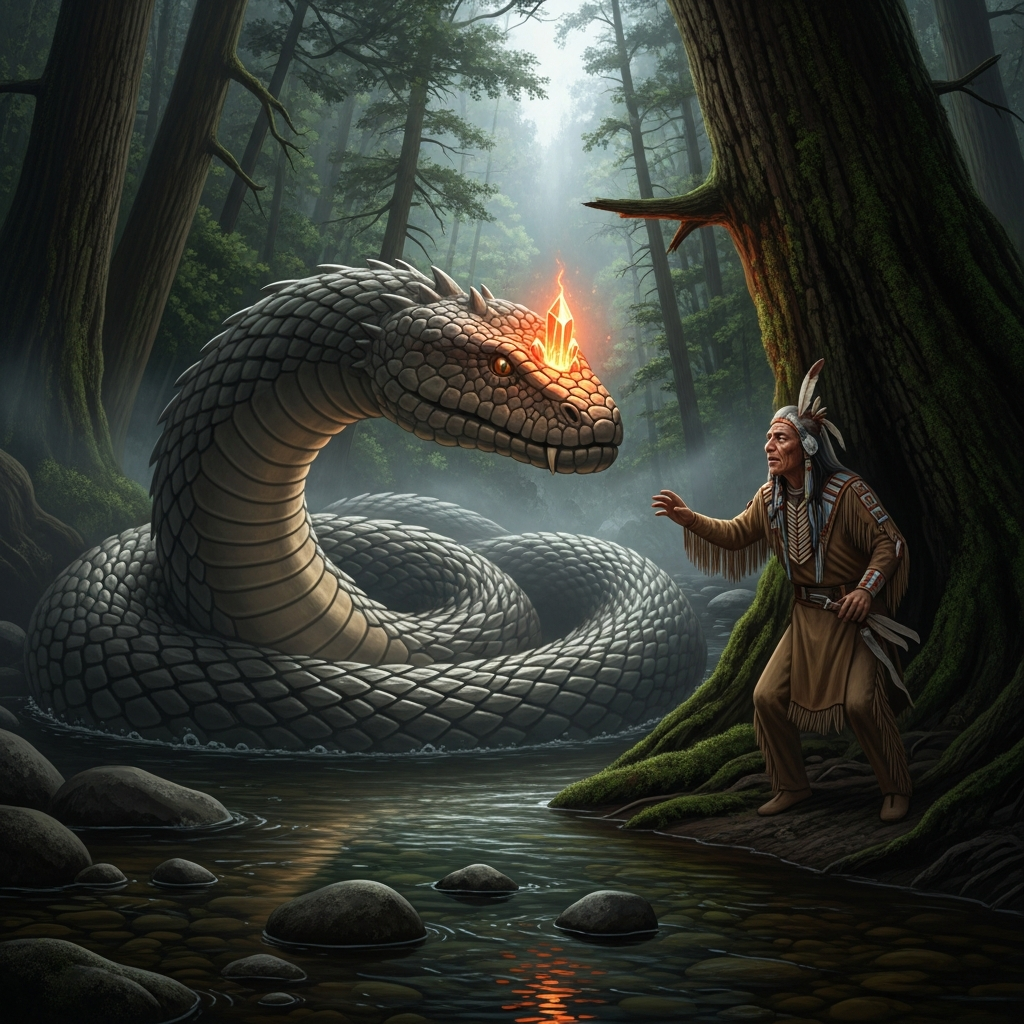
The Nunnehi Who Live Inside the Mountains
All times — Nunnehi are always present in the Cherokee homeland · The mountain passes and riverbanks of the Southern Appalachians; particularly around Pilot Knob and Blood Mountain
Contents
The Nunnehi — the immortal people who live inside the mountains and beneath the rivers — sometimes help lost hunters and travelers, sometimes take people away forever, and appeared to help the Cherokee on the Trail of Tears when no human help remained.
- When
- All times — Nunnehi are always present in the Cherokee homeland
- Where
- The mountain passes and riverbanks of the Southern Appalachians; particularly around Pilot Knob and Blood Mountain
They are in the mountains.
Not on them, not near them — in them, inside the rock and soil, in the invisible places where the mountain has volume that no human eye can see. The Nunnehi have been there since the mountains were made, and they will be there when the mountains are something else. They are not ghosts; they are not dead people. They are a different kind of people, one that does not age and does not die and does not need to eat, who live in a world that intersects the human world at certain times and places.
They are sometimes heard.
Hunters in the deep passes have heard drumming coming from inside the rock faces — the sound of ceremony, the sound of people celebrating something, coming from a mountain that has no cave visible, no opening, no way in. They have heard it stop when approached and start again when the hunter moved away. The Nunnehi have ceremonies too, and their ceremonies are for their own purposes, and they are not interrupted by human presence, only paused.
They help sometimes.
A hunter who is lost in the mountains at night — truly lost, past the point where fear has become something that makes the legs fail — sometimes finds himself in a village of people who seem familiar. They give him food and a place to sleep. In the morning they show him the way home. He arrives back at his own village not knowing quite how he got there. When he describes the village where he stayed, no one recognizes it. There is no village in that part of the mountains.
The Nunnehi take people sometimes too.
Young people who spend time alone in the mountains sometimes come home different — distracted, turned toward something inside themselves, listening for something the family cannot hear. Sometimes they go back into the mountains alone and do not return. The Nunnehi have taken them, and taken means taken permanently: they are in the mountains now, in the invisible country, living the life of persons who do not age.
When the soldiers came for the removal in 1838, the Nunnehi were seen.
The elders tell it this way: the Nunnehi came to the Cherokee families who were being gathered and said, in the language of the Cherokee, that they could hide the people inside the mountains — that there was room, that the people could live inside the rock until the soldiers were gone. Some families went. They walked toward the mountains and disappeared before the soldiers could stop them, and no one who searched those mountains ever found them.
The people who went in are still there.
On certain days, in certain weather, the drumming from the mountains is the drumming of those families in the invisible country, still doing their ceremonies, still alive in the land that could not be taken from them because they are inside it.
The rest of the Cherokee walked the trail west.
They carried the memory of what the Nunnehi offered, and the knowledge that the land did not abandon them — the land hid some of them inside itself, and the rest they carried west in their hearts, the mountains of home present in them the way the Nunnehi are present in the mountains: invisible but real, always.
Echoes Across Traditions
Entities
- the Nunnehi (the immortal spirit people)
- the lost hunter
- the Cherokee people on the Trail of Tears
Sources
- James Mooney, *Myths of the Cherokee* (Bureau of American Ethnology, 1900)
- Barbara R. Duncan, *Living Stories of the Cherokee* (University of North Carolina Press, 1998)
- John Howard Payne Papers, Newberry Library, Chicago