Uktena: The Great Horned Serpent
Cherokee oral tradition; recorded by James Mooney, *Myths of the Cherokee* (1900) · The mountain streams and rivers of Cherokee territory (southern Appalachians)
Contents
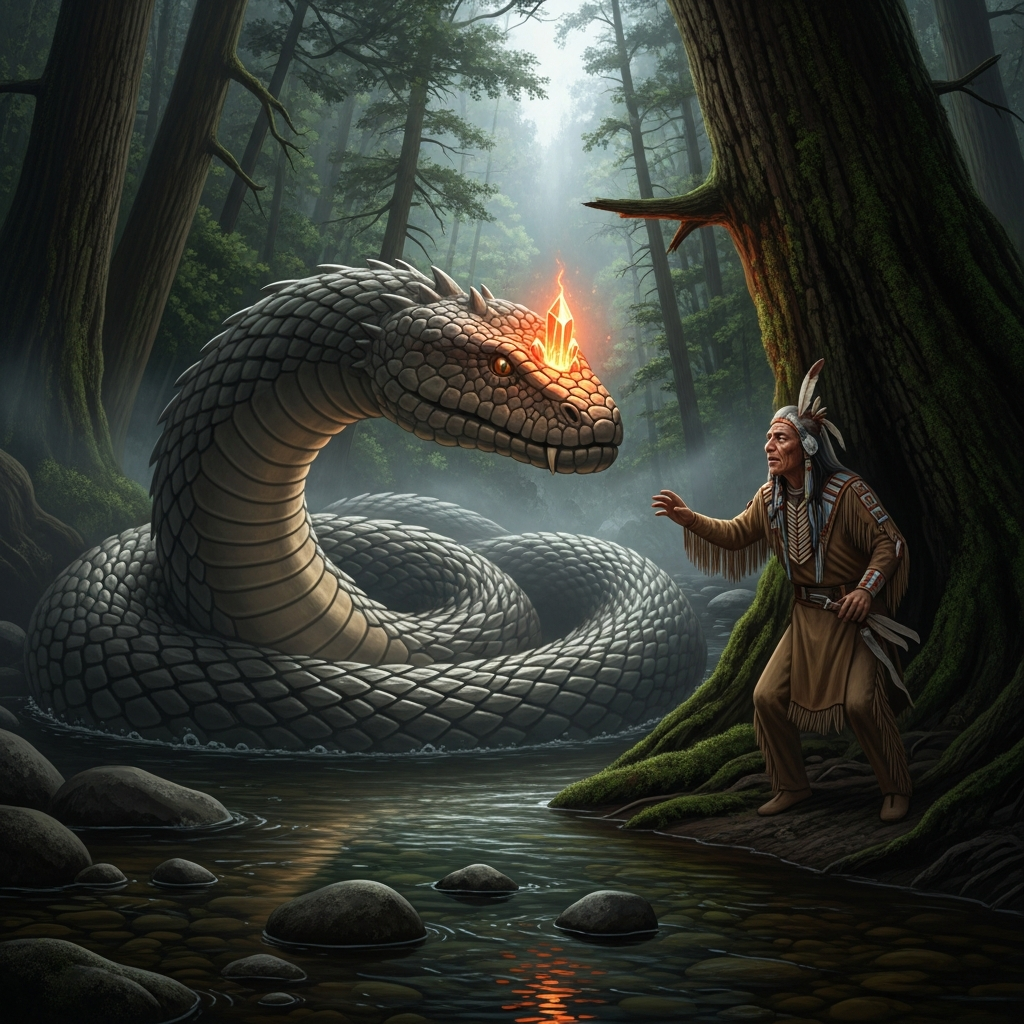
Uktena is a massive serpent with a blazing crystal set in its forehead — the Ulunsuti — that grants visions and power but kills anyone who looks at it unprepared. A Cherokee shaman named Aganunitsi is the only one to obtain a piece of the Ulunsuti, stealing it by tricking the serpent. The crystal must always be fed — with blood, with flesh. It is the most dangerous sacred object in the Cherokee world.
- When
- Cherokee oral tradition; recorded by James Mooney, *Myths of the Cherokee* (1900)
- Where
- The mountain streams and rivers of Cherokee territory (southern Appalachians)
Uktena was not always a serpent.
The tradition is precise about this origin. Before the current world, when the Sun was living among people and could be spoken to directly, the Sun grew angry at the humans and sent disease and death to destroy them. The animals and people tried to kill the Sun to stop the killing, and failed; they tried to trick the Sun, and the trick killed the wrong thing. In the aftermath of this failure, something changed. A man — or a group of men, the tradition varies — who had been transformed in the attempt became the great serpent Uktena, the being who lurks in the deep mountain pools and river bends of the Cherokee country.
He is enormous. His body is as wide as a tree trunk, scaled in a pattern that flashes red and yellow and white. His eyes are fire. His horns rise from the sides of his head. And set in the center of his forehead, bright as a star and more dangerous, is the Ulunsuti — the transparent crystal, the looking-stone, the most powerful object in the Cherokee world.
To see the Ulunsuti from the front is to die. This is not a prohibition but a description: the crystal blazes with a light that the unprepared eye cannot survive. The shaman who wants to use the Ulunsuti cannot approach Uktena from the front. He must come from behind. He must think his way around the problem, which is the characteristic challenge the Cherokee tradition places before its practitioners: the most dangerous things cannot be conquered by direct force. They require the angle, the patience, the approach that power cannot teach.
Aganunitsi was the only one to try.
He was a shaman from the old days, the time when the knowledge of how to approach such things was still intact in the memory of the medicine people. The tradition does not explain why he wanted the Ulunsuti — this is not a story about ambition or greed but about the understanding that the Ulunsuti needed to be in the world, needed to be held by someone, and that if it was going to be held it should be held by someone who knew what they were doing.
He went to the part of the mountains where Uktena was known to lie — the deep pools, the hollows beneath waterfalls, the bends in the river where the current slows and the water goes black with depth. He did not approach the front.
He came from behind.
He waited for the serpent to be still, which is something a serpent that large can afford to be for very long periods. He watched the light of the Ulunsuti reflecting upward from the water surface ahead of him. He moved when the serpent moved away. He positioned himself at the tail end of the great body.
He shot his arrow. The arrow struck the seventh spot behind the serpent’s head — the one vulnerable place, the one space between the scales where entry is possible — and the arrow went deep. The serpent convulsed. In the convulsion, the crystal fell free from the forehead.
Aganunitsi ran.
He grabbed the crystal as he passed and kept running, because a wounded Uktena is more dangerous than an unwounded one, and the tradition is clear that you do not stay to witness what happens to the serpent after the arrow. He ran until the sounds of the serpent’s dying were too far away to hear, and then he stopped and looked at what he had.
The Ulunsuti is bright.
The tradition describes it as a piece of clear crystal, roughly diamond-shaped, with a small spot of blood-red in the center. When you look at it in the right way — without looking directly at it, which is still dangerous, even separated from the serpent — you can see in the red center the image of what you want to see: the future, the location of an enemy, the whereabouts of the sick person’s lost soul, the game that has moved away from the usual territory.
But the Ulunsuti is hungry.
It must be fed. If it is not fed — with blood, with raw meat, with some form of the life it lost when the serpent died — it will fade, and a faded Ulunsuti is worse than no Ulunsuti. It becomes a thing that turns on its keeper, that brings bad luck rather than good, that attracts the very misfortune its visions were supposed to prevent. The care of the Ulunsuti is a perpetual obligation. It cannot be put aside. It cannot be handed to someone else for a season. It requires constant attention and regular sacrifice.
This is the Cherokee understanding of the cost of sacred power: it is not a resource you acquire and then use at your convenience. It is a relationship. The Ulunsuti is a living thing, or alive in the sense that it requires maintenance, and the maintenance is the relationship, and the relationship is the power. You cannot have one without the others.
Aganunitsi became the keeper of the Ulunsuti.
He wrapped it in buckskin and placed it in a clay pot and buried it when he was not using it, because even the light that leaked from the buried crystal had power — it could be detected by other medicine people, and by the things in the world that move toward power in the way that certain animals move toward a fire. He consulted it according to the protocol he had been given or had worked out: never directly, never casually, always with the offering prepared first, always with the understanding that what he learned had a price that would be subtracted somewhere.
The Thunder Boys are the natural enemies of Uktena.
They are sons of the Thunders, celestial beings who move through the sky in the storms, and they and the Uktena occupy opposite ends of the vertical world — the Thunders in the heights, the Uktena in the deep pools. When the Thunders move through the mountains in summer storms, they are hunting Uktena. When a lightning bolt strikes a pool, it may be a Thunder Boy’s arrow aimed at the serpent in the deep. This cosmic opposition — sky and water, lightning and depth — is the structural framework within which the Ulunsuti’s power makes sense: it is the power of the deep brought into the hands of a person who lives at the surface.
The Cherokee shaman who holds the Ulunsuti holds the deep.
The story does not end with Aganunitsi’s acquisition of the crystal. It continues into the ethnographic present, because the tradition holds that the Ulunsuti he acquired was passed down through generations of medicine people, carefully kept, carefully fed, carefully consulted. James Mooney, who recorded this story in the 1890s at the cost of considerable trust from his Cherokee informants, was told that the Ulunsuti still existed — that it was still being kept by medicine people who knew how to hold it.
What happened to it after that is not recorded. Or it is recorded, but not in any source accessible to the outside.
This is appropriate. Not every dangerous sacred object needs to have its whereabouts publicly known. The tradition’s reticence about the Ulunsuti’s current location is itself part of the teaching: the most powerful things in the world are known about but not possessed by everyone who knows about them. The shaman’s knowledge is specialized not by accident but by necessity. Some things are kept for good reasons by people who know the cost.
Uktena is still in the mountain pools.
This is not metaphor. The tradition does not speak of Uktena in the past tense. The great serpent is in the deep water, in the bend of the river where the current slows, in the pool beneath the waterfall where the light goes strange in the afternoon. He has lost his crystal. He is not depleted — he was something before the crystal, and he is something after, and the something is still in the water.
The Thunders are still hunting him.
The shaman who knows the seventh spot behind the head is not obligated to find him again. The tradition asks only that people who go to the mountain pools know what they are walking near, and behave accordingly: with attention, with respect, without the assumption that what is in the deep water is there for your convenience.
Echoes Across Traditions
Entities
- Uktena (the great serpent)
- Aganunitsi (the shaman)
- The Ulunsuti (the crystal)
- The Thunder Boys
Sources
- James Mooney, *Myths of the Cherokee*, 19th Annual Report of the Bureau of American Ethnology, 1900
- Raymond Fogelson, 'An Analysis of Cherokee Sorcery and Witchcraft,' in *Four Centuries of Southern Indians*, ed. Charles Hudson, 1975
- Charles Hudson, *The Southeastern Indians*, 1976
- Rayna Green, *Women in American Indian Society*, 1992
- Daniel Salas, 'Uktena, the Great Serpent of Cherokee Tradition,' *American Indian Quarterly* 22:1, 1998