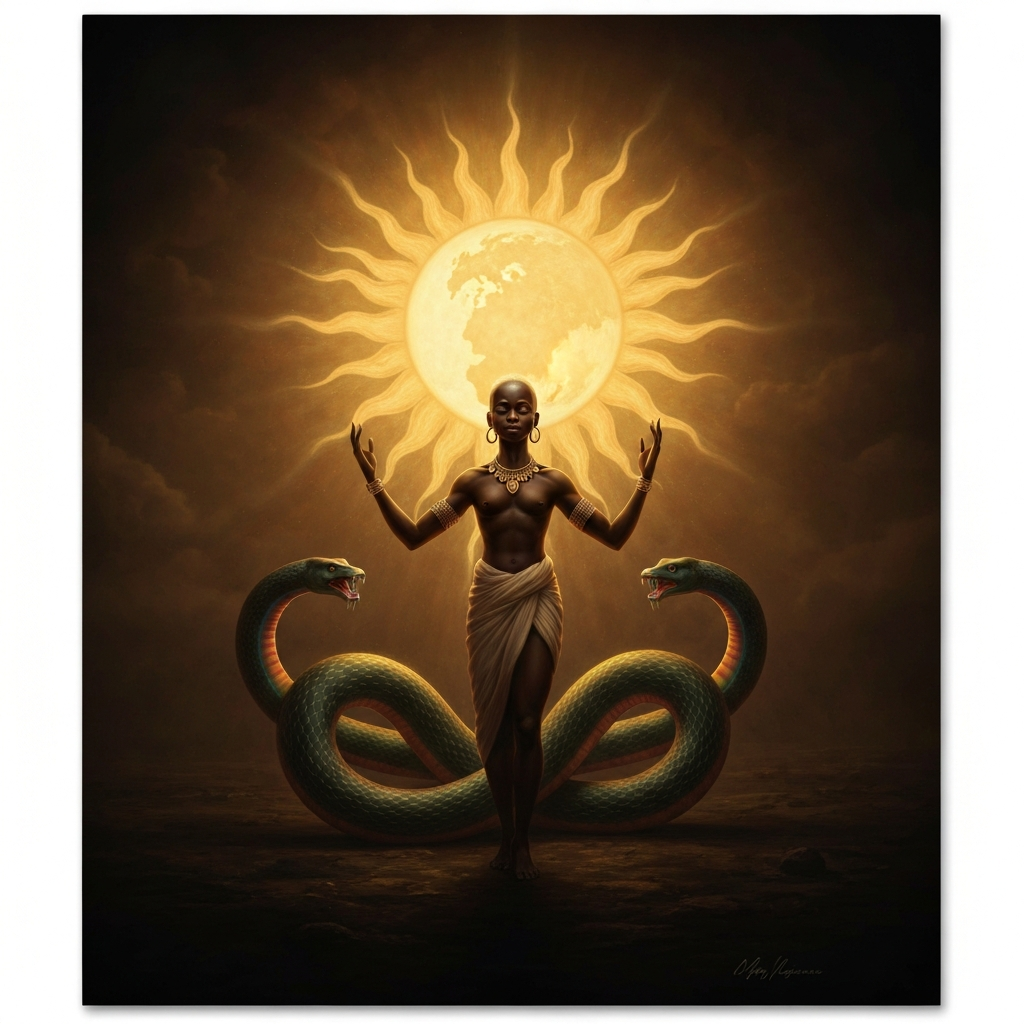
Da Ayido Hwedo: The Serpent That Holds the World
From the beginning of creation — Da appeared before the world was formed · Beneath and around the world — in the sea, in the sky as the rainbow, in the earth as underground water
Contents
The great rainbow serpent Da Ayido Hwedo curls around the base of the world, biting his own tail — if the sea dries up and he overheats, his thrashing will end everything.
- When
- From the beginning of creation — Da appeared before the world was formed
- Where
- Beneath and around the world — in the sea, in the sky as the rainbow, in the earth as underground water
He was there before the world.
When Mawu-Lisa began the work of creation, Da Ayido Hwedo was already present — not as a created thing but as the medium of creation, the vehicle in whose mouth the divine pair traveled through the formless void making things. He is older than everything he carries. He is the condition of the world’s existence, the way the ocean is the condition of the wave’s existence.
Da means the thing that comes before in the language his name speaks. He is before the beginning.
He has two forms.
In the sky he is the rainbow — Hwedo, the arc of colors that appears when rain and sun coincide, the bridge between the cloud-world and the earth-world. When you see the rainbow after rain, Da is visible, his serpent body showing in spectral form above the landscape. The Fon regard the rainbow with respect: you do not point at it, you do not speak carelessly about it, you acknowledge what you are seeing.
In the earth and sea he is the coiled foundation — the immense serpent who encircled the world when creation was complete and has been holding it since, biting his own tail in the gesture that every tradition that encounters the cosmic serpent eventually discovers: the ouroboros, the self-devouring circle, the image of something that contains itself, that is its own vessel and its own content.
His food is iron.
Da Ayido Hwedo eats iron. This is what keeps him in his place — the iron ore deposits in the earth that feed him through the long geological ages of his task. The smith-god’s metal is the cosmic serpent’s sustenance. Iron connects the human world of craft and warfare to the cosmic world of foundations and support.
When the iron runs out, Da will have to move. His movement will be the end.
The Fon do not treat this as merely a mythological statement. It is a description of a process that is actually happening: the iron deposits under the earth are finite, and Da is eating them. The world has a timeframe. The timeframe is determined by the serpent’s hunger.
There is also the matter of the sea.
Da lies in the sea as well as under the earth — his coils run through the ocean, and the ocean’s coldness keeps him from overheating. The ocean is Da’s cooling system. If the sea evaporates, Da overheats, thrashes, and the world shakes apart.
The Fon connection between caring for the environment and maintaining cosmic stability is not metaphorical. It is physical: the sea is the sea, and if it dries up (whether through divine judgment, ecological disruption, or the natural processes of a world with a finite lifespan), the serpent overheats, and the world ends.
This is a cosmological theory of environmental responsibility.
His children are everywhere.
Da Ayido Hwedo has many offspring, and they inhabit the rivers, streams, and rainbows of the human world as local manifestations of the cosmic serpent’s energy. The python is sacred throughout West Africa partly because of Da: the python is the visible, embodied form of the serpent principle in the human world, the living echo of the great coiled being at the world’s base.
Pythons in certain communities may not be killed. They may not be touched without specific ritual preparation. They move through villages and sacred spaces as protected beings, the children of the cosmic foundation, carrying something of their ancestor’s sacredness in their patient, cold bodies.
When the python crosses your path in the forest, Da’s presence has come close.
He traveled to Haiti.
The Middle Passage carried Da Ayido Hwedo across the Atlantic in the memory-bodies of enslaved Fon people. In Haiti he became Danbala Wedo — the great white serpent Lwa, the oldest of the divine beings in Haitian Vodou. He still lives in water and trees. His wife is Ayida Wedo, the rainbow (the division of Da into two, or the union of Da with the female rainbow principle). Together they are still coiled around the base of the universe.
Danbala does not speak in words. He is too old for words. When a practitioner is mounted by Danbala during a Vodou ceremony, they hiss and move like a snake, they crawl on the floor, they cannot speak — because the oldest being, the being who preceded speech, has no words.
He has only the motion.
The coiling, the holding, the slow patient grip of something that has been supporting everything for longer than any human count of time.
He is still there, at the base of things.
Biting his own tail.
Holding on.
Echoes Across Traditions
Entities
- Da Ayido Hwedo
- Mawu-Lisa
- The Rainbow
Sources
- Herskovits, Melville J. and Frances S. Herskovits, *Dahomean Narrative* (Northwestern University Press, 1958)
- Blier, Suzanne Preston, *African Vodun: Art, Psychology, and Power* (University of Chicago Press, 1995)
- Cosentino, Donald J., ed., *Sacred Arts of Haitian Vodou* (UCLA Fowler Museum, 1995)