Contents
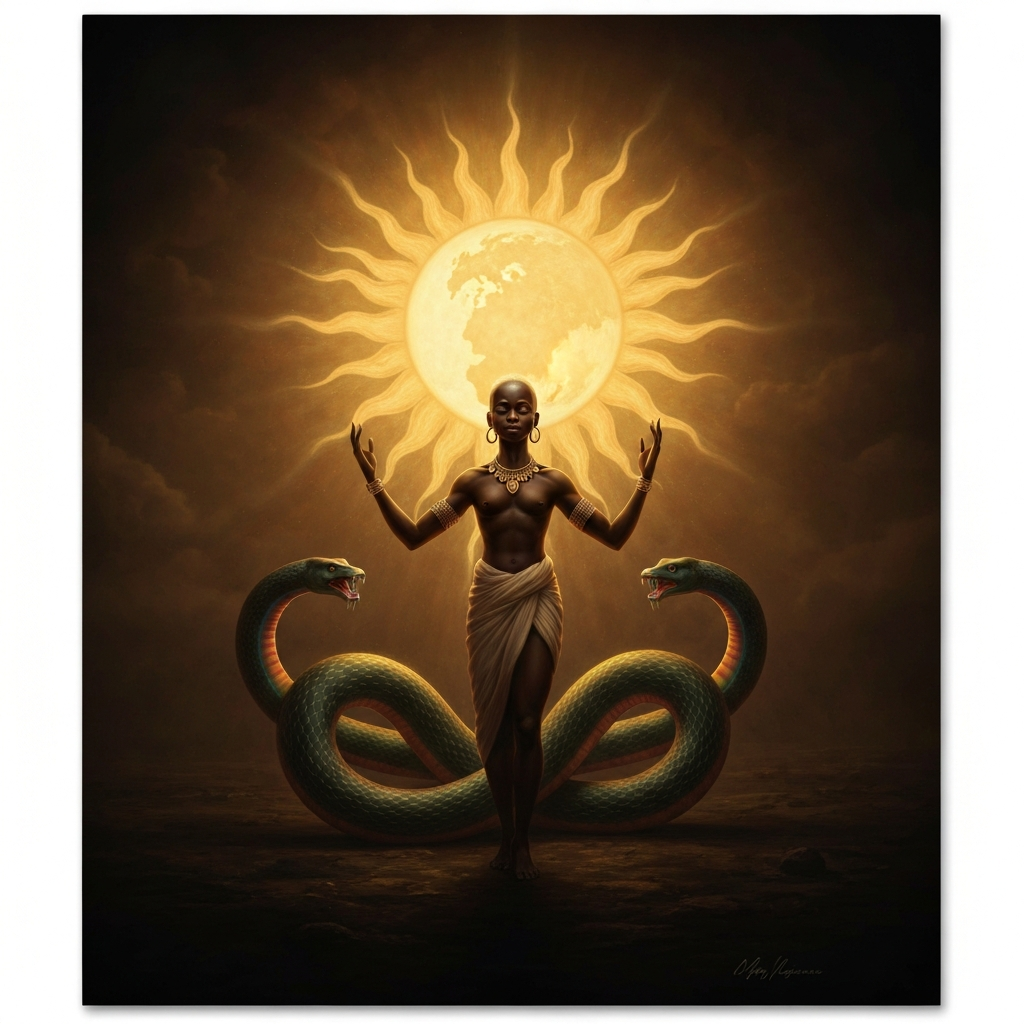
Sakpata, the earth god of smallpox and epidemic disease, is both the cause and the only cure — the terrifying deity who sends the spotted death and the only power who can recall it.
- When
- Historical and ongoing — Sakpata's cult was active during the great smallpox epidemics of West Africa
- Where
- The earth — Sakpata is an earth deity, governing disease from below
He wears the earth’s colors.
Sakpata’s colors are red and white — the red of fever heat and blood, the white of the pustule, the white of the purified thing that has come through the fire of disease and survived. His priests wear the same colors. His shrines are red and white. The disease he sends — variola, the smallpox that marked West Africa for centuries before and after European contact — leaves its survivors wearing Sakpata’s colors permanently, the pocked skin that says I met this god and lived.
Sakpata is the eldest of Mawu-Lisa’s sons. He was given the earth as his domain — and the earth includes everything that lives and dies in the earth, which is everything. Disease is an earthly thing: it comes from the ground, from the water, from the close-packed bodies of the community. Sakpata does not send disease from the sky like a punishment. He sends it from below, where it has always been.
He also receives it back.
The priests of Sakpata are the first epidemiologists.
The cult of Sakpata was not merely a religious system for explaining disease. It was a practical institution for managing it. When smallpox appeared in a town, it was the priests of Sakpata who took charge: quarantining the sick, managing the movement of the healthy, preparing the ritual responses that addressed the deity directly.
They knew things that European medicine would not officially acknowledge for another century.
The Sakpata priests understood that people who survived smallpox did not get it again. They understood that people who were exposed to a mild form of the disease were often protected from the severe form. The practice that European physicians called variolation — deliberately infecting a person with matter from a mild smallpox case to induce immunity — was known in West Africa in a form that may have predated its Ottoman and Chinese versions or developed independently.
When enslaved Fon people arrived in colonial America, the knowledge traveled with them. Cotton Mather’s famous slave Onesimus, who described variolation to Mather in the early eighteenth century and helped introduce the practice to Boston during the 1721 smallpox epidemic, was carrying knowledge from a tradition that had maintained it for generations.
His anger is terrible.
Sakpata does not send disease at random. In the Fon understanding, epidemic has causes: violation of Sakpata’s prohibitions (certain animals that cannot be eaten near his shrines, certain behaviors in his presence), disrespect toward the earth, or the accumulated moral failures of a community that has not maintained its relationship with the earth god.
When Sakpata is angry, the spots appear.
The appropriate response to an epidemic in the Fon world is not merely medical quarantine but religious reconciliation: the community must identify what violated the relationship with Sakpata and address it. The priests diagnose not just the disease but its cause. The offerings made to Sakpata are not bribes but reparations — the acknowledgment that something was wrong in the relationship between the community and the earth, and the commitment to correct it.
This framework has been dismissed as superstition by people who do not notice that it accomplishes, through religious means, exactly what modern epidemiology accomplishes through secular ones: it identifies the social behaviors that spread disease (the prohibitions around food preparation, communal gathering, contact with the sick), enforces isolation (the quarantine that is simultaneously the sick person’s special status as Sakpata’s chosen), and creates community-wide behavioral change through the authority of divine mandate.
In Brazil he is Omolu.
The Middle Passage carried Sakpata to Brazil, where the Yoruba equivalent — Sopona, the smallpox deity — merged with the Fon Sakpata in the syncretic Candomblé tradition and became Omolu, the lord of earth and disease. Omolu arrived in Bahia still wearing his colors: black and red (the Brazilian version), still covered in the straw that represents the skin of the pox-marked body.
When Candomblé practitioners were dying of smallpox in colonial Bahia and the Portuguese Catholic authorities had no treatment, the Omolu priests were treating patients. The knowledge of the earth god, preserved through the crossing and through generations of forced conversion, was still functional in a new continent with new diseases.
Sakpata adapted. The earth does not change its fundamental nature when you carry a boat’s worth of people across an ocean. Disease is still disease. The earth still receives the dead. The spotted god still knows the treatment.
He always has.
Echoes Across Traditions
Entities
- Sakpata
- Mawu-Lisa
- The priests of Sakpata
Sources
- Herskovits, Melville J. and Frances S. Herskovits, *Dahomean Narrative* (Northwestern University Press, 1958)
- Blier, Suzanne Preston, *African Vodun* (University of Chicago Press, 1995)
- Law, Robin, *The Slave Coast of West Africa, 1550-1750* (Oxford University Press, 1991)
- Thornton, John K., *Africa and Africans in the Making of the Atlantic World* (Cambridge University Press, 1998)