Contents
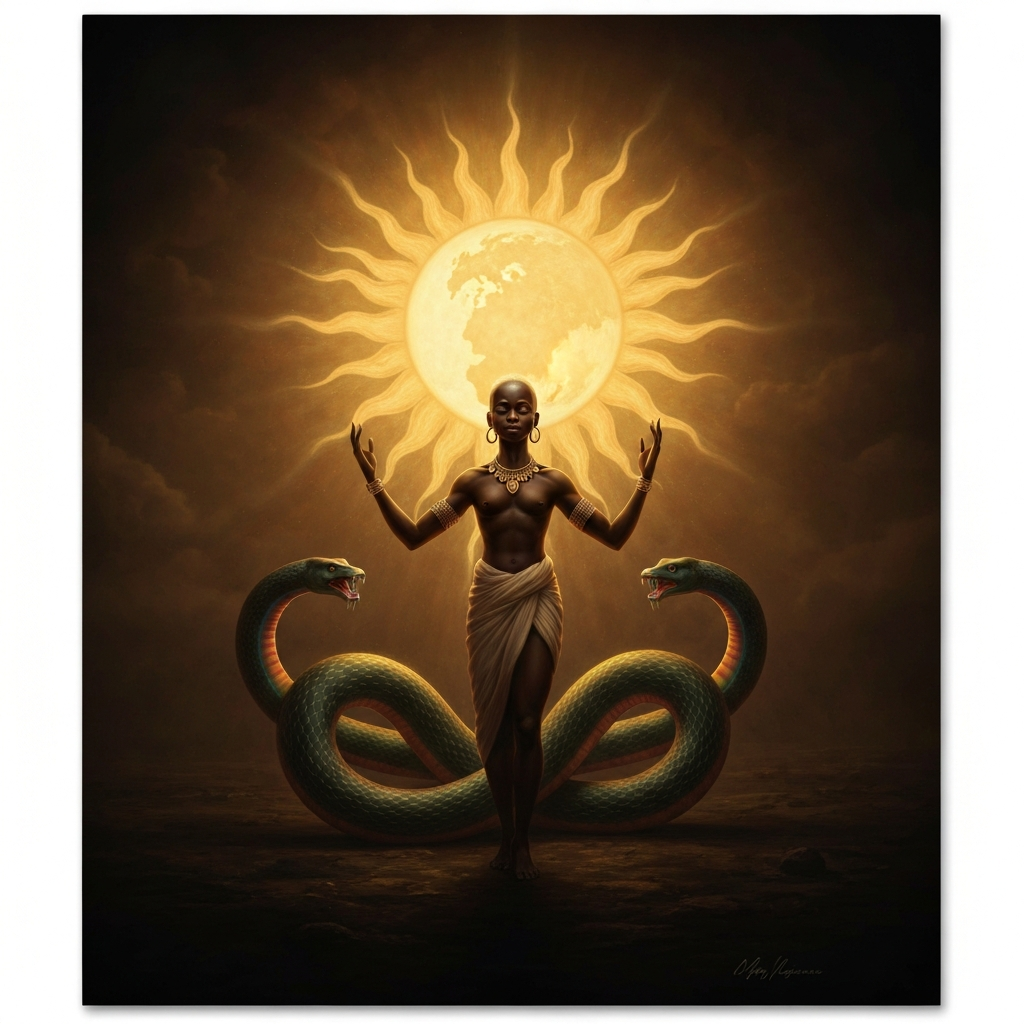
The supreme deity of the Fon people is a divine pair — Mawu the moon-woman and Lisa the sun-man — who together create the world and divide it between them, inseparable and complementary in every act.
- When
- Before the world — the primordial creative act before time
- Where
- The sky — before the earth and sea and stars were arranged
In the beginning there is Mawu-Lisa.
Not Mawu. Not Lisa. Mawu-Lisa: the hyphenated double being whose name is always spoken as a pair, whose identity cannot be split without losing the essential thing. Two in one, or one that expresses itself always as two, or the union that is more than the sum of its parts — the Fon language does not draw the boundary where Western philosophy would draw it, between one and two, between same and different.
Mawu is the moon. She is cool, and her coolness is wisdom. She is the intelligence that comprehends what needs to be done, the cosmic planning function, the knowing before acting. She is old — older than Lisa, the Fon say, or older in the sense that wisdom is always prior to action, that you cannot act correctly without the knowing that precedes the act.
Lisa is the sun. He is hot, and his heat is strength. He is the executive function, the power that does what Mawu has planned, the arm that the mind moves. He is young — or young in the sense that action is always subsequent to wisdom, that the arm is always subsequent to the understanding that directs it.
Together they create.
Da Ayido Hwedo carries the world.
Before Mawu-Lisa begins the work of creation, the great cosmic serpent Da Ayido Hwedo comes to serve as the vehicle of creation — the transport and the support. The Fon understand creation not as an ex nihilo event but as an act of ordering, arrangement, and placement, and Da Ayido Hwedo provides both the medium and the foundation.
He carries Mawu-Lisa in his mouth as they travel through the void making mountains, rivers, trees, and animals. His excrement is the mountains — the accumulation of creation’s refuse becomes the landscape. When the work is done, he curls himself into a ring at the edge of the world, biting his own tail, and supports the earth on his coils.
The world sits on a serpent. When the serpent moves, the earth trembles. The Fon explain earthquakes as Da’s readjustment — shifting the weight, finding a better position for the endless task of holding everything up.
The sea surrounds the serpent’s body, cooling him. If the sea ever dries up, Da will overheat. He will thrash. The world will end. The Fon attend to the sea because the sea attends to the serpent who holds the world.
Mawu and Lisa divide the world between them.
After the creation is complete — mountains, rivers, animals, humans, the plants and weather and the arrangement of the sky — Mawu and Lisa distribute their realm between their children. The Vodun (the divine beings, what Haitian Vodou will call Lwa) are Mawu-Lisa’s offspring, and each Vodun receives a portion of the world to govern.
The sky Vodun govern from above. The earth Vodun govern from within the ground. The water Vodun govern the rivers and sea. The thunder Vodun — who will be known as Hevioso in Fon theology and will travel to the Americas as Shango and Xango — governs the storms.
Mawu takes the night. Lisa takes the day.
This division is not a separation. It is a cooperation — the same cooperation that was present in their shared identity, now expressed in the alternation of night and day, cool and hot, rest and action. Every twenty-four hours is a miniature re-enactment of the Mawu-Lisa dynamic: the moon’s wisdom prepares what the sun will do, and the sun’s action confirms what the moon understood.
The Fon pray to Mawu-Lisa rarely, for the same reason that many African peoples do not pray to the supreme being directly: the supreme being is too vast for specific petition. You pray to the Vodun for specific things. You acknowledge Mawu-Lisa as the condition of all things.
The pair structure runs through everything.
Fon religious practice, art, and political organization are shot through with the twin principle inherited from Mawu-Lisa. Twin births are extraordinarily sacred among the Fon and many of their West African neighbors — twins are called Hohovi, children of the divine pair, each child a partial realization of the divine duality. The cult of twins requires elaborate ongoing ritual: carved figures representing the twins must be kept, fed, dressed, and taken to market. If one twin dies, the surviving twin and the carved figure of the dead twin must be treated as inseparably paired, because the paired state is sacred and cannot simply be dissolved by the death of one element.
The theology of divine pairing reaches its most elaborate expression in the Vodou of Haiti, where the Lwa frequently appear in pairs or have male and female aspects that are invoked together. Mawu-Lisa’s theological structure survived the Middle Passage in the bodies of enslaved Fon-speaking people, arrived in Saint-Domingue, and survived two centuries of forced conversion to Catholicism by flowing beneath Catholic surfaces.
You can still find it in the paired sacred images, in the male-female altar arrangements, in the cosmology that insists on complementarity rather than hierarchy.
Mawu and Lisa are still speaking.
They speak in every night that prepares a day.
Echoes Across Traditions
Entities
- Mawu
- Lisa
- Da Ayido Hwedo (the cosmic serpent)
- The Vodun
Sources
- Herskovits, Melville J. and Frances S. Herskovits, *Dahomean Narrative* (Northwestern University Press, 1958)
- Bay, Edna G., *Wives of the Leopard: Gender, Politics, and Culture in the Kingdom of Dahomey* (University of Virginia Press, 1998)
- Blier, Suzanne Preston, *African Vodun: Art, Psychology, and Power* (University of Chicago Press, 1995)