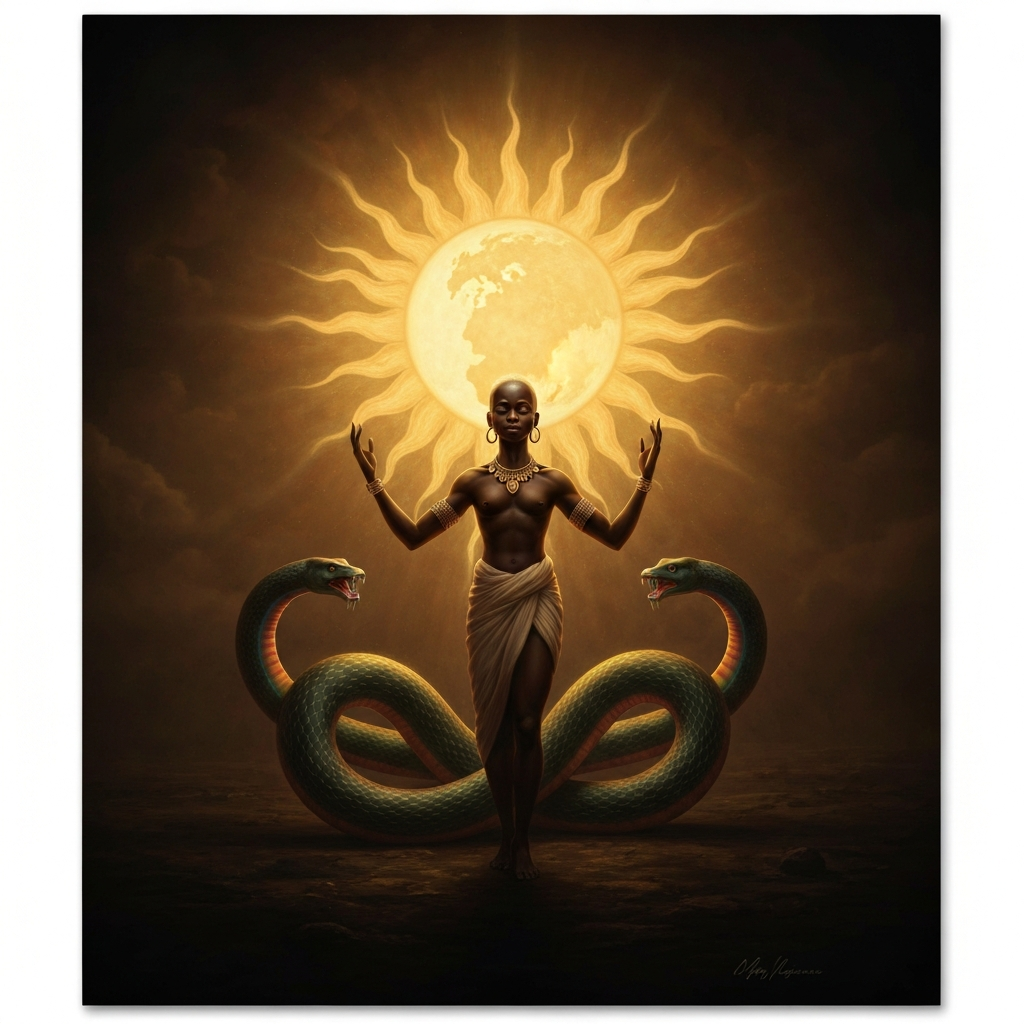
Legba Opens and Closes Every Door
From the completion of creation — Legba's role was assigned when the world was distributed among Mawu-Lisa's children · Every threshold, crossroads, and gateway — Legba has no single home because every entrance is his home
Contents
The youngest son of Mawu-Lisa stands at every crossroads and threshold — without Legba's permission, no prayer reaches the other Vodun, no spirit enters the human world, no door opens.
- When
- From the completion of creation — Legba's role was assigned when the world was distributed among Mawu-Lisa's children
- Where
- Every threshold, crossroads, and gateway — Legba has no single home because every entrance is his home
Nothing begins without him.
Before the ceremony opens, before the drums start, before any Vodun is called, before any prayer is addressed to any divine being — Legba must be addressed first. He is the gatekeeper, the one who holds the key to every door between the human world and the world of the Vodun. If you skip Legba, you are speaking into an empty room. No one receives what you are saying. No door opens.
He is the youngest son of Mawu-Lisa, and his position is the position that was left after all the other children had been given their domains. The sky Vodun, the earth Vodun, the thunder Vodun, the iron Vodun — all of these received clear, prestigious portfolios. Legba received what remained: the space between the domains. The thresholds. The crossroads.
It looked, to his siblings, like a poor inheritance.
They did not understand what they were watching him receive.
Legba’s domain is every entry point in the world.
He lives at the gate of the compound. His image is placed there — a small carved figure, often with an erect phallus (sign of vital, creative force), with offerings of palm wine and food at its base. When the household goes out in the morning, they pass Legba. When they return, they pass Legba. When guests arrive, they pass Legba. Every crossing of the threshold is noted by the being who lives in the threshold.
He lives at the crossroads. His image is placed where roads meet — not as a warning or a marker but as an acknowledgment that where paths cross is a charged space, a place where choices are made, where different trajectories intersect. The crossroads is the point of maximum possibility and maximum danger, the place where you choose your direction and where everything that uses the road passes through.
He knows every language.
This is perhaps his greatest power: Legba is the only Vodun who speaks all languages — human and divine, the languages of the living and the dead, the languages of every country and every tradition. When the Vodun speak to each other, Legba can translate. When humans pray to the Vodun, Legba carries the prayer in the appropriate language. Without this universal translation function, the entire system of divine communication would collapse into mutual unintelligibility.
He is also a trickster.
The youngest of Mawu-Lisa’s children has the youngest child’s characteristic: mischief. Not malice — Legba does not harm for the sake of harm. But he will create confusion if confusion serves a teaching purpose. He will allow a message to arrive slightly altered if the alteration reveals something true. He will close a door that was about to be used badly.
There is a story about Legba and Mawu-Lisa.
Mawu-Lisa had arranged the world so that every misfortune, every error, would be attributed to Legba — who was the visible face of the divine world, the one who stood at the threshold and was seen by everyone. When things went wrong in the village, people would curse Legba: the youngest son, the troublemaker, the one whose face was at the gate.
Legba decided to teach Mawu-Lisa something about attribution.
He spent three days rearranging all the tools and objects in Mawu-Lisa’s compound at night, so that every morning Mawu-Lisa would wake to find things in the wrong places — the hoe in the kitchen, the cooking pot in the field, the sandals in the river. Mawu-Lisa would rage and curse, asking who had done this. The neighbors, confused, would apologize for things they had not done. The entire divine household was in disorder.
After three days, Legba revealed what he had done, and why.
Mawu-Lisa, who is too vast to feel shame but can recognize an accurate lesson, arranged after that for human beings to know that misfortune is not Legba’s fault but part of the complexity of creation.
Legba got credit for the lesson, but he also remained the face at the gate.
In Haiti he is the old man.
The crossing of the Atlantic changed Legba’s image. In West Africa he is associated with vitality and youth as well as age. In Haiti, Papa Legba arrived as an old man: limping, using a cane, wearing a straw hat, patient beyond any human patience. He had been across the water. He had watched his people survive the crossing. He had opened and closed the door through which millions passed.
He was old enough to have held all of that.
Robert Johnson met him at a crossroads in Mississippi in 1930, or so the story goes — the bluesman who sold his soul to the devil at the crossroads, who came back with a guitar that played like nothing human. The figure at that Mississippi crossroads was not the Christian devil. The figure was the one who lives at every crossroads, who speaks all languages, who holds the key to every door.
He is still there.
At every threshold, every crossroads, every beginning.
Address him first.
Echoes Across Traditions
Entities
- Legba
- Mawu-Lisa
- The Vodun
Sources
- Herskovits, Melville J. and Frances S. Herskovits, *Dahomean Narrative* (Northwestern University Press, 1958)
- Deren, Maya, *Divine Horsemen: The Living Gods of Haiti* (Thames and Hudson, 1953)
- Blier, Suzanne Preston, *African Vodun: Art, Psychology, and Power* (University of Chicago Press, 1995)
- Thompson, Robert Farris, *Flash of the Spirit: African and Afro-American Art and Philosophy* (Random House, 1983)