Water Beetle Brings Up the Earth
Before time — before the land existed · The primordial ocean; the vault of the sky; the mountains of the Cherokee homeland
Contents
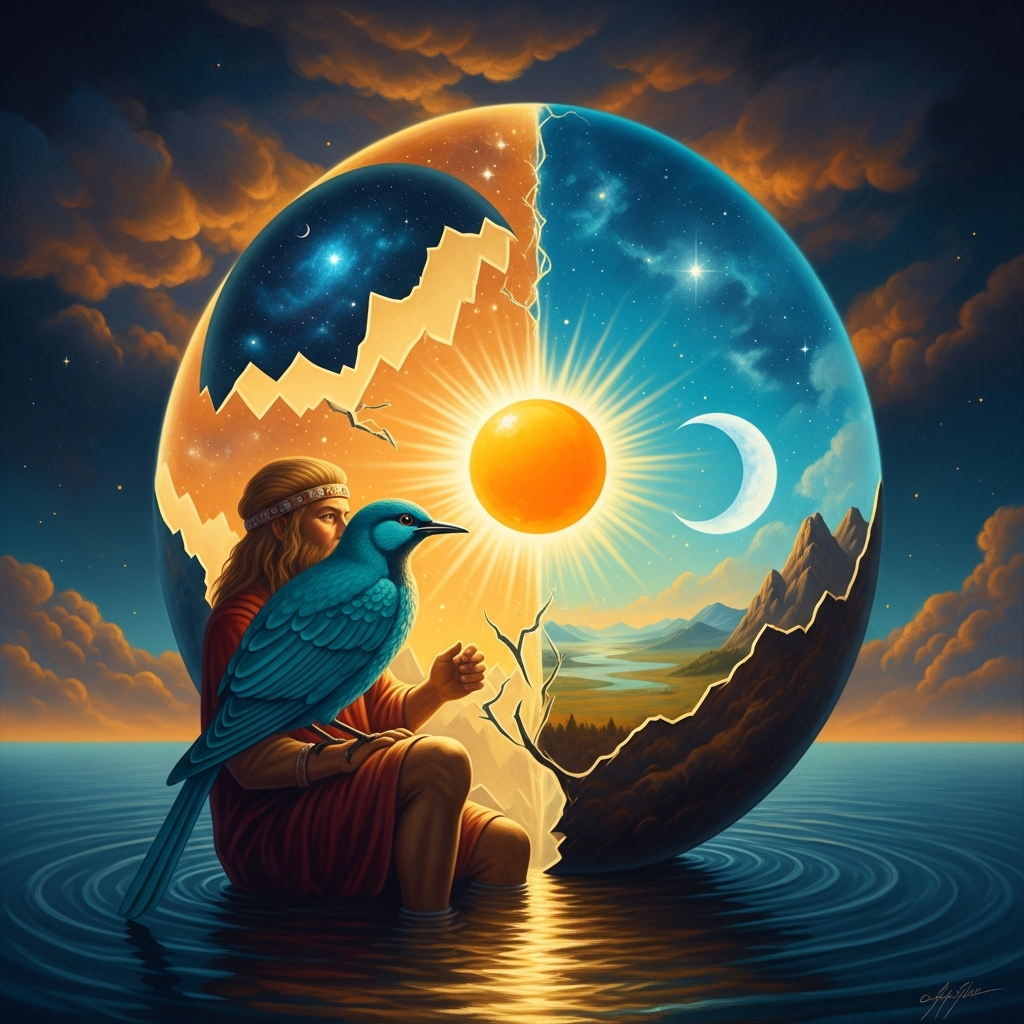
In the beginning all is water, and the animals in the sky vault are crowded. Water Beetle dives to the bottom of the endless sea and brings up a piece of soft mud, and from that mud the earth grows — a great island floating on the water, hung from the sky by four cords.
- When
- Before time — before the land existed
- Where
- The primordial ocean; the vault of the sky; the mountains of the Cherokee homeland
Before the earth, everything is water.
The animals live above the water in the vault of the sky, which is a solid dome, and the vault is crowded. Every creature that will ever exist is up there, packed together, and the crowding has been getting worse for a long time. The animals hold council after council about the crowding.
Someone finally says: there must be land somewhere below.
Water Beetle volunteers.
He is small and not generally considered important, but he is the one who says: I will go look. He dives off the edge of the sky vault and down to the surface of the water, and then keeps going, down through the dark cold water to the very bottom. At the bottom is soft mud.
He brings back a piece of it.
Just a small piece, just enough to hold in his legs, but when he brings it to the surface it begins to grow. It spreads in every direction, getting larger and drier as the animals watch from above. It grows and grows until it is an island in the middle of the water — not the whole world, but enough to stand on.
The island is soft and wet. The animals want to come down but it is too soft. They wait for it to dry.
Great Buzzard goes down to check on it.
He flies low over the island, beating his great wings to test the firmness. He is very large and flies very close. Where his wings beat downward against the earth, the soft ground is pressed into valleys. Where his wings sweep upward, the ground lifts into ridges. He flies the length and width of the island, his wings making the landscape, and when the animals finally descend, the earth of the Cherokee homeland has the mountains and valleys that the people will know forever.
The Appalachian Mountains are the marks of Buzzard’s wings.
The island is suspended from the sky vault by four cords, one at each direction, and the stability of the world depends on those cords. The elders say that when the cords break, the world will end and everything will sink back into the water. But they do not say when. The cords are very strong.
The animals come down to the new earth. The sun is moved to the right height — not too close to burn, not too far to be cold — through several trials. The plants are given to be food. The people are made last, or appear last, and they find the world already arranged: the mountains and valleys made by Buzzard’s wings, the rivers already running, the trees already standing.
The Cherokee call the earth Elohino — the earth mother — and the sky Galunlati, the vault above. Between them, the island of the world hangs on its four cords, maintained by the care of the living things upon it.
Water Beetle is not celebrated in any particular ceremony. He did a small thing that became a large thing, which is how the most important things tend to happen. He dove to the bottom and brought back what was there, and from what was there, everything else came.
The mountains are still the shape of Buzzard’s wings.
You can see this if you know how to look at them.
Echoes Across Traditions
Entities
- Water Beetle (Dayunisi)
- the animals of the sky vault
- Great Buzzard
- the four cords
Sources
- James Mooney, *Myths of the Cherokee* (Bureau of American Ethnology, 1900)
- Raymond Fogelson, ed., *Handbook of North American Indians, Vol. 14: Southeast* (Smithsonian, 2004)
- Kathi Smith Littlejohn, *The Cherokee Full Circle* (University of North Carolina Press, 2010)