Contents
Old Man Coyote floats alone on the primordial waters and, bored with eternity, asks a duck to dive down and bring up mud — and from that mud, talking the whole time, he makes the earth and everything on it.
- When
- Before time — the primordial waters before the earth existed
- Where
- The primordial waters; the newly made earth of the northern plains
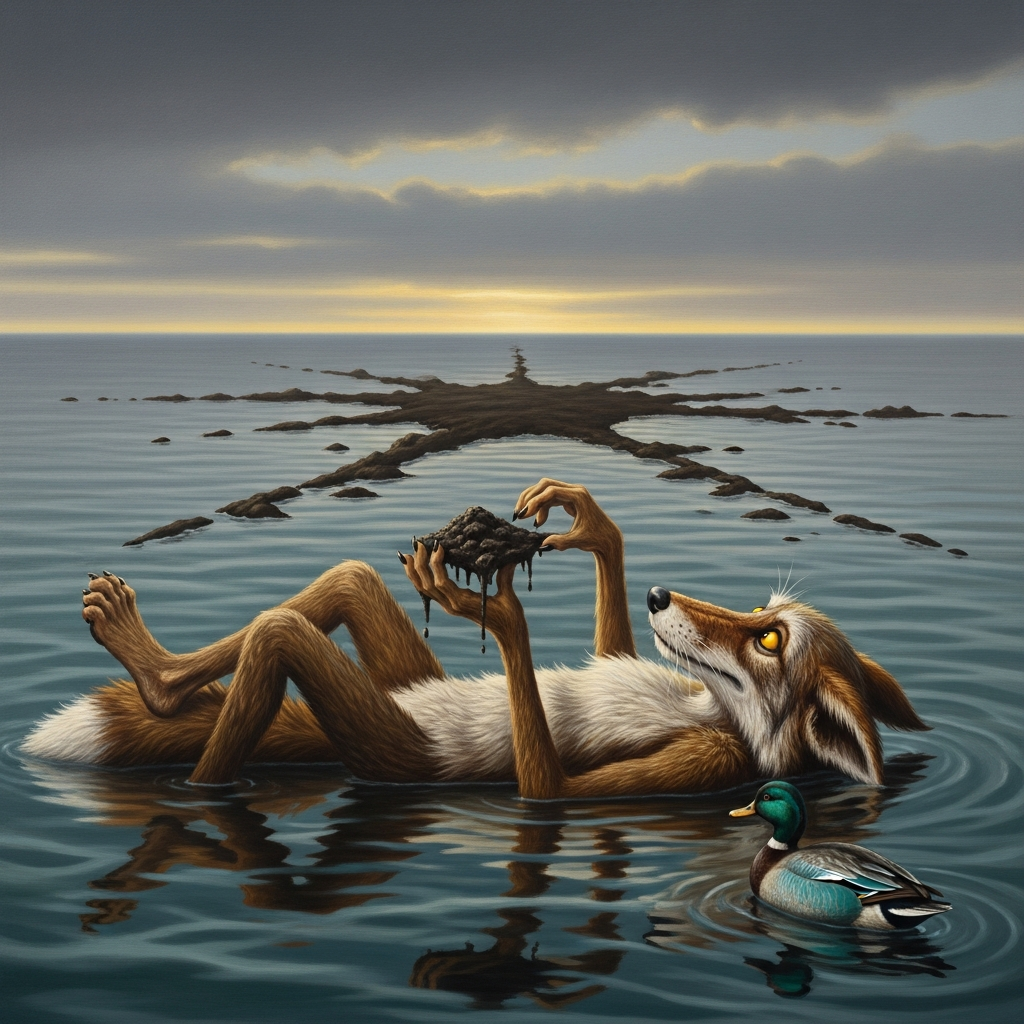
In the beginning, Old Man Coyote floats.
There is nothing but water in every direction — no land, no sky with edges, just the flat gray water stretching forever and Old Man Coyote drifting on it, face up, watching the clouds he has not yet made. He has been here for a very long time and he is bored in the way that only very old beings can be bored, which is the kind of boredom that eventually becomes dangerous.
He starts talking.
He talks to the water and the water doesn’t answer. He talks to the sky and the sky is indifferent. He says: there should be something here besides water. There should be land. There should be things happening. He is talking to himself, which is what he will always do when no one else is available.
A duck floats by.
Old Man Coyote grabs it by the neck, not roughly, just firmly, the way you hold something you need. He says: Dive down. Bring me mud from the bottom. The duck says: How far down is the bottom? Old Man Coyote says: Far. Go find out. The duck dives.
It is gone a long time.
When it surfaces, gasping, it has a small smear of mud on its beak and claws, barely enough to see. Old Man Coyote takes this mud carefully, all of it, even the tiny bits on the feathers, and he begins to work. He rolls it between his hands, singing. He blows on it. He tells it what to be: be flat here, be a hill here, have a river going through you here. The mud grows as he talks. It spreads across the surface of the water, getting larger and firmer and more complicated as Old Man Coyote keeps talking, because he has a great deal to say.
By the time he has talked a long time the mud is the earth.
He walks on it. He tests the ground with his feet and finds some places he wants to change. He makes the Black Hills because he thinks the flat parts need some relief. He makes rivers because the earth looks thirsty. He makes the buffalo because the grass is growing and something should be eating it.
He makes people last, and he makes them from mud too, pinching them into shapes and blowing into their mouths. The first people are Crow people. They stand up and look around and ask him: Who are you? He says: I am Old Man Coyote, I made all this. They look at the hills and the rivers and the buffalo and they say: It’s pretty good. He takes this as the high praise it is.
Then he makes death, because Little Coyote, his companion, argues that without death the world will get too full and the food will run out. Old Man Coyote agrees but he is sorry about it. He makes death but he makes it so that the dead go somewhere — not nowhere, somewhere — because he can’t quite bring himself to make a world where things simply stop. They go somewhere else. He doesn’t say exactly where. He isn’t sure himself.
He walks across the earth he has made, still talking, looking for what needs to be added.
There is always something that needs to be added.
Echoes Across Traditions
Entities
- Old Man Coyote (Isaahkawuattee)
- the diving duck
- Little Coyote
- the first people
Sources
- Rodney Frey, *The World of the Crow Indians: As Driftwood Lodges* (University of Oklahoma Press, 1987)
- Joseph Medicine Crow, *From the Heart of the Crow Country* (Crown, 1992)
- Peter Nabokov, ed., *Native American Testimony* (Penguin, 1991)