Cernunnos: Lord of Wild Things
prehistoric — Cernunnos as a pre-Celtic deity absorbed into the Celtic world, attested from the Iron Age through Roman Gaul · The deep forest — notionally, the sacred center of the forest at the boundary of the human and wild worlds throughout Gaul, Britain, and Ireland
Contents
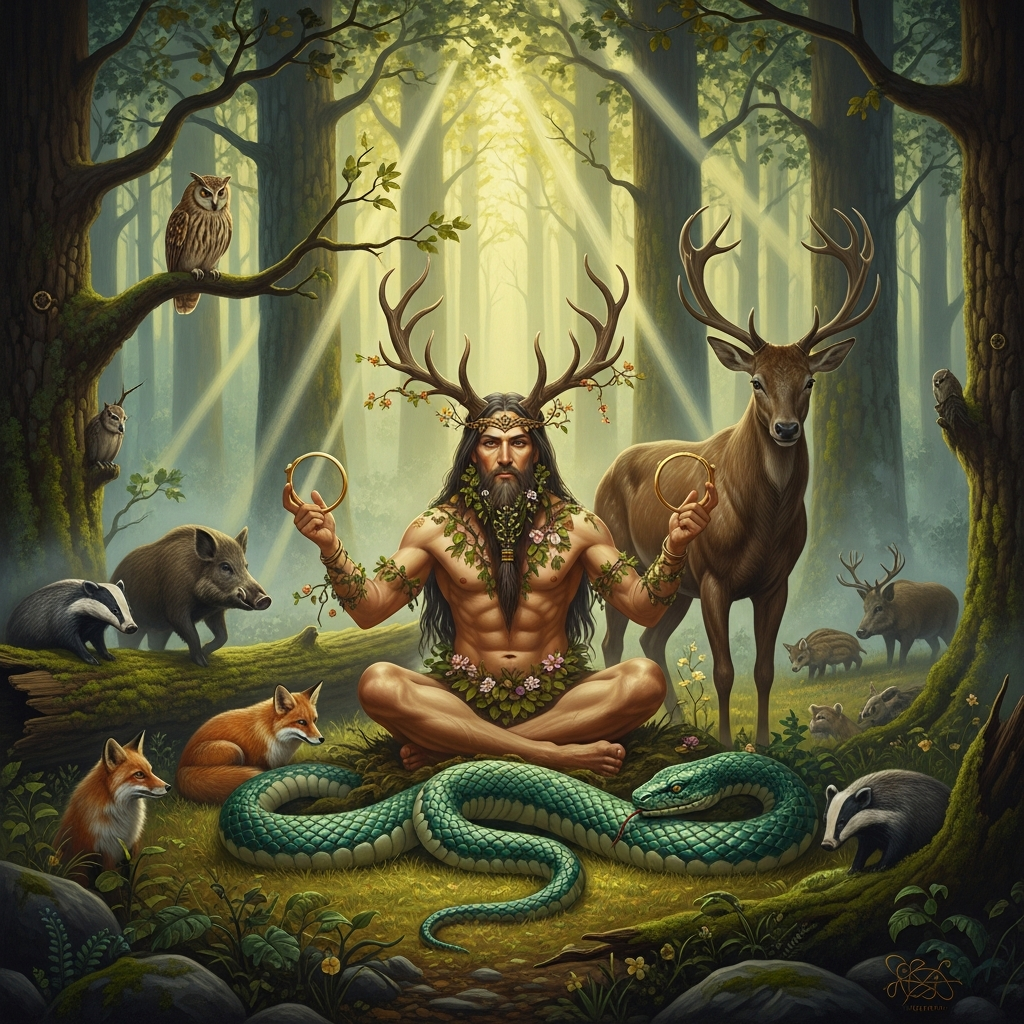
At the center of the forest where the paths end, the antlered god sits in the posture of the earth's patience: surrounded by serpents and stags and all the creatures that live at the margin between the human world and the wild one, holding the torque that is the world's sovereignty.
- When
- prehistoric — Cernunnos as a pre-Celtic deity absorbed into the Celtic world, attested from the Iron Age through Roman Gaul
- Where
- The deep forest — notionally, the sacred center of the forest at the boundary of the human and wild worlds throughout Gaul, Britain, and Ireland
He sits where the paths end.
Beyond the last path, beyond the last human-made clearance, where the tree canopy is continuous and the light is green-filtered and the ground is the soft permanent damp of soil that has never been worked — here is where he is. Cross-legged on the earth. Antlered head rising above the canopy. Torque in hand, torque around his neck.
The torque is the symbol of sovereignty in the Celtic world: the twisted gold neckring worn by the highest-ranked warriors and deities, the metal collar that marks who is in charge. Cernunnos holds the torque. The torque in his hand means: this is my domain. Everything in it is mine. Mine in the sense of responsibility, not ownership — the way a shepherd is responsible for the flock, not by possessing them but by being the organizing principle of their safety.
The animals come to him.
On the Gundestrup Cauldron — the great silver ritual vessel found in a Danish bog, made in the 2nd or 1st century BCE — Cernunnos is shown in the cross-legged posture with a stag to his right and a ram-headed serpent in his left hand. Other animals crowd around him: a bull, a wolf, a lion in the continental tradition. They are not afraid of each other in his presence. The predators and the prey sit together at the feet of the one who holds the torque.
This is his function: the temporary suspension of the predator-prey relation. Not the abolition of it — he is not a vegetarian god, not a god of unnatural peace. He is the god of the moment when the stag and the wolf drink from the same stream before the chase resumes. He holds the wild in a balance that the human world requires but cannot enter.
His name comes from cernon, meaning horn or antler — he is the horned one, the antlered one, the god whose crown is the forest’s own growth. He sheds it and it grows back, the way the stag does, the way the forest does after fire. He is cyclical in his appearance, which is not death and rebirth exactly but the same regenerative truth: what is lost in the dark season is restored in the growth season.
A single inscription in Paris names him: ERNVNNOS, on a pillar of the Nautes, the boatmen’s guild. Found under Notre-Dame Cathedral, dedicated by sailors, the name preserved in stone while everything else about him lives in image and speculation.
He may be the oldest god in the Celtic world. The Indus Valley seals from 3000 BCE show a figure in his exact posture — cross-legged, antlered, surrounded by animals — which suggests this image of divine wildness is at least five thousand years old and may be considerably older. The specific coincidence between the Indus Valley Pashupati and Cernunnos is the most tantalizing archaeological question in comparative religion.
He does not speak in the Irish texts. He is not named in the Welsh ones. He appears in the forest of iconography — on cauldrons, on coins, on the walls of Gaulish shrines — and he does not need a story told about him the way the other gods do, because his story is told by the animals around him.
The stag knows him. The serpent at his feet knows him. The forest at the path’s end knows him.
You can feel him when you go past the last path and the trees are old enough and the light is green and the ground is the specific quiet of soil that has never been turned.
He is sitting there. He is always sitting there.
Echoes Across Traditions
Entities
- Cernunnos
- The stag
- The horned serpent
- The ram-headed serpent

Sources
- Miranda Jane Green, *Celtic Myths* (British Museum Press, 1993)
- Anne Ross, *Pagan Celtic Britain: Studies in Iconography and Tradition* (Routledge, 1967)
- John Haywood, *The Historical Atlas of the Celtic World* (Thames and Hudson, 2001)