The Four Bacabs Who Hold Up the Sky
Classic Maya period, c. 300-900 CE; cosmological framework preceding historical record · The four corners of the Maya cosmos — east, north, west, south; each identified with a color and a Year Bearer day
Contents
At the four corners of the Maya cosmos stand the Bacabs — four brothers, each a different color, each facing a different direction — whose arms and shoulders bear the weight of the sky, holding the world open between earth and heaven.
- When
- Classic Maya period, c. 300-900 CE; cosmological framework preceding historical record
- Where
- The four corners of the Maya cosmos — east, north, west, south; each identified with a color and a Year Bearer day
The sky is held.
This is the thing the Maya cosmos knows that it never needs to explain: the sky is being held up, right now, by four brothers who are standing at the four corners of the world with their arms raised. The sky is not floating. It is not self-supporting. It rests on the Bacabs the way a roof rests on its corner posts, and if the Bacabs were to lower their arms the sky would come down.
This has happened before.
The great flood of a previous world era — the flood that destroyed the wooden people — was also a collapse of the sky. The Bacabs were overwhelmed, or they were not yet in position, or the previous world was not organized the same way. The current world is different: the Bacabs are in place, the cosmos has its corners defined, and as long as the right ceremonies are performed and the Bacabs are honored, the sky will stay where it is.
Each Bacab has a direction, a color, and a Year Bearer.
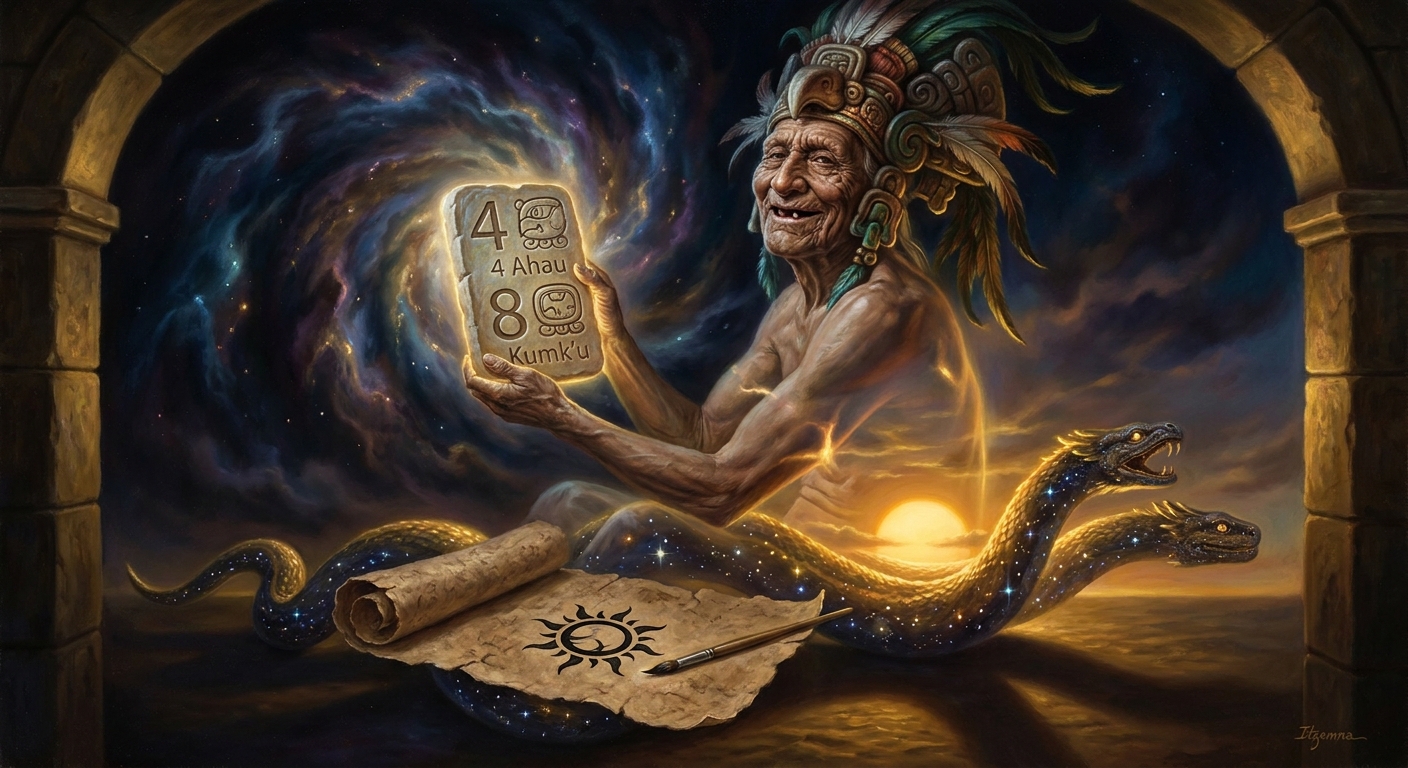
Mulac stands in the east and is associated with red and the east wind. Kan stands in the north, associated with white. Ix stands in the west, associated with black. Cauac stands in the south, associated with yellow. Each one is named after one of the four possible day signs that can begin a Maya year — the Year Bearers — and the year that begins under Mulac’s direction is different in quality from a year under Kan or Ix or Cauac.
At the end of each year the Bacab of that year is ritually replaced by the Bacab of the next.
This is not a metaphor — it is an architectural event in the Maya ceremonial calendar. The ceremonies of the five unlucky Uayeb days that close each 365-day haab year and begin the new one include the placement of new deity images at the four directions and the formal acknowledgment of which Bacab is now taking up the burden. The transition is dangerous because in the moment of handoff, if the ceremony is wrong, the sky is not being held.
Every year, the sky could fall.
Every year it does not, because the ceremony is performed, the Bacabs are honored, the transition is made correctly. The religious obligation to perform these ceremonies was not felt as oppressive by the Maya — it was felt as necessary, the way the obligation to eat is necessary. You do it because you understand what happens if you do not.
The Bacabs also have a healing function.
They appear in the Maya ritual texts of Yucatán as invoked protectors in curing ceremonies — called upon to stand at the four directions around a sick person, creating a sacred enclosure, a temporary world made right at the local level even if the larger world remains dangerous. The four-directional invocation is one of the oldest and most widely distributed ritual patterns in Mesoamerica, and the Bacabs are the Maya personification of the corners that every ritual space requires.
When a Maya shaman performs a healing ceremony, he or she is also, in small, doing what the Bacabs do at the cosmic scale: holding open the space between earth and sky where the sick person can breathe.
The Bacabs never rest. The world is held by effort, not by automatic mechanism. This is not the universe of Newtonian physics, where gravity simply happens and the sky does not need support. This is a universe where the sky stays up because someone is holding it, and the someone has arms that must be tired after all these years, and the only thing that keeps them holding is the knowledge that everything below depends on it.
The four brothers hold. The sky is there when you wake. The world is still open.
Echoes Across Traditions
Entities
- Bacab Mulac
- Bacab Kan
- Bacab Ix
- Bacab Cauac
- Itzamna

Sources
- Diego de Landa, *Relación de las Cosas de Yucatán* (c. 1566, translated by Alfred Tozzer, 1941)
- Mary Miller and Karl Taube, *An Illustrated Dictionary of the Gods and Symbols of Ancient Mexico and the Maya* (Thames & Hudson, 1993)
- Anthony F. Aveni, *Skywatchers of Ancient Mexico* (University of Texas Press, 1980)