The Hero Twins Are Born from Their Father's Decapitated Head
Mythic time — the era before the current world; Classic Maya tradition · Xibalbá, the Maya underworld; the road to Xibalbá; the house of Xquic's father
Contents
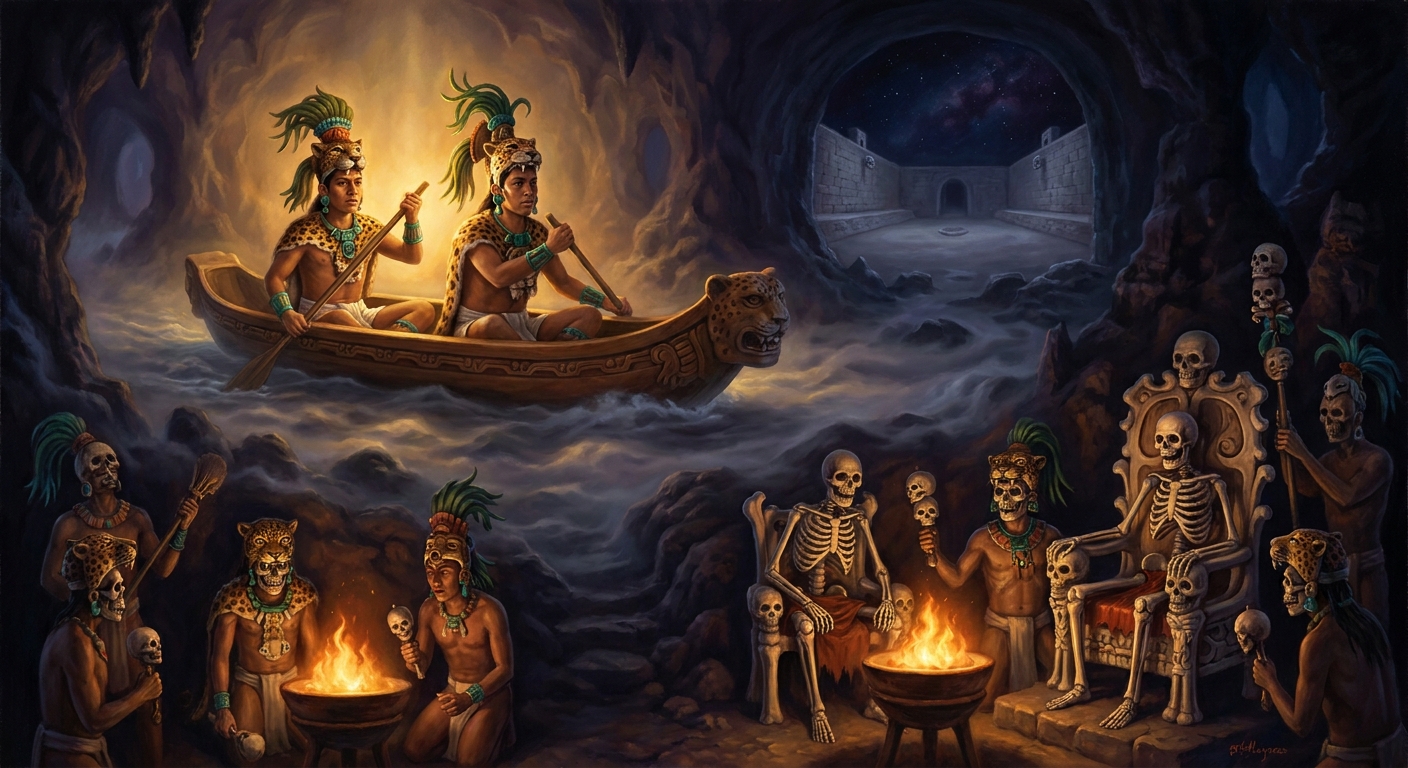
The lords of Xibalbá hang the severed head of the ballplayer Hun Hunahpú in a dead tree; a young woman named Xquic reaches up to touch it, and the head spits into her palm, and she becomes pregnant with the Hero Twins.
- When
- Mythic time — the era before the current world; Classic Maya tradition
- Where
- Xibalbá, the Maya underworld; the road to Xibalbá; the house of Xquic's father
The lords of Xibalbá call for the ballplayers.
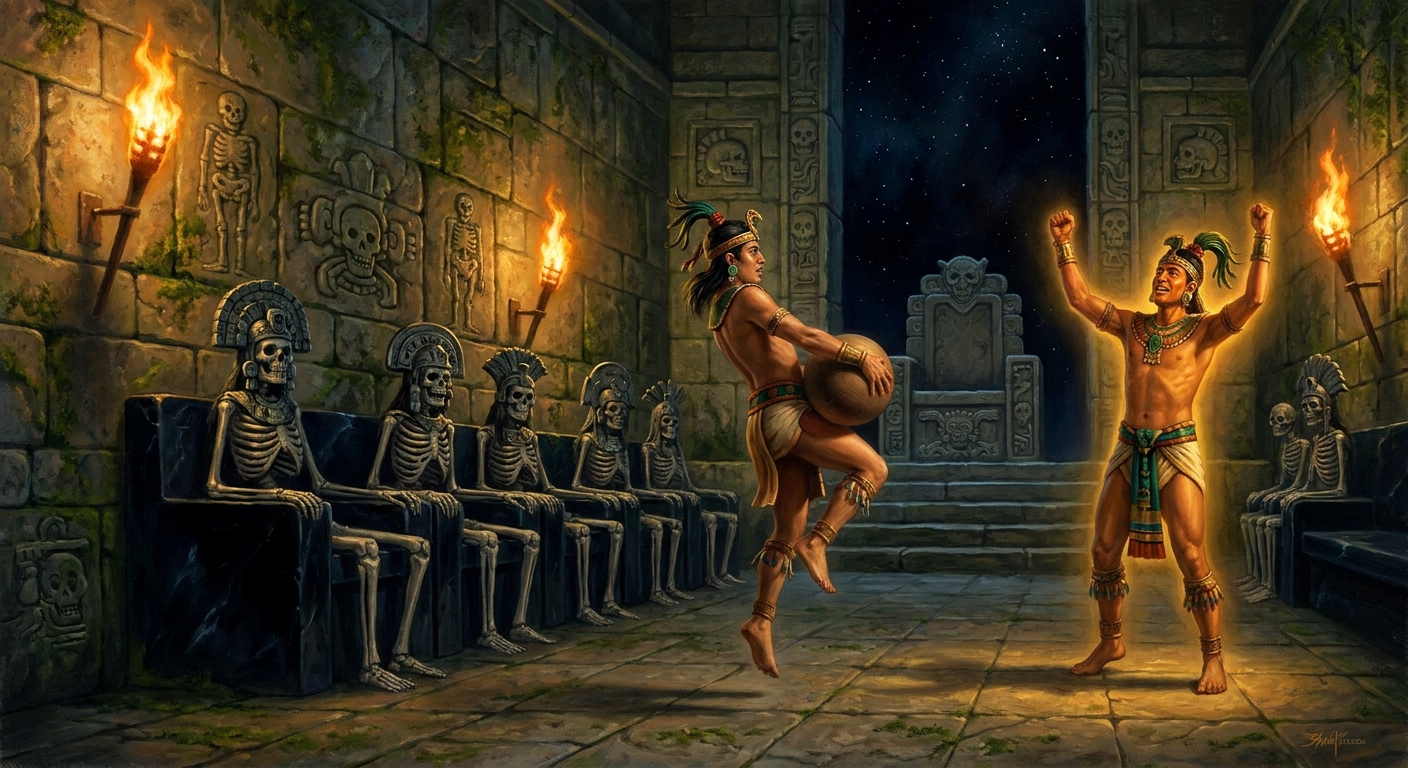
Hun Hunahpú and his brother Vucub Hunahpú play the ball game on the surface of the earth, and the sound of their playing — the thud of the rubber ball against the stone court, the rhythmic pounding that rolls down through the layers of the earth — disturbs the lords below. One Death and Seven Death, the principal lords of the underworld, send their messengers up through the dark road: come down, play your game here.
Hun Hunahpú and his brother go. They travel the long road to Xibalbá — across the river of pus, across the river of blood, past the crossed paths and the wooden dummies planted in them as traps — and when they arrive they are already diminished by the journey. The lords seat them on the hot stone and they sit on it and burn. They are shown the dark house, the cold house, the houses of fire and razors and bats, and they do not survive the sequence. The lords of Xibalbá kill them and bury their bodies beneath the ball court.
But the head of Hun Hunahpú they hang in a tree — a tree that had never before had fruit, a dead tree at the crossroads of Xibalbá.
The head hangs there, and the dead tree blooms. The tree puts out round gourds, and the round gourds cluster all through the branches, and the head of Hun Hunahpú hangs among them so perfectly matched that no one can tell which gourd is the head and which are the tree’s own fruit. The lords of Xibalbá decree that no one shall pick the fruit of this tree, no one shall approach it.
A young woman named Xquic hears about the tree.
Xquic is the daughter of a lord of Xibalbá, which means she knows the rules of the underworld and she knows what she is risking. She goes to the tree anyway. She stands below it looking up at the cluster of gourds and at the thing among them that is a head, and she stretches up her hand toward the fruit.
The head speaks.
What are you asking for? it says. These round things among the branches are just skulls.
She says she still wants the fruit.
All right, the head says. Stretch out your right hand.
She holds out her hand, palm upward, and the skull spits into it. The saliva lands in her palm and she looks at it but it is already gone — absorbed into her skin, she thinks, though she cannot be sure. The head explains: It is just a sign I have given you — my saliva, my spittle. The lord’s son doesn’t die; he continues to live in his descendants. The face passes but its features are preserved in the child, in the son. The father is not lost, only transformed.
Xquic walks back through Xibalbá pregnant.
When the pregnancy becomes visible her father notices and orders her brought before the lords. She denies that any man has come to her. The lords do not believe her. They order her heart cut out and burned, and they give the order to the owls who serve as their messengers.
The owls take her to a distant place to kill her, but Xquic persuades them. She tells them to burn red tree sap instead of her heart — copal, the blood of trees — and to bring the smoke back to the lords as proof. The owls do it. The lords of Xibalbá receive the burning copal and accept it, and Xquic escapes upward through the road that leads from the underworld to the surface of the earth.
She comes to the house of Xmucane, the grandmother of the Hero Twins’ father, who is an old woman keeping the house and tending the corn. Xquic arrives and says: I am your daughter-in-law, I am the wife of Hun Hunahpú. The old woman does not believe her. She sets her tests: go to the garden and bring back a net full of corn, though there is only one plant in the garden.
Xquic goes to the garden, touches the silk of the single plant, and the net fills itself. She carries it back full.
The old woman accepts her.
The twins are born in the house of Xmucane, on the surface of the earth, in the light: Hunahpú and Xbalanqué. They sleep outside on the anthills because the old woman does not welcome them. They grow up in the forest. They become hunters, and then ballplayers, and then something that cannot quite be named — the instrument by which the underworld that killed their father will finally be defeated.
The saliva dried in their grandmother’s palm.
The twins are alive.
Echoes Across Traditions
Entities
- Hun Hunahpú
- Xquic
- Hunahpú
- Xbalanqué
- One Death
- Seven Death
Sources
- Popol Vuh, translated by Dennis Tedlock (Simon & Schuster, 1985)
- Allen J. Christenson, *Popol Vuh: The Sacred Book of the Maya* (University of Oklahoma Press, 2007)
- Mary Miller and Karl Taube, *An Illustrated Dictionary of the Gods and Symbols of Ancient Mexico and the Maya* (Thames & Hudson, 1993)