Enlil Sends the Flood: The Atrahasis Tablet
Old Babylonian, c. 1700 BCE; legendary horizon at the dawn of human history · The divine council, and the city of Shuruppak on the lower Euphrates
Contents
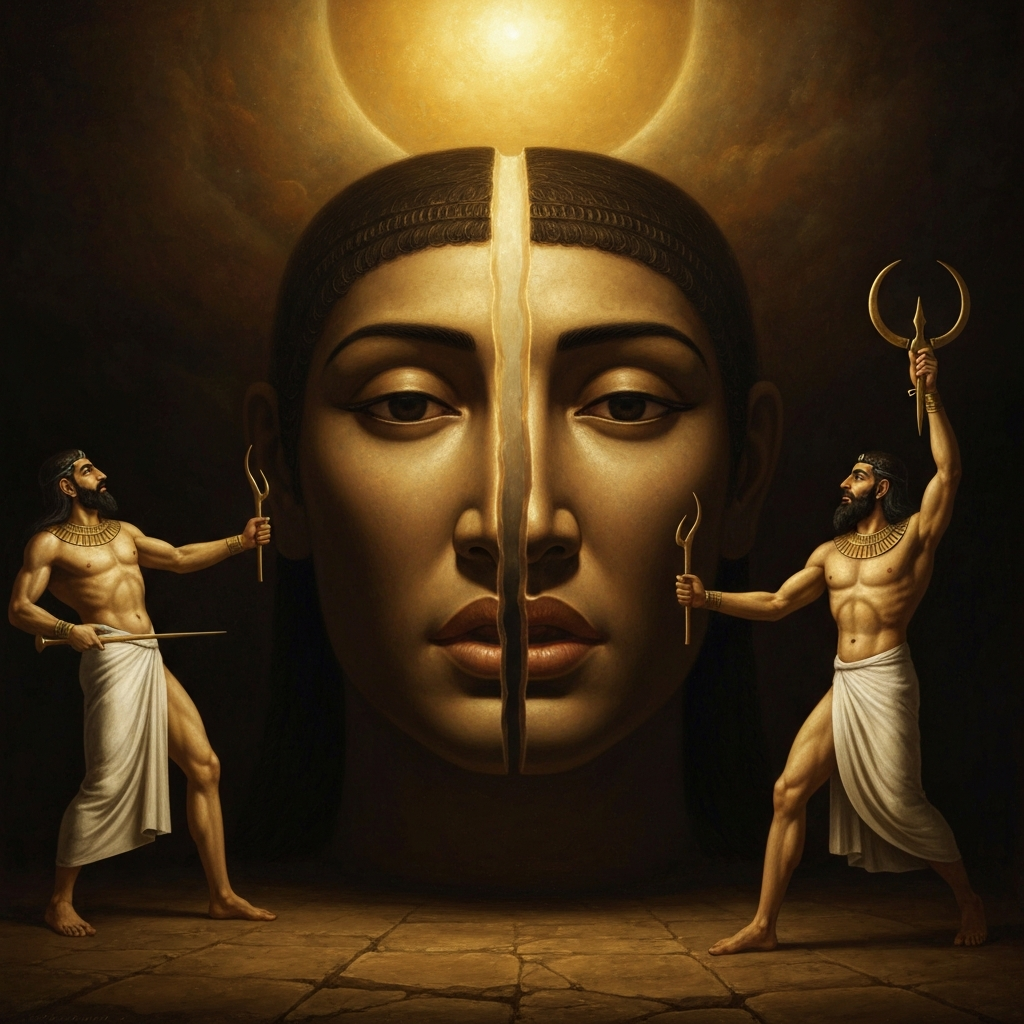
The noise of humanity keeps Enlil awake. He sends plague; Enki teaches humans to heal. He sends drought; Enki teaches them to find water. Finally the divine council votes for flood — and Enki, sworn to silence, speaks to a wall in Atrahasis's house.
- When
- Old Babylonian, c. 1700 BCE; legendary horizon at the dawn of human history
- Where
- The divine council, and the city of Shuruppak on the lower Euphrates
In the beginning, before there were people, the lower gods were the workers.
They dug the canals. They cleared the silt. They piled up the levees and they hauled the bricks and they kept the rivers from running where they wanted to run instead of where the gods needed them to run. The cosmos at this stage was an enormous construction site, and the workforce was the Igigi, the lower gods, the gods who had drawn the short straw at the moment of creation. They worked for three thousand years. The work was hard. The work did not end. They began to grumble.
In the four thousandth year — or thereabouts; the tablet is not precise about the duration of the grumbling, only that it grew and grew — the Igigi went on strike. They burned their tools. They surrounded the great house of Enlil at midnight with torches and shouts and rage. They demanded relief. The high gods came out to negotiate. Anu looked down at the burned tools and the angry faces and understood that the cosmos as he had organized it was no longer functional.
Enki proposed a solution. Let us make humanity, he said. Let mankind bear the toil of the gods.
The mother goddess Mami — also called Nintur, also called Belet-ili, the lady of the gods — agreed to do the making. She mixed clay with the blood of a slain god, We-ila, the god whose intelligence would be transferred into the new creature. She sang. She shaped. Fourteen pieces of clay became seven men and seven women. The first humans woke up in the world with the work in front of them: dig the canals, clear the silt, pile up the levees, haul the bricks, keep the rivers in their channels. The Igigi were freed. The high gods returned to their long sleep. The world resumed its proper order.
For a while.
The problem with humanity is that humanity reproduces.
Mami had not anticipated this rate. The seven men and seven women produced children, and the children produced children, and within a few centuries the lower world was full of people in every direction, and the people had moved beyond simply doing the work the gods had assigned. They built cities. They built temples. They held festivals. They argued in markets. They wept at funerals. They laughed at jokes. They shouted at their neighbors. They made love loudly. They sang at harvest. The lower world, which had been a quiet construction site, was now a roaring, brawling, drumming, weeping, laughing, copulating, perpetually awake city of cities.
Enlil, in his great house, could not sleep.
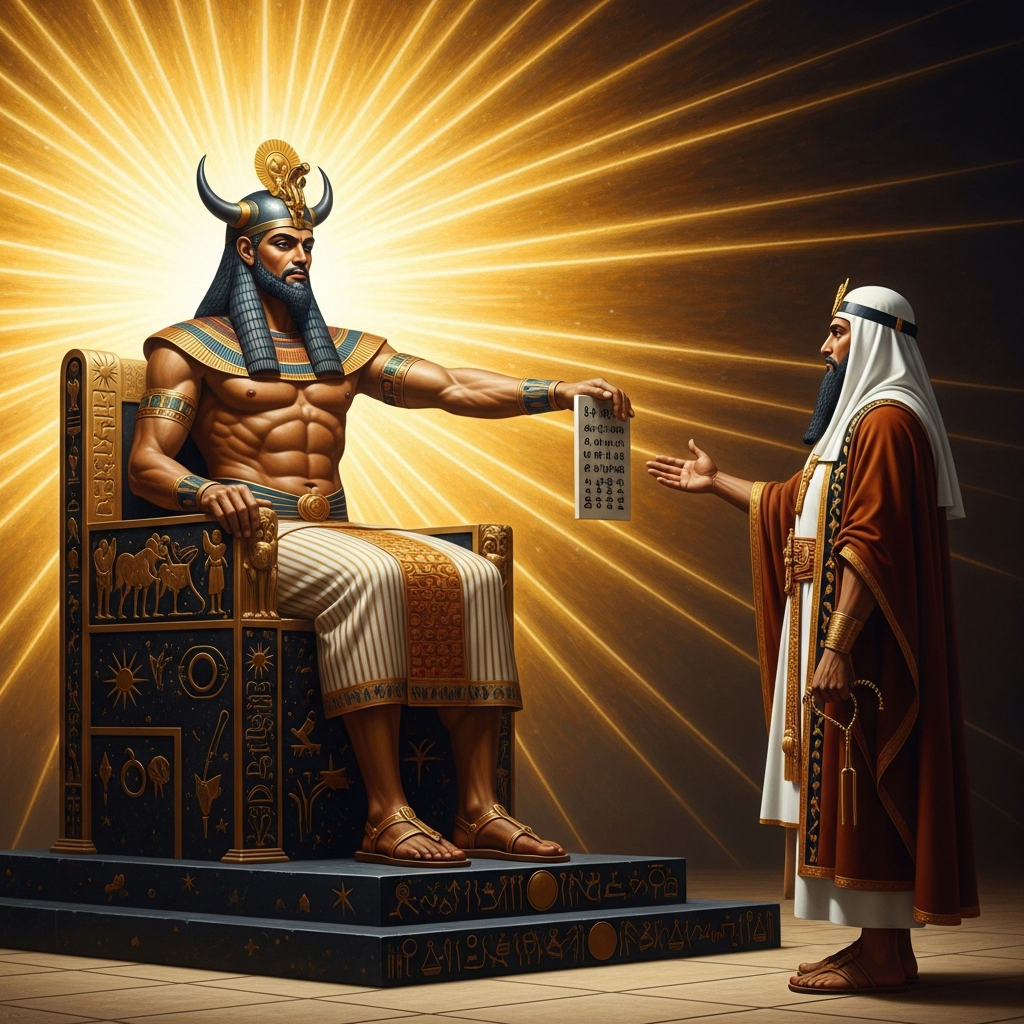
This is the part of the story that the Babylonian audience understood with their bones and that the modern audience sometimes finds petulant. Enlil is not a frivolous god. He is the high god of the storm, the lord of the air, the keeper of the Tablet of Destinies, the executive of the divine council. He requires sleep the way a king requires sleep — not for rest, but for the divine processes that happen in dream, the calibrations of the cosmos that occur when the high god’s mind is not occupied with daytime business. The noise of humanity has now become loud enough to interrupt those processes. The rivers are running but the calibrations are off. Cosmic order is fraying because the executive cannot complete a full sleep cycle.
Enlil goes to the divine council. They are too many. They are too loud. The clamor of mankind is unbearable. Sleep cannot find me. I propose to reduce them.
Enki listens. He says nothing.
The first reduction is plague.
Enlil sends Namtar, god of pestilence, to walk through the cities of the south. The plague comes through the canals and the wells. Children die first. Then the old. Then the strong. The cities go quiet. For a season, perhaps two seasons, Enlil sleeps.
But Atrahasis — the man whose name means exceedingly wise, the king of Shuruppak, the most pious of the priests — has been advised. By a voice that came to him in his temple. By Enki, although Enki is not named in the message. Build no temples to your other gods. Send no prayers to your usual sources. Direct everything to Namtar himself. Honor him. Feed him. Pray only to him. Atrahasis does this. The plague god, embarrassed by the unprecedented attention, withdraws. The plague stops. The cities recover. The people multiply again. Within a generation the noise is back to where it was.
Enlil tries again. Drought.
Adad, god of rain, is told to keep his rain to himself. The clouds do not form. The rivers shrink. The fields crack. The wells turn to mud. The granaries empty. Once again, the children die first. Once again, the cities are quiet for a while. Once again, the noise is creeping back, because Enki has visited Atrahasis again and told him to redirect all worship to Adad, and Adad too has eventually relented and brought the rain.
Enlil tries once more. Salinization. The rivers will continue to flow but the salt will rise from the soil and poison the fields. The wheat will not grow. The barley will not grow. The figs and dates and onions and lentils will all fail. Famine, slow and grinding, will reduce the population over a decade.
Enki visits Atrahasis again. The wheat is moved to higher fields. The salt is washed out by careful irrigation. The famine is mitigated. The population, having dipped, recovers.
Enlil understands that he has a problem.
The problem is Enki.
Enki is the friend of humanity. Enki was the god who proposed making humans in the first place. Enki was the engineer of the design — and the engineer feels for the design. Every time Enlil sends a reduction, Enki finds a loophole, a workaround, a piece of advice that lets humanity survive. The reductions are not working. Humanity is going to keep multiplying. The noise is going to keep getting louder. Enlil cannot sleep.
The divine council convenes again. Enlil makes his proposal — the final one. A flood. Total. The waters above and the waters below, released together. No exceptions. No survivors. We will start over. Mami can make a new humanity, smaller, quieter, with a built-in ceiling on its numbers. The current experiment is concluded.
The council debates. Anu is reluctant but acquiesces. Mami weeps — she has spent four thousand years watching her clay creation grow into something she loves, and she does not want to drown them, but she also does not control the council’s vote. Adad will provide the rain. Ninurta will breach the levees. Errakal will tear up the mooring posts. Each god is assigned a role. The flood will last seven days.
Enlil turns to Enki. Swear an oath. By the great names. That you will not warn them.
Enki considers. The oath is binding. To break it would be to invite cosmic punishment of an order that even he cannot afford. He swears. He swears by the great names. He cannot, by any direct means, warn Atrahasis or any other human being of what is coming.
The council rises. The gods disperse to make their preparations. Enki walks home along the canal of Eridu, thinking.
He walks for a long time. He thinks of every option. He cannot speak to Atrahasis. He cannot send a messenger. He cannot write a letter. He cannot send a dream — well, possibly he can send a dream, but a direct dream might count as breaking the oath. The oath is precise. Do not warn them. He has sworn not to warn them. He has not sworn not to talk to anything else.
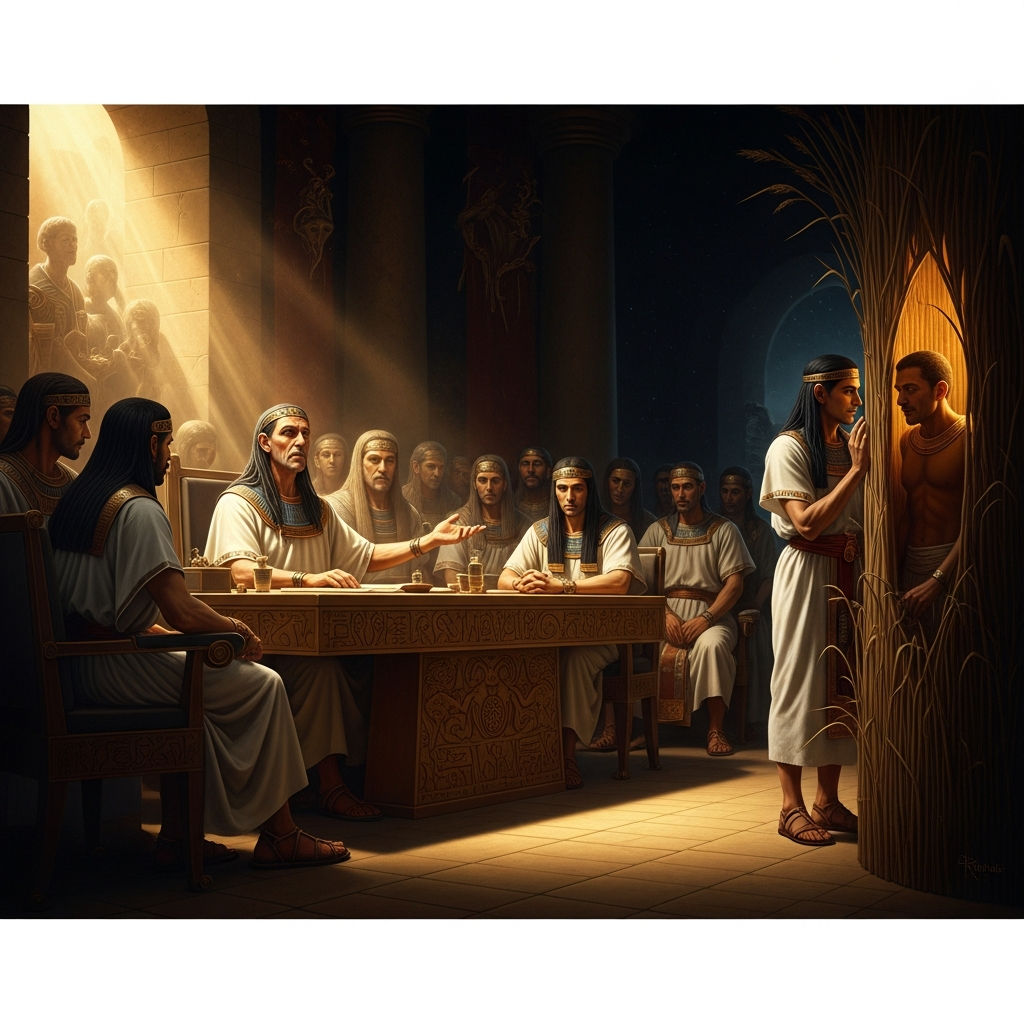
That night, Enki goes to Atrahasis’s house in Shuruppak. He does not enter. He stands outside. Atrahasis is sleeping inside. There is a reed wall — a screen, the kind of light wall the houses of southern Mesopotamia have between rooms — between Enki and Atrahasis. Enki addresses the wall.
Reed wall, reed wall, he says, in a voice loud enough to carry through the reeds, brick wall, brick wall. Reed wall, hear me. Brick wall, take note. Tear down your house. Build a boat. Reject possessions. Save life. The boat that you build, let her dimensions be measured. Let her width and length be equal. Let her be roofed like the abzu. Let no sun penetrate her. The waters above and the waters below are coming. Six days and seven nights of rain. Take into the boat the seed of every living thing.
Atrahasis wakes. He is not sure if he has heard a voice or dreamed a voice. He is not sure if the voice was speaking to him or to the wall. He is sure of what the voice said. He sits up in the dark. He understands what is required.
He builds the boat.
The construction of the ark in the Atrahasis tablet is described with the precision of a building manual. Cubits. Beams. Bitumen. Pitch on the inside, pitch on the outside. Six decks, divided into nine compartments each. Atrahasis tells his neighbors he is building the boat because Enlil has driven him out of the city — a half-truth that satisfies the city’s curiosity. He brings his family aboard. He brings his servants. He brings the seed of every living thing, plant and animal — the granary in seed form, the herds in pairs, the wild creatures gathered in by the divine instinct of the moment. He brings craftsmen. He seals the door with bitumen.
The flood comes.
The tablet is unsparing about the flood. The waters rise. The cities of the south go under. The temples go under. The high places go under. Even Enlil, in his great house, is shocked by what he has unleashed — the sound of the wind and the water is so loud that the gods themselves cannot stand it, and they flee to the highest heaven and crouch there together, weeping. Mami especially weeps. I gave birth to them, she says. Now they fill the sea like fish. Their bodies are caught in the wreckage of their cities. Even Enlil, watching, begins to suspect that he has gone too far.
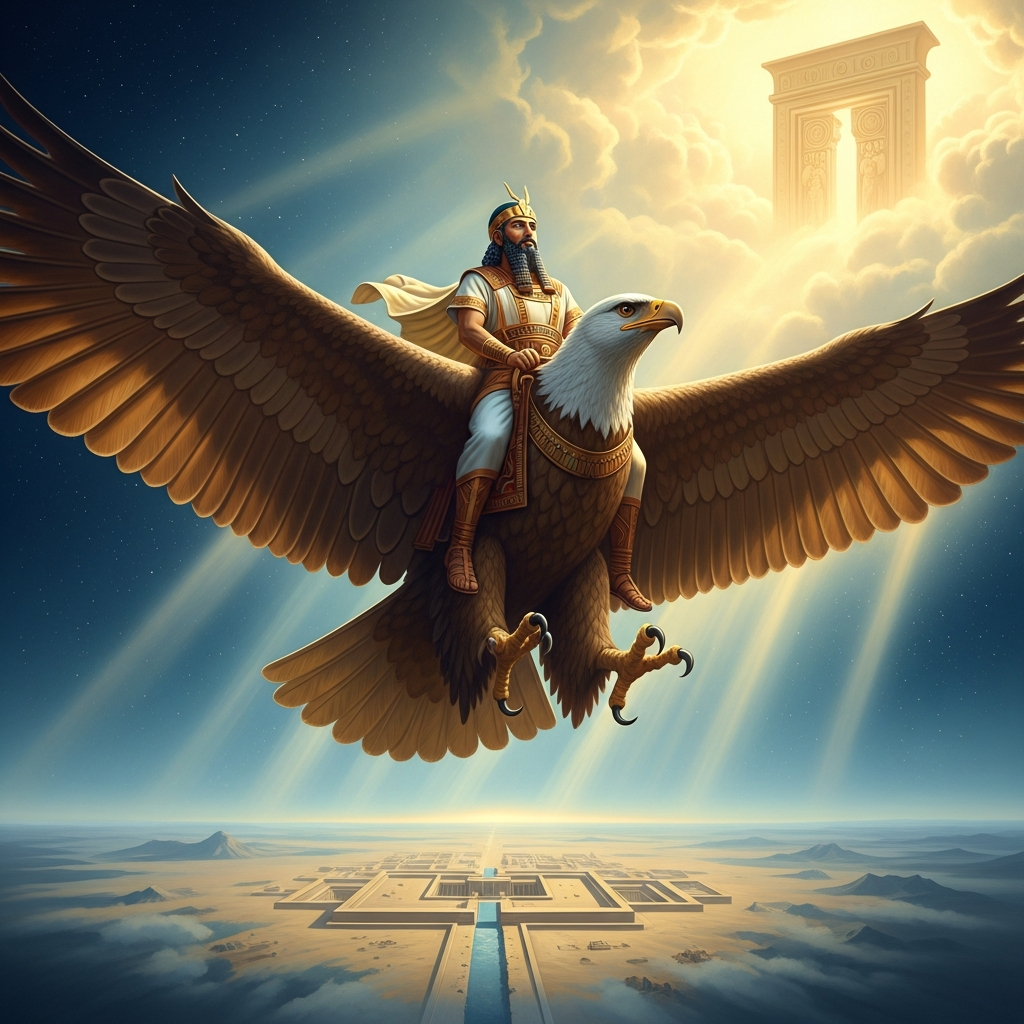
The boat rides it out. Six days and seven nights. On the seventh day the rain stops. The boat grounds on a mountain — Mount Nisir, in the Babylonian version, in the eastern range. Atrahasis opens a hatch. He sends out a dove. The dove returns. He sends out a swallow. The swallow returns. He sends out a raven. The raven does not return. He understands the waters are receding. He opens the boat. He emerges. He builds an altar. He sacrifices. The smoke rises into the cleared sky.
The gods, who have been hungry for seven days because the flood killed all the priests who fed them, smell the smoke and rush down to the altar. They gather around the smoke like flies, the tablet says. Mami arrives, weeping, and lifts the great fly-shaped lapis lazuli pendant of her necklace. These flies will be my mourning ornament, she says. I will remember these days. I will not forget them.
Enlil arrives last. He sees Atrahasis. He sees the boat. He understands what Enki has done. He turns on Enki. You swore the oath. You broke it.
Enki replies, calmly: I did not warn the man. I spoke to a wall. The wall heard me. The man was sleeping in another room. If walls now have ears, that is not my fault. The oath was not broken.
The gods, despite themselves, laugh. Enki has found the loophole he needed. Enlil, defeated, accepts the outcome. A compromise is reached: humanity will continue, but there will be limits. Some women will be barren. Some children will die in infancy. There will be priestesses who do not bear children. Death will come to all eventually, the lifespan capped at a length that prevents indefinite multiplication. The noise will be controlled by built-in mechanisms rather than by total reduction. Atrahasis is granted long life and the gods withdraw to their high seats.
The world, somewhat smaller and somewhat sadder, resumes.
The Atrahasis flood is the original of every flood story in the Western tradition. The story was old when Genesis was written. The Hebrew authors, who knew it well, kept the structure (warning, ark, animals, dove, altar) and changed the theology. The Babylonian flood is about noise; the Hebrew flood is about wickedness. The Babylonian flood ends with built-in birth control; the Hebrew flood ends with a rainbow. The Babylonian gods are afraid of what they did; the Hebrew God is sorry but resolute.
The most striking detail is Enki’s loophole. He found a way to keep his oath and save humanity at the same time. The Babylonian moral imagination loves this — the god who is bound by his word and yet refuses to abandon his creation finds a technicality, a wall to talk to, a workaround that violates the spirit of the oath without violating its letter. This is not seen as cheating. It is seen as wisdom. Enki is wise specifically because he can find the gap in the rules.
The wall that heard Enki’s voice is one of the strangest objects in literature. It is the medium of salvation. It is also the prototype of every later prophet who claims to have heard the voice of God when in fact God was technically speaking to the air around the prophet, and the prophet happened to be in earshot. The Sumerian and Babylonian theology of revelation — that gods speak indirectly, that warnings come at angles, that the wise person is the one who hears what was not addressed to them — is older than every revelation tradition that came after.
Atrahasis kept the seed of every living thing. The boat held it. The flood passed. The walls of every house in Mesopotamia, after that, were a little more interesting than the walls of houses anywhere else, because every wall might be the wall that heard the warning, and every man sleeping behind one might be the next Atrahasis.
Echoes Across Traditions
Entities


Sources
- Stephanie Dalley (trans.), *Myths from Mesopotamia* (Oxford University Press, 1989), Atrahasis Epic
- W.G. Lambert and A.R. Millard, *Atra-hasis: The Babylonian Story of the Flood* (Oxford, 1969)
- Benjamin Foster, *Before the Muses: An Anthology of Akkadian Literature* (CDL Press, 2005)
- Tablet II of the Atrahasis Epic, Old Babylonian period, c. 1700 BCE