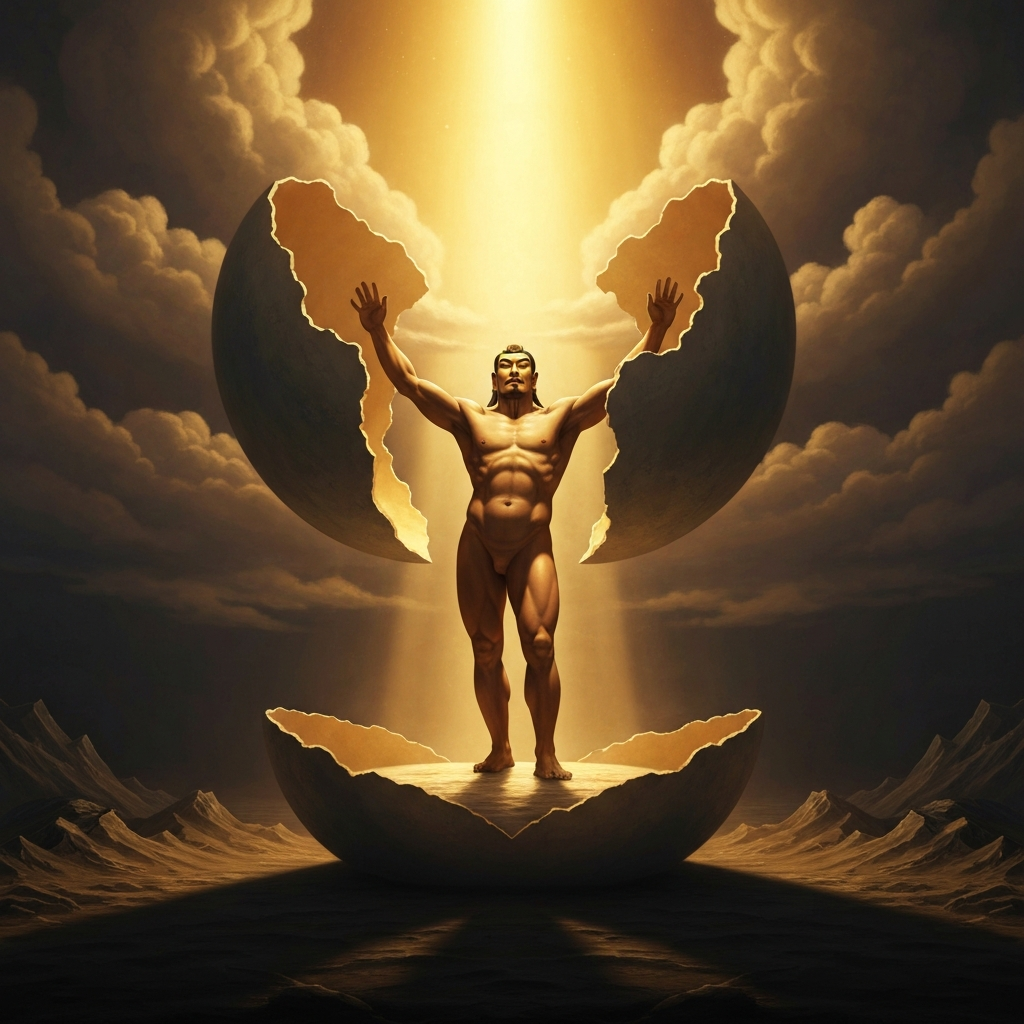
The Yellow Emperor and Chī Yóu's War
Traditional date c. 2697 BCE — the battle that ends the age of the Three Sovereigns · The plain of Zhuolu, in what is now Hebei Province, northern China
Contents
The metal-headed war god Chī Yóu raises eighty-one brothers against heaven, conjures a fog that blinds the Yellow Emperor's armies for three days, and forces the gods themselves into battle to determine who will rule the world.
- When
- Traditional date c. 2697 BCE — the battle that ends the age of the Three Sovereigns
- Where
- The plain of Zhuolu, in what is now Hebei Province, northern China
Chī Yóu has eighty-one brothers and they all have the same face: iron heads, bronze foreheads, stone hearts, eating nothing softer than sand and iron and stone. He has four eyes and six arms and hooves and horns and wings. He invented the weapons that made killing precise. He is the god of metal and the god of war and he has decided that heaven should be under different management.
The Yellow Emperor receives the news of Chī Yóu’s rebellion on the plain of Zhuolu.
He does not dismiss it. He has seen Chī Yóu’s armies — the eighty-one brothers, the demons that march with them, the creatures that serve as his lieutenants, beasts with human faces and serpent bodies and the particular hunger of things that have been given power and given nothing to do with it but accumulate more. He sends for his generals. He sends for his shamans. He sends for the divine animals whose alliance he has spent a lifetime cultivating: the bear, the tiger, the leopard, the lynx.
He sends for the drums made from the skin of the creature called Kui — the one-legged beast of Liubo — whose sound, the texts say, carries five hundred li.
Chī Yóu blows his fog.
It comes out of the south like weather that has decided to become a weapon — a thick yellow fog that has no direction in it, that dissolves landmarks and makes north indistinguishable from south. The Yellow Emperor’s armies march into it and stop. For three days they turn in circles on the plain of Zhuolu while Chī Yóu’s forces move around them unseen. Soldiers collapse from thirst and confusion. Generals cannot find their troops. The fog is so complete that men kill their own allies by mistake.
The Yellow Emperor does not panic. He is, above all, the emperor of ingenuity. He calls his craftsman Feng Hou and tells him to find the direction in the fog. Feng Hou builds the south-pointing chariot — a device with a gear mechanism that keeps a figure always pointing south regardless of the chariot’s direction. This is not magic. It is the first compass. The Yellow Emperor’s armies now have direction while Chī Yóu’s fog surrounds them, and direction in a fog is everything.
But Chī Yóu then calls the Wind Earl and the Rain Master, and a storm breaks over Zhuolu that turns the plain to mud. The Yellow Emperor, in turn, calls his daughter Ba — the Drought Goddess, Ba — who is herself so hot and so dry that she burns the rain from the air wherever she walks. The storm stops. The plain dries. Both armies stand in the clear morning air looking at each other across the field.
The drums begin.
The drumbeats of Kui-skin carry across the plain in the way that sound carries when it has something to say beyond itself. Chī Yóu’s forces are metal-strong but they are not immune to sound — the Kui-skin drums, struck hard, carry a frequency that shakes the metal in Chī Yóu’s brothers, that rattles the iron in their heads and makes them momentarily uncertain. This is the opening the Yellow Emperor has been waiting for.
He advances with the bears and tigers, with the human armies behind the divine animals, with the south-pointing chariot keeping the lines oriented, with Feng Hou managing the formation and the Drought Goddess Ba burning the air ahead to keep it clear.
Chī Yóu fights. He fights with everything he has, with all the metal and all the brothers and all the fog he can generate and all the war-ingenuity that makes him the god of war. But the Yellow Emperor is the first emperor, and the first emperor is defined precisely as the one who cannot be defeated by chaos, who answers each disorder with a new form of order, who defeats the fog with geometry, the rain with drought, the iron heads with drums that resonate in the iron itself.
Chī Yóu is captured. He is killed. The texts describe his death with precision: his shackles are removed and buried in a different place from his body, so that they cannot become instruments of resurrection.
The plain of Zhuolu becomes quiet.
The Yellow Emperor surveys the field. His daughter Ba is standing at the edge of the plain, still burning, unable now to stop — the Drought Goddess who was called to do one thing and is still doing it. She cannot return to heaven. She wanders the earth afterward, bringing drought wherever she travels. This is the price the Yellow Emperor pays for his victory: his daughter, exiled by her own usefulness, becomes a permanent feature of the world’s weather. The victory is complete. The price is permanent. This is how the first civilization begins.
Echoes Across Traditions
Entities
- Huangdi (Yellow Emperor)
- Chī Yóu
- the Drought Goddess Ba
- the Wind Earl
- the Rain Master
- the South Dipper
Sources
- Shiji (史記), Sima Qian, 'Basic Annals of the Five Emperors,' c. 91 BCE
- Shanhaijing (山海經) / Classic of Mountains and Seas, multiple entries on Chī Yóu
- Huainanzi (淮南子), chapter 3 and chapter 9
- Anne Birrell, *Chinese Mythology: An Introduction* (Johns Hopkins, 1993)