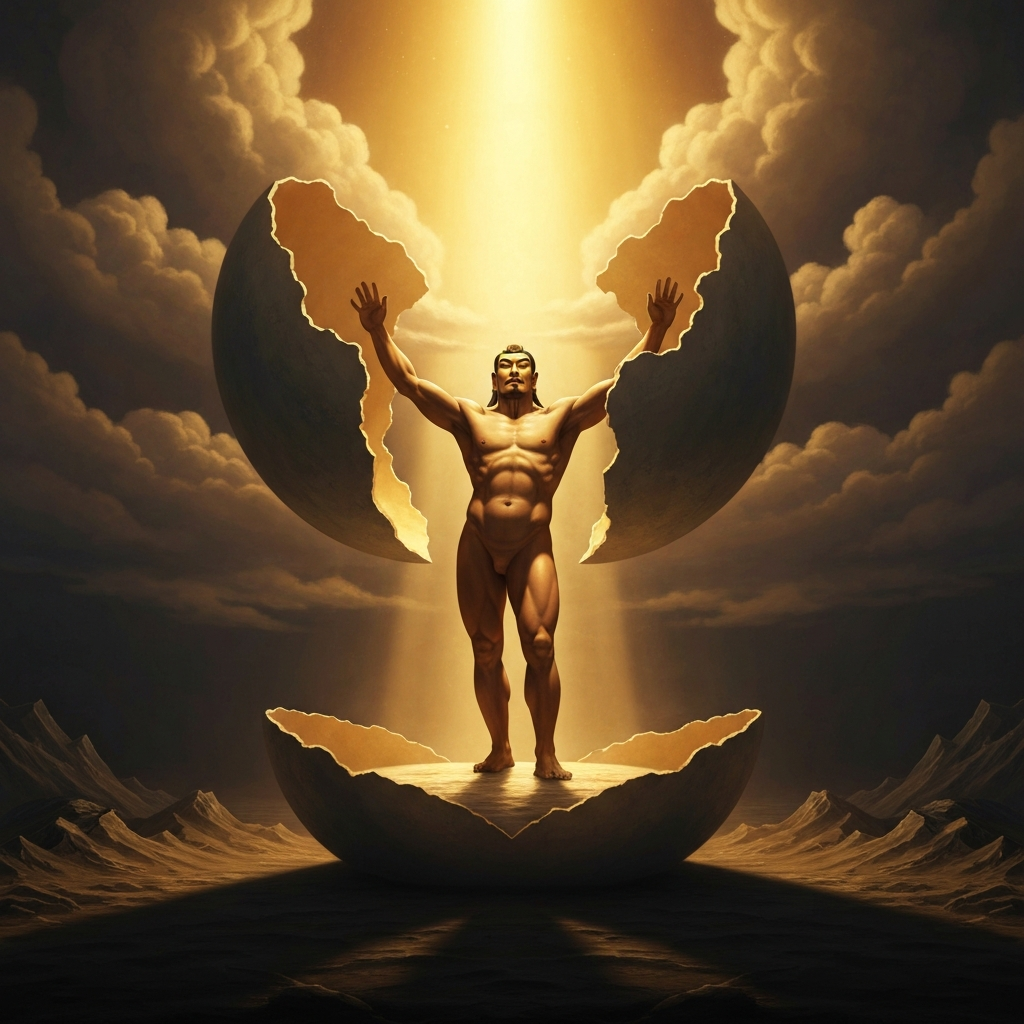
The Three Sovereigns Who Shaped the World
Traditional: c. 2953-2598 BCE — the mythological age before written history · The entire territory of ancient China — the Yellow River basin, the mountains, and the great plains
Contents
Before the emperors, before the dynasties, before history, three divine figures established the conditions of human life: Fúxī who read the cosmos's grammar, Shénnóng who discovered food and medicine, and the Yellow Emperor who created civilization's tools.
- When
- Traditional: c. 2953-2598 BCE — the mythological age before written history
- Where
- The entire territory of ancient China — the Yellow River basin, the mountains, and the great plains
They are not a committee and they do not work together.
The Three Sovereigns — in the most common arrangement, Fúxī, Shénnóng, and the Yellow Emperor — are sequential, each one beginning from where the previous left off, each one addressing the specific insufficiency that remained after the previous one’s gift. The sequence is the civilization’s autobiography: here is what we needed first, here is what we needed next, here is what we needed to become what we are.
Fúxī comes first.
He comes before the human world has a grammar for itself. He stands at the river and the tortoise comes up with the pattern on its shell and he reads the pattern and draws the eight trigrams, and now the universe has a map. Not a map of places but a map of relationships — the grammar of change, the syntax of heaven and earth interacting. He also — less philosophically but more immediately — teaches humanity to fish and to hunt, because before you can philosophize about the grammar of the universe you need to have eaten.
He invents the qin — the zither — whose music is the sound of the eight trigrams made audible. He establishes marriage, because a world full of people made from clay and scattered from Nüwa’s vine needs some structure for how they pair, how they form households, how the children know who their parents are and the parents know who their children are. He creates the basic grammar of human social life and the basic grammar of cosmic understanding simultaneously, and these two grammars turn out to be the same grammar.
Shénnóng comes second.
He addresses the body’s problem. People are alive, they have grammar and fish and music and marriage, but they are dying of things they could be not dying of — plants that would heal them are treated as poison because no one has catalogued the distinction, and plants that would nourish them are untested because no one has eaten them first. Shénnóng eats everything. His transparent body shows him what each plant does. He builds the catalogue that becomes the foundation of Chinese medicine.
He also teaches farming. Not just which plants are edible but how to cultivate them, how to encourage the wild plants that feed people to produce more reliably. The plow, the field, the cycle of agricultural labor — Shénnóng establishes the relationship between humans and plants that makes settled civilization possible. Without Fúxī’s grammar, you cannot understand the universe. Without Shénnóng’s catalogue, you die while trying.
The Yellow Emperor comes third.
He addresses everything else: clothing, boats, carts, weapons, writing, the calendar, mathematics, medicine in its institutional form. His wife Leizu discovers silk when a cocoon falls into her tea. His court develops bronze smelting. His astronomer Rong Cheng creates the calendar that organizes the agricultural year. His minister Cang Jie invents writing — an invention so significant that the tradition says grain fell from heaven and ghosts wept when it happened, because writing meant that deeds could be remembered past the lifetime of the person who did them.
He also fights the war that establishes the Han people’s sovereignty over the territory that will become China, which makes him simultaneously a culture-hero and a military founder — the figure at the hinge between the gift-giving civilization-builders and the political-military history that follows.
The Three Sovereigns together give humanity the tools of human existence. After them, the Five Emperors refine and govern what has been given. After the Five Emperors, the Xia dynasty — the first dynasty — begins, and with it the transition from mythology to history, from the founding gift to the long work of using it. The three figures stand at the beginning of that work, looking forward into the civilization their gifts made possible, not knowing what it would become but having given it what it needed to find out.
Echoes Across Traditions
Entities
- Fúxī
- Shénnóng
- Huangdi (Yellow Emperor)
- Nüwa (in some traditions)
- the Five Emperors
Sources
- Shiji (史記), Sima Qian, 'Basic Annals of the Five Emperors'
- Shanhaijing (山海經) and Huainanzi (淮南子) on the Three Sovereigns
- Michael Loewe & Edward Shaughnessy, eds., *The Cambridge History of Ancient China* (Cambridge, 1999)
- Lihui Yang & Deming An, *Handbook of Chinese Mythology* (Oxford, 2008)