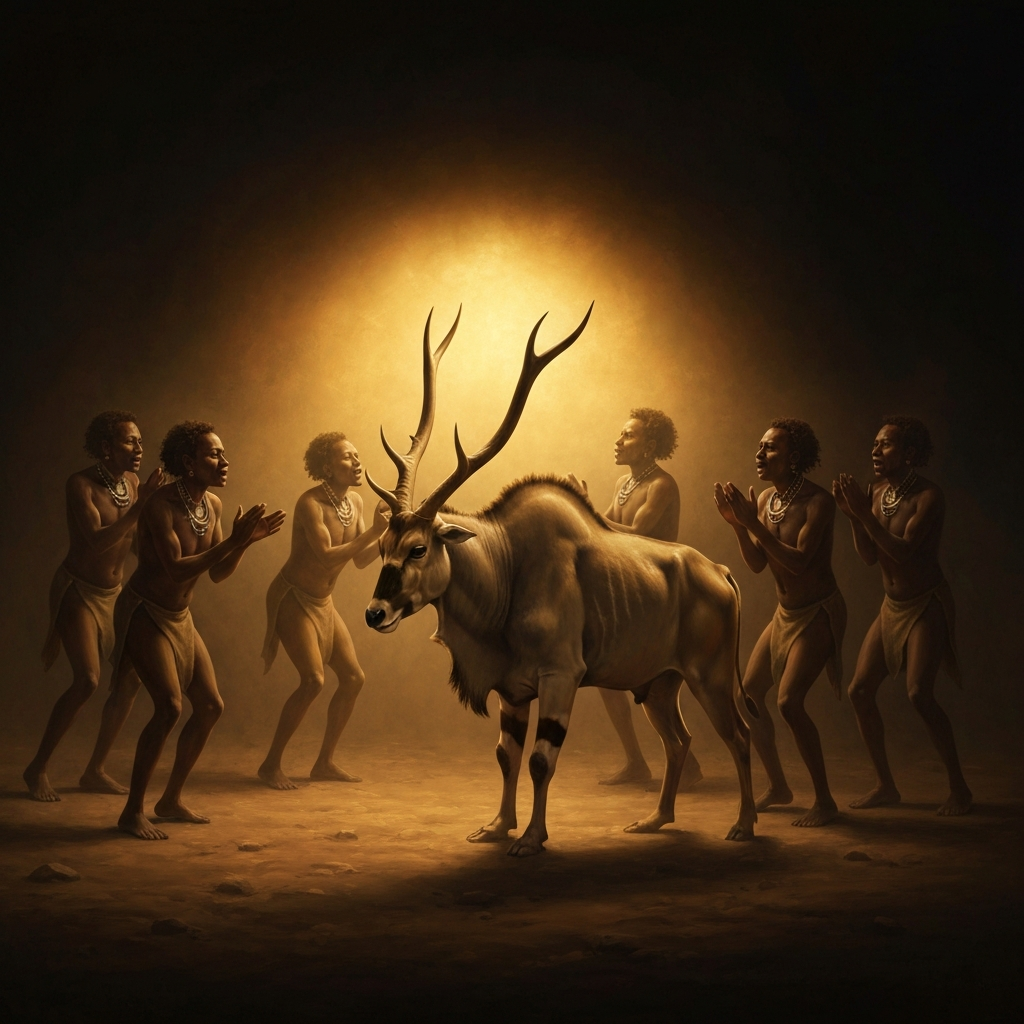
The Trance Dance: Half Dead, Half Alive
Whenever illness threatens the community — the trance dance is the primary San response to sickness · Any San encampment — the dance happens in the open, around a central fire
Contents
The San healing ceremony lasts all night — the healers dance to exhaustion, die a little, travel in spirit to fight illness and retrieve souls, and return carrying healing in their hands.
- When
- Whenever illness threatens the community — the trance dance is the primary San response to sickness
- Where
- Any San encampment — the dance happens in the open, around a central fire
The fire is at the center. The women sit around it.
They begin clapping the rhythms of the healing songs — specific rhythms, specific songs, not improvised but known, passed down through generations of women who have kept these patterns. The handclapping is not accompaniment. It is the engine of the ceremony: the rhythmic pulse that will drive the healers into trance over the next several hours, the sonic ground beneath everything.
The healers begin to dance around the fire.
They dance in a circle, the same path, the same direction, for hours. The dance is not expressive in the modern Western sense — it is not about communicating emotion or demonstrating virtuosity. It is about the sustained rhythmic movement that, combined with the women’s clapping and singing, the firelight and the darkness alternating, will produce in the healer’s nervous system the state that makes healing possible.
N/om — the healing potency — begins to heat in the healer’s body. The San describe it as a physical sensation: a warmth in the stomach that rises, heating the spine, reaching the skull. When the n/om boils, the healer enters !kia — trance, the state that the San translate variously as dying, half-dying, going to another place.
The healer dies a little.
!Kia is not sleep and not unconsciousness. The trance state that the healers describe and that researchers have documented is a specific altered state with predictable features: visual phenomena (geometric patterns, then formed hallucinations), distorted body image, the sensation of leaving the body, encounters with specific kinds of entities. The San have been exploring this territory for longer than any other people and have developed the most detailed and reliable map of it.
In !kia, the healer’s consciousness moves through the world in the form of a spirit, and the world it moves through contains things invisible to ordinary perception. The spirits of recently dead people float near their living relatives, sometimes intentionally, sometimes not, pulling the living toward death through grief and attachment. Illness often has this shape in San understanding: a sick person is being pulled toward the dead person they miss.
The healer’s job is to intervene.
They approach the spirits, argue with them, plead with them, sometimes physically wrestle them (reports of healing dances often include descriptions of healers engaged in fierce, apparently one-sided physical combat with invisible opponents). They protect the sick person’s soul. They apply the n/om they have absorbed from the eland-energy of the spirit world to the sick person’s body by laying hands on them, pressing their hands to the sick person’s head and spine and belly, trembling with the potency they are discharging.
The women sing them back.
The danger of !kia is that the healer does not return. Death is available in the trance state — the real death, not the ritual one — and healers who go too deep, too far, who are not properly anchored in the ceremony by the women’s singing and the firelight and the physical presence of the community, can fail to come back.
The women know this. Their songs are not passive accompaniment. They are cables, the tether that keeps the healer connected to the living world while their consciousness is elsewhere. The senior women know when a healer is in trouble — the rhythm of their trembling changes, the sounds they make become less controlled, the posture of their body shifts from purposeful to collapsed. When this happens, the women intensify their singing, they speak directly to the healer by name, they touch them and call them back.
The ceremony contains its own safety system: the collective feminine knowledge that anchors the individual masculine journey.
By dawn, the dance ends.
The healers come down from !kia over the course of an hour, the boiling n/om cooling, the geometric visions fading, the spirit landscape withdrawing into ordinary perception. They sit at the fire. The women bring water. The community waits to hear what was seen.
The sick person, who has been present at the dance — always present, the patient is never absent from their own healing ceremony — often shows change. Sometimes the fever breaks that night. Sometimes the change is more gradual. Sometimes the healer returns with information about what is causing the illness that allows specific behavioral or social changes that address the real cause.
The dance is empirical. It is tested against outcomes across thousands of years. The San do not dance for sick people because they have been told to. They dance because they have watched it work.
The fire burns out in the morning light.
The birds begin.
The healer sleeps.
Echoes Across Traditions
Entities
- The Healers (n/om-kxaosi)
- Kaggen
- The spirits of the dead (//gauwasi)
- The sick person
Sources
- Lewis-Williams, J. David, *The Mind in the Cave* (Thames and Hudson, 2002)
- Lewis-Williams, J. David and David Pearce, *San Spirituality: Roots, Expressions, and Social Consequences* (AltaMira Press, 2004)
- Lee, Richard B., *The !Kung San* (Cambridge University Press, 1979)
- Katz, Richard, *Boiling Energy: Community Healing among the Kalahari !Kung* (Harvard University Press, 1982)