Contents
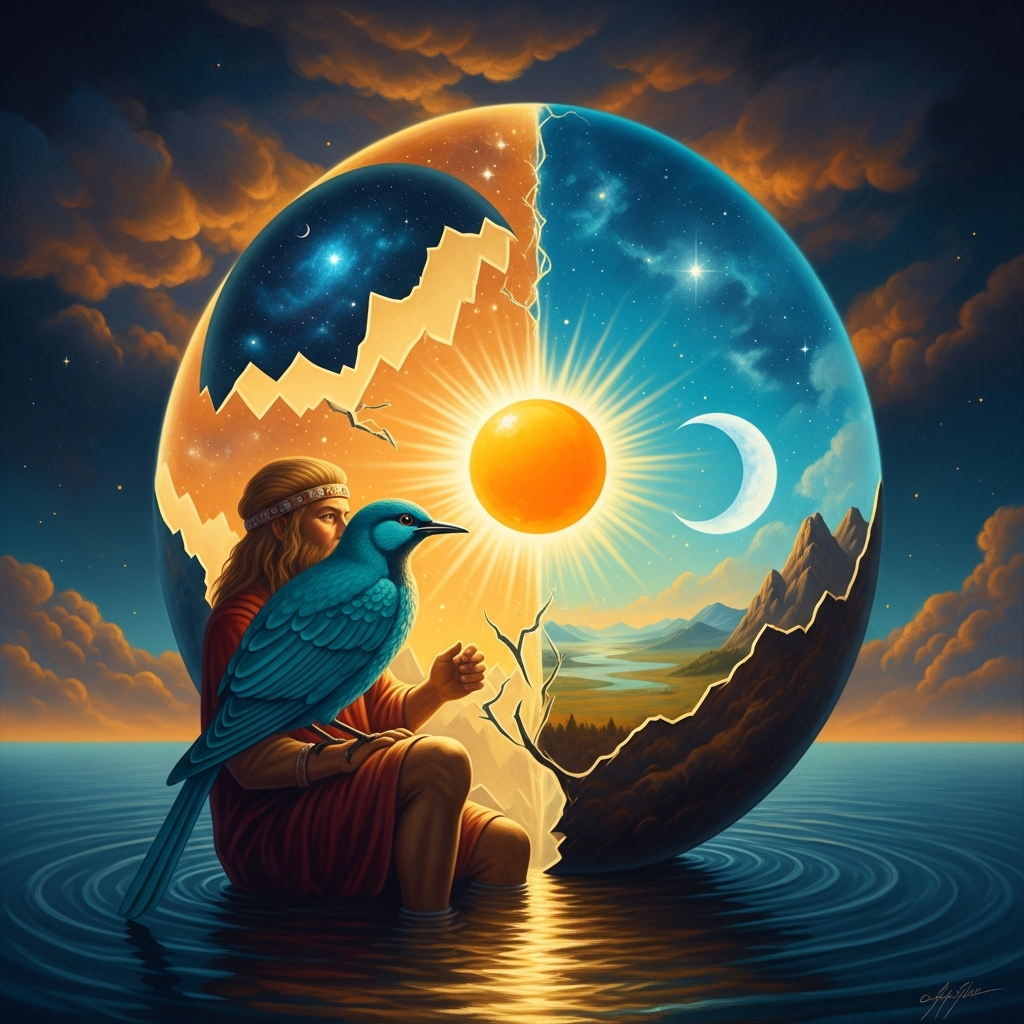
The sun and moon are husband and wife — and the moon's phases, including her monthly darkness, are explained by the continuing quarrel between them, with the moon covering her face in shame after each beating.
- When
- From the beginning of the sky — the quarrel has been going on since sun and moon were placed there
- Where
- The sky above the East African savanna
They fight.
They have always fought, the sun and the moon, from the first days when Enkai placed them both in the sky. The sun is hot and aggressive, burning everything he touches. The moon is cool and reflective, brightening the dark hours with borrowed light. They are married, which is to say they share the sky and must negotiate its governance, and the negotiations have never been easy.
The Maasai say: look at the moon carefully. You can see the marks of her husband’s anger. The craters on the moon’s face are the bruises from the fights she has lost. The way she hides and shows herself in the monthly cycle is the cycle of their quarrel: she covers her face in shame after being beaten (the dark of the moon), slowly recovers her courage and her brightness (the waxing moon), reaches her full confidence and radiance (the full moon), then the quarrel begins again, the brightness diminishes as the conflict escalates, and she withdraws once more.
But she always comes back.
This is the part of the story that matters most to the Maasai women who carry it: Olapa always comes back. She covers her face, she withdraws, she goes through her dark phase — and then she re-emerges. The waxing crescent is Olapa gathering herself. The full moon is Olapa at her most powerful. The fight that follows does not destroy her.
She fought back once.
The full telling includes an episode in which Olapa scratched the sun’s face, marking him — but the sun’s marks are invisible in daylight, washed out by his own brightness. You can only see the sun’s wounds at dusk, when his light softens and the colors at the horizon — the oranges and reds and deep crimsons — are the colors of his old wounds still fading.
This is the narrative reversal that saves the story from being only a story about victimhood. The sun is not unmarked by the quarrel. He carries his wounds too. He simply carries them in the light rather than in the dark, and his light is too strong to let the wounds show in ordinary daylight.
At sunrise and sunset — when the full sun is below the horizon and only his light colors the sky — the Maasai can see what Olapa did to him.
The Maasai regard the moon as essentially female.
This is not universal in African traditions, where the sun and moon are gendered differently in different cultures, but among the Maasai the association is consistent: moonlight is female, cool and safe to work by; sunlight is male, hot and dangerous at its peak. The practical divisions follow: the long walks, the cattle movements, the serious travel that takes Maasai warriors across the savanna happen in the cooler morning and evening light, in the moon’s domain, not in the midday sun’s aggressive heat.
Women’s most important activities — the brewing of milk tea, the making of beaded jewelry, the birth and care of young children — happen in and around the house during the hours when the sun’s aggression is mitigated, in Olapa’s hours.
The eclipses are the worst fights.
When the moon disappears entirely during a lunar eclipse — when Olapa’s face goes dark even at full moon, when the red blood-color appears — the Maasai understand this as the most serious domestic crisis: not the ordinary monthly diminishment but an acute confrontation from which it is not clear Olapa will recover. The community responds loudly: shouting, drumming, making as much noise as possible to interrupt the fight, to call attention to it, to declare their support for the moon’s survival.
The noise works. Olapa comes back.
This is the lesson the elders give young married women: make noise when there is a fight that threatens to destroy you. Do not be silent in your withdrawal. The community’s noise is the community saying we see what is happening; we are here; come back.
The moon always comes back.
She has not failed yet.
Echoes Across Traditions
Entities
- Olapa (the Moon)
- The Sun (Enkai's fire)
- Enkai
Sources
- Hollis, A.C., *The Masai: Their Language and Folklore* (Oxford University Press, 1905)
- Kipury, Naomi, *Oral Literature of the Maasai* (Heinemann Kenya, 1983)
- Llewelyn-Davies, Melissa, *The Worlds of a Maasai Warrior* (University of California Press, 1994)